Listen to this Post
Introduction
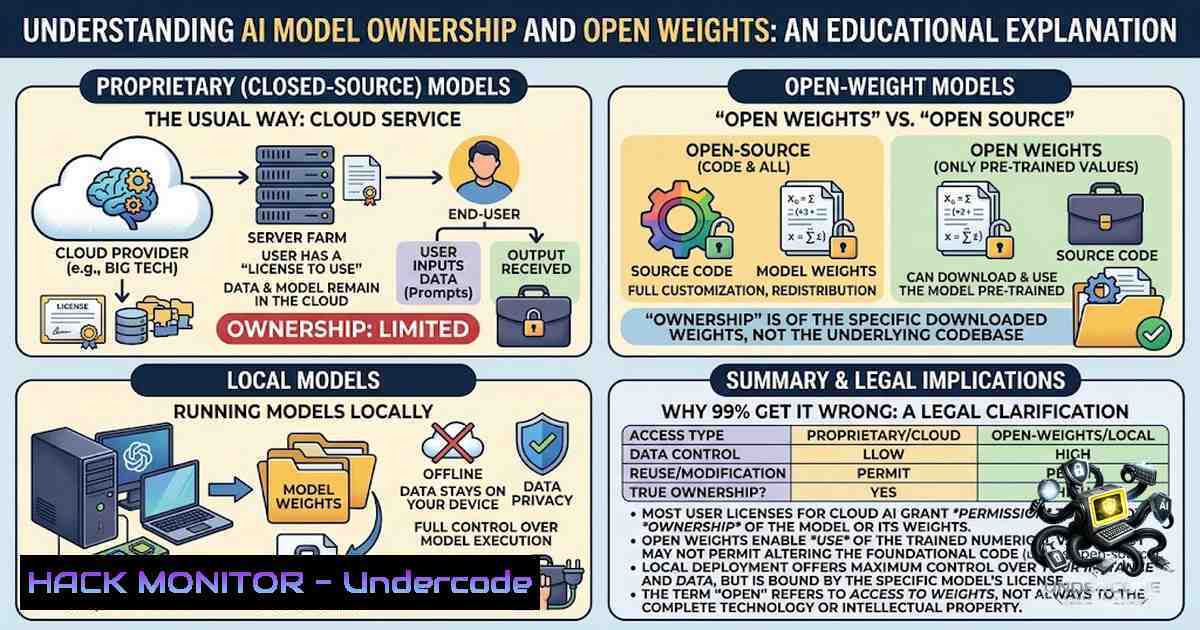
Everyone in tech talks about AI models all day, yet almost no one can clearly define what one actually is. While debates rage over openness, authorship, and whether AI writes code, the fundamental nature of these digital artifacts remains misunderstood by practitioners and executives alike. This article demystifies the AI model as a tangible object—a frozen record you can own but cannot read—and provides hands-on guidance for running, securing, and truly controlling your own local models.
Learning Objectives
- Understand the three metaphors—vinyl record, compiled binary, and compiler—that explain what AI models are and what “open” truly means.
- Learn to deploy, run, and optimize open-weight models locally on your own hardware using Ollama, llama.cpp, and related tools.
- Grasp the security, privacy, and compliance implications of running models locally versus relying on cloud APIs.
You Should Know
- What an AI Model Actually Is: The Vinyl Record Metaphor
An AI model is, above all, a record: frozen information that makes no sound until something plays it. Training is the recording session—ruinously expensive, done once, and almost impossible to repeat casually. The weights are the pressed disc: billions of numbers encoding patterns, fixed and inert. Inference is putting the needle down—running the model to produce an output. Quantization is simply making an MP3 of the record: storing each number in fewer bits so the file shrinks and plays on humbler hardware. This distinction matters because when you “have” a model, you have a disc—not the studio, not the master tapes, not the ability to re-record.
Step‑by‑Step: Running Your First Local Model
The disc is a file—typically `.safetensors` or .gguf—and the turntable comes in sizes. Here is how to set up your own local inference engine:
- Install Ollama (the living-room turntable for an audience of one):
– Linux/macOS: `curl -fsSL https://ollama.com/install.sh | sh`
– Windows: Download the installer from ollama.com
2. Pull a model (download the disc): `ollama pull llama3.2:3b` (a ~2GB file that runs on modest hardware)
3. Run inference: `ollama run llama3.2:3b “Explain what a transformer is”`
4. Verify no network activity (to confirm it is truly local): Use `netstat -an | grep ESTABLISHED` on Linux or `netstat -an | findstr ESTABLISHED` on Windows to ensure no external connections are made during inference.
- Open Weights vs. Open Source: The Compiled Binary Distinction
When a lab announces an “open” model, it almost always releases the weights—and nothing else. This is why open weights and open source are not the same thing. Releasing weights is like shipping an `.exe` and calling your program open. You can run it and even patch it, but you cannot read the logic that produced it, and you cannot cleanly rebuild it from scratch. The source—training code, data, and the thousand decisions of the recipe—stays in the building. The Open Source Initiative has explicitly stated that open weights reveal only a fraction of what you would need to reconstruct the system.
Step‑by‑Step: Verifying Model Provenance and Integrity
With only the disc in hand, no one can settle provenance questions by reading the source, because there is no source to read. Independent researchers can probe weights from the outside for tell-tale traces, but provenance is not legible—it is only inferable. To audit a model you have downloaded:
- Checksum verification: Download the model’s SHA256 hash from the official repository and run `sha256sum
` on Linux or `Get-FileHash ` on PowerShell to confirm integrity. - Metadata inspection: Use `ollama show
–modelfile` to view configuration details (temperature, context length, system prompt). - Behavioral probing: Run a series of known prompts to detect potential data leakage or alignment drift. For example, test with `ollama run
“What is the capital of France?”` and compare against expected outputs. - Static analysis: On Linux, use `strings
| head -100` to peek at any human-readable artifacts embedded in the weights—though this will reveal little beyond metadata. -
Running Models Locally: Privacy, Security, and Total Possession
Keeping a model running on a machine at home—a folder, a few gigabytes—answers with no network, no account, nothing in the cloud. It is, in the most literal sense, yours: you can copy it, move it, keep it running long after the company that made it is gone. Yet you cannot read it: open the file and there is nothing but an ocean of numbers. This strange pairing—total possession, zero legibility—is where every AI argument gets tangled. Running locally is never free: a capable disc still wants a serious graphics card, and the biggest ones a whole rack.
Step‑by‑Step: Securing Your Local AI Deployment
- Isolate the inference environment: Use Docker to containerize Ollama:
docker run -d --gpus all -v ollama:/root/.ollama -p 11434:11434 --1ame ollama ollama/ollama
- Restrict network access: Bind Ollama to localhost only by setting `OLLAMA_HOST=127.0.0.1:11434` to prevent unintended exposure.
- Implement API authentication: If exposing via a reverse proxy, use API keys or OAuth2. On Linux, configure Nginx with `auth_basic` or leverage
oauth2_proxy. - Monitor resource usage: Use `nvidia-smi` (Linux) or Task Manager (Windows) to track GPU memory and utilization during inference.
- Log all queries: Enable request logging to audit what is being sent to the model—critical for compliance in regulated industries.
4. Quantization and Model Optimization: Making the MP3
Quantization is the process of reducing the precision of the numbers in the weights—from sixteen bits to eight or four—so the file shrinks and plays on humbler hardware. Model size is arithmetic: a seven-billion parameter model at 16-bit is about fourteen gigabytes; a seventy-billion one about a hundred and forty. Quantization squeezes the boxed set onto a shelf that should not fit it. The trade-off is fidelity: lower precision means faster inference and lower memory usage but can degrade output quality.
Step‑by‑Step: Quantizing a Model with llama.cpp
- Clone llama.cpp: `git clone https://github.com/ggerganov/llama.cpp && cd llama.cpp`
2. Build the quantization tool: `make` (Linux/macOS) or use the provided Windows binaries. - Convert a model to GGUF format (if not already): `python convert.py
`
4. Quantize to Q4_K_M (a popular 4-bit quantization): `./quantizeQ4_K_M`
5. Benchmark: Run `./llama-bench -m-p 512 -1 128` to measure tokens per second and memory usage. - Compare output: Run inference on both the full and quantized models with the same prompt to evaluate quality degradation.
-
The Distillation Debate: Learning from Someone Else’s Record
Distillation—training on millions of a competitor’s model outputs—is a flashpoint in the industry. A coalition led by NVIDIA, including Meta, Microsoft, Hugging Face, Mistral, Mozilla, and the Linux Foundation, published a letter defending distillation as “a widely used technique” that “reflects a long tradition of learning from, building upon, and improving existing technologies”. Critics call it theft. With only the disc in hand, no one can settle the question by reading the source, because there is no source to read. This is the honest shape of “openness”: you get the disc, you can play it, but you do not get the session that made it.
Step‑by‑Step: Detecting Potential Distillation Artifacts
- Output distribution analysis: Collect a large set of completions from the suspect model and compare the token probability distributions against known base models.
- Temperature sweep testing: Run prompts at multiple temperatures (0.0, 0.5, 1.0) and look for anomalous consistency that might indicate imitation rather than original learning.
- Benchmark contamination checks: Test the model on datasets that post-date its claimed training cutoff—if it performs suspiciously well, distillation from a later model may be occurring.
- Use open-source forensic tools: Projects like `model-diff` and `weight-forensics` (available on GitHub) can help compare weight matrices for structural similarities.
-
The Compiler, Twice: AI as a Layer of Abstraction
Linus Torvalds famously deflated the hype: “AI is a great new tool, but it’s a tool… when I see people saying, ‘Hey, 99% of our code is written by AI,’ I literally get angry, because those same people—I can pretty much guarantee—that 100% of their code is written by compilers”. Nobody holds a press conference to announce that GCC wrote their C++. Torvalds’ point is about category: AI is another layer of abstraction in a long line—machine code, assemblers, high-level languages, compilers—and every one was called transformative in its day. Each raised the floor of what you could build without lowering the ceiling of understanding you still need to build something that lasts. The quiet corollary: this may increase the demand for engineers rather than shrink it—new floors open new rooms.
Step‑by‑Step: Integrating AI as a Compiler in Your Development Workflow
- Set up an AI coding assistant locally: Run `ollama run codellama:7b-code` to have a local code-completion model.
- Integrate with your editor: Configure VS Code to use Ollama’s API (`http://localhost:11434`) with the Continue extension.
- Treat AI-generated code as compiled output: Always review, test, and commit generated code with the same rigor as hand-written code. Use `pylint` or `eslint` to lint AI-generated snippets.
- Maintain a separate review log: Document which parts of your codebase were AI-generated and why—this is becoming a compliance requirement in some regulated industries.
- Use AI for boilerplate, not business logic: Let the model generate CRUD endpoints, tests, and documentation, but keep core algorithms and security-sensitive code human-reviewed.
7. The Thing We Cannot Yet Name
The binary metaphor smuggles in an assumption: that somewhere there is a source, and that editing the source and recompiling yields a new model. But that is not how any of this works. Labs do not rebuild their models by tweaking a dataset and pressing compile; a training run is closer to weather than to a build script, only partly reproducible even by the people who ran it. This may be the first artifact we have built that is neither quite a recording nor quite a program—something we can own without reading, run without rebuilding, and suspect without ever confirming. We reached for the oldest words we had; it is worth staying alert to the possibility that none of them, yet, is the right one.
Step‑by‑Step: Architecting for the Unnameable
- Treat models as immutable artifacts: Version your model files with DVC or Git LFS, just as you would a compiled binary.
- Build an inference audit trail: Log model version, input, output, and timestamp for every query—essential for debugging and compliance.
- Implement canary deployments: When updating a model, run both old and new versions in parallel for a period and compare outputs before cutting over.
- Design for graceful degradation: If a model produces unexpected output, have fallback logic (rule-based systems or simpler models) to maintain service availability.
- Document the undocumented: Maintain internal documentation on model behavior, known failure modes, and edge cases—because the weights themselves offer no legibility.
What Undercode Say
- Key Takeaway 1: The distinction between open weights and open source is not semantic nitpicking—it has profound implications for security, compliance, and intellectual property. Organizations must audit what they are actually getting when they adopt an “open” model.
-
Key Takeaway 2: Running models locally is the only way to achieve true data sovereignty. While cloud APIs offer convenience, they also introduce data leakage risks, vendor lock-in, and ongoing costs that can exceed the hardware investment for a local deployment.
Analysis: Íñigo Medina García’s essay cuts through the AI hype with refreshing clarity. The vinyl record metaphor is not just clever—it is operationally accurate and should be the mental model for every engineer working with AI. The observation that we own models completely yet understand them not at all is the central tension of our era. For cybersecurity professionals, this opacity is both a risk and an opportunity: risk because we cannot easily audit or explain model behavior; opportunity because local deployments allow us to control data flows and maintain compliance in ways cloud APIs cannot. The distillation debate reveals that the industry is still writing the norms for this new object—and those norms will be shaped as much by legal battles as by technical innovation. Torvalds’ compiler analogy is the necessary antidote to the mysticism that surrounds AI; it is a tool, not an author, and treating it as such is the first step toward responsible adoption. The ultimate lesson is that we are dealing with a genuinely new category of artifact—one that challenges our existing frameworks for ownership, authorship, and transparency. Organizations that recognize this early and build governance around it will have a strategic advantage.
Prediction
- +1 Local AI deployments will become a standard requirement for regulated industries (finance, healthcare, government) within 24 months, driving a new market for on-premise inference hardware and secure model hosting platforms.
-
+1 The open-weight ecosystem will bifurcate: truly open models (with training data and code released) will command a premium in trust-sensitive applications, while “open-weight-only” models will be treated as proprietary binaries with limited auditability.
-
-1 The distillation debate will escalate into high-profile litigation within the next 12–18 months, creating uncertainty that slows enterprise adoption of open-weight models until clear legal precedents are established.
-
-1 The opacity of model internals will lead to a wave of AI supply-chain attacks, where adversaries subtly poison weights or exploit quantization artifacts to introduce backdoors that are nearly impossible to detect.
-
+1 The demand for AI security engineers—professionals who understand model internals, can perform weight forensics, and can secure inference pipelines—will outpace supply, making it one of the most lucrative cybersecurity specializations by 2027.
▶️ Related Video (62% Match):
https://www.youtube.com/watch?v=-6vDgYT2xEQ
🎯Let’s Practice For Free:
🎓 Live Courses & Certifications:
Join Undercode Academy for Verified Certifications
🚀 Request a Custom Project:
Secure, high-velocity infrastructure and disruptive technological engineering. Contact our engineering team for high-tier development and proprietary systems:
[email protected]
💎 Smart Architecture | 🛡️ Secure by Design | ⭐ Trusted by Thousands
IT/Security Reporter URL:
Reported By: Inigomedina Everyone – Hackers Feeds
Extra Hub: Undercode MoN
Basic Verification: Pass ✅


