
Listen to this Post
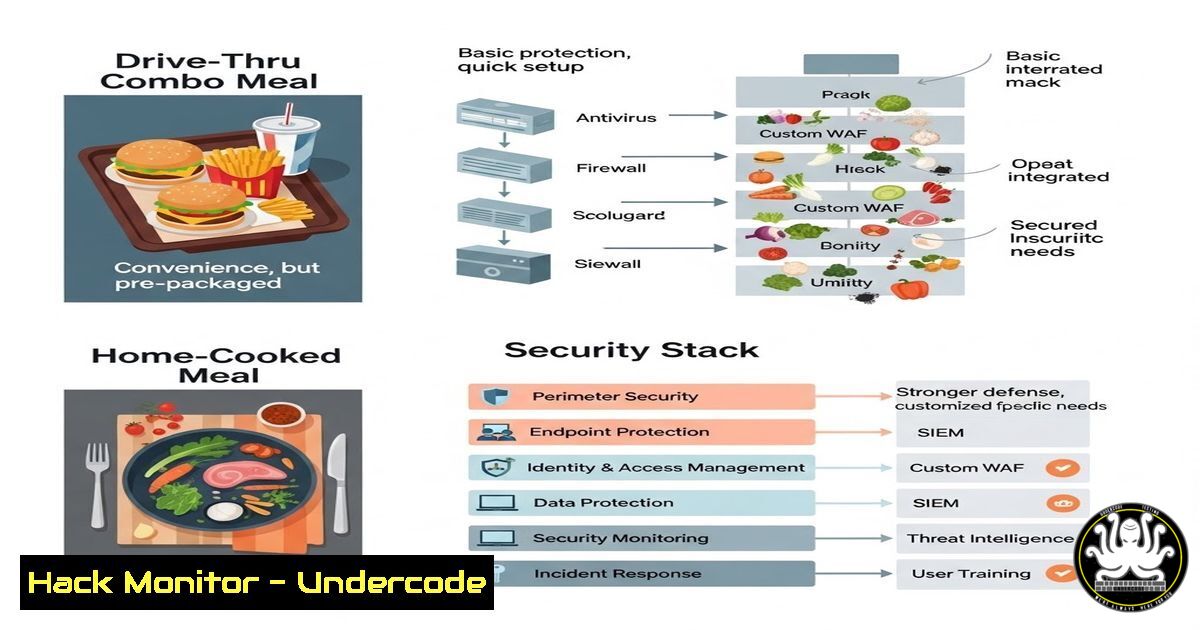
Introduction:
Cybersecurity programs have been systematically optimized for speed, optics, and procurement convenience rather than operational resilience. The result is a landscape littered with pre‑packaged “combo meals”—scanner‑dashboard‑framework bundles that provide the appearance of coverage while leaving critical assets exposed. This article dissects the technical symptoms of fast‑food security and provides executable, vendor‑agnostic steps to rebuild a defense‑in‑depth kitchen that prioritizes control over velocity.
Learning Objectives:
- Identify the six common “combo meal” failure patterns in enterprise security stacks.
- Execute concrete Linux and Windows commands to uncover coverage gaps hidden by dashboards.
- Implement governance controls that shift measurement from deployment speed to incident containment time.
You Should Know:
- Inventory Your Real Menu — Not the Dashboard’s “Coverage”
Most organizations believe they are protected because a console shows 98% agent deployment. That 2% is often your domain controllers, jump boxes, or OT equipment—the very systems adversaries target first.
Step‑by‑step guide to validate true coverage:
Linux (find un‑managed endpoints):
sudo nmap -sS -p 445,3389,22,443 <internal_CIDR> -oG live_hosts.txt
grep -oE "([0-9]{1,3}.){3}[0-9]{1,3}" live_hosts.txt > potential_assets.txt
Cross‑reference against your EDR console’s exported host list using:
comm -23 <(sort potential_assets.txt) <(sort edr_hosts.txt)
Windows (PowerShell – identify systems without specific security agents):
Get-ADComputer -Filter  -Properties Name,OperatingSystem | ForEach-Object {
$agent = Get-Service -ComputerName $<em>.Name -Name "CrowdStrike Falcon" -ErrorAction SilentlyContinue
if (!$agent) { [bash]@{Host=$</em>.Name; OS=$_.OperatingSystem; Status="Missing Agent"} }
} | Export-Csv missing_agents.csv -NoTypeInformation
- Decompose the Combo — Isolate Scanner from Response
Vulnerability scanners are the iceberg lettuce of security—filling, nutritionless, and often months old. Pairing scanning with automated patching creates a false‑positive treadmill.
Break the bundle manually:
- Disable auto‑remediation rules in your VM tool.
- Use `ycql` or `osquery` to verify patch state independently:
SELECT name, version, patch FROM deb_packages WHERE name LIKE 'openssl%' OR name LIKE 'kernel%';
- Linux manual verification (no vendor tools):
dpkg -l | grep -E "openssl|libc6|linux-image" > installed_versions.txt
wget -qO- https://security-tracker.debian.org/tracker | grep -f installed_versions.txt  crude CVE mapping
- Windows manual patch audit:
Get-HotFix | Where-Object {$_.HotFixID -like "KB"} | Export-Csv patches.csvCompare against Microsoft’s latest security update list using `MSRC` API.
3. Command Authority: Who Can Say “No”?
Linda Restrepo’s comment in the source post correctly identifies the absence of decision power. Translate this into technical controls.
Implement a deployment circuit breaker:
- CI/CD pipeline guardrails (GitHub Actions / GitLab CI):
security_hold:
stage: deploy
script:</li>
<li>echo "Manual approval required by AppSec team"</li>
<li>exit 1
when: manual
allow_failure: false
- AWS SCP to enforce deployment approval:
{
"Sid": "RequireApprovalForEC2Changes",
"Effect": "Deny",
"Action": ["ec2:RunInstances", "ec2:CreateSecurityGroup"],
"Resource": "",
"Condition": {
"StringNotEquals": {"aws:RequestTag/approved-by": "security-team"}
}
}
- API Security — The Secret Sauce You Didn’t Order
Combo meals rarely include API protection. Yet most SaaS‑to‑SaaS traffic and internal microservice communication bypass traditional inspection.
Audit and harden API ingestion:
- Check for unauthenticated internal APIs (Linux):
ss -tulpn | grep -E ":(8080|8443|5000|3000)"  common API ports
curl -X GET http://localhost:8080/health  often no auth
- Enforce mutual TLS using OpenSSL:
openssl req -newkey rsa:2048 -nodes -keyout server.key -x509 -days 365 -out server.crt
Configure API gateway (e.g., Kong, NGINX) to reject non‑mTLS connections.
5. Cloud Hardening — Undo the Vendor‑Default Recipe
Every cloud console offers “one‑click security.” That combo meal delivers default VPCs with overly permissive routes and storage buckets that scream “exploit me.”
Remediate exposed assets (AWS CLI):
 Find public S3 buckets
aws s3api list-buckets --query "Buckets[].Name" | xargs -I {} aws s3api get-bucket-acl --bucket {} | grep -B1 "AllUsers"
 Block public access
aws s3api put-public-access-block --bucket $bucket --public-access-block-configuration BlockPublicAcls=true,IgnorePublicAcls=true,BlockPublicPolicy=true,RestrictPublicBuckets=true
Azure:
Get-AzStorageAccount | Where-Object {$_.AllowBlobPublicAccess -eq $true} | Set-AzStorageAccount -AllowBlobPublicAccess $false
- Vulnerability Exploitation — Prove the Receipt Is Real
Use controlled, ethical exploitation to demonstrate that “coverage” does not equal protection. Show leadership the actual receipt.
Linux privilege escalation via missing kernel patch:
uname -r
 If < 5.14, test for CVE-2022-0847 (Dirty Pipe)
gcc dirty_pipe.c -o dirty_pipe
./dirty_pipe /etc/passwd 1 "newroot:x:0:0::/root:/bin/bash"
Windows credential dumping (legitimate EDR gap demonstration):
 Simulate attacker using Mimikatz export (Detections should fire)
mimikatz.exe "privilege::debug" "sekurlsa::logonpasswords" "exit"
Note: Run only in isolated lab environments with explicit approval.
7. Tabletop Exercises — Cook, Don’t Heat
The “toy in the box” compliance checkbox exercise is reheating last year’s incident. A proper exercise introduces friction.
Sample inject:
“At 09:00, the SIEM shows lateral movement from HR workstation to domain controller via SMB. The CISO is in an all‑hands meeting; the head of engineering says pushing a critical revenue feature cannot be paused. Who has the authority to quarantine the domain controller?”
Technical validation during the exercise:
 Simulate containment playbook
New-NetFirewallRule -DisplayName "Emergency Block SMB" -Direction Outbound -Protocol TCP -RemotePort 445 -Action Block
Document the time from detection to containment. This is your true security maturity metric.
What Undercode Say:
Key Takeaway 1: Speed is a lousy proxy for security. Your NIST CSF mapping doesn’t stop ransomware; the ability to isolate a compromised host in 90 seconds does. Stop measuring how fast you buy tools and start measuring how fast you contain breaches.
Key Takeaway 2: Governance is code. If you cannot point to a Service Control Policy, a CI/CD manual approval gate, or a firewall rule that explicitly blocks a line of business under certain conditions, you do not have command authority—you have suggestions.
Analysis: The fast‑food analogy is uncomfortable because it is accurate. We have built entire security programs around procurement ease rather than operational necessity. The comments on the original post from Linda Restrepo and Charles Loring highlight a central truth: tools are not the problem; the absence of enforceable decision rights is. Organizations continue to “order the combo” because the organizational reward system values deployment cadence over resilience. Until a CISO’s bonus is tied to mean time to contain (MTTC) instead of mean time to deploy (MTTD), the menu will remain unchanged. The commands provided above are not exotic—they are basic hygiene that has been skipped in favor of dashboard greens. Implementing them is not about technology; it is about refusing to eat at the window.
Prediction:
Over the next 24 months, at least three major breaches will be publicly attributed not to a zero‑day, but to the gap between a vendor’s “managed” service and the actual configuration of the asset. Regulatory bodies (SEC, FTC, EU DORA) will begin requiring attestation of security control effectiveness—not just deployment status. Boards will finally demand evidence of containment capability. The organizations that have already removed the dashboard blinders and learned to cook from raw ingredients will have a competitive advantage; those still eating combos will pay the receipt in public, with stock price impact.
▶️ Related Video (72% Match):
🎯Let’s Practice For Free:
IT/Security Reporter URL:
Reported By: Joshuacopeland Unpopularopinion – Hackers Feeds
Extra Hub: Undercode MoN
Basic Verification: Pass ✅


