Listen to this Post
Introduction:
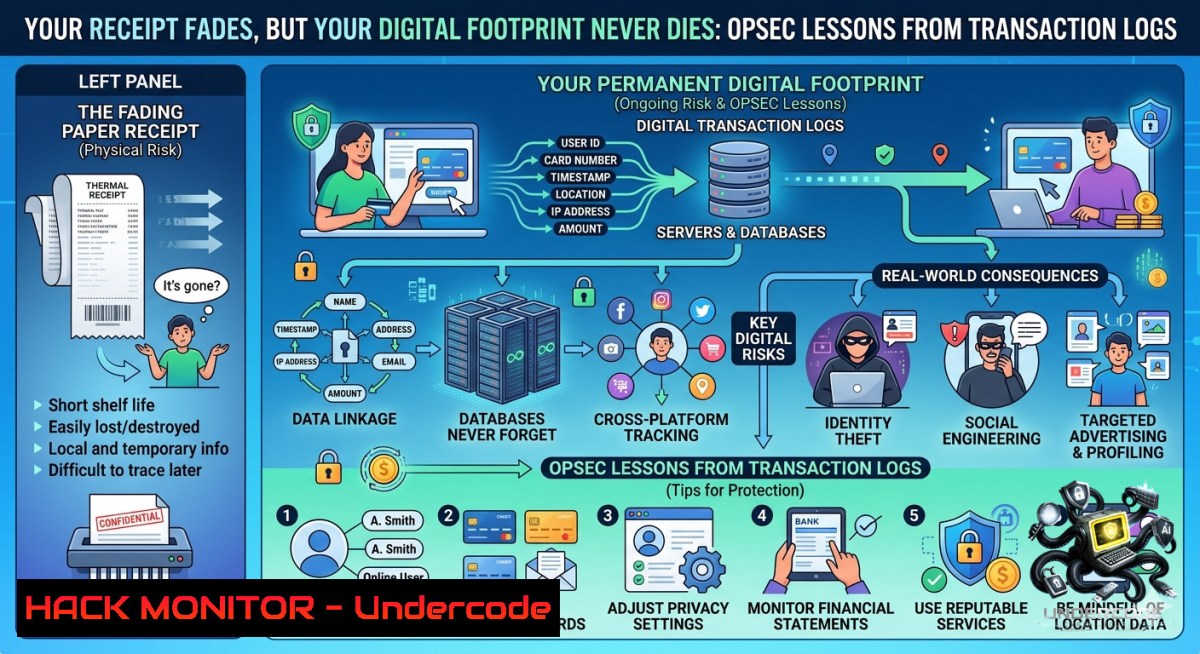
Thermal receipt paper is designed to fade within months or years, giving consumers a false sense of privacy after discarding a blank slip. In reality, every digital transaction—whether by card, mobile payment, or loyalty program—creates permanent, unalterable records across merchant systems, payment processors, and banking infrastructure. Understanding the asymmetry between ephemeral physical evidence and persistent digital logs is critical for operational security (OPSEC), privacy hardening, and forensic awareness.
Learning Objectives:
– Analyze persistent transaction logs across Linux/Windows systems and cloud payment APIs
– Implement OPSEC countermeasures to minimize digital footprints without breaking compliance
– Apply forensic techniques to detect unauthorized access to transaction data
You Should Know:
1. How Digital Transaction Logs Outlive Physical Receipts
The post highlights a core OPSEC truth: the receipt you keep will fade, but the bank, the processor, and the merchant retain permanent records. This extends to every tap, swipe, or click. Let’s examine where these logs live and how to access them.
Step‑by‑step guide – Inspecting local transaction artifacts on Linux/Windows:
Linux – Check systemd journal for payment gateway API calls (e.g., from a POS or e‑commerce app):
 View recent logs from a specific service (e.g., 'payment-processor')
sudo journalctl -u payment-processor --since "2026-06-01" --1o-pager

 Search for transaction IDs or card hashes
sudo grep -r "transaction_id" /var/log/ 2>/dev/null

 Monitor live logs while simulating a purchase
sudo journalctl -u payment-processor -f
Windows – Extract Event Logs for payment application activity:
 Get logs from custom 'Application' events with source 'PaymentGate'
Get-WinEvent -LogName Application | Where-Object { $_.ProviderName -eq "PaymentGate" } | Format-List

 Export all security logs related to registry access (if payment software stores keys)
wevtutil epl Security C:\sec_export.evtx /q:"[System/EventID=4663]"
What these commands do: They reveal that even if you never save a receipt, your operating system and payment software may log transaction metadata (timestamp, amount, masked PAN). Attackers or forensic analysts can recover this months later. To mitigate, configure log rotation and disable verbose application logging (but stay compliant with PCI DSS if handling card data).
2. Mapping the Permanent Records: Merchant, Processor, and Bank
The post notes that the merchant, payment processor, and bank all keep records. From a technical perspective, each layer introduces distinct data retention policies and access vectors.
Step‑by‑step guide – API enumeration of payment processor endpoints (authorized testing only):
Many processors (Stripe, Braintree, Adyen) expose REST APIs that list transactions. A simple API call with a compromised key reveals years of history.
 Using curl to list recent charges (requires a valid secret key)
curl -X GET https://api.stripe.com/v1/charges \
-H "Authorization: Bearer sk_live_xxxx" \
-H "Content-Type: application/x-www-form-urlencoded"

 Same for Braintree (using their SDK)
php braintree-cli.php transaction search --customerId=abc123
Hardening against API‑based exposure:
– Rotate API keys every 90 days; never embed them in client‑side code.
– Enforce IP whitelisting for production payment APIs.
– Use webhook signatures to verify authenticity of transaction notifications.
Windows command to check for leaked API keys in environment variables:
Get-ChildItem Env: | Where-Object { $_.Name -match "API_KEY|SECRET|STRIPE" }
3. Cash and Cameraless Purchases – The Lowest‑Footprint Option
The author recommends cash purchases at stores without cameras to create the fewest records. This is a classic OPSEC trade‑off. But even cash leaves traces: serial numbers, ATM withdrawal records (if you used a card to get cash), and CCTV footage.
Step‑by‑step guide – Hardening cash‑based OPSEC:
– Step 1 – Withdraw cash anonymously: Use ATMs in low‑traffic areas without cameras (rare). Better: person‑to‑person cash exchange via local classifieds.
– Step 2 – Use privacy coins for online equivalents: Monero (XMR) leaves no public blockchain trace.
 Generate a Monero subaddress for each transaction
monero-wallet-cli --generate-1ew-wallet /tmp/anon_wallet
 Inside wallet: address new <label>
– Step 3 – Destroy serial number records: Soak bills in isopropyl alcohol or run through a bill shredder before disposal (not recommended for legal currency retention).
Windows – Monitoring USB camera devices that could record you at checkout:
Get-PnpDevice | Where-Object { $_.Class -eq "Camera" } | Disable-PnpDevice -Confirm:$false
4. Digital Forensics: Recovering Faded Receipts from Thermal Paper Images
If you photographed the receipt before it faded (as the author suggests), that image is a rich source of OSINT. Attackers or law enforcement can extract metadata from the photo.
Step‑by‑step guide – Extracting receipt data from a smartphone image using open‑source tools:
 Install exiftool to read photo metadata (GPS, timestamp, device info)
sudo apt install exiftool
exiftool receipt_photo.jpg

 Use Tesseract OCR to extract the faded text from a high‑contrast image
tesseract receipt_photo.jpg stdout --psm 6

 For thermal paper, apply image sharpening first
convert receipt_photo.jpg -sharpen 0x1 -threshold 50% sharpened.png
tesseract sharpened.png stdout
Mitigation for privacy: Strip all metadata before sharing any receipt image. Use `exiftool -all=` to remove EXIF data. Consider adding noise to QR codes or barcodes to prevent scanning.
5. Cloud Hardening: Transaction Logs in AWS/Azure/GCP
Modern merchants store transaction records in cloud object storage (S3, Blob, GCS). Misconfigured buckets leak millions of receipts. The post’s lesson—permanent digital records—is starkly visible in public cloud leaks.
Step‑by‑step guide – Audit cloud storage for exposed transaction logs:
AWS CLI – List buckets and check for public ACLs:
aws s3api list-buckets --query "Buckets[].Name"
aws s3api get-bucket-acl --bucket <bucket-1ame> | grep "URI" | grep "AllUsers"
Azure – Detect anonymous access on Blob containers:
 Using Azure PowerShell
$ctx = New-AzStorageContext -StorageAccountName "merchantstore"
Get-AzStorageContainer -Context $ctx | Where-Object { $_.PublicAccess -1e "Off" }
Remediation: Enforce “Block public access” at the account level. Enable S3 Object Lock to prevent deletion (compliance) while ensuring logs remain available only to authorized roles.
6. Exploiting Weak Transaction Log Retention Policies
From an adversarial perspective, permanent logs can be weaponized. If a merchant retains transaction records longer than required (e.g., 10+ years), a data breach exposes customers’ entire purchase history, enabling targeted phishing or physical stalking.
Step‑by‑step – Simulating a log injection attack (educational):
On a vulnerable payment form, try injecting line breaks into the `item_name` field to corrupt log parsers:
POST /charge HTTP/1.1
item_name=Sneakers\n2026-06-07 00:00:00 [bash] Access granted to admin
If the logging system is poorly designed, this may create false alerts or even remote code execution in log viewers (log4shell style).
Mitigation: Sanitize all user inputs before logging; use structured logging (JSON) with type enforcement.
7. Training Courses and Further Technical Deep Dives
While the original post contains no URLs, professionals looking to master transaction privacy and OPSEC should explore:
– SANS SEC575: Cloud Penetration Testing – Covers AWS/Azure log analysis and API abuse.
– INE’s eCPPT – Includes payment gateway exploitation modules.
– Open‑source course: “OPSEC for Digital Nomads” (GitHub: OPSEC‑365/labs) – Weekly practicals on receipt tracking, OSINT, and thermal paper forensics.
Linux command to clone an example OPSEC lab:
git clone https://github.com/opsec365/lab-transaction-logs
cd lab-transaction-logs && docker-compose up -d
What Undercode Say:
– Key Takeaway 1: The ephemeral nature of physical media (faded receipts) is a dangerous OPSEC illusion—digital artifacts are permanent and often more accessible to adversaries than the paper itself.
– Key Takeaway 2: Cash without CCTV remains the gold standard for minimizing records, but even that leaves fingerprints (serial numbers, ATM withdrawals). True anonymity requires compartmentalization and technical controls like Monero and metadata stripping.
Analysis: The post succinctly exposes a cognitive bias: humans trust what they see (or don’t see) fading. But threat actors and forensic investigators don’t need the receipt—they query databases, APIs, and logs. For defenders, this means shifting focus from physical destruction to digital hygiene: rotating API keys, auditing cloud buckets, and understanding that every “private” transaction leaves a permanent echo. The OPSEC365 series consistently highlights these low‑tech truths with high‑tech implications.
Prediction:
– +1 Over the next 24 months, privacy‑focused payment rails (Lightning Network, Fedimint) will gain mainstream traction as consumers realize receipt fading does nothing to erase digital logs.
– -1 Regulatory bodies (FATF, EU) will expand transaction record‑keeping requirements to include even cash withdrawals above $200, shrinking the last anonymous refuge.
– +1 Open‑source forensic tools for extracting faded thermal receipt images will become standard in OSINT kits, empowering journalists and auditors to recover “dead” evidence.
– -1 Merchants will face class‑action lawsuits for failing to delete outdated transaction logs after breaches, citing the “permanent record” problem raised by OPSEC researchers.
▶️ Related Video (80% Match):
🎯Let’s Practice For Free:
🎓 Live Courses & Certifications:
[Join Undercode Academy for Verified Certifications](https://undercode.co.uk/certifications/)
🚀 Request a Custom Project:
Secure, high-velocity infrastructure and disruptive technological engineering. Contact our engineering team for high-tier development and proprietary systems:
[[email protected]](mailto:[email protected])
💎 Smart Architecture | 🛡️ Secure by Design | ⭐ Trusted by Thousands
IT/Security Reporter URL:
Reported By: [Sam Bent](https://www.linkedin.com/posts/sam-bent_opsec365-share-7466715137115201536-CeTs/) – Hackers Feeds
Extra Hub: Undercode MoN
Basic Verification: Pass ✅
🔐JOIN OUR CYBER WORLD [ CVE News • HackMonitor • UndercodeNews ]
[💬 Whatsapp](https://undercode.help/whatsapp) | [💬 Telegram](https://t.me/UndercodeCommunity)
📢 Follow UndercodeTesting & Stay Tuned:
[𝕏 formerly Twitter 🐦](https://x.com/undercodeupdate) | [@ Threads](https://www.threads.net/@undercodetesting) | [🔗 Linkedin](https://www.linkedin.com/company/undercodetesting/) | [🦋BlueSky](https://bsky.app/profile/undercode.bsky.social)


