Listen to this Post
Introduction:
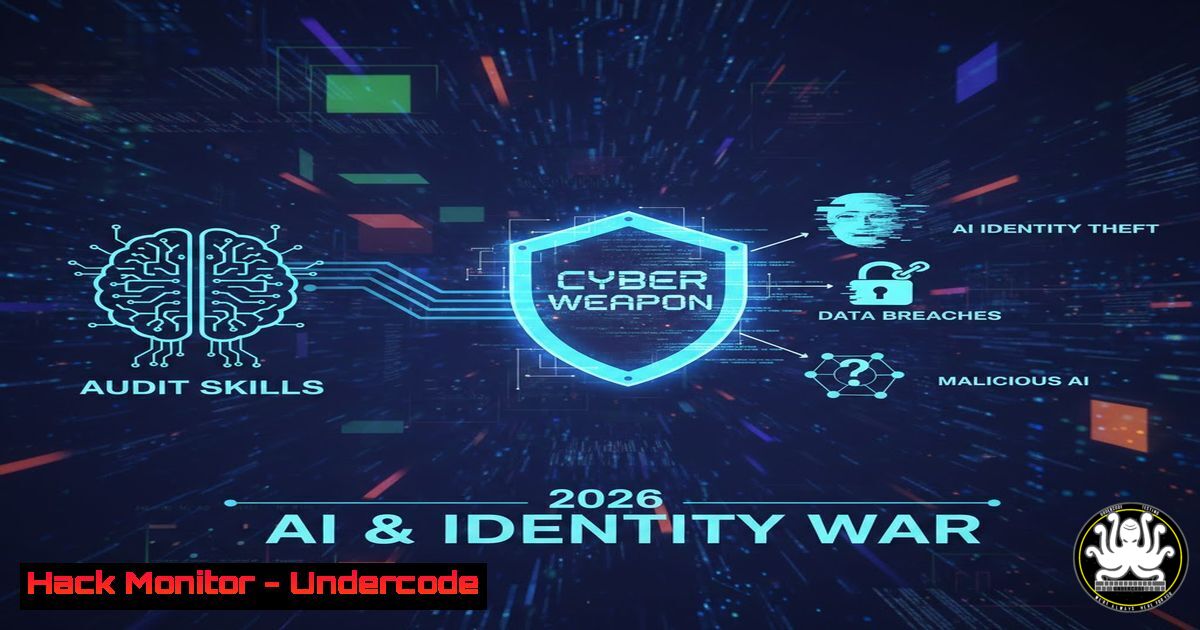
The cybersecurity landscape of 2026 will be defined not by purely technical challenges, but by profound governance, risk, and compliance (GRC) crises stemming from Agentic AI and decades of accumulated identity mismanagement. Professionals with audit and compliance backgrounds possess the critical thinking, control design, and forensic rigor required to secure this new frontier. This article translates future predictions into actionable technical and procedural guidance, empowering you to leverage your unique skill set.
Learning Objectives:
- Architect control frameworks for autonomous AI systems to mitigate novel “Agentic AI” risks.
- Execute technical “Identity Debt” remediation through systematic access review and hygiene enforcement.
- Translate cybersecurity initiatives into business-risk language to drive strategic, board-level value.
You Should Know:
- Governance for Agentic AI: From Theory to Technical Enforcement
The rise of autonomous AI agents that can execute tasks, access data, and make decisions creates a paradigm shift in access control and accountability. An auditor’s mindset is key to defining the “who, what, when, and why” for non-human identities. Technically, this requires implementing robust audit trails, least-privilege access, and explicit approval workflows for AI actions.
Step‑by‑step guide explaining what this does and how to use it.
Step 1: Establish AI Agent Identity & Logging. Every AI agent must have a unique service identity (e.g., Service Principal in Azure, IAM Role in AWS). Force detailed logging of all its actions.
Linux Command Example (via journald): `sudo journalctl -u my_ai_agent.service –since “2024-05-01″ –output json | jq ‘.[] | select(.IDENTIFIER==”agent-alpha”)’` This queries system logs for a specific AI agent’s activity, piping the JSON output to `jq` for filtering.
Step 2: Enforce Policy as Code (PaC). Define and deploy access policies for AI agents using code (e.g., Open Policy Agent – OPA). This ensures reproducible, auditable controls.
Tutorial Snippet (OPA Rego Policy):
package ai_agent.authz
default allow = false
allow {
input.agent.identity == "data-analyzer-01"
input.action == "read"
input.resource.type == "database"
input.resource.name == "customer_metrics"
}
This policy only allows the specific agent “data-analyzer-01” to perform read actions on the specific “customer_metrics” database.
Step 3: Implement Human-in-the-Loop (HITL) Critical Action Approval. For high-impact actions (e.g., financial transaction, data deletion), configure the AI system to require human approval via an integrated ticketing system (e.g., ServiceNow API, Jira).
2. Remediating “Identity Debt”: A Technical Forensic Audit
“Identity Debt” refers to the cumulative risk from stale user accounts, excessive permissions, and unrevoked access. It’s a toxic asset on your balance sheet. Remediation is a forensic exercise: discovering, assessing, and cleaning hidden liabilities across complex systems (Active Directory, Cloud IAM, SaaS apps).
Step‑by‑step guide explaining what this does and how to use it.
Step 1: Discovery and Inventory. Use native tools and scripts to list all identities and their entitlements.
Windows PowerShell (AD): `Get-ADUser -Filter -Properties LastLogonDate, Enabled, MemberOf | Where-Object {$_.LastLogonDate -lt (Get-Date).AddDays(-90) -and $_.Enabled -eq $true} | Export-Csv StaleUsers.csv` This finds enabled AD users who haven’t logged in 90+ days.
AWS CLI Command: `aws iam generate-credential-report` then analyze the CSV to find users with old password or access key ages.
Step 2: Analyze for Excessive Privilege. Map users to roles and permissions, flagging deviations from the “least privilege” principle.
Azure AD/Azure CLI: Use `az ad user get-member-groups` and `az role assignment list` to build a comprehensive map of a user’s group memberships and Azure resource roles.
Step 3: Automated Deprovisioning & Right-Sizing. Establish automated lifecycle workflows. For cloud environments, use tools like AWS IAM Access Analyzer or Azure AD Access Reviews to systematically certify and rectify access.
- Quantifying Cyber Risk: Speaking the Language of the Board
The shift to cybersecurity as a business enabler demands quantifying risk in financial and operational terms. Auditors excel at this by linking controls to business outcomes. The goal is to move from “we need a phishing solution” to “investing in this controls reduces our material risk of a $4.3M business email compromise loss by 70%.”
Step‑by‑step guide explaining what this does and how to use it.
Step 1: Adopt a Risk Quantification Framework. Implement the FAIR (Factor Analysis of Information Risk) model. Start by defining loss scenarios (e.g., ransomware-induced operational downtime).
Step 2: Gather Data for Monte Carlo Simulation. Use historical incident data (internal or from consortiums like VERIS), and business data like cost of downtime per hour. Feed this into a FAIR tool (e.g., RiskLens, FAIR-U) or simple Monte Carlo simulation in Python to model probable loss ranges.
Basic Python (using numpy) Snippet for Modeling Loss:
import numpy as np
 Simulate frequency of incidents per year (e.g., Poisson distribution)
frequency = np.random.poisson(lam=2, size=10000)
 Simulate loss magnitude per incident (e.g., Lognormal distribution)
magnitude = np.random.lognormal(mean=10, sigma=1.5, size=10000)
 Calculate total annual loss
total_loss = frequency  magnitude
 Calculate key risk metrics
print(f"95th Percentile Annual Loss: ${np.percentile(total_loss, 95):,.2f}")
Step 3: Build a Cyber Risk Register. Create a living document that aligns each quantified risk with control ownership, mitigation status, and residual risk exposure. This becomes the core artifact for board-level communication.
- API Security: The Auditable Gateway for AI and Integrations
Agentic AI and modern IT heavily rely on APIs, which are prime attack surfaces. Auditors must verify API security postures, focusing on authentication, excessive data exposure, and rate limiting. This involves reviewing API specifications, testing endpoints, and auditing logs.
Step‑by‑step guide explaining what this does and how to use it.
Step 1: Inventory and Specification Review. Use tools like Swagger/OpenAPI to document all APIs. Audit the specs for clear authentication/authorization schemes and data models that don’t over-expose fields (like internal user IDs or PII).
Step 2: Test Authentication and Parameter Tampering. Use a tool like OWASP ZAP or `curl` for basic security testing.
Linux Command Example (Broken Object Level Authorization Test): curl -H "Authorization: Bearer <USER_TOKEN>" https://api.example.com/users/123` Then try changing the user ID to124`. If it returns another user’s data, a critical vulnerability exists.
Step 3: Implement and Monitor API Audit Logs. Ensure all API interactions, especially by AI agents, are logged with principal identity, timestamp, action, and resource. Centralize these logs in a SIEM for anomalous behavior detection.
5. Cloud Configuration Hardening: The Control Environment Baseline
Misconfigured cloud storage (S3 buckets, Blob containers) and overly permissive network security groups are a primary cause of breaches. This is a direct control failure. Use infrastructure-as-code (IaC) scanning and continuous compliance tools to enforce baseline hardening.
Step‑by‑step guide explaining what this does and how to use it.
Step 1: Define Hardened Baselines as Code. Use industry benchmarks (CIS AWS/Azure Foundations) to create Terraform or CloudFormation templates with secure defaults.
Step 2: Scan IaC Pre-Deployment. Integrate a scanner like Checkov, Terrascan, or Cfn-Nag into your CI/CD pipeline.
Command Example (Checkov): `checkov -d /path/to/terraform/code –quiet` This will fail the build if, for example, an S3 bucket is defined without encryption enabled.
Step 3: Enable Continuous Post-Deployment Compliance. Use cloud-native tools like AWS Config, Azure Policy, or GCP Security Command Center to continuously detect and remediate configuration drift from your defined baselines.
What Undercode Say:
- Auditors Are the Architects of the AI-Secure Future. Their ability to design testable, accountable control frameworks is the single most critical skill for governing Agentic AI, surpassing pure AI programming knowledge in importance for secure implementation.
- Technical Debt is a Risk Debt, and Identity is Its Largest Ledger. The systematic, forensic approach of an audit professional is the optimal methodology for remediating identity debt, transforming a nebulous tech problem into a manageable, scoped risk-reduction project.
Analysis: The original post correctly identifies the convergence of deep technical systems and profound governance gaps. The future CISO’s inner circle will require professionals who don’t just understand how to build an AI agent or configure a cloud entitlement, but who possess the ingrained discipline to ask, “How do we prove it’s working correctly and not violating policy?” This is the essence of auditing. The technical guides provided here are the concrete manifestations of that audit mindset—they are controlled, repeatable, and evidence-producing procedures. The transition from audit to cyber GRC is not a pivot; it’s an evolution into a role with higher stakes and greater demand.
Prediction:
By 2026, organizations that successfully integrate audit-skilled professionals into the core of their cybersecurity engineering and strategy teams will demonstrate a statistically significant reduction in the severity and financial impact of breaches related to AI and identity. “Cybersecurity Auditor” will emerge as a distinct, hybrid role within Security Engineering and GRC teams, commanding a premium for its unique blend of risk quantification, control design, and technical verification skills. The major regulatory push around AI (like the EU AI Act) will formalize this need, making AI governance controls not just best practice, but a legal requirement, solidifying the value of this skillset.
▶️ Related Video (80% Match):
🎯Let’s Practice For Free:
IT/Security Reporter URL:
Reported By: Olamide Akintayo – Hackers Feeds
Extra Hub: Undercode MoN
Basic Verification: Pass ✅


