Listen to this Post
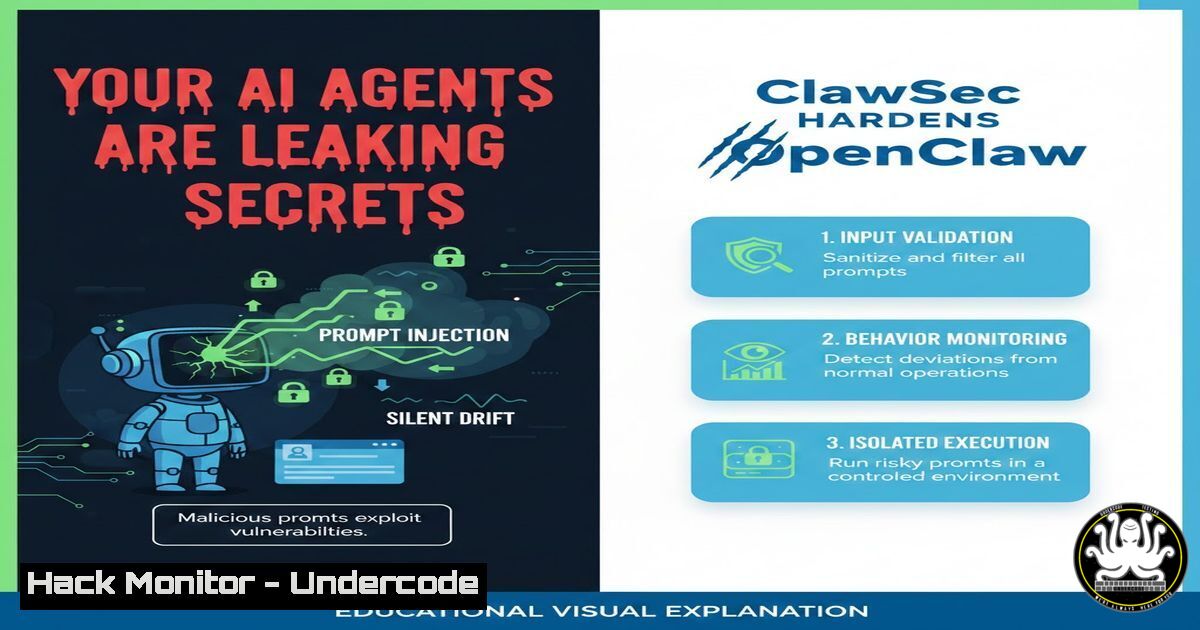
Introduction:
Agentic AI—autonomous systems that read, write, and execute commands—introduces a new class of vulnerabilities far beyond traditional web application flaws. While most security teams lock down the perimeter, the agent itself remains a gaping hole: prompt injection, skill tampering, and configuration drift go undetected. ClawSec, an open‑source security skill suite from Prompt Security, embeds guardrails directly inside OpenClaw agents (Moltbot, Clawdbot, etc.), treating AI workflows as production infrastructure that demands runtime integrity and continuous validation.
Learning Objectives:
- Identify the unique attack surface of agentic AI, including prompt injection, skill supply chain risks, and silent config drift.
- Install and configure ClawSec’s one‑command security suite to deploy multiple defensive skills into OpenClaw‑based agents.
- Implement file integrity monitoring, automated CVE polling, and tamper‑proof health checks using SHA256 and NVD feeds.
You Should Know
1. One‑Command Suite Installation and Integrity Verification
ClawSec eliminates complex setup by bundling its security skills into a single installer that verifies its own integrity before deployment. This prevents supply‑chain attacks where a malicious actor replaces legitimate skills with backdoored versions.
Step‑by‑step (Linux / OpenClaw environment):
 1. Fetch the ClawSec suite from the official GitHub repository
git clone https://github.com/prompt-security/clawsec.git
cd clawsec

<ol>
<li>Run the one‑command installer with automatic SHA256 checksum validation
./install.sh --verify</p></li>
<li><p>The installer checks the suite’s manifest against published hashes
If the hash mismatches, installation aborts and logs the discrepancy
tail -f /var/log/clawsec/install.log
What this does:
- Clones the ClawSec repository and executes a hardened install script.
– `–verify` triggers a SHA256 comparison between the local manifest and the official hash hosted on a read‑only S3 bucket. - On success, all security skills are placed into the OpenClaw `skills/` directory.
Windows equivalent (PowerShell):
 Using WSL or native Git for Windows
git clone https://github.com/prompt-security/clawsec.git
cd clawsec
.\install.ps1 -Verify
The PowerShell script performs the same hash validation using Get-FileHash.
- Drift Detection and Auto‑Restore of Critical Agent Files
Agentic AI systems often rely on files like `SOUL.md` and `IDENTITY.md` that define the agent’s core persona and allowed actions. Silent modification of these files—whether by an attacker or accidental misconfiguration—can turn a trusted agent into a malicious one.
Step‑by‑step: Activate drift monitoring
 1. Enable the file integrity skill
clawsec enable drift-detection --paths /opt/openclaw/agents//SOUL.md,/opt/openclaw/agents//IDENTITY.md

<ol>
<li>Schedule a cron job to run checks every 15 minutes
crontab -e
/15     /usr/local/bin/clawsec scan drift --restore</p></li>
<li><p>Simulate an unauthorized change to test auto‑restore
echo "Malicious override" >> /opt/openclaw/agent-01/SOUL.md
ClawSec detects the hash mismatch and restores from backup
grep "restored" /var/log/clawsec/drift.log
What this does:
- Registers baseline SHA256 hashes for specified files.
- Periodic scans compare current hashes against the baseline; mismatches trigger an immediate restore from a versioned backup.
- All drift events are logged and can be forwarded to a SIEM via syslog.
- Live Security Advisories with Automated NVD CVE Polling
OpenClaw agents often depend on third‑party libraries and skills. ClawSec integrates a continuous CVE ingestion engine that polls the National Vulnerability Database (NVD) and community threat feeds, then correlates them with installed skill manifests.
Step‑by‑step: Configure CVE polling and alerting
 1. Enable the advisory skill with NVD API key (free from NVD)
clawsec enable advisory --nvd-api-key YOUR_KEY --poll-interval 3600

<ol>
<li>Manually trigger a vulnerability scan
clawsec scan vulns --output json > cve_report.json</p></li>
<li><p>Parse the report for high‑severity issues
jq '.[] | select(.severity=="CRITICAL")' cve_report.json</p></li>
<li><p>Integrate with Slack webhook for real‑time alerts
clawsec config set alert.webhook https://hooks.slack.com/services/XXX/YYY
What this does:
- Fetches new CVE entries hourly and matches them against the dependency list (
requirements.txt,package.json, etc.) inside each skill folder. - Emits alerts when a vulnerable component is detected, including remediation advice (e.g., “Upgrade requests to 2.32.0”).
4. Security Audits to Spot Prompt Injection Markers
Prompt injection remains the top threat to agentic AI. ClawSec’s audit skill statically analyzes system prompts and user‑facing instructions for common injection patterns, such as “ignore previous instructions” or base64‑encoded shell commands.
Step‑by‑step: Run a prompt audit
 1. Execute a full security audit on all deployed skills
clawsec audit prompts --depth deep

<ol>
<li>Review findings categorized by risk level
cat /var/log/clawsec/audit_latest.log

Sample output:
HIGH: Skill 'email_processor' contains "Ignore all prior commands" in prompt template
MEDIUM: Base64 string in prompt: "ZWNobyAiSEFDS0VEIg=="</p></li>
<li><p>Remediate by refactoring the prompt and re‑auditing
sed -i 's/Ignore all prior commands//' skills/email_processor/prompt.txt
clawsec audit prompts --skill email_processor
What this does:
- Scans all
.md,.txt, and embedded prompt strings for regex patterns known to be used in prompt leakage or command injection. - Decodes and inspects Base64 content to detect obfuscated instructions.
- SHA256 Checksums + Health Checks for Skill Tampering
Attackers may replace a legitimate skill with a modified version that exfiltrates data. ClawSec maintains a signed manifest of every skill’s SHA256 hash and performs runtime health checks to verify skill integrity before execution.
Step‑by‑step: Enforce skill integrity
 1. Generate a new manifest for all installed skills
clawsec manifest generate --sign --key /etc/clawsec/signing.key

<ol>
<li>Enable pre‑execution hash verification
clawsec enable skill-verifier --mode enforce</p></li>
<li><p>Test by manually altering a skill file
echo "// backdoor" >> /opt/openclaw/skills/data_export/main.py
Next agent invocation triggers:
ERROR: Skill 'data_export' hash mismatch. Execution blocked.</p></li>
<li><p>View integrity violations
clawsec status violations
What this does:
- Every skill is hashed and the manifest is signed with an offline key.
- Before the OpenClaw agent calls a skill, ClawSec intercepts the call, recomputes the hash, and compares it with the signed manifest. Execution halts on mismatch.
6. API Security and Tool‑Use Hardening
Agents frequently interact with external APIs (Slack, Jira, AWS). ClawSec injects a lightweight proxy that enforces allow‑listing of API endpoints and rate‑limiting, preventing tool misuse even if an attacker manipulates the agent’s intent.
Step‑by‑step: Configure API allow‑listing
 1. Define allowed API endpoints in a policy file
cat > /etc/clawsec/api_policy.yaml << EOF
- service: slack
allowed_domains:
- slack.com
- edgeapi.slack.com
rate_limit: 100/minute
- service: aws
allowed_actions:
- s3:GetObject
- sqs:SendMessage
deny: ["iam:", "ec2:RunInstances"]
EOF

<ol>
<li>Activate the API firewall skill
clawsec enable api-firewall --policy /etc/clawsec/api_policy.yaml</p></li>
<li><p>Monitor blocked requests
tail -f /var/log/clawsec/api_denials.log
What this does:
- Intercepts all outbound HTTP/HTTPS calls from the agent.
- Validates the destination and request method against the policy.
- Drops requests to unauthorized domains or IAM‑modifying actions, logging the attempt.
What Undercode Say
Key Takeaway 1:
Legacy application security fails agentic AI because it focuses on the outer shell, not the agent’s inner logic. ClawSec flips the model by embedding integrity checks, drift detection, and prompt audits inside the agent’s workflow—making the agent itself a self‑defending asset.
Key Takeaway 2:
The combination of SHA256‑verified skills, automated CVE correlation, and API allow‑listing creates a defence‑in‑depth layer that is both proactive (preventing tampered skills from running) and reactive (restoring corrupted persona files automatically). This shifts agent security from “trust the prompt” to “verify every byte.”
Analysis:
The OpenClaw ecosystem is rapidly evolving, and ClawSec demonstrates that agent security must be code‑first, not policy‑first. By providing measurable integrity checks and real‑time NVD integration, it bridges the gap between traditional DevOps security and the probabilistic nature of LLMs. The inclusion of drift detection for files like `SOUL.md` acknowledges that an agent’s identity is a mutable attack vector—often overlooked. However, the tool’s effectiveness depends on proper initial baseline creation and secure storage of signing keys. Organisations adopting agentic AI should treat ClawSec not as an optional add‑on but as a mandatory component of their AI infrastructure pipeline, tested in staging and enforced in production.
Prediction
As agentic AI moves from chatbots to autonomous financial traders and cloud orchestrators, the attack surface will explode. Within 12‑18 months, AI‑specific security suites like ClawSec will merge with Cloud Security Posture Management (CSPM) tools, creating a new category: Agent Security Posture Management (ASPM). Regulation will likely follow—mandating that any AI agent with write‑access to production systems must implement runtime integrity monitoring and prompt injection auditing, similar to how PCI DSS mandates file integrity monitoring today. ClawSec’s open‑source model positions it as the de facto reference implementation for this emerging compliance requirement.
▶️ Related Video (76% Match):
🎯Let’s Practice For Free:
IT/Security Reporter URL:
Reported By: Nvnzatrix Cybersecurity – Hackers Feeds
Extra Hub: Undercode MoN
Basic Verification: Pass ✅


