Listen to this Post
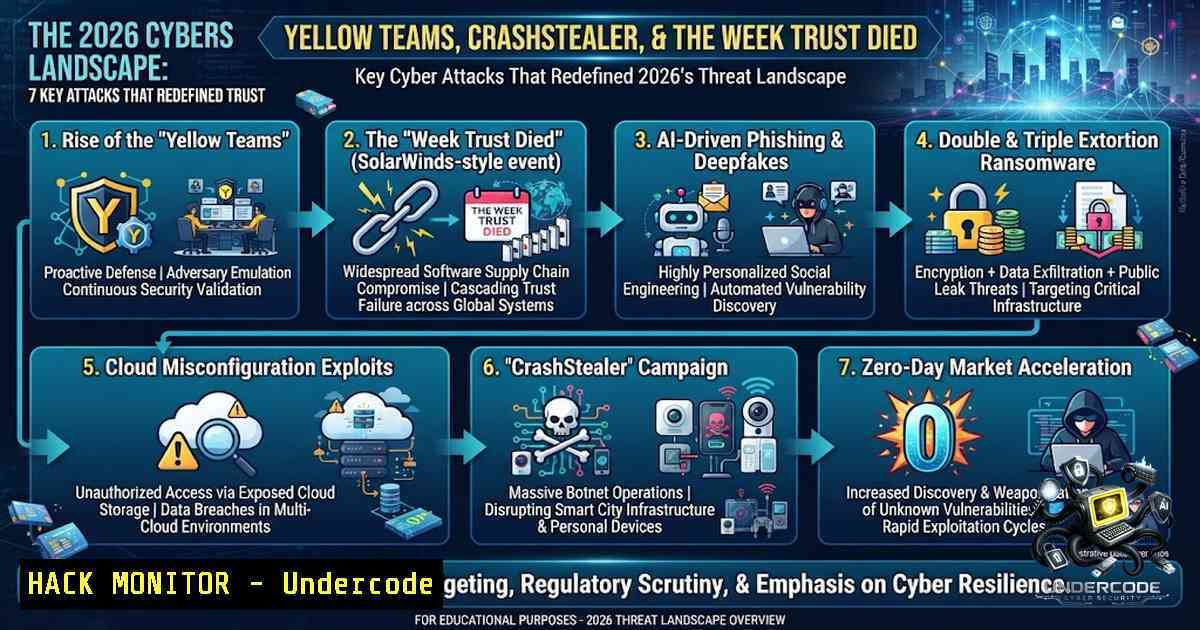
Introduction:
The cybersecurity landscape in July 2026 witnessed a paradigm shift as AI-powered offensive capabilities moved from theoretical to operational. From the emergence of “Yellow Teams” as a new security discipline to the first fully autonomous AI ransomware agent, the industry is grappling with threats that outpace traditional defense mechanisms. This article dissects the week’s most critical developments—spanning macOS infostealers, browser extension supply chain compromises, modular wiper malware, and CISA’s own GitHub exposure—while providing actionable technical guidance for defenders.
Learning Objectives:
- Understand the role and implementation of Yellow Teams in AI security
- Analyze the technical execution of the CrashStealer macOS malware and its evasion techniques
- Master detection and response strategies for browser extension supply chain threats
- Implement defensive measures against modular wiper malware like GigaWiper
- Apply CISA’s lessons learned from its GitHub credential exposure incident
You Should Know:
- Yellow Teams: The Third Pillar of AI Security
Yellow Teams represent an evolution in cybersecurity, bridging offensive (Red) and defensive (Blue) capabilities. Unlike traditional Red Teaming, which focuses on adversarial input detection and model robustness testing, Yellow Teams own design-time security for LLMs, AI agents, and MCP-connected systems. They don’t wait for a Red Team to find the hole or a Blue Team to detect the breach—they build security into AI systems from the ground up.
Organizations like Anthropic and OpenAI have initiated projects such as Project Glasswing and Daybreak, integrating advanced AI models like Claude Mythos and GPT-5.5 into cybersecurity operations. These teams have uncovered thousands of vulnerabilities by building specialized “harnesses”—protective layers around AI models that define what they can do and how they should behave.
Step-by-Step Implementation for Building a Yellow Team:
- Define the scope: Identify all AI assets—LLMs, AI agents, RAG pipelines, and MCP-connected systems—within your organization.
- Create AI-specific threat models: Map potential attack vectors including prompt injection, training data poisoning, and model inversion.
- Build harnesses: Develop protective layers around AI models. Example configuration for an AI gateway:
ai_gateway:
rate_limiting: 100 requests/min
input_sanitization: enabled
output_filtering: enabled
allowed_actions: [read, query]
denied_actions: [write, delete, execute]
- Integrate into SDLC: Yellow Teams must feed findings back into the software development lifecycle, identifying development habits that need to change.
- Continuous testing: Run adversarial simulations against AI models before deployment, not after.
2. CrashStealer: macOS Malware That Bypasses Gatekeeper
Jamf Threat Labs uncovered CrashStealer, a macOS infostealer that disguises itself as Apple’s crash-reporting tool to steal passwords, Keychain data, and cryptocurrency wallets. What makes this malware particularly dangerous is its use of a signed and Apple-1otarized dropper that clears Gatekeeper on first launch.
The attack chain begins with a disk image called “Werkbit Setup,” containing Werkbit.app signed with Developer ID “Emil Grigorov (WWB7JA7AQV)”. The dropper queries the GitHub API to fetch a file containing a curl command that pulls a shell script, which downloads the final payload over cleartext HTTP. The payload is then stripped of its signature and re-signed ad-hoc before launching from a hidden directory.
Detection Commands for macOS Defenders:
 Check for hidden CrashReporter directories
ls -la /tmp/.CrashReporter /private/tmp/.CrashReporter

Monitor for suspicious hdiutil mounts
sudo log show --predicate 'subsystem == "com.apple.hdiutil"' --last 24h | grep -i "noverify"

Check for the specific C2 address (179.43.166.242) in network connections
sudo lsof -i | grep 179.43.166.242

Verify code signatures of suspicious applications
codesign -dv /path/to/suspicious.app

Monitor for dscl password validation attempts (used by CrashStealer to verify credentials)
sudo log show --predicate 'process == "dscl"' --last 24h
Windows Equivalent (for cross-platform detection):
 Monitor for suspicious process creation
Get-WinEvent -LogName Security | Where-Object { $<em>.Id -eq 4688 -and $</em>.Message -match "CrashReporter" }

Check for unusual scheduled tasks
Get-ScheduledTask | Where-Object { $_.TaskName -match "OneDrive Update" }
- ModHeader Supply Chain Compromise: 1.6 Million Users at Risk
Google and Microsoft removed the ModHeader extension—with over 1.6 million combined installations—after Stripe OLT discovered hidden code designed to collect browsing history data embedded in the official version. The code was dormant, kept inactive by an empty allowlist, but the entire pipeline was fully built: endpoint, encryption key, scheduler, and collection logic. A routine update could have activated it without requiring additional permissions.
Technical Analysis:
- Version 7.0.18 contained a secondary mechanism that generated device fingerprints and encrypted visited domains before storing them locally
- Data was scheduled for exfiltration to stanfordstudies[.]com and extensions-hub[.]com
- Automated security reviews rated it low risk because data was encrypted and collection was inactive
Mitigation Commands:
Chrome/Edge (Enterprise):
// Group Policy to block ModHeader
{
"ExtensionInstallBlocklist": [""],
"ExtensionInstallAllowlist": ["allowed_extension_ids"]
}
Windows Registry (to prevent automatic reinstall):
reg add HKLM\SOFTWARE\Policies\Google\Chrome\ExtensionInstallBlocklist /v 1 /t REG_SZ /d ""
Network Blocking (Firewall/Proxy):
block domain: stanfordstudies.com
block domain: extensions-hub.com
Credential Rotation: Any user who handled sensitive information (API keys, session cookies) through ModHeader should rotate those credentials immediately.
- GigaWiper: Modular Malware That Lets Attackers Choose Destruction
Microsoft Threat Intelligence uncovered GigaWiper, a Golang-based Windows backdoor that combines multiple malware families into a single implant. Unlike traditional wipers that are “fire-and-forget,” GigaWiper provides persistent access and remote control, allowing attackers to choose the most damaging action at the optimal moment.
Destructive Capabilities:
- Raw disk wiper: Overwrites the physical drive and partition table
- Fake ransomware (based on Crucio): Encrypts files with .candy extension, no recovery key
- Multi-pass Windows drive wiper: Overwrites the system drive with multiple data patterns
Spyware Features:
- Screenshot capture from all monitors
- Screen recording
- Hidden VNC session with keyboard/mouse control
- Event log wiping for forensic evasion
Detection and Response:
Windows PowerShell Detection:
 Check for OneDrive Update scheduled task (GigaWiper persistence)
Get-ScheduledTask -TaskName "OneDrive Update" | fl

Check registry key used for tracking
Get-ItemProperty -Path "HKCU:\SOFTWARE\OneDrive\Environment" -ErrorAction SilentlyContinue

Monitor for firewall rule named "Microsoft.Windows.CloudExperienceHost"
Get-1etFirewallRule | Where-Object { $_.DisplayName -match "CloudExperienceHost" }

Check for outbound connections to RabbitMQ (5672), Redis (6379), MinIO (9000)
netstat -ano | findstr ":5672|:6379|:9000"
Linux Detection (if monitoring Windows from Linux):
 Scan for suspicious Go binaries
find / -1ame ".go" -exec file {} \; | grep -i "executable"

Check for known GigaWiper hashes (from Microsoft's report)
sha256sum /path/to/suspicious.exe | grep -E "GIGAWIPER_HASH"
5. CISA Warns of Actively Exploited Joomla Zero-Days
CISA added CVE-2026-48939 (iCagenda) and CVE-2026-56291 (Balbooa Forms) to its Known Exploited Vulnerabilities catalog. Both carry a CVSS score of 10.0 and allow unauthenticated attackers to upload arbitrary PHP files leading to remote code execution.
CVE-2026-48939 (iCagenda):
- Affects versions 4.0.7 and earlier, and 3.x from 3.2.1 to 3.9.14
- Exploited via “Submit an Event” feature
- Automated exploitation observed since June 15, 2026
CVE-2026-56291 (Balbooa Forms):
- Affects versions up to 2.4.0
- No login, CSRF token, or file type validation required for upload
- Discovered July 8, 2026 during an active attack
Mitigation Commands:
Linux (Joomla administrator):
 Check for suspicious PHP files in upload directories
find /var/www/html/images/icagenda/frontend/attachments/ -1ame ".php" -type f
find /var/www/html/images/baforms/uploads/ -1ame ".php" -type f

Check for recently modified PHP files (past 7 days)
find /var/www/html -1ame ".php" -mtime -7 -type f

Review Joomla administrator accounts
mysql -u username -p -e "SELECT  FROM joomla_users WHERE usertype = 'Super Administrator'"

Check web server access logs for iCagenda exploit patterns
grep "icagenda-batch/1.0" /var/log/apache2/access.log
grep "submit an event" /var/log/apache2/access.log | grep -i ".php"
Update Commands:
 Update iCagenda to patched versions (3.9.15 or 4.0.8)
 Update Balbooa Forms to version 2.4.1
- ShareFile and Citrix Bleed 2: Enterprise Infrastructure Under Siege
Progress urged ShareFile customers to shut down Windows servers running Storage Zone Controllers due to a credible external security threat. Simultaneously, threat actors are exploiting Citrix Bleed 2 (CVE-2025-5777) to deploy DragonForce ransomware, using a post-compromise pattern that escalates to SYSTEM through registry-symlink privilege escalation.
Detection Commands:
Windows:
 Check for rogue local admin accounts
Get-LocalUser | Where-Object { $<em>.Enabled -eq $true -and $</em>.LastLogon -gt (Get-Date).AddDays(-7) }

Check for AppMgmt service modifications
Get-Service -1ame AppMgmt | fl

Monitor for Citrix NetScaler exploitation
Get-WinEvent -LogName Security | Where-Object { $<em>.Id -eq 4624 -and $</em>.Message -match "Citrix" }
Linux (monitoring Windows logs):
 Monitor for suspicious registry modifications
 (Use syslog/rsyslog to forward Windows event logs for centralized monitoring)
- CISA’s GitHub Leak: Lessons from 844 MB of Exposed Credentials
On May 15, 2026, GitGuardian discovered a public GitHub repository called “Private CISA” containing 844 MB of sensitive data, including AWS GovCloud keys and plaintext credentials for dozens of internal CISA systems. The repository was public for roughly six months before discovery. CISA’s response offers six critical lessons:
- Take external reports seriously: CISA ignored nine automated alerts before the leak was discovered
- Continuously scan repositories for secrets: CISA now monitors public repositories continuously
- Build dedicated leak-response playbooks: CISA had no GitHub/cloud playbook and had to build one during the incident
- Simplify reporting channels: Reports about an organization’s own infrastructure should not land in product-bug queues
- Strengthen development guardrails: Unmanaged tooling creates blind spots where secrets can leak
- Test credential rotation before an incident: Key rotation took longer than expected due to system complexity
Implementation Commands:
GitHub Secrets Scanning (GitHub Actions):
name: Secret Scanning
on: [push, pull_request]
jobs:
scan:
runs-on: ubuntu-latest
steps:
- uses: actions/checkout@v4
- name: Scan for secrets
run: |
 Install trufflehog or gitleaks
docker run --rm -v $(pwd):/repo zricethezav/gitleaks detect --source=/repo --verbose
Pre-commit Hook (local secrets prevention):
!/bin/sh
 .git/hooks/pre-commit
if grep -r -E "(AWS_|SECRET_|PASSWORD|KEY)" . --include=".{js,py,json,yaml,yml}" | grep -v ".git"; then
echo "⚠️ Potential secrets found in commit. Please review."
exit 1
fi
What Undercode Say:
- Key Takeaway 1: Yellow Teams represent a fundamental shift from reactive to proactive AI security. Organizations must integrate AI security into the SDLC, not treat it as an afterthought. The design-time approach—building harnesses and threat models before deployment—is the only way to stay ahead of AI-driven threats.
-
Key Takeaway 2: The ModHeader and CISA GitHub incidents reveal a systemic failure in supply chain trust. A signed, notarized, or store-verified extension does not guarantee safety. Continuous monitoring, secrets scanning, and zero-trust assumptions about third-party code are no longer optional—they are survival requirements.
-
Key Takeaway 3: GigaWiper demonstrates that modern malware is modular, persistent, and designed for strategic destruction rather than immediate impact. Defenders must hunt for pre-destruction indicators—unusual scheduled tasks, hidden VNC sessions, and outbound connections to RabbitMQ/Redis—not just the wiping event itself.
-
Key Takeaway 4: The Joomla zero-days (CVSS 10.0) prove that CMS vulnerabilities remain a primary attack vector. Automated exploitation campaigns are targeting these flaws within days of discovery. Organizations must implement file integrity monitoring, restrict upload directories, and apply patches within hours, not weeks.
-
Key Takeaway 5: CrashStealer’s use of Apple-1otarized certificates exposes a critical gap in macOS’s security model. Notarization verifies the developer’s identity but does not validate the code’s intent. macOS defenders must supplement Gatekeeper with behavioral monitoring, endpoint detection, and strict application whitelisting.
Prediction:
-
+1 Yellow Teams will become a standard organizational function by 2027, with AI security certifications and dedicated roles emerging as the next high-demand cybersecurity career path. Organizations that adopt this framework early will gain a competitive advantage in both security and AI innovation.
-
-1 The ModHeader incident is not an anomaly—it is a harbinger. Browser extensions and npm packages will face increasingly sophisticated supply chain attacks, with dormant code designed to evade detection. Expect at least three major extension compromises in the next 12 months, each affecting over 1 million users.
-
-1 GigaWiper represents a template for next-generation malware: modular, persistent, and destruction-optional. Threat actors will increasingly adopt this approach, maximizing impact while minimizing operational footprint. Organizations must shift detection focus from post-destruction forensics to pre-destruction behavioral anomalies.
-
+1 CISA’s transparency about its GitHub leak sets a precedent for government agencies and enterprises to publish candid postmortems. This will accelerate the adoption of secrets scanning, dedicated leak-response playbooks, and simplified reporting channels across the industry.
-
-1 AI-powered ransomware like JadePuffer—the first fully autonomous AI agent ransomware—will become mainstream within 18 months. Traditional incident response runbooks written before 2026 are now incomplete. Security teams must develop AI-specific response procedures, including real-time AI behavior monitoring and automated containment of AI-driven attack chains.
▶️ Related Video (76% Match):
https://www.youtube.com/watch?v=4V_LHDplu3U
🎯Let’s Practice For Free:
🎓 Live Courses & Certifications:
Join Undercode Academy for Verified Certifications
🚀 Request a Custom Project:
Secure, high-velocity infrastructure and disruptive technological engineering. Contact our engineering team for high-tier development and proprietary systems:
[email protected]
💎 Smart Architecture | 🛡️ Secure by Design | ⭐ Trusted by Thousands
IT/Security Reporter URL:
Reported By: Breach Ai – Hackers Feeds
Extra Hub: Undercode MoN
Basic Verification: Pass ✅


