Listen to this Post
Introduction:
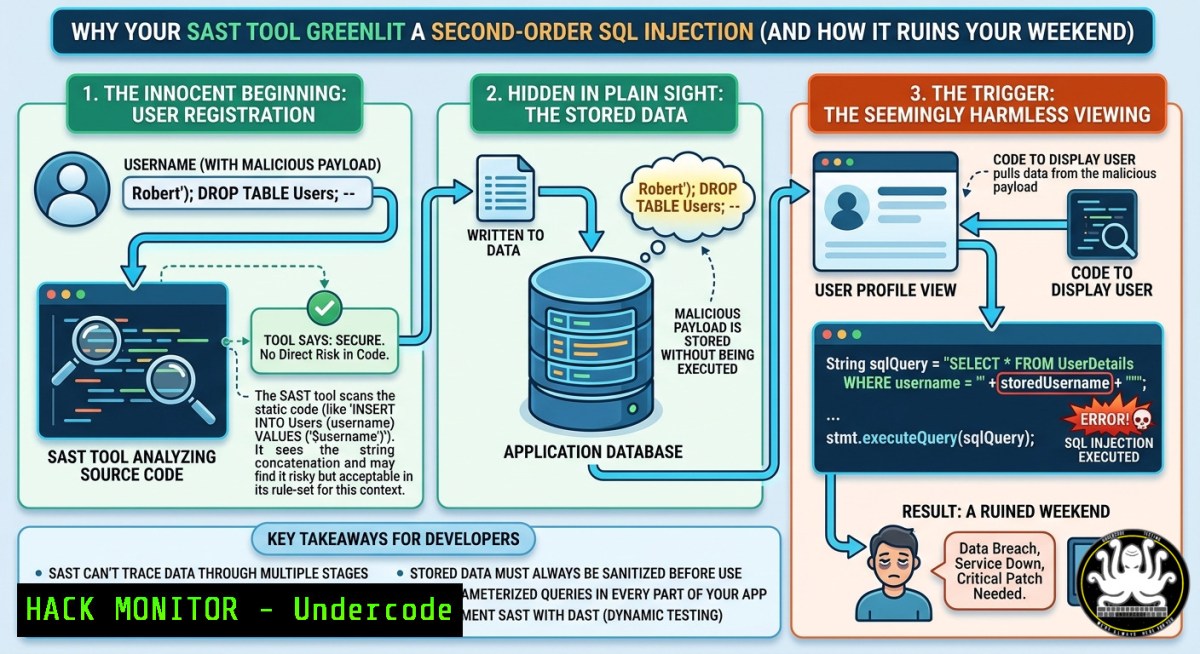
Static Application Security Testing (SAST) tools excel at catching syntax errors and obvious injection patterns, but they fail catastrophically when malicious data crosses trust boundaries through asynchronous flows. Second-order SQL injection—where attacker-controlled input is stored innocuously and later used in a parameterized query—bypasses SAST because the structural safety masks architectural compromise. This article dissects how SAST misses logic flaws that AI-driven reasoning can uncover, and provides hands-on techniques to detect and mitigate these stealthy attacks.
Learning Objectives:
- Identify second-order SQL injection vectors that evade traditional SAST rules.
- Implement data-flow tracing across microservices, queues, and databases to expose hidden injection paths.
- Apply AI-assisted code reasoning and runtime controls to harden applications against logic-based exploits.
You Should Know:
1. How Second-Order SQL Injection Silently Bypasses SAST
Second-order injection occurs when an application safely stores user input (e.g., via parameterized INSERT), then later retrieves that stored value and concatenates it into a SQL query without re-parameterization. SAST sees the first operation as safe and the second query as syntactically clean if bind variables are used—but it cannot model that the retrieved value originated from an untrusted source.
Step‑by‑step guide to exploiting and testing for second-order SQLi:
- Register a malicious payload – Insert `’; DROP TABLE users; –` into a “username” field that is parameterized during INSERT.
- Trigger the stored payload – Access a feature that reads the username and embeds it dynamically into a reporting query.
- Monitor application logs – Look for SQL errors or unexpected behavior.
Linux command to simulate the injection flow using `psql` and curl:
 Insert malicious payload via API
curl -X POST https://vuln-app.com/register -d "username=test'; DROP TABLE logs; --&password=123"

Trigger stored payload in a later request (second-order)
curl "https://vuln-app.com/generate-report?user=test'; DROP TABLE logs; --"
Windows PowerShell alternative (Invoke-WebRequest):
Invoke-WebRequest -Uri "https://vuln-app.com/register" -Method POST -Body "username=test'; DROP TABLE logs; --&password=123"
Invoke-WebRequest -Uri "https://vuln-app.com/generate-report?user=test'; DROP TABLE logs; --"
Mitigation in Python (Flask + SQLAlchemy):
 Vulnerable second-order retrieval
username = request.args.get('user')
query = f"SELECT  FROM reports WHERE created_by = '{username}'"  Unsafe concatenation
db.session.execute(query)

Safe approach: always parameterize even when data originated from DB
username = request.args.get('user')
query = text("SELECT  FROM reports WHERE created_by = :user")
db.session.execute(query, {"user": username})
2. Mapping Data-Flow Paths Across Distributed Systems
SAST tools analyse single files or compilation units. They cannot follow data that travels from an HTTP parameter → message queue → worker service → database → another microservice → final SQL execution. AI reasoning systems (e.g., LLM-based code analyzers) infer these paths by understanding application semantics and trust boundaries.
Step‑by‑step data-flow mapping using open-source tools:
- Instrument your code with OpenTelemetry to trace HTTP headers and database operations.
- Use `grep` to find all SQL execution points and map input sources:
grep -r "execute|query|prepare" ./src --include=".py" --include=".java" | tee sql_usage.log
3. Build a simple taint‑tracking script (Linux):
 Find all places where request parameters are read
grep -r "request.args|request.form|req.query" ./src --include=".py" > taint_sources.txt
 Find all database write/read calls
grep -r "INSERT|UPDATE|SELECT" ./src --include=".sql" > db_operations.txt
4. Manually correlate by reviewing cross‑file includes and message queue consumers (e.g., RabbitMQ, Kafka).
Windows (using `findstr`):
findstr /s /i /m "execute|query" .py .java > sql_usage.txt
findstr /s /i /m "request.args|request.form" .py > taint_sources.txt
AI‑assisted approach – prompt for LLM:
“Given this codebase, trace all paths where HTTP parameter ‘user_id’ can eventually reach a SQL query after passing through a queue or database read. Identify any missing parameterization.”
- Building an AI‑Enhanced SAST Pipeline with Trust Boundary Modeling
Traditional SAST checks syntax; AI checks logic by creating a graph of data lineage. You can augment your CI/CD with a lightweight reasoning step.
Step‑by‑step integration:
- Export SAST results (e.g., from SonarQube, Checkmarx) as JSON.
- Run a local LLM (Ollama + CodeLlama) to review flagged SQL nodes and trace back to input sources:
Pull CodeLlama
ollama pull codellama:7b
Send code snippet for analysis
echo "Analyze this function for second-order SQL injection: $(cat vulnerable_function.py)" | ollama run codellama:7b
- Automate with a Python script that queries the LLM for each SQL execution node and checks whether the parameter source crosses a trust boundary (e.g., user input, file upload, message broker).
Example Python snippet for boundary detection:
import ast
import re

def trace_taint(node, source_vars):
 Mock taint tracer – in production use CodeQL or Joern
if isinstance(node, ast.Call) and node.func.id == 'execute':
for arg in node.args:
if any(var in ast.unparse(arg) for var in source_vars):
print("Potential second-order injection:", ast.unparse(node))
source_vars = {'request.args', 'req.query', 'message.body'}
 Walk AST...
- Hardening Cloud and API Endpoints Against Stored Injection
Cloud architectures amplify second-order risks because decoupled services (queues, serverless functions, object storage) break linear code review.
Mitigation techniques:
- Use prepared statements everywhere, regardless of data origin.
- Apply runtime context-aware filtering – e.g., AWS WAF with regex on stored values before use.
- Implement database‑side allowlists – restrict dynamic SQL generation using stored procedures with explicit parameter types.
Linux command to audit PostgreSQL for unsafe dynamic SQL:
-- Find functions that use EXECUTE or format() with non-literal strings
SELECT proname, prosrc FROM pg_proc
WHERE prosrc ~ 'EXECUTE|format(%|quote_ident|quote_literal'
AND prosrc !~ 'quote_ident(|quote_literal(';
Azure Policy example to block dynamic SQL on managed instances:
{
"if": {
"field": "type",
"equals": "Microsoft.Sql/servers/databases"
},
"then": {
"effect": "auditIfNotExists",
"details": {
"type": "Microsoft.Sql/servers/databases/securityAlertPolicies",
"existenceCondition": {
"field": "Microsoft.Sql/servers/databases/securityAlertPolicies/state",
"equals": "Enabled"
}
}
}
}
- Exploitation and Mitigation Walkthrough – Real-World Scenario
A social media app allows users to set a “bio” (parameterized INSERT). An admin panel later searches bios using:
`SELECT FROM users WHERE bio LIKE ‘%{search_term}%’` (unsafe concatenation). An attacker sets bio to `%’ OR 1=1; –` and triggers the admin search, dumping all users.
Manual exploitation (Linux using `sqlmap`):
sqlmap -u "https://target.com/admin/search?term=test" --second-order "https://target.com/profile/update" --data "bio=test" --technique=Q --dbms=mysql
Fix: Use parameterized queries even for “trusted” database values:
// Java (JDBC) safe version
String search = request.getParameter("searchTerm");
PreparedStatement pstmt = conn.prepareStatement("SELECT  FROM users WHERE bio LIKE ?");
pstmt.setString(1, "%" + search + "%");
What Undercode Say:
- SAST greenlights structurally safe queries while missing architectural trust violations – second-order injection is the silent killer of compliance-driven testing.
- AI reasoning bridges the gap by modeling data lineage across distributed systems, turning a “syntax passed” into a “logic rejected” gate.
> Analysis: The industry over-relies on SAST metrics (e.g., “zero critical findings”) without understanding that parameterization is only half the battle. Real security requires tracing every data flow from user input to database execution, even if that flow passes through three files and a message broker. AI and semantic code analysis are not optional – they are the only way to catch these logic flaws at scale.
Prediction:
Within two years, regulatory frameworks (PCI DSS v5, FedRAMP High) will mandate data-flow modeling for all applications processing sensitive data. AI‑driven SAST will become standard, and second-order injection will shift from an obscure “advanced” attack to a basic compliance violation. Organizations that still rely on legacy SAST without taint‑tracking across queues and databases will face crippling breach liabilities.
▶️ Related Video (78% Match):
🎯Let’s Practice For Free:
IT/Security Reporter URL:
Reported By: Davidmatousek Your – Hackers Feeds
Extra Hub: Undercode MoN
Basic Verification: Pass ✅
🎓 Live Courses & Certifications:
Join Undercode Academy for Verified Certifications
🚀 Request a Custom Project:
Secure, high-velocity infrastructure and disruptive technological engineering. Contact our engineering team for high-tier development and proprietary systems:
[email protected]


