
Listen to this Post
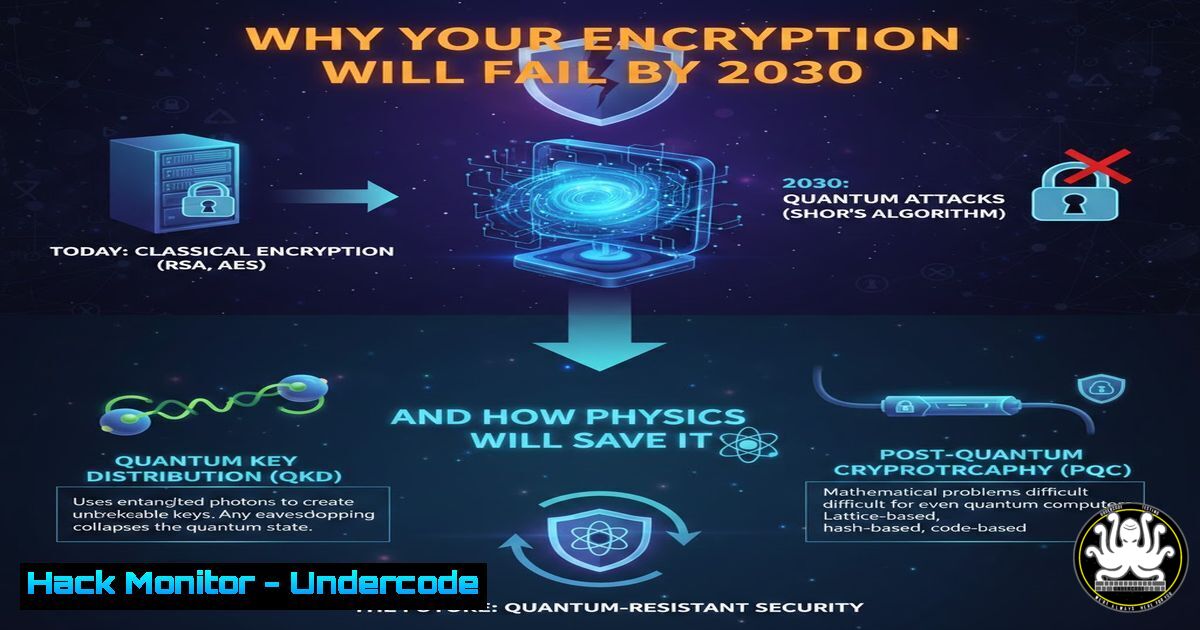
Introduction:
For decades, the bedrock of digital security has been mathematical complexity—the assumption that factoring large primes or solving discrete logarithms is too time-consuming for adversaries. However, the advent of quantum computing threatens to shatter these assumptions, rendering algorithms like RSA and ECC obsolete. In response, a paradigm shift is underway: moving from computationally-secure cryptography to physically-secure cryptography, leveraging the immutable laws of quantum mechanics to protect data in transit.
Learning Objectives:
- Understand the fundamental difference between traditional encryption and Quantum Key Distribution (QKD).
- Identify the core principles of quantum mechanics that enable tamper-evident communication.
- Recognize the limitations of QKD and its distinct role alongside Post-Quantum Cryptography (PQC).
- Explore the infrastructure requirements for deploying quantum-safe networks.
You Should Know:
- The Looming Threat: Why “Hard-to-Crack” Isn’t Good Enough Anymore
Traditional encryption, such as AES for symmetric encryption or RSA for asymmetric encryption, relies on mathematical problems that are currently difficult to solve. RSA, for example, relies on the computational difficulty of factoring the product of two large prime numbers. A sufficiently powerful quantum computer, running Shor’s algorithm, could factor these numbers exponentially faster than any classical computer, effectively breaking RSA.
This creates a “harvest now, decrypt later” risk, where adversaries collect encrypted data today, waiting for quantum technology to mature so they can decrypt it retroactively. For data with long-term sensitivity (state secrets, health records, intellectual property), this is an existential threat. The post’s assertion that traditional security makes hacking “hard” is accurate, but it does not make it future-proof.
2. Quantum Cryptography: Trusting Physics, Not Math
The LinkedIn post highlights the core of Quantum Cryptography, specifically Quantum Key Distribution (QKD). Unlike traditional methods that transmit a key over a secure channel or use public-key cryptography to exchange it, QKD uses the properties of quantum particles (typically photons) to generate and share a secret key between two parties.
How it works (The BB84 Protocol Simplified):
- Preparation: Alice (the sender) encodes random bits (0s and 1s) onto photons, choosing randomly between two different bases (e.g., rectilinear + and diagonal x).
- Transmission: She sends these photons to Bob (the receiver) over a fiber-optic cable.
- Measurement: Bob randomly chooses a basis to measure each incoming photon. He only gets the correct bit value if he chooses the same basis Alice used; otherwise, his result is random.
- Sifting: Bob tells Alice (over a public classical channel) which basis he used for each photon, but not the result. Alice tells him which bases were correct. They keep the bits from the correctly-matched bases—this becomes their raw key.
- Eavesdropping Detection: The magic lies in the quantum “no-cloning theorem.” If an eavesdropper (Eve) intercepts a photon, she cannot perfectly copy it. She must measure it, which inevitably disturbs its quantum state. This introduces a high error rate in the bits Bob receives. By comparing a small subset of their key, Alice and Bob can detect Eve’s presence. If the error rate is below a certain threshold, the channel is secure; if it’s too high, they abort and try again.
Simulating a QKD Exchange (Conceptual Python Example):
While you cannot simulate true quantum mechanics without specialized hardware, you can model the logic of the BB84 protocol to understand the process and the error introduction by an eavesdropper.
import random

Helper functions
def random_bits(n):
return [random.choice([0,1]) for _ in range(n)]

def random_bases(n):
return [random.choice(['+', 'x']) for _ in range(n)]

def encode_bit(bit, basis):
 Simplified: In a real system, this would be photon polarization.
if basis == '+':
return ('|' if bit == 0 else '—')  Represent vertical/horizontal
else:
return ('/' if bit == 0 else '\')  Represent diagonal

def measure_photon(photon, basis):
 Simplified measurement logic
if basis == '+':
if photon in ['|', '—']:
return 0 if photon == '|' else 1
else:
return random.choice([0,1])  Wrong basis, random result
else:
if photon in ['/', '\']:
return 0 if photon == '/' else 1
else:
return random.choice([0,1])

Simulation Parameters
num_qubits = 20
print(" BB84 Protocol Simulation (No Eavesdropper) ")

<ol>
<li>Alice's preparation
alice_bits = random_bits(num_qubits)
alice_bases = random_bases(num_qubits)
encoded_photons = [encode_bit(alice_bits[bash], alice_bases[bash]) for i in range(num_qubits)]</li>
</ol>

print(f"Alice's bits: {alice_bits}")
print(f"Alice's bases: {alice_bases}")
print(f"Encoded Photons: {encoded_photons}")

<ol>
<li>Bob's measurement (No Eve)
bob_bases = random_bases(num_qubits)
bob_results = [measure_photon(encoded_photons[bash], bob_bases[bash]) for i in range(num_qubits)]
print(f"\nBob's bases: {bob_bases}")
print(f"Bob's results: {bob_results}")</p></li>
<li><p>Sifting (over public channel)
sifted_key_alice = []
sifted_key_bob = []
for i in range(num_qubits):
if alice_bases[bash] == bob_bases[bash]:
sifted_key_alice.append(alice_bits[bash])
sifted_key_bob.append(bob_results[bash])</p></li>
</ol>

<p>print(f"\nSifted Key (Alice): {sifted_key_alice}")
print(f"Sifted Key (Bob): {sifted_key_bob}")
print(f"Matching Key? {sifted_key_alice == sifted_key_bob}")

Eavesdropping Simulation
print("\n BB84 Protocol Simulation (With Eavesdropper Eve) ")
eve_bases = random_bases(num_qubits)
eve_measurements = []
intercepted_photons = []
for i in range(num_qubits):
 Eve intercepts and measures
eve_result = measure_photon(encoded_photons[bash], eve_bases[bash])
eve_measurements.append(eve_result)
 Eve resends a new photon based on her measurement and basis
intercepted_photons.append(encode_bit(eve_result, eve_bases[bash]))

Bob measures the photons resent by Eve
bob_bases_eve = random_bases(num_qubits)
bob_results_eve = [measure_photon(intercepted_photons[bash], bob_bases_eve[bash]) for i in range(num_qubits)]

Sifting with Eve present
error_count = 0
comparison_bits = []
print("Basis Comparison & Error Detection:")
for i in range(num_qubits):
if alice_bases[bash] == bob_bases_eve[bash]:
comparison_bits.append(i)
if alice_bits[bash] != bob_results_eve[bash]:
error_count += 1

if comparison_bits:
error_rate = error_count / len(comparison_bits)
print(f"Error rate on sifted key: {error_rate:.2f}")
if error_rate > 0.1:  Threshold exceeded
print("ALERT: Eavesdropper detected! Key discarded.")
else:
print("Eavesdropping potentially successful (below threshold).")
else:
print("No matching bases for comparison.")
This code demonstrates that when an eavesdropper (Eve) intercepts and resends photons, she inevitably introduces errors into the key that Alice and Bob derive, making her presence known. This is the core principle that makes hacking “impossible to hide.”
- The Great Debate: QKD vs. Post-Quantum Cryptography (PQC)
The comment from Brian C. in the post is crucial. He rightly points out that QKD is not a silver bullet. The cybersecurity industry is currently focused on Post-Quantum Cryptography (PQC) , which are new mathematical algorithms designed to be secure against both classical and quantum computers.
| Feature | Quantum Key Distribution (QKD) | Post-Quantum Cryptography (PQC) |
| : | : | : |
| Core Principle | Physics (Quantum Mechanics) | Mathematics (Lattice-based, etc.) |
| Primary Use | Securing key exchange over a link | Encrypting data in transit and at rest, digital signatures |
| Infrastructure | Requires specialized hardware (photon sources, detectors, dedicated fiber or free-space optics). | Software-based; can run on existing hardware and networks. |
| Threat Model | Detects eavesdropping on the key exchange in real-time. | Resists cryptanalysis by quantum computers. |
| Limitations | Distance-limited (needs repeaters), point-to-point, does not protect data at rest. | “Harvest now, decrypt later” remains a risk until migration is complete. |
The future is not one or the other, but a hybrid approach. QKD can secure the most sensitive, high-value, point-to-point links (like government fiber backbones), while PQC will be deployed broadly across the internet for general-purpose security.
- Migrating to a Quantum-Safe World: A Practical Checklist
Organizations cannot wait for quantum computers to arrive. A migration strategy must begin now. - Cryptographic Inventory: Use tools to scan your entire infrastructure and discover where cryptography is used (TLS certificates, code signing, VPNs, databases).
- Data Classification: Identify data with the longest security lifespan (secrets, PII) to prioritize its protection.
- Standardization: Follow NIST’s ongoing PQC standardization process. Start experimenting with hybrid schemes (e.g., X25519Kyber768) in development environments.
- Vendor Engagement: Ask your hardware and software vendors about their quantum-safe roadmaps. Are they planning to support PQC or integrate with QKD hardware?
5. Linux/Windows Hardening for Crypto Agility:
- Linux (OpenSSL): Check your OpenSSL version (
openssl version). Modern versions support quantum-safe cryptographic algorithms via providers or patches. You can test a connection:Test a server's supported algorithms (look for Kyber or other PQC) openssl s_client -connect example.com:443 -groups kyber768
- Windows (Schannel): Windows supports TLS 1.3, which is algorithm-agile. Stay updated with patches that introduce new cipher suites as NIST finalizes its standards. Use PowerShell to check TLS settings:
Get currently enabled TLS Cipher Suites
Get-TlsCipherSuite
What Undercode Say:
- Physics-Based Security is a Game-Changer, Not a Replacement: QKD introduces an unprecedented detection capability—the ability to know, in real-time, if a key exchange has been compromised. However, it solves only the key distribution problem for data in transit. It does not replace the need for robust encryption algorithms for data at rest.
- The Transition is the Real Battle: The commentary by Brian C. is the reality check the industry needs. The hardest part is not building QKD links, but overhauling the vast, complex, and legacy cryptographic governance of enterprises. The “silver bullet” doesn’t exist; a layered defense combining PQC for scale and QKD for critical paths is the only viable path forward.
Prediction:
By the late 2020s, we will see the first major government and financial networks implement “quantum-safe corridors” using a hybrid of PQC for authentication and QKD for session key generation over short, critical fiber links. The broader internet will rely on PQC, but “harvest now, decrypt later” attacks will intensify against targets still using legacy encryption, forcing regulators to mandate quantum-safe migrations for sensitive sectors much faster than currently anticipated.
▶️ Related Video (82% Match):
🎯Let’s Practice For Free:
IT/Security Reporter URL:
Reported By: Nisar Ahamed – Hackers Feeds
Extra Hub: Undercode MoN
Basic Verification: Pass ✅


