
Listen to this Post
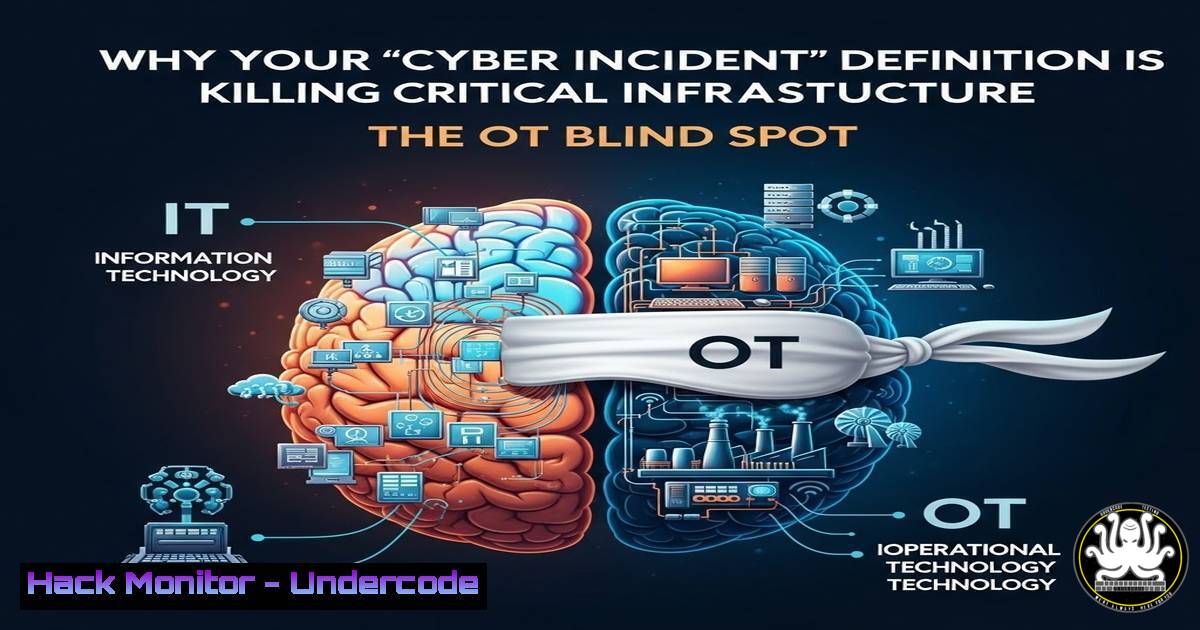
Introduction:
The cybersecurity industry is suffering from a critical vocabulary failure. By narrowly defining a “cyber incident” through the lens of IT network breaches and malicious attacks, organizations are blinding themselves to the real-world risks facing Operational Technology (OT) and Industrial Control Systems (ICS). As highlighted by expert Joe Weiss, control-system incidents—often non-malicious but rooted in electronic or logic failure—can degrade physical processes, cause equipment damage, and create safety hazards, yet they are frequently dismissed as “maintenance noise.” This article dissects this governance gap and provides a technical roadmap for aligning engineering and security teams to detect, log, and respond to the full spectrum of cyber-physical incidents.
Learning Objectives:
- Differentiate between an IT breach-centric incident and an OT cyber-physical failure.
- Learn how to configure logging and monitoring to detect non-malicious control-system anomalies.
- Understand how to align security and engineering teams through unified incident taxonomies.
- The “Apples and Oranges” Problem: IT Breaches vs. OT Process Degradation
The core issue, as articulated by Weiss via Control Global, is that a breach-centric metric (e.g., “was there malware?”) fails to capture incidents that actually move the risk needle in a 3°C world. In OT, a cyber incident can be an unexpected valve closure due to a faulty sensor signal, a logic bomb in a PLC, or a loss of view in an HMI—even if no “hacker” is present.
Step‑by‑step guide: Auditing Your Current Incident Taxonomy
To check if your organization is suffering from this blind spot, audit your last five “operational disruptions” and see if they fit a cyber-physical definition.
- Review Past Incidents: Gather reports from the last 12 months labeled “unplanned downtime” or “equipment malfunction.”
- Apply the OT Cyber Lens: Ask the following questions for each:
– Was there a loss of view (HMI freezing) or loss of control (inability to send commands)?
– Did a sensor send erroneous data that caused a logic controller to act?
– Was there a firmware crash or unexpected reboot of a field device?
3. Command Line Check (Windows Event Logs for HMI): If the HMI is Windows-based, check for application crashes related to the SCADA software.
 Run on HMI or Engineering Workstation
Get-EventLog -LogName Application -EntryType Error | Where-Object { $<em>.Source -like "SCADA" -or $</em>.Source -like "PLC" } | Select-Object TimeGenerated, Message -First 10
4. Linux Syslog Check (for Historians/OT Gateways): If your OT data historian is on Linux, check for I/O errors.
 Check kernel messages for USB/serial disconnections (common sensor links)
sudo dmesg | grep -i "usb" | grep -i "disconnect"
 Check for application-specific errors
sudo tail -50 /var/log/syslog | grep -i "timeout" | grep -i "device"
5. Recategorize: If any of these events were purely treated as maintenance issues, they should be recategorized as “cyber-physical incidents” for future root-cause analysis.
- Aligning Engineering and Security: Defining the Shared Incident
Weiss emphasizes the need to align engineering and security on a shared incident definition. Security teams look for “indicators of compromise” (IOCs), while engineers look for “deviations in process variables.” The overlap is where true resilience lives.
Step‑by‑step guide: Creating a Unified Detection Rule
This example shows how to create a detection rule that appeals to both teams by monitoring for a “process deviation” (engineering) that could indicate a “cyber manipulation” (security). We will use a SIEM query logic (pseudo-code) that monitors PLC register values.
- Identify Critical Process Threshold: Work with engineers to define a normal operating range for a critical sensor (e.g., Temperature in Boiler 3 should be between 350°F and 375°F).
- Ingest OT Data into Monitoring Tool: Ensure your SIEM or monitoring platform (like Wazuh, Splunk, or Grafana) is ingesting data from the PLCs via protocols like OPC UA or Modbus.
3. Write the Correlation Rule:
 SIEM Rule Logic (Example)
WHEN
source_asset_type = "PLC"
AND tag_name = "Boiler3.Temperature"
AND tag_value > 400
AND duration > 30 seconds
EVALUATE
 Check for concurrent network anomalies (security lens)
Is there a recent firmware change on this PLC? (Check asset management DB)
Is there a new network connection to the PLC from an unauthorized IP? (Check netflow logs)
ACTION
Create Incident: "Critical: Boiler 3 Temperature Deviation beyond Safety Limits"
Assign to: "Engineering Shift Lead" AND "OT Security Analyst"
4. Outcome: This forces the engineer and the security analyst to collaborate on the same ticket immediately, preventing the “maintenance noise” dismissal.
- The Non-Malicious Threat: Sensor Spoofing and Signal Degradation
Many OT incidents stem from signal degradation or electronic failure, which can have the same physical effect as a malicious attack. A failing 4-20mA sensor can tell a PLC to open a relief valve just as effectively as a hacker.
Step‑by‑step guide: Detecting Signal Anomalies with Wireshark
You can use network analysis to detect “stale” or “jittery” data from field devices.
- Capture Traffic: On a SPAN port mirroring the control network traffic, use `tcpdump` or Wireshark to capture Modbus/TCP traffic.
Capture Modbus traffic on interface eth0 and save to file
sudo tcpdump -i eth0 -w modbus_capture.pcap port 502
- Analyze for Stale Data: In Wireshark, use a filter to isolate read requests to a specific register. If the value remains static while other dynamic values change, it indicates a “loss of view” or a stuck sensor.
Wireshark Filter: `modbus.func_code == 3 && modbus.reference_num == 40001`
3. Analyze for Jitter: Look for rapid, illogical fluctuations in analog input registers. This could indicate electromagnetic interference or a failing analog-to-digital converter on the PLC input card.
4. Hardening the “Logic”: PLC and Firmware Integrity
If an incident can stem from corrupted firmware or logic, verifying the integrity of the control logic itself is paramount. This moves beyond network monitoring to “endpoint detection” for PLCs.
Step‑by‑step guide: Verifying PLC Logic Checksums
Most modern PLCs (Siemens, Rockwell, Schneider) allow you to calculate a checksum of the running logic.
1. Baseline Creation:
- Connect to the PLC via its engineering software (e.g., TIA Portal, Studio 5000).
- Go to the PLC properties and generate a “checksum” or “signature” of the project.
- Record this baseline hash in a secure password manager or CMDB.
- Automated Verification (Linux CLI via `python` and
pymodbus):
You can write a script to periodically query the PLC and compare a known safe value.!/usr/bin/env python3 simple_plc_integrity_check.py from pymodbus.client import ModbusTcpClient import hashlib import time</li> </ol> PLC_IP = "192.168.1.10" Assume register 40050 holds a static "firmware version" or a rolling hash This is a placeholder - actual implementation depends on PLC vendor client = ModbusTcpClient(PLC_IP) connection = client.connect() if connection: Read 2 holding registers starting at address 40050 result = client.read_holding_registers(49, 2, unit=1) Unit ID 1 if not result.isError(): data = result.registers Convert registers to bytes and hash them hash_object = hashlib.sha256(str(data).encode()) current_hash = hash_object.hexdigest() print(f"Current PLC Logic Hash: {current_hash}") Compare with stored baseline hash if current_hash != BASELINE_HASH: raise Alert client.close()3. Alert on Mismatch: If the hash changes outside of a scheduled maintenance window, treat it as a high-priority cyber-physical incident.
- Bridging the Cultural Gap: Training and Board Narratives
The technical fixes are useless without cultural alignment. The board narrative must shift from “we had no breaches” to “we had no process deviations that led to safety incidents.”
Step‑by‑step guide: Running a Hybrid Tabletop Exercise
- Scenario: “The Safety PLC controlling a chemical reactor is reporting a pressure spike. The HMI shows the relief valve is open, but the field operator reports the valve is actually closed (Loss of Control). No malware was found on the IT network.”
- Participants: CISO, VP of Engineering, Plant Manager, Safety Officer.
3. Facilitator Prompts:
- “Engineering, what is your immediate action to ensure physical safety?” (Manual override).
- “Security, how do we investigate the ‘Loss of Control’ without a network breach?” (Check PLC firmware, check signal cabling, check for logic race conditions).
- “Board, what do we tell regulators? A safety incident? A cyber incident? Both?”
- Outcome: This exercise exposes the weaknesses in the “breach-centric” vocabulary and forces the creation of a joint response plan that addresses the physical outcome, not just the digital vector.
What Undercode Say:
- Redefine the Incident: The most critical takeaway is that if your definition of a cyber incident requires a malicious actor, you are operationally blind. You must expand your incident taxonomy to include “cyber-physical anomalies” stemming from electronic failure, signal degradation, and logic corruption.
- Unite the Teams: The bridge between engineering and security is not a technology; it is a shared vocabulary and shared metrics. Security must care about process variable integrity, and engineers must understand that a firmware glitch is a cybersecurity issue, not just a “machine hiccup.”
The analysis here is clear: critical infrastructure protection is failing not because of a lack of firewalls, but because of a failure to recognize that the process is the endpoint. When a sensor fails and causes a shutdown, the outcome is identical to a ransomware attack on a PLC—lost production and potential safety hazards. Organizations must treat operational anomalies as cyber-relevant signals, demanding the same rigor in root-cause analysis as a network intrusion. This requires a shift in board-level metrics, moving away from “breach count” to “process continuity integrity,” and ensuring that every unexpected valve closure or HMI freeze is investigated through both an engineering and a security lens.
Prediction:
Within the next 24 months, regulatory bodies (like TSA for pipelines or NERC for power) will mandate that “cyber incident” reporting includes non-malicious electronic failures that impact physical processes. This will force a massive recalibration of incident response plans and a surge in demand for “OT Forensic Engineers” who can root-cause a logic bomb as easily as a broken wire. The era of “process intrusion detection” will replace the current obsession with “network intrusion detection” in the industrial sector.
▶️ Related Video (82% Match):
🎯Let’s Practice For Free:
IT/Security Reporter URL:
Reported By: Ivan Savov – Hackers Feeds
Extra Hub: Undercode MoN
Basic Verification: Pass ✅🔐JOIN OUR CYBER WORLD [ CVE News • HackMonitor • UndercodeNews ]
📢 Follow UndercodeTesting & Stay Tuned:


