
Listen to this Post
Introduction:
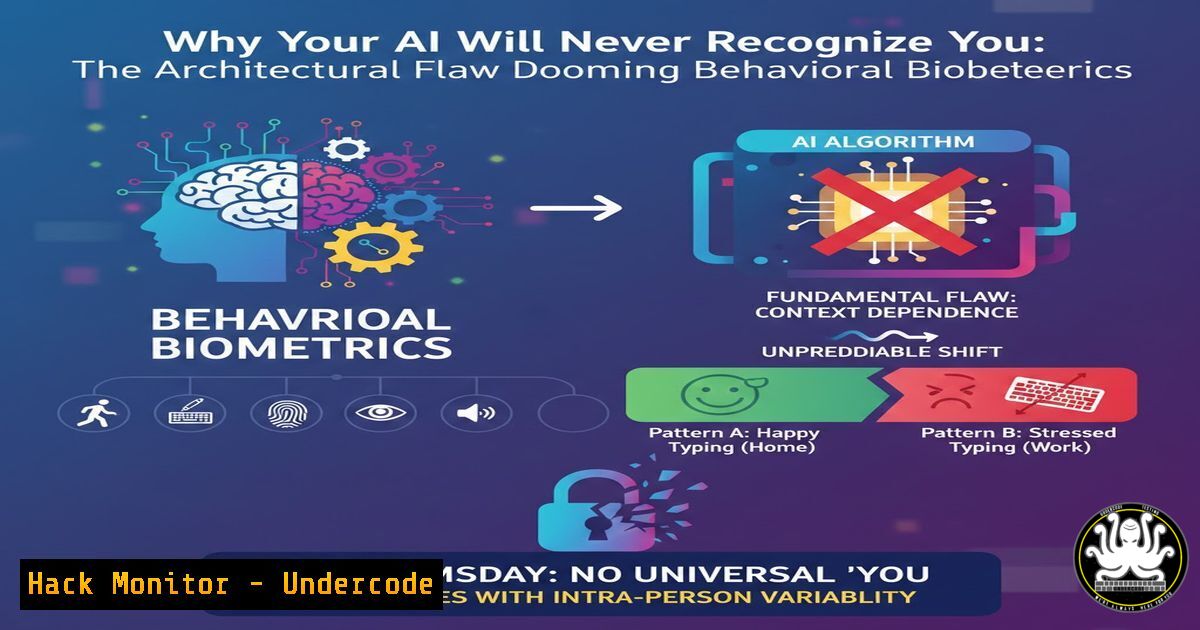
The promise of behavioral biometrics for seamless, continuous authentication is a cornerstone of next-generation AI security. However, a groundbreaking critique of a seminal thesis reveals a fundamental architectural flaw that prevents AI from truly learning identity, posing a critical risk to deployment. This analysis exposes systems that are functionally blind to new users, rendering them useless outside their training bubble.
Learning Objectives:
- Understand the three structural limitations that prevent AI from internalizing identity in behavioral biometric systems.
- Learn to identify and test for these flaws in machine learning architectures.
- Implement mitigation strategies and architectural patterns that enable genuine adaptive authentication.
You Should Know:
1. The Fatal Flaw: Systems Without Persistent State
The core failure is the absence of a persistent internal state. The analyzed system operates as a stateless function: it takes an input (behavioral data), computes a similarity score, and outputs a decision. After each authentication attempt, the system “resets,” with no memory of past interactions to build a evolving model of the user.
Step‑by‑step guide explaining what this does and how to use it.
To test for this in your own models, you can instrument the code to check for state retention.
 Pseudo-code to illustrate stateless operation
class StatelessBiometricModel:
def authenticate(self, current_behavior):
 Model weights are static, no user-specific state is updated
score = self.model.predict(current_behavior)
return score > self.threshold

vs. a stateful approach
class StatefulBiometricModel:
def <strong>init</strong>(self, user_id):
self.user_profile = self.load_base_profile(user_id)  Persistent store

def authenticate_and_update(self, current_behavior):
decision = self.assess_against_profile(current_behavior, self.user_profile)
if decision == "GRANT":
self.user_profile = self.update_profile(self.user_profile, current_behavior)  CRITICAL: State updates
self.save_profile()
return decision
On a system level, check if your authentication service logs or stores user behavior patterns dynamically. Use Linux commands to monitor if user session data persists or is discarded:
 Check if a process maintains open user-specific files or memory segments
lsof -p <PID_of_auth_service> | grep data
 Or inspect log entries for continuous user model updates
tail -f /var/log/auth_service.log | grep "profile updated"
2. The Silo Effect: No Cross-Modal Integration
Behavioral authentication uses modalities like keystroke dynamics, mouse movements, and gait analysis. In flawed architectures, each modality is processed in isolation. The system never fuses data to create a holistic, robust identity signature, making it vulnerable to spoofing and unstable in dynamic real-world conditions.
Step‑by‑step guide explaining what this does and how to use it.
Implement a test to verify if modalities are integrated or siloed. A simple API test can reveal this.
 Test API endpoints for isolated modality processing
curl -X POST https://your-biometric-api/auth/keystroke -d '{"data":"..."}'
curl -X POST https://your-biometric-api/auth/mouse -d '{"data":"..."}'
 If they return independent scores without a central fusion engine, it's a siloed architecture.
For cloud-deployed services (e.g., AWS), check if Lambda functions for each modality write to a shared DynamoDB table representing a unified user identity, or to separate tables.
 AWS CLI example to list DynamoDB tables linked to a service
aws dynamodb list-tables --query "TableNames[?contains(@, 'BioAuth')]"
- Syntactic vs. Semantic Understanding: Pattern Matching ≠ Identity
The system operates syntactically, recognizing statistical patterns in the training data. It lacks semantic understanding—the “why” behind the behavior. It can match a typing rhythm but cannot adapt if a user injures their hand, because it doesn’t model the identity producing the behavior.
Step‑by‑step guide explaining what this does and how to use it.
To identify a purely syntactic model, perform adversarial testing. Introduce minor, semantically logical variations a human would explain but a pattern-matcher would fail on.
 Generate a test case: Simulate a user with a sprained wrist (slower, erratic keystrokes but same semantic intent)
normal_typing_pattern = [100, 150, 120, 130...]  milliseconds between keys
injured_pattern = [250, 300, 180, 400...]  Slower, more variable
 A syntactic system's confidence score will plummet. A semantic system might flag for step-up auth but not outright reject.
Use explainability tools like SHAP on your model to see if features are interpreted as rigid patterns rather than flexible indicators.
4. Hardening Your Architecture: Implementing Re-entrant Feedback Loops
The fix requires architectural change. A re-entrant feedback loop allows the system’s output (authentication decision) to influence its internal state, enabling learning from new, post-deployment interactions.
Step‑by‑step guide explaining what this does and how to use it.
Design a microservice that feeds low-risk authentication events back into the model update pipeline.
 Example Kubernetes CronJob manifest to retrain models with new, verified data
apiVersion: batch/v1
kind: CronJob
metadata:
name: biometric-model-updater
spec:
schedule: "0 /6   "  Every 6 hours
jobTemplate:
spec:
template:
spec:
containers:
- name: updater
image: retrain:latest
command: ["python", "/scripts/retrain.py", "--source", "persistent_user_state_db"]
On Windows, you could implement a scheduled task that runs a PowerShell script to export recent behavioral logs and kick off a model fine-tuning job in Azure Machine Learning.
5. Building Cross-Temporal Invariants for Resilience
An identity persists over time. Your system must find invariants—stable characteristics amid behavioral noise. This requires algorithms that separate transient noise from stable signals across longer time horizons.
Step‑by‑step guide explaining what this does and how to use it.
Implement a time-series analysis layer before your main classifier. Use a library like `tsfresh` to extract invariant features.
from tsfresh import extract_features
 df contains behavioral time-series data over multiple sessions
extracted_features = extract_features(df, column_id="session_id", column_sort="timestamp")
 Analyze variance of each feature across sessions; low-variance features are potential invariants
invariant_candidates = extracted_features.columns[extracted_features.std() < threshold]
In your cloud infrastructure, use a data pipeline (e.g., AWS Kinesis, Google Cloud Dataflow) to continuously aggregate user data into session-based feature sets for this analysis.
6. Mitigating the Risk in Production: Fail-Secure Protocols
Until the architecture is fixed, deploy strict fail-secure protocols. Treat behavioral biometrics as a single factor within a robust multi-factor authentication (MFA) scheme.
Step‑by‑step guide explaining what this does and how to use it.
Configure your authentication service (e.g., Keycloak, Auth0, or a custom OAuth 2.0/OpenID Connect provider) to use behavioral biometrics as a conditional step.
 Example using Open Policy Agent (OPA) for a conditional authentication rule
 rego policy
default grant = false
grant {
count(successful_factors) >= 2
successful_factors := [factor | factors[bash] == "grant"; factor := f]
}
 Factors could be ["password", "biometric", "hardware_key"]
On a Linux server running an SSO portal, integrate `pam_script` to call your biometric service as one of several PAM modules, ensuring failure defaults to the next factor.
7. Validation and Continuous Red-Teaming
Assume your system has this flaw. Regularly test it with user cohorts completely absent from training data. Measure the false rejection rate (FRR). If it’s catastrophically high, you have confirmed the architectural limitation.
Step‑by‑step guide explaining what this does and how to use it.
Set up a CI/CD pipeline stage that runs a “new user rejection test.”
 GitLab CI example
stages:
- test
biometric_integration_test:
stage: test
script:
- python test_new_user_rejection.py --model_path ./deployed_model --test_data ./held_out_users/
allow_failure: false  This test must pass for deployment
Use a containerized environment (Docker) to ensure consistent testing of the production model artifact against fresh data.
What Undercode Say:
- Key Takeaway 1: An AI that cannot form an internal, persistent model of identity is not an authentication system—it is a pattern-matching trapdoor that will fail catastrophically in real-world deployment. No amount of data can cure an architectural deficiency.
- Key Takeaway 2: The cybersecurity implication is profound. Relying on such flawed systems for “continuous authentication” creates a false sense of security. Attackers, or simply novel legitimate users, exist outside the training distribution and will be either wrongly granted access or wrongly denied, both critical failures.
This analysis transcends a single thesis; it is a verdict on a prevalent class of AI systems. The rush to deploy “AI-powered” security often overlooks foundational theory. In cybersecurity, a system that works 99% of the time on test data but 0% on new entities is not just broken—it’s dangerous. It represents a single point of failure that can be bypassed by novelty itself. The mitigation path is not incremental tuning but fundamental redesign toward stateful, integrative, and adaptive architectures.
Prediction:
Within two years, a major security breach will be publicly attributed to the failure of a behavioral biometric system precisely due to these architectural flaws. This will trigger a regulatory and standards push—similar to the move toward “Zero Trust”—mandating that adaptive authentication systems demonstrate genuine continuous learning and explainable identity modeling. The AI security market will bifurcate: vendors selling syntactic pattern matchers will collapse, while those offering architectures with verifiable persistent state and cross-modal integration will dominate. The foundational theory of machine learning will see a renewed focus on “internal representation” and “consciousness” in AI, not as philosophy, but as a prerequisite for secure, autonomous operation.
🎯Let’s Practice For Free:
IT/Security Reporter URL:
Reported By: Stuart Wood – Hackers Feeds
Extra Hub: Undercode MoN
Basic Verification: Pass ✅


