Listen to this Post
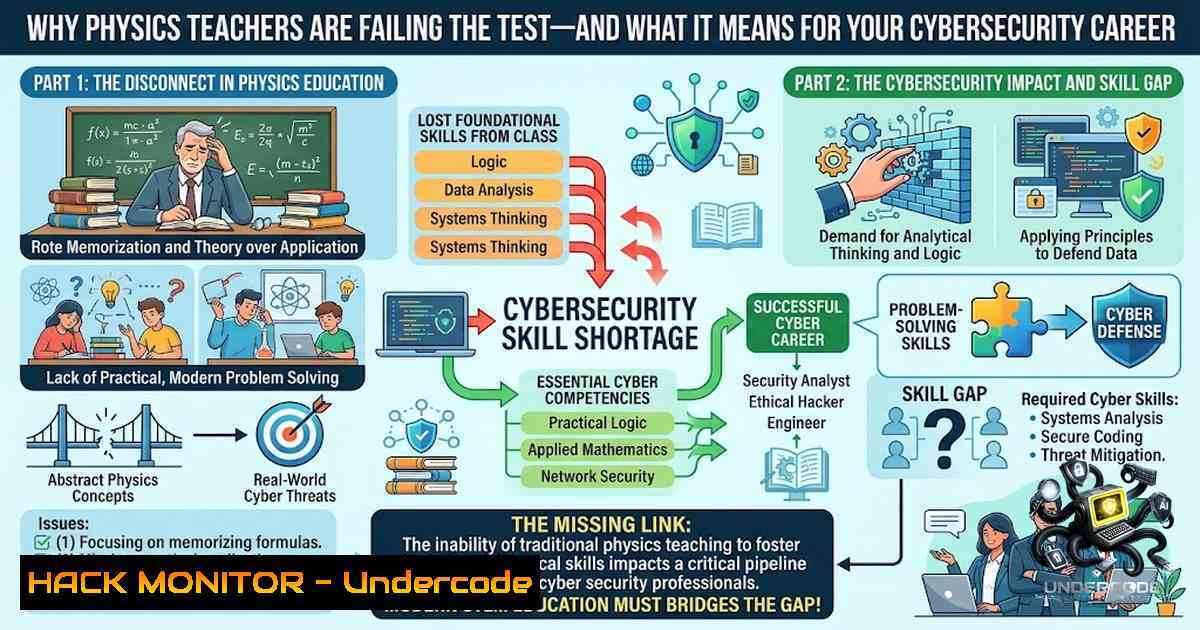
Introduction:
The way coaching institutes evaluate physics teachers—prioritizing formula recall and speed over conceptual depth—mirrors a dangerous trend in cybersecurity hiring. Organizations often mistake certifications and rote knowledge for real-world competence, leaving them vulnerable to attacks that exploit shallow understanding. This article draws a parallel between teacher evaluation flaws and the cybersecurity skills gap, offering actionable steps to build a truly resilient defense team.
Learning Objectives:
- Recognize the gap between certification-based competency and practical security skills.
- Apply first-principles thinking to incident response, threat hunting, and vulnerability assessment.
- Implement hands-on labs and command-line exercises to evaluate and improve cybersecurity aptitude.
- The Certification Trap: Why Rote Memory Fails in Security
Many hiring managers treat certifications like CISSP, CEH, or OSCP as proxies for skill. But just as a physics teacher who can recite formulas may fail to explain why E=mc², a certified professional might pass a multiple-choice exam without understanding packet-level networking or privilege escalation chains.
Step‑by‑step guide to test practical skills:
- Set up a lab environment – Use VirtualBox or VMware to spin up a Kali Linux attacker machine and a Windows 10 target.
- Simulate a real-world scenario – Ask candidates to enumerate a target using Nmap, identify open ports, and propose an exploitation path.
- Evaluate reasoning, not just output – Have them explain why they chose specific flags and how they would adapt if the target changed.
Linux command example (reconnaissance):
nmap -sV -sC -O -p- 192.168.1.100
This runs a version scan (-sV), default scripts (-sC), OS detection (-O), and scans all ports (-p-). A candidate who merely memorized the command might not know that `-sC` invokes the default script set, or that `-O` requires root privileges for accurate results.
Windows equivalent (PowerShell):
Test-1etConnection -ComputerName 192.168.1.100 -Port 80
This tests connectivity to a specific port—useful for quick checks but limited compared to Nmap’s depth.
2. First‑Principles Thinking in Incident Response
Great physics teachers build intuition from first principles. Similarly, elite incident responders don’t just follow playbooks—they understand the underlying OS internals, file system artifacts, and network protocols.
Step‑by‑step guide to first‑principles IR:
- Collect memory images – Use `dumpit` or `FTK Imager` on Windows, or `avml` on Linux.
- Analyze with Volatility – Run `volatility -f memory.dump imageinfo` to determine the profile, then `volatility –profile=Win10x64 pslist` to list running processes.
- Correlate with network logs – Use `tshark` or Wireshark to extract suspicious connections.
Linux command to carve network connections from a live system:
ss -tulpan | grep ESTAB
This shows established TCP connections with process IDs—critical for spotting beaconing or data exfiltration.
Windows command (Command Prompt):
netstat -ano | findstr ESTABLISHED
The `-o` flag displays the owning process ID, which you can cross-reference with Task Manager or tasklist.
- Evaluating Threat Hunters: Beyond the SIEM Dashboard
Coaching institutes that value speed over depth produce teachers who can solve known problems but cannot adapt. The same applies to threat hunters who rely solely on SIEM alerts without understanding log sources or attack lifecycles.
Step‑by‑step guide to hands‑on threat hunting:
- Generate realistic telemetry – Use the Red Canary `atomic-red-team` framework to execute attack techniques (e.g., T1059 – Command and Scripting Interpreter).
- Ingest logs into ELK or Splunk – Configure Beats or Universal Forwarder to ship Windows Event Logs and Sysmon data.
- Write custom queries – Hunt for lateral movement by searching for `EventID 4624` (successful logons) with unusual source IPs.
Elasticsearch query example (KQL):
{
"query": {
"bool": {
"must": [
{ "match": { "event_id": 4624 } },
{ "range": { "@timestamp": { "gte": "now-1h" } } }
],
"filter": [
{ "term": { "logon_type": 3 } }
]
}
}
}
This hunts for network logons (type 3) in the last hour—a common indicator of credential misuse.
- API Security: Testing What You Actually Protect
Many developers memorize OWASP Top 10 bullet points but fail to implement proper input validation or rate limiting. Like a physics teacher who knows Ohm’s law but cannot wire a circuit, they lack practical application.
Step‑by‑step guide to API vulnerability assessment:
- Deploy a vulnerable API – Use `crackme` or `vulnapi` containers via Docker.
- Fuzz endpoints with Burp Suite or OWASP ZAP – Send malformed JSON, SQLi payloads, and oversized requests.
- Review response codes and error messages – Look for stack traces or verbose errors that leak internal paths.
Linux command to test rate limiting with `curl`:
for i in {1..100}; do curl -X GET https://api.example.com/v1/users -H "Authorization: Bearer $TOKEN"; done
If the API returns `200 OK` for all 100 requests, rate limiting is missing—a critical flaw that enables brute-force attacks.
Windows PowerShell equivalent:
1..100 | ForEach-Object { Invoke-RestMethod -Uri "https://api.example.com/v1/users" -Headers @{Authorization = "Bearer $TOKEN"} }
- Cloud Hardening: Moving from Theory to Reality
Cloud certifications often focus on service names and pricing models rather than actual misconfigurations. A teacher who can recite S3 bucket policies but cannot spot a public bucket is as dangerous as one who knows Newton’s laws but cannot apply them to a falling object.
Step‑by‑step guide to cloud misconfiguration detection:
- Install AWS CLI – Configure with
aws configure. - Enumerate S3 buckets – Run `aws s3 ls` to list buckets, then `aws s3api get-bucket-acl –bucket
` to check permissions. - Use ScoutSuite or Prowler – Automate compliance scanning against CIS benchmarks.
AWS CLI command to check for public access:
aws s3api get-bucket-policy-status --bucket my-bucket
If `IsPublic` is true, the bucket is exposed—immediately restrict with a bucket policy.
Azure CLI equivalent:
az storage container show --1ame mycontainer --account-1ame mystorage --query "properties.publicAccess"
6. Exploitation and Mitigation: The Attacker’s Mindset
The best physics teachers anticipate student misconceptions; the best security professionals think like attackers. Exploit development isn’t about memorizing Metasploit modules—it’s about understanding memory corruption, race conditions, and logic flaws.
Step‑by‑step guide to buffer overflow analysis:
- Compile a vulnerable C program with
gcc -g -fno-stack-protector -z execstack -o vuln vuln.c. - Fuzz with Python – Send increasingly long inputs until the program crashes.
- Use GDB and Pwntools to control EIP/RIP and craft a shellcode payload.
Linux command to check for ASLR and NX:
cat /proc/sys/kernel/randomize_va_space
A value of `2` means full ASLR—mitigation is active. To test without it, set to `0` (for lab use only).
Windows mitigation check (PowerShell):
Get-Process | Select-Object -Property ProcessName, @{N='DEP';E={$_.DEPEnabled}}
This lists Data Execution Prevention (DEP) status for running processes.
- Building a Culture of Curiosity, Not Cramming
The LinkedIn post that inspired this article laments that coaching institutes overlook teachers with deep conceptual understanding. In cybersecurity, the same bias plagues hiring and training. We must evaluate not just what a candidate knows, but how they think—and how they teach others to think.
Step‑by‑step guide to fostering a learning culture:
- Host weekly “war rooms” – Review real incidents (sanitized) and ask team members to hypothesize root causes.
- Implement pair programming for security automation – Have junior and senior engineers write detection rules together.
- Encourage CTF participation – Platforms like HackTheBox and TryHackMe force players to apply first principles, not regurgitate facts.
Linux command to monitor team progress (simple log analysis):
grep "failed password" /var/log/auth.log | awk '{print $1,$2,$3,$9}' | sort | uniq -c
This counts failed SSH login attempts per user—a practical exercise in log analysis that builds intuition.
Windows Event Log query (PowerShell):
Get-WinEvent -LogName Security | Where-Object { $<em>.Id -eq 4625 } | Select-Object TimeCreated, @{N='User';E={$</em>.Properties[bash].Value}}
This extracts failed logon events (4625) with the target username.
What Undercode Say:
- Key Takeaway 1: Certifications and speed tests measure surface-level knowledge, not the ability to adapt, teach, or innovate. Cybersecurity demands practitioners who can reason from first principles, not just recall commands.
- Key Takeaway 2: Hands-on labs, real-world simulations, and open-ended problem-solving are far better indicators of competence than multiple-choice exams or timed formula recitations.
Analysis:
The post’s core argument—that true teaching requires intuition and clarity, not rote memory—translates directly to security. Attackers evolve; defensive playbooks become obsolete. Professionals who understand why a firewall rule blocks traffic, how a buffer overflow corrupts memory, or when to escalate an alert are the ones who prevent breaches. Organizations that prioritise certifications over practical reasoning will continue to suffer from the “paper tiger” syndrome—highly credentialed but incapable of responding to novel threats. The solution is to redesign evaluations: include live-fire exercises, whiteboard sessions, and peer-teaching scenarios that reveal a candidate’s thought process. Additionally, continuous learning—through CTFs, bug bounties, and open-source contributions—should be valued as much as formal education. By shifting from “what do you know?” to “how do you think?”, we can build teams that are not only skilled but also resilient, adaptable, and capable of mentoring the next generation.
Prediction:
- +1 Over the next 3–5 years, more enterprises will adopt performance-based hiring assessments (e.g., custom CTFs, live incident simulations) over traditional certification filters, reducing the prevalence of credential inflation.
- +1 Open-source security frameworks (e.g., Atomic Red Team, Caldera) will become standard evaluation tools, enabling objective measurement of practical skills across candidates.
- -1 However, smaller organisations without resources for custom labs will continue to rely on certifications, perpetuating the skills gap and leaving them vulnerable to sophisticated attacks that require adaptive thinking.
- -1 The rise of AI-powered coding assistants may exacerbate the problem—candidates who can prompt an AI for commands may pass simple tests but lack the foundational understanding to debug or modify those commands under pressure.
- +1 Universities and bootcamps will pivot toward project-based curricula, emphasising incident response playbooks, cloud misconfiguration remediation, and reverse engineering, mirroring the shift from formula memorisation to conceptual mastery advocated in the original post.
▶️ Related Video (80% Match):
🎯Let’s Practice For Free:
🎓 Live Courses & Certifications:
Join Undercode Academy for Verified Certifications
🚀 Request a Custom Project:
Secure, high-velocity infrastructure and disruptive technological engineering. Contact our engineering team for high-tier development and proprietary systems:
[email protected]
💎 Smart Architecture | 🛡️ Secure by Design | ⭐ Trusted by Thousands
IT/Security Reporter URL:
Reported By: Dr Asadullah – Hackers Feeds
Extra Hub: Undercode MoN
Basic Verification: Pass ✅


