
Listen to this Post
Introduction:
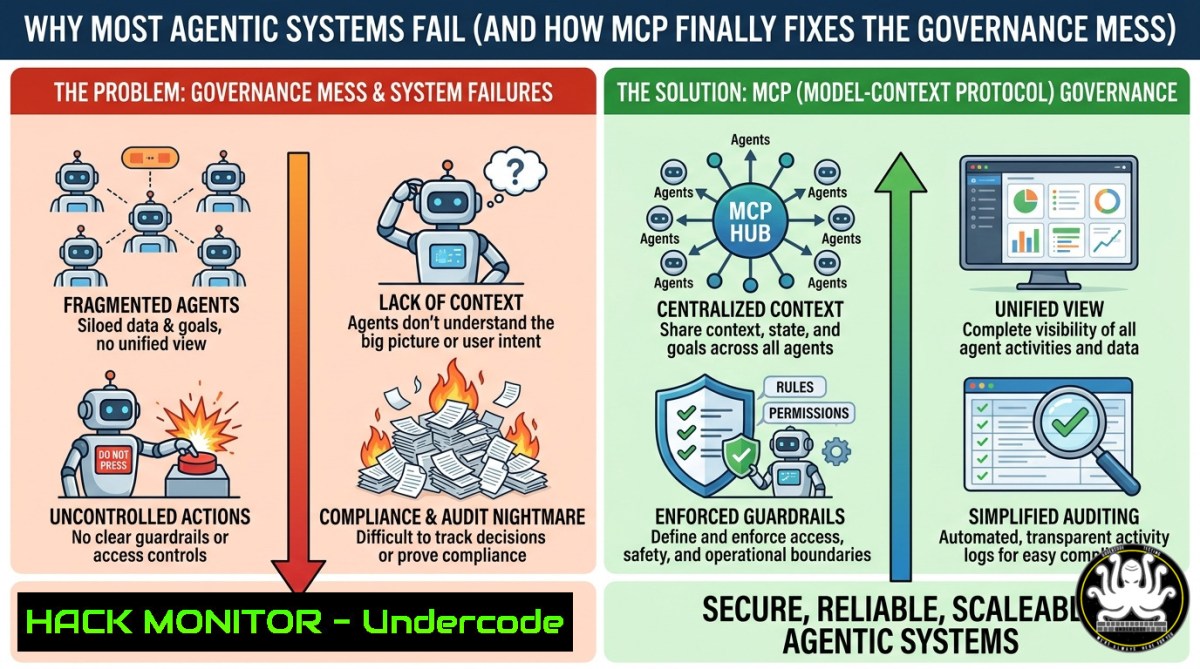
The Model Context Protocol (MCP) is emerging as the first standardized interface for agent-tool integration, turning chaotic, bespoke connectors into a unified control plane. Without MCP, teams build fragile webs of custom integrations that lack visibility, security, and reproducibility—leading to tool poisoning, confused deputy attacks, and unmanageable supply chain risk. This article breaks down MCP’s three extension mechanisms, when to use each, and how to harden your agentic infrastructure against real-world threats.
Learning Objectives:
- Understand MCP’s three primitives (tools, resources, prompts) and their governance implications
- Apply a five‑question decision flow to choose the right extension mechanism for each agent call
- Implement security controls—input validation, least privilege, and memory isolation—to prevent agent‑specific attacks
You Should Know:
- MCP as Dependency Injection for Agents – What It Actually Changes
MCP standardises how agents discover and invoke capabilities, replacing one‑off API calls with a protocol that treats every tool as a pluggable service. Think of it as dependency injection for agentic systems: the agent asks for a “tool” by name and parameters, and MCP resolves the actual implementation, handles transport, enforces policies, and logs every interaction.
Step‑by‑step: Set up a basic MCP tool server (Node.js / Python example)
 Linux/macOS – install MCP SDK
pip install mcp-sdk

Create a simple tool server
cat > weather_tool.py << EOF
from mcp.server import Server, Tool
import json

app = Server("weather")

@app.tool()
async def get_weather(city: str) -> str:
 Simulated weather lookup
return json.dumps({"city": city, "temp": 22, "condition": "sunny"})

if <strong>name</strong> == "<strong>main</strong>":
app.run(transport="stdio")
EOF

Run the server (stdio transport for local agent)
python weather_tool.py
Windows (PowerShell) equivalent:
 Create virtual environment
python -m venv mcp_env
.\mcp_env\Scripts\Activate.ps1
pip install mcp-sdk

Same Python script as above – works cross‑platform
Verification: Test the tool using MCP’s CLI inspector
mcp inspect weather_tool.py --tool get_weather --params '{"city":"Boston"}'
What this does: Your agent now calls `get_weather` without hardcoding an HTTP endpoint or API key. The MCP server manages authentication, rate limiting, and logging centrally—reducing bespoke connector fragility.
- The Five‑Question Decision Flow – Routing Every Agent Call
David Matousek’s decision framework asks five questions before each agent‑tool interaction:
- Is the action idempotent? → Yes → Tool; No → Resource
- Does the agent need to read data without side effects? → Resource
- Is the interaction user‑facing and conversational? → Prompt
- Does the tool require approval or audit trail? → Wrap with policy enforcement
- Is the result large or streaming? → Resource with pagination
Step‑by‑step: Implement a decision‑aware agent loop (pseudocode)
 Agent decision module
def decide_mechanism(action, is_idempotent, requires_user_consent):
if is_idempotent and not requires_user_consent:
return "tool"
elif not is_idempotent and not requires_user_consent:
return "resource"
elif requires_user_consent:
return "prompt"  defer to user via prompt template
return "tool"

Example usage
call = {"name": "delete_file", "idempotent": False}
mechanism = decide_mechanism(call["name"], call["idempotent"], requires_user_consent=True)
print(f"Use {mechanism} for {call['name']}")  Use prompt for delete_file
Security note: Never mark destructive operations as idempotent. Always route them through `prompt` or a resource with a confirmation step.
- Memory Layers – Preventing Context Poisoning and Hallucination
MCP’s three‑layer memory model separates working, episodic, and semantic memory. Without isolation, agents can poison their own context via tool outputs—leading to command injection or data leakage.
Layer 1 – Working memory (per‑call): In‑context only; reset after each turn.
Layer 2 – Episodic memory (session): Stored encrypted with checksums to detect tampering.
Layer 3 – Semantic memory (long‑term): Vector store with access controls and input sanitization.
Step‑by‑step: Secure memory implementation
 Linux – encrypt episodic memory with age encryption
age-keygen -o key.txt
echo "agent observed: user deleted file X" | age -r age1xyz... -o memory.enc

Verify integrity with SHA‑256
sha256sum memory.enc > memory.sha256

Decrypt only when agent session restarts
age -d -i key.txt memory.enc
Windows (PowerShell with OpenSSL):
 Encrypt memory log
echo "agent action: read_sensitive_data" | openssl enc -aes-256-cbc -salt -out memory.enc -pass pass:yourpassword
 Decrypt
openssl enc -aes-256-cbc -d -in memory.enc -pass pass:yourpassword
Mitigation rule: Never pass raw tool output directly into memory without escaping. Use a sanitisation layer:
import html
safe_output = html.escape(tool_output)  prevents injection of control characters
- Tool Poisoning and Confused Deputy – Real Attack Vectors
In a confused deputy attack, an agent with high privileges is tricked into calling a malicious tool that appears benign. Tool poisoning occurs when an attacker replaces a legitimate tool’s code or configuration.
Example attack chain:
1. Attacker compromises a public MCP tool registry.
- They replace `send_email` tool with a version that also exfiltrates data.
- Agent calls `send_email` believing it’s the official tool.
4. Data is sent to attacker’s server.
Step‑by‑step: Defend with hash pinning and allowlisting
 Linux – compute and pin tool hashes
sha256sum /usr/local/mcp_tools/send_email.py > tools.allowlist
 Verify before every load
sha256sum -c tools.allowlist || exit 1

Run MCP server with read‑only filesystem
bwrap --ro-bind /usr/local/mcp_tools /tools --ro-bind /etc/passwd /etc/passwd python mcp_server.py
Windows (PowerShell + AppLocker):
 Generate file hash rule
$hash = (Get-FileHash C:\mcp\tools\send_email.py -Algorithm SHA256).Hash
 Enforce with AppLocker rule (XML)
New-AppLockerPolicy -RuleType Hash -User Everyone -Hash $hash -Path "C:\mcp\tools" -Action Allow
API security layer: Add mutual TLS (mTLS) between agent and MCP server to prevent eavesdropping and impersonation.
5. Cloud Hardening for Agentic MCP Deployments
When MCP servers run in the cloud (AWS, Azure, GCP), they inherit infrastructure risks: metadata service exposure, overly permissive IAM roles, and unencrypted transport.
Step‑by‑step: Hardened MCP deployment on AWS ECS/Fargate
 Disable IMDSv1 (requires IMDSv2)
aws ec2 modify-instance-metadata-options --instance-id i-12345 --http-tokens required

IAM policy – least privilege for tool execution
cat > mcp_tool_policy.json << EOF
{
"Version": "2012-10-17",
"Statement": [
{
"Effect": "Allow",
"Action": ["s3:GetObject", "s3:ListBucket"],
"Resource": ["arn:aws:s3:::my-allowed-bucket/"]
},
{
"Effect": "Deny",
"Action": ["s3:", "ec2:", "iam:"],
"Resource": ""
}
]
}
EOF

Enforce TLS 1.3 only for MCP endpoints
aws elbv2 set-security-policies --load-balancer-arn arn:aws:elasticloadbalancing... --security-policies ELBSecurityPolicy-TLS13-1-2-2021-06
Azure equivalent:
 Restrict managed identity access
az role assignment create --assignee <agent-mcp-identity> --role "Reader" --scope /subscriptions/.../resourceGroups/mcp-rg/providers/Microsoft.Storage/storageAccounts/safeaccount
 Enable service endpoints and firewall
az storage account update --name safemcpstorage --default-action Deny
az storage account network-rule add --account-name safemcpstorage --ip-rule 10.0.0.0/24
What Undercode Say:
- Key Takeaway 1: MCP isn’t just a protocol—it’s a governance boundary. Teams that skip decision flows and security layers will face tool poisoning and supply chain breaches within months.
- Key Takeaway 2: Memory isolation is the most overlooked attack surface. Without encryption and integrity checks, an agent can be forced into re‑playing malicious context across sessions.
Analysis (10 lines):
The post nails the core failure mode of current agentic systems: treating every integration as a unique, hand‑rolled connector. MCP forces standardisation, but standardisation without security is a bigger target. The three memory layers, the five‑question decision flow, and the six defences (tool poisoning, confused deputy, supply chain) form a practical maturity model. Most importantly, the author highlights that MCP’s own spec flags governance gaps—meaning even the protocol authors recognise that security is an operational layer, not automatic. The recipe/kitchen/journal analogy (skills = recipe, MCP = kitchen, memory = journal) helps non‑experts visualise separation of concerns. However, real‑world adoption will struggle until MCP gains native support for policy‑as‑code (e.g., OPA) and dynamic trust evaluation. The supplied slides come from production work, which gives credibility—but without open‑source examples, teams may re‑implement the same flaws. The comment about atomic processes vs. workflows is critical: every decision node must re‑evaluate memory and skills, not just the first call. Finally, the LinkedIn conversation implies that even senior practitioners are still mapping MCP onto existing patterns like LangGraph—suggesting we’re in early adopter phase, with standardization 12–18 months out.
Prediction:
By Q4 2026, MCP will be the default for enterprise agent orchestration, but a wave of breaches caused by misconfigured memory layers and poisoned tool registries will spark a “MCP Hardening” certification. Vendors will compete on policy engines and automated decision-flow validators. Open‑source MCP firewalls will emerge to inspect all tool calls and resource reads in real time. The teams that adopt MCP today with security‑first habits (hash pinning, least privilege, memory encryption) will become the architects of the next generation of resilient AI infrastructure—while those who treat it as just another API will spend 2027 cleaning up post‑incident.
▶️ Related Video (82% Match):
🎯Let’s Practice For Free:
IT/Security Reporter URL:
Reported By: Davidmatousek Connecting – Hackers Feeds
Extra Hub: Undercode MoN
Basic Verification: Pass ✅


