Listen to this Post
Introduction:
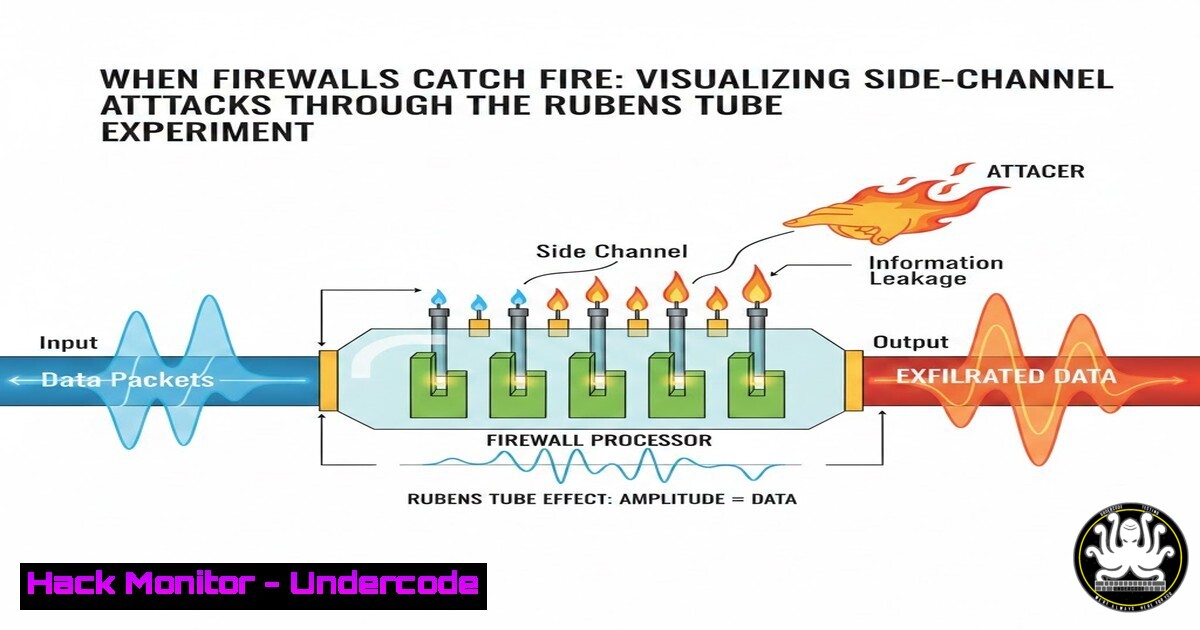
In the world of cybersecurity, not all attacks come through the network port. Some of the most insidious threats exploit physical phenomena—sound, heat, or electromagnetic radiation—to steal data from air-gapped systems. The Rubens Tube, a 1904 physics apparatus that visualizes sound waves through dancing flames, serves as a perfect analog for modern side-channel attacks. Just as sound waves manipulate gas pressure to create visible patterns in fire, malicious actors can manipulate sonic or thermal emissions to extract cryptographic keys from seemingly secure hardware. This article bridges classical physics and offensive security, demonstrating how understanding resonance and wave mechanics can help red teams identify physical-layer vulnerabilities and help blue teams build more robust isolation controls.
Learning Objectives:
- Understand the principles of side-channel attacks and their relationship to physical phenomena (acoustic, thermal, optical).
- Learn how to model resonance and wave propagation using Linux-based signal analysis tools.
- Explore practical mitigation techniques against hardware-based data exfiltration.
You Should Know:
- The Physics of Leakage: How the Rubens Tube Models Data Exfiltration
The Rubens Tube operates on a simple principle: a standing wave created by sound reflecting off the tube’s ends causes varying pressure zones. Where pressure is high (anti-nodes), gas escapes faster, creating taller flames; where pressure is low (nodes), flames are shorter. This visualizes the wavelength and frequency of the audio source.
In cybersecurity, this mirrors how a CPU’s power consumption or electromagnetic emissions vary based on the data it processes. For example, when a processor executes a cryptographic operation, the fluctuation in power consumption creates a specific frequency pattern—much like the sound wave in the Rubens tube. An attacker with physical proximity can measure these fluctuations (via a oscilloscope or microphone) and reconstruct the secret key.
Linux Command for Acoustic Analysis:
To capture and analyze sound waves that could represent such leakage, security researchers often use `arecord` and `sox` on Linux:
 Record a 5-second sample at 48kHz
arecord -d 5 -f cd -t wav leak.wav

Use SoX to generate a spectrogram (visual frequency analysis)
sox leak.wav -n spectrogram -o leak_spectrogram.png
This spectrogram can reveal dominant frequencies, which, in a side-channel context, might correlate with specific CPU instructions.
2. Acoustic Cryptanalysis: Stealing Keys via Ultrasound
Modern research has shown that capacitors and coils on a motherboard emit high-frequency sounds (often in the 20kHz–100kHz range) when processing data. These sounds are inaudible to humans but can be picked up by a smartphone microphone or a cheap ultrasonic sensor. By analyzing the timing and amplitude of these sounds, an attacker can differentiate between a “0” and a “1” being processed during an RSA decryption.
Step‑by‑step guide for a proof-of-concept lab:
- Set up a target machine (e.g., a Raspberry Pi running an RSA signing operation).
- Use a sensitive microphone (like a MEMS microphone breakout board) connected to an oscilloscope or a high-end sound card.
- Capture the signal using Python and the `pyaudio` library:
import pyaudio
import numpy as np</li>
</ol>

CHUNK = 1024
FORMAT = pyaudio.paInt16
CHANNELS = 1
RATE = 192000  High sample rate for ultrasound

p = pyaudio.PyAudio()
stream = p.open(format=FORMAT,
channels=CHANNELS,
rate=RATE,
input=True,
frames_per_buffer=CHUNK)

frames = []
for _ in range(0, int(RATE / CHUNK  5)):
data = stream.read(CHUNK)
frames.append(np.frombuffer(data, dtype=np.int16))

Save and analyze the waveform...
4. Apply FFT (Fast Fourier Transform) to isolate the frequency bands corresponding to the CPU activity. A spike at a specific frequency during the “multiply” operation versus “addition” can reveal the key bit.
3. Thermal Imaging as a Side-Channel
Just as the Rubens tube uses fire to show pressure differences, thermal cameras can show heat differences on a chip. When a CPU processes a “1,” certain transistors draw more current and heat up slightly. By taking a high-speed thermal video of the chip during decryption, an attacker can sometimes reconstruct the data flow.
Windows Command for Thermal Monitoring (simulated):
While direct thermal imaging requires hardware, you can simulate the concept using PowerShell to monitor CPU stress:
 Monitor CPU temperature and load during a crypto operation
while ($true) {
$cpu = Get-WmiObject win32_processor | Measure-Object -Property LoadPercentage -Average
$temp = (Get-WmiObject MSAcpi_ThermalZoneTemperature -Namespace "root/wmi").CurrentTemperature
Write-Host "Load: $($cpu.Average)% - Temp: $((($temp/10)-273.15))°C"
Start-Sleep -Seconds 1
}
In a real attack, the thermal trace would be aligned with the algorithm’s steps to guess the secret.
4. Optical Emission: Watching the LEDs
Many devices have status LEDs (on network cards, hard drives, or even power buttons). Researchers have demonstrated that the flicker of an HDD activity LED, when amplified, can transmit data at slow speeds. Similarly, the light emitted from a chip’s surface (photon emission) during transistor switching can be captured by a photodiode. This is the optical equivalent of the Rubens flame—where the intensity of light corresponds to data states.
Mitigation Technique:
To prevent optical side-channel attacks, blue teams can apply opaque epoxy coatings to chips or ensure that all status LEDs are driven by circuits that mask data-dependent activity. For example, adding a capacitor to an LED circuit will smooth out rapid fluctuations, preventing data leakage.
5. Exploiting Resonance for Denial of Service
The Rubens tube demonstrates how resonant frequencies can amplify energy in a system. In the digital world, attackers can use resonant frequencies to disrupt hardware. For instance, sending sound waves at the resonant frequency of a hard drive’s read-head arm can cause physical damage or at least induce read/write errors. This is a form of acoustic denial of service.
Linux Command to Generate a Resonant Frequency:
Using `sox` and
aplay, you can generate a tone at a specific frequency to test hardware resilience:Generate a 10-second sine wave at 110Hz (common HDD resonance) sox -n -r 44100 resonance.wav synth 10 sine 110 Play it through speakers or a directed speaker array aplay resonance.wav
In a controlled environment, this tests whether the system’s chassis or hard drives are susceptible to vibration-induced failures.
6. Harden Against Physical Leakage: Faraday and Isolation
Just as the Rubens tube contains the gas and waves, a Faraday cage contains electromagnetic waves. To prevent TEMPEST-style attacks (where EM emissions are captured from a distance), organizations deploy shielding.
Windows/Linux Configuration for EM-Safe Operation:
While hardware shielding is primary, software can also help by introducing “noise” into the system. For example, enabling “Constant Frequency” mode in a CPU’s power management (rather than variable “ondemand”) reduces the variability in power consumption, making side-channel analysis harder.
– On Linux, set the CPU governor toperformance:sudo cpupower frequency-set -g performance
– On Windows, adjust the Power Plan to “High Performance” and disable “PCI Express Link State Power Management” to reduce power state transitions.
7. Cloud and Virtualization Implications
In cloud environments, if an attacker can co-locate their VM on the same physical host as a target, they might attempt a cross-VM side-channel attack via shared caches or power lines. The Rubens Tube analogy here is that the “flames” (VM activity) are visible through the shared “tube” (the physical hardware).
Mitigation in Kubernetes/Docker:
To reduce the risk of cache-based side-channels, use resource isolation features:
 Pod spec with dedicated CPU cores (reduces sharing)
apiVersion: v1
kind: Pod
metadata:
name: sensitive-pod
spec:
containers:
- name: app
image: myapp:latest
resources:
requests:
cpu: "2"
memory: "4Gi"
limits:
cpu: "2"
memory: "4Gi"
 Pin to specific cores
topologySpreadConstraints:
- maxSkew: 1
topologyKey: kubernetes.io/hostname
whenUnsatisfiable: DoNotSchedule
Additionally, ensure that the hypervisor (KVM, Xen) is patched against known L1TF and Spectre variants.
What Undercode Say:
- Key Takeaway 1: Side-channel attacks are not theoretical—they are practical extensions of fundamental physics. The Rubens Tube is a 120-year-old reminder that energy in a system will always find a way to express itself. In cybersecurity, that “expression” is data leakage.
- Key Takeaway 2: Mitigation requires a layered approach. While hardware shielding (Faraday cages, acoustic dampeners) is the ultimate defense, software obfuscation (constant-time algorithms, noise injection) raises the bar significantly.
- Analysis: The convergence of classical physics and modern computing is a double-edged sword. On one hand, it enables powerful diagnostic tools (like the Rubens Tube for education). On the other, it arms adversaries with low-cost methods to bypass sophisticated software defenses. Red teams should incorporate physical-layer testing into their exercises, while blue teams must extend their monitoring to include environmental sensors (temperature, sound, EM). The future of security is full-stack, from the physics of the transistor up to the cloud orchestration layer.
Prediction:
As computing devices shrink and edge AI proliferates, the attack surface for physical side-channels will expand. We predict a rise in “sensor fusion” attacks, where attackers combine acoustic, thermal, and optical leakage to triangulate sensitive data with higher accuracy. Defenders will respond with AI-driven anomaly detection that monitors for unusual environmental patterns—essentially, a “Rubens Tube” for the data center that visualizes attacks before data is stolen. By 2030, expect to see commercial products that integrate physical-layer security as a standard compliance requirement for high-security deployments.
▶️ Related Video (84% Match):
🎯Let’s Practice For Free:
IT/Security Reporter URL:
Reported By: Novaeras Representa%C3%A7%C3%A3o – Hackers Feeds
Extra Hub: Undercode MoN
Basic Verification: Pass ✅🔐JOIN OUR CYBER WORLD [ CVE News • HackMonitor • UndercodeNews ]
📢 Follow UndercodeTesting & Stay Tuned:


