Listen to this Post
Introduction:
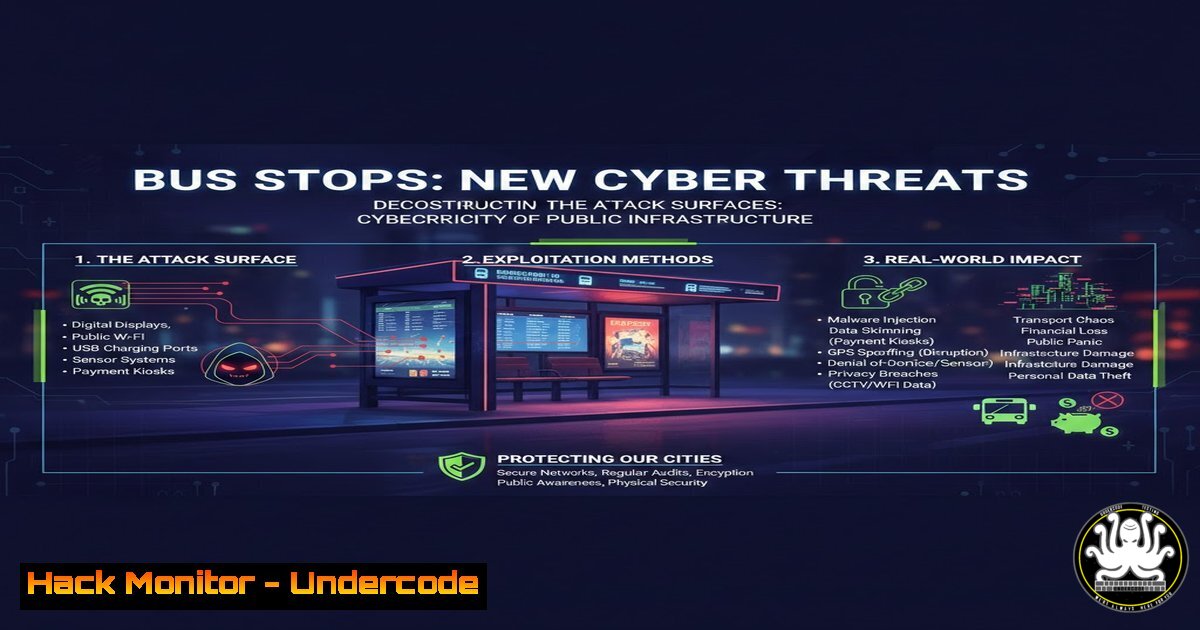
The debate surrounding the UK’s “floating bus stops” has highlighted critical failures in physical safety and accessibility. However, for cybersecurity and IT professionals, this public infrastructure presents a different kind of risk. Modern bus stops are no longer just concrete islands; they are Internet of Things (IoT) hubs, containing digital signage, real-time tracking systems, contactless payment terminals, and traffic management sensors. This article analyzes the technical blueprint of these systems, extracting the underlying architecture to provide a guide on hardening urban transport infrastructure against cyber-physical threats. We will dissect the attack surface of a smart bus stop, moving beyond the policy debate to explore the command-line controls, network vulnerabilities, and mitigation strategies that define its security posture.
Learning Objectives:
- Identify the IoT and OT (Operational Technology) components within modern public transport infrastructure.
- Execute network discovery and vulnerability scanning commands to map the attack surface of edge devices.
- Analyze insecure API endpoints commonly found in traffic management systems.
- Implement basic hardening techniques for Linux-based embedded systems used in signage.
- Understand the implications of insecure data validation in public infrastructure.
You Should Know:
1. Reconnaissance: Mapping the Floating Stop’s Digital Footprint
Before discussing security, one must understand the “scope.” A floating bus stop is likely equipped with a passenger information display (PID), an automatic vehicle location (AVL) beacon, and possibly a CCTV unit. These devices are typically connected via cellular backhaul (4G/5G) or local mesh Wi-Fi to a central management system.
To begin a security assessment, we must perform network enumeration. If you are on-site (with authorization), you would identify the access points.
Linux Command (Wi-Fi Assessment):
Use `iwconfig` and `airodump-ng` to identify the network the stop is broadcasting or connected to.
 Check your wireless interface
iwconfig

Start monitoring (assuming wlan0)
sudo airmon-ng start wlan0
sudo airodump-ng wlan0mon
This reveals BSSIDs and channels of nearby access points. If the stop creates its own hotspot, you can capture the handshake for later WPA/WPA2 cracking analysis.
Windows Command (Network Discovery):
If connected to the same administrative network, use PowerShell to scan for live hosts.
 Ping sweep to find devices in the subnet (e.g., 192.168.1.0/24)
$subnet = "192.168.1"
1..254 | ForEach-Object {
$ip = "$subnet.$_"
if (Test-Connection -ComputerName $ip -Count 1 -Quiet) {
Write-Output "$ip is active"
}
}
2. Firmware Analysis and Embedded Linux Hardening
Many PIDs run on embedded Linux distributions (BusyBox, Yara, etc.). The Department for Transport (DfT) guidance might specify hardware specs, but it rarely mandates secure build configurations. Default credentials are a plague in this sector.
If you gain access to the device (often via a serial console or SSH on port 22/TCP left open), the first step is to check the running processes and users.
Linux Hardening Checklist on the Device:
 Check for default passwords in /etc/passwd and /etc/shadow
cat /etc/passwd

List all listening ports
netstat -tulpn

Check for unnecessary services (e.g., Telnet, FTP)
ps aux | grep -E '(telnet|ftp|vnc)'

Update the package repository and kernel (if applicable)
 (Command varies: apt-get, opkg, yum)
sudo apt-get update && sudo apt-get upgrade -y
Mitigation: Disable root SSH login and change default passwords immediately.
 Edit SSH config
sudo nano /etc/ssh/sshd_config
 Set: PermitRootLogin no
 Restart service
sudo systemctl restart sshd
3. API Security: The Backend Connection
The “smart” aspect relies on APIs. The bus stop sends its location to the Traffic Management Centre (TMC) and receives estimated arrival times. These APIs are often RESTful and, in my experience auditing similar systems, frequently lack proper rate limiting or authentication for data retrieval.
You can test the API endpoint if the device’s firmware reveals the URL (via strings command on a firmware dump or via Wireshark capture).
Command Line API Testing with cURL:
Assuming the device calls `https://api.trafficdata.gov.uk/v2/stops/12345`
 Test for Insecure Direct Object References (IDOR)
 Can you access stop 12346?
curl -X GET "https://api.trafficdata.gov.uk/v2/stops/12346" -H "Accept: application/json"

Test for Missing Authentication
curl -X GET "https://api.trafficdata.gov.uk/v2/stops/12345/feed" -H "Accept: application/json"

Test for Injection by manipulating parameters
curl -X GET "https://api.trafficdata.gov.uk/v2/stops/12345?format=../../etc/passwd"
A successful response to any of these without a valid API key indicates a critical flaw where an attacker could spoof bus locations or extract passenger data.
4. Cloud and Data Storage Vulnerabilities
The data collected (passenger counts, times, CCTV feeds) is often streamed to a cloud bucket (like AWS S3 or Azure Blob) for analytics. Misconfigured cloud storage is the modern equivalent of leaving the safe door open.
AWS CLI Check for Public Buckets:
If you suspect the data is stored in a bucket named “transport-london-data”, you can check its listing permissions.
 Attempt to list the contents of a bucket (should fail if secure)
aws s3 ls s3://transport-london-data/

If it allows unauthenticated listing, you can sync it
aws s3 sync s3://transport-london-data/ ./leaked_data/
Mitigation: Ensure buckets are private and policy is set to deny unauthenticated access. Enable S3 Block Public Access.
5. Exploitation Simulation: Spoofing Arrival Times
A physical attack on a floating bus stop could involve tricking the system. By exploiting the API or the network, an attacker could send false data to the display.
Using a tool like `ncat` or netcat, if you can spoof the MAC address of the legitimate control unit and the protocol is UDP-based (common in legacy SCADA systems), you could inject packets.
Netcat UDP Injection (Proof of Concept):
 Assuming the display listens on UDP port 5000
echo "ARRIVAL:IMMINENT:HAZARD" | ncat -u [bash] 5000
While this is simplistic, more sophisticated attacks involve ARP spoofing on the local network using `arpspoof` (from the dsniff suite) to become the man-in-the-middle between the stop and the router, modifying API responses in real-time.
What Undercode Say:
The floating bus stop controversy is a case study in security convergence. It demonstrates that physical safety cannot be achieved without digital integrity. The key takeaway is that “incomplete data” (as cited in the accident reports) is often a symptom of “insecure data.” If an attacker can manipulate the data stream, they can effectively disable accessibility features or cause accidents. Furthermore, the reliance on outdated OT protocols and misconfigured cloud storage in public tenders represents a systemic risk that outweighs the current focus on curb geometry. Security professionals must advocate for “security by design” in every piece of public infrastructure, treating every sensor as a potential ingress point.
Prediction:
Within the next 3-5 years, we will see the first major ransomware attack targeting a city’s public transport network, not just ticketing systems, but the physical infrastructure itself. Attackers will lock down traffic control interfaces and smart signage, demanding payment to restore the flow of information and vehicles, effectively holding a city’s transport network hostage. This will force governments to retroactively apply the cybersecurity patches and network segmentation that should have been mandated from the start.
▶️ Related Video (84% Match):
🎯Let’s Practice For Free:
IT/Security Reporter URL:
Reported By: Lord Chris – Hackers Feeds
Extra Hub: Undercode MoN
Basic Verification: Pass ✅


