Listen to this Post
Introduction:
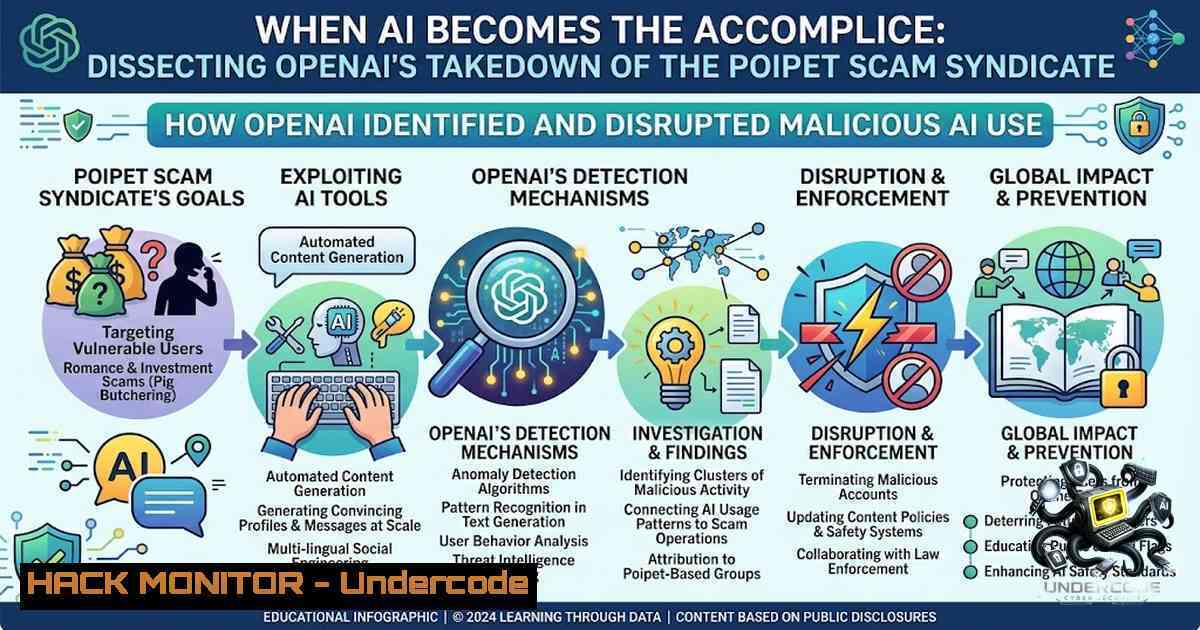
The same generative AI models celebrated for unlocking human productivity are now being weaponized at industrial scale—not by sophisticated nation-state actors, but by organized criminal networks operating from Southeast Asian scam compounds. OpenAI’s recent disruption of a Cambodia-based operation that leveraged ChatGPT across investment, romance, gambling, and law enforcement impersonation schemes exposes a uncomfortable paradox: the very platforms designed to advance intelligence are struggling to prevent their own technology from fueling a multimillion-dollar fraud ecosystem. This incident forces cybersecurity professionals to confront an urgent question—if AI cannot reliably detect and block its own malicious use in real time, what does that mean for the security architectures we are building around it?
Learning Objectives:
- Understand the operational mechanics of AI-augmented scam networks, including the “ping-zing-sting” attack chain and synthetic identity deployment.
- Identify the specific tactics, techniques, and procedures (TTPs) used by threat actors to weaponize ChatGPT for content generation, translation, persona management, and administrative fraud.
- Develop practical detection and mitigation strategies, including log analysis, API monitoring, and OSINT-based threat hunting, to counter AI-enabled social engineering campaigns.
You Should Know:
- The Ping-Zing-Sting Attack Chain: How ChatGPT Supercharges Social Engineering
The Poipet network did not merely use ChatGPT as a translation tool; they operationalized it across every stage of the fraud lifecycle. OpenAI’s investigation revealed a three-step methodology—ping, zing, and sting—that demonstrates how generative AI lowers the barrier to entry for large-scale cybercrime.
Step-by-Step Guide to Understanding and Simulating the Attack Flow:
Step 1: Ping (Initial Outreach)
Scammers deployed ChatGPT to generate personalized icebreaker messages in multiple languages, targeting victims on WhatsApp and Telegram. The AI crafted culturally adapted opening lines, significantly increasing response rates compared to manually written scripts. To simulate this, security teams can use Python to analyze message patterns:
 Example: Basic pattern analysis of scam outreach messages
import re
from collections import Counter

messages = ["Dear friend, I have an investment opportunity...", "Hello, this is Officer Chen..."]
patterns = [re.findall(r'\b(investment|bonus|win|prize|fine|arrest|urgent)\b', msg.lower()) for msg in messages]
print(Counter([word for sublist in patterns for word in sublist]))
Step 2: Zing (Trust Building)
The network created fake dating profiles, fictitious investment experts, and fraudulent law enforcement personas—all with bios and conversation histories generated by ChatGPT. They engaged in extended romantic dialogues and simulated professional authority, building trust over days or weeks. Defenders can monitor for sudden spikes in account creation or unnatural conversational fluency using API call frequency analysis.
Step 3: Sting (Monetization)
Victims were instructed to make deposits, pay activation fees, or settle non-existent fines. ChatGPT generated fake screenshots of transfers, stock-purchase confirmations, gambling platform interfaces, and even forged passports and legal notices. The AI also produced internal administrative documents—employee debt records, salary deductions, visa overstays, and recruitment incentives—to manage the criminal enterprise itself.
Linux Command for Detecting Suspicious AI API Traffic:
 Monitor outbound API requests to OpenAI endpoints from your environment
sudo tcpdump -i eth0 -1 'host api.openai.com and port 443' -v
 Parse logs for anomalous request volumes
grep "api.openai.com" /var/log/nginx/access.log | awk '{print $1}' | sort | uniq -c | sort -1r
Windows PowerShell Equivalent:
 Check for unusual outbound connections to known AI service IPs
Get-1etTCPConnection -RemotePort 443 | Where-Object {$_.RemoteAddress -like "openai"} | Format-Table
- Synthetic Identity Factories: The AI-Powered Persona Industrial Complex
The Poipet operation did not rely on a single scam type; they ran investment fraud, romance scams, fake gambling bonuses, and law enforcement impersonation simultaneously, often targeting the same victims across multiple vectors. ChatGPT enabled them to create and operate hundreds of synthetic identities with minimal human oversight.
Step-by-Step Guide to Identifying Synthetic Personas:
Step 1: Profile Consistency Analysis
Authentic social media profiles exhibit behavioral inconsistencies over time. Synthetic profiles generated by AI often display unnaturally consistent language patterns, perfect grammar, and repetitive emotional cadence. Use sentiment analysis tools to flag profiles with abnormally low variability.
Step 2: Image and Document Forensics
The network generated forged passports, legal notices, and gambling interfaces. Security analysts should use metadata analysis and reverse image search to verify document authenticity:
 Extract metadata from suspect images
exiftool suspect_document.jpg
 Check for AI-generated artifacts using error level analysis
python3 -c "from PIL import Image; import numpy as np; img = Image.open('suspect.png'); print(np.std(np.array(img)))"
Step 3: Cross-Platform Correlation
The scammers operated across WhatsApp, Telegram, and dating platforms. Use OSINT frameworks like theHarvester or Recon-1g to correlate usernames, phone numbers, and email addresses across services:
 Example: theHarvester for email enumeration (ethical use only)
theHarvester -d example.com -b google,bing,linkedin
- API Security and Abuse Detection: What OpenAI Got Right (and Wrong)
OpenAI’s disruption was reactive—they banned a coordinated network of accounts after the fact. The more critical question is: why did the abuse persist long enough to generate thousands of fraudulent interactions? This section provides actionable guidance for organizations integrating third-party AI APIs.
Step-by-Step Guide to Hardening AI API Deployments:
Step 1: Implement Rate Limiting and Anomaly Detection
Monitor API usage patterns for sudden spikes in generation volume, unusual language switching, or repetitive prompt structures indicative of automation:
 Flask middleware example for rate limiting AI API calls
from flask import request, jsonify
from collections import defaultdict
import time

rate_limit = defaultdict(list)
def check_rate_limit(api_key):
now = time.time()
rate_limit[bash] = [t for t in rate_limit[bash] if now - t < 60]
if len(rate_limit[bash]) >= 10:  10 requests per minute
return False
rate_limit[bash].append(now)
return True
Step 2: Prompt Injection and Content Filtering
Deploy a secondary moderation layer that scans both input prompts and output generations for scam-related keywords (e.g., “investment bonus,” “law enforcement fine,” “crypto transfer”):
 Use grep to scan logs for high-risk terms
grep -E "(investment|bonus|fine|arrest|crypto|transfer|visa|passport)" /var/log/ai_api.log
Step 3: User Behavior Analytics (UBA)
Establish baseline behavior for legitimate users. Sudden shifts to night-time activity, high-volume generation, or repeated requests for document templates should trigger alerts. Integrate with SIEM solutions like Splunk or Elastic Stack:
-- Splunk query for anomalous API usage
index=ai_api_logs sourcetype=openai
| stats count by user, hour
| eventstats avg(count) as avg_count, stdev(count) as stdev_count by user
| where count > avg_count + (3  stdev_count)
4. Cloud Hardening for AI-Enabled Environments
Organizations deploying AI models in the cloud must assume that their own infrastructure could be co-opted for malicious purposes if credentials are compromised. The Poipet network’s use of ChatGPT for administrative tasks—tracking employee debts, visa status, and recruitment incentives—highlights how AI can be repurposed for internal criminal management.
Step-by-Step Guide to Securing AI Cloud Deployments:
Step 1: Implement Zero-Trust Access Controls
Restrict API key permissions to the minimum necessary scope. Use AWS IAM or Azure AD conditional access policies to enforce geographic and time-based restrictions:
 AWS CLI: List IAM users with OpenAI API access
aws iam list-users --query 'Users[?contains(UserName, <code>ai</code>)]'
 Attach a policy that denies access outside business hours
aws iam put-user-policy --user-1ame ai_user --policy-1ame time_restriction --policy-document file://policy.json
Step 2: Enable Comprehensive Audit Logging
Ensure all AI API interactions are logged with user identity, timestamp, prompt content, and output. Store logs in a tamper-evident format:
 Configure AWS CloudTrail for API logging
aws cloudtrail create-trail --1ame ai-api-trail --s3-bucket-1ame my-audit-logs
 Enable log file validation
aws cloudtrail update-trail --1ame ai-api-trail --enable-log-file-validation
Step 3: Deploy Automated Remediation
Use serverless functions (AWS Lambda, Azure Functions) to automatically revoke suspicious API keys when anomalous patterns are detected:
 AWS Lambda function to auto-revoke keys
import boto3
def lambda_handler(event, context):
iam = boto3.client('iam')
if event['anomaly_score'] > 0.9:
iam.delete_access_key(UserName=event['user'], AccessKeyId=event['key_id'])
return {'status': 'revoked'}
5. Vulnerability Exploitation and Mitigation: The Human Element
The Poipet network recruited victims with false promises of lucrative jobs, confiscated passports, and forced them into slave-like conditions. This is not a technical vulnerability—it is a human one. However, technical controls can mitigate the scale of such operations.
Step-by-Step Guide to Human-Centric Defense:
Step 1: Employee Awareness Training
Simulate AI-generated phishing and vishing attacks using internal red-team exercises. Use ChatGPT to generate realistic scam scripts and test employee response rates.
Step 2: Deploy Anti-Impersonation Tools
Implement DMARC, DKIM, and SPF to prevent email spoofing. Use Microsoft Defender or Google Workspace security to flag messages with unnatural language patterns:
 Check DMARC record for your domain
dig TXT _dmarc.example.com
 Configure SPF record
v=spf1 include:spf.protection.outlook.com -all
Step 3: Collaborate with Industry Partners
OpenAI partnered with Meta-owned WhatsApp to investigate the network. Organizations should share threat intelligence via ISACs (Information Sharing and Analysis Centers) and participate in cross-platform takedown efforts.
What Undercode Say:
- Key Takeaway 1: AI is not inherently malicious, but its accessibility and scalability make it the perfect force multiplier for organized crime. The Poipet network demonstrates that generative AI can automate not just the fraud itself, but the entire administrative backend of a criminal enterprise—from employee payroll to visa tracking.
-
Key Takeaway 2: Reactive disruption is insufficient. OpenAI’s ban of the account network is commendable, but the fact that the operation persisted long enough to interact with hundreds of victims—with individual losses in the thousands of dollars—exposes a fundamental failure in proactive AI governance. The industry must shift from post-breach remediation to real-time behavioral detection.
The deeper analysis here is that we are witnessing the commoditization of cybercrime. Previously, executing a multilingual, multi-vector fraud campaign required a team of writers, translators, graphic designers, and administrators. Today, a single operator with ChatGPT can orchestrate the entire pipeline. This democratization of offensive capability means that the barrier to entry for cybercrime has collapsed. Defenders must respond not by building higher walls, but by deploying AI-vs-AI countermeasures—automated detection systems that can识别 synthetic personas, flag anomalous conversational patterns, and correlate cross-platform activity in real time. The Poipet takedown is a victory, but it is a skirmish in a much larger war. Until AI platforms can reliably distinguish between legitimate and malicious use at the point of generation, every API call is a potential threat vector.
Prediction:
- -1: The Poipet disruption will not deter similar operations; it will merely drive them to less regulated AI platforms and open-source models. Expect a surge in scams leveraging uncensored LLMs deployed on darknet infrastructure within the next 12 months.
- -1: As AI-generated content becomes indistinguishable from human-authored material, traditional email and messaging filters will become obsolete. Organizations will be forced to adopt biometric and behavioral authentication for high-value transactions, increasing operational friction.
- +1: The incident will accelerate regulatory frameworks for AI accountability, similar to GDPR for data privacy. Mandatory API abuse reporting and real-time content moderation will become compliance requirements, potentially creating a new market for AI security auditing services.
- +1: Open-source threat intelligence sharing around AI abuse patterns will mature, enabling faster cross-platform takedowns and reducing the average lifespan of scam campaigns from months to days.
▶️ Related Video (82% Match):
🎯Let’s Practice For Free:
🎓 Live Courses & Certifications:
Join Undercode Academy for Verified Certifications
🚀 Request a Custom Project:
Secure, high-velocity infrastructure and disruptive technological engineering. Contact our engineering team for high-tier development and proprietary systems:
[email protected]
💎 Smart Architecture | 🛡️ Secure by Design | ⭐ Trusted by Thousands
IT/Security Reporter URL:
Reported By: Alexandre Blanc – Hackers Feeds
Extra Hub: Undercode MoN
Basic Verification: Pass ✅


