Listen to this Post
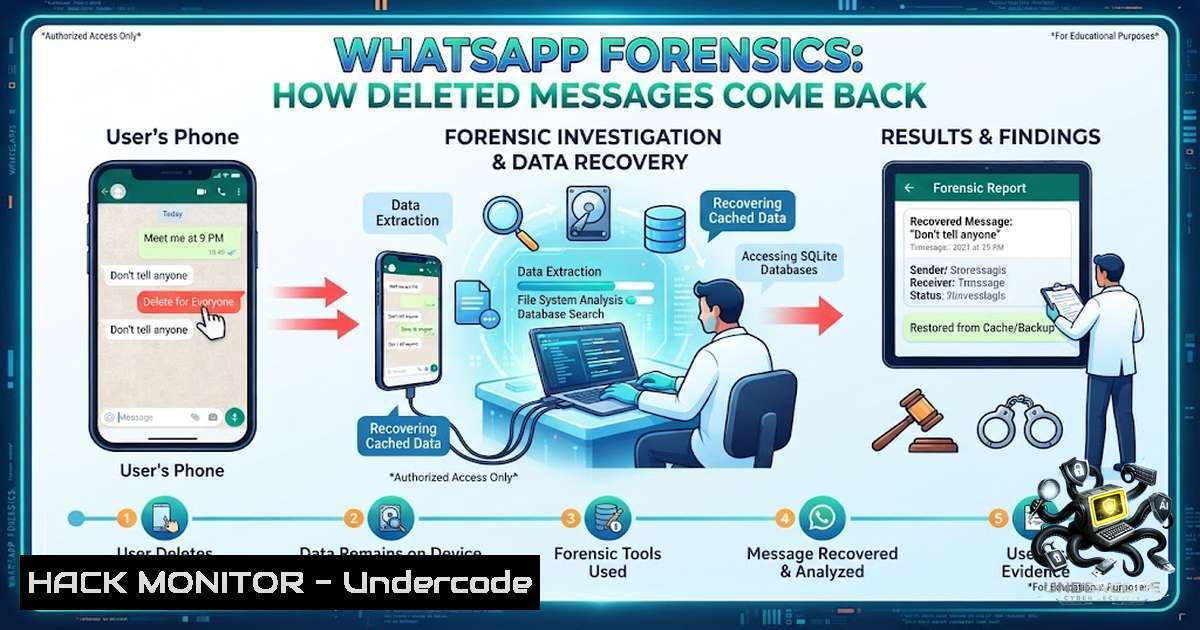
Introduction:
In the world of digital forensics and incident response, the assumption that “deleted” means “gone” is one of the most dangerous misconceptions an investigator can hold. When it comes to WhatsApp, the world’s most popular encrypted messaging platform, forensic analysis reveals that messages are rarely truly destroyed upon deletion, persisting in database freelists, write-ahead logs, and backup artefacts long after users believe they are safe. This technical deep-dive explores the forensic recovery landscape of WhatsApp, examining data persistence mechanisms across Android and iOS platforms, advanced extraction techniques, and practical methodologies that investigators and cybersecurity professionals can employ to recover crucial evidence from mobile devices.
Learning Objectives:
- Understand how WhatsApp’s SQLite database architecture stores messages and manages deletion operations
- Differentiate between forensic recovery capabilities on Android versus iOS platforms
- Master technical techniques including SQLite freelist analysis, WAL extraction, and backup decryption
- Identify appropriate forensic tools and methodologies for different device states and operating systems
- Analyse real-world data persistence scenarios through comprehensive case walkthroughs
1. Understanding WhatsApp’s Data Storage Architecture
WhatsApp’s underlying data storage mechanism is fundamentally built around SQLite databases that serve as the backbone for message persistence. On Android devices, the primary database file is msgstore.db, while iOS devices utilise ChatStorage.sqlite. These databases contain comprehensive records of all messaging activity, including timestamps, sender/recipient information, message content, and status indicators. The architecture is critical to understanding how deleted data can be recovered.
When a user deletes a message, SQLite does not immediately overwrite the data on the physical storage medium. Instead, the database engine typically marks the records as free space within what is known as a “freelist.” This freelist represents storage blocks that are available for future database operations but still contain the original data until they are overwritten by new records. Forensic investigators can extract and analyse the freelist content directly using specialised SQLite analysis tools. This principle is fundamental to both civilian incident response and law enforcement digital investigations.
Step-by-Step Analysis Procedure:
1. Identify the target database location:
- Android: `/data/data/com.whatsapp/databases/msgstore.db`
– iOS: Obtain via file system extraction to locate `ChatStorage.sqlite`
2. Create a forensic copy of the database:
 Linux command to create a bit-for-bit copy
dd if=/data/data/com.whatsapp/databases/msgstore.db of=./msgstore_forensic.db bs=4096 conv=noerror,sync
3. Analyze the freelist using SQLite commands:
-- Connect to the database
sqlite3 msgstore_forensic.db

-- Check freelist status
PRAGMA freelist_count;

-- Extract database schema
.schema

-- Query the message table for deleted content patterns
SELECT  FROM messages WHERE timestamp > X;
4. Recover deleted records using forensic tools:
Utilise `sqlite3` with recovery flags: `.recover` command or specialised recovery scripts to extract data from freelist blocks.
Example Command Sequence for Linux Forensics Workstation:
 Mount the device in read-only mode
sudo mount -o ro /dev/sdX1 /mnt/evidence/

Copy the WhatsApp database directory
sudo cp -R /mnt/evidence/data/com.whatsapp/databases/ ~/forensics/

Analyse with sqlite3
sqlite3 ~/forensics/msgstore.db "SELECT COUNT() FROM sqlite_master WHERE type='table';"

Use Python with sqlite3 library for advanced parsing
python3 -c "
import sqlite3
conn = sqlite3.connect('~/forensics/msgstore.db')
conn.text_factory = bytes
cursor = conn.cursor()
cursor.execute('SELECT  FROM messages LIMIT 10')
for row in cursor.fetchall():
print(row)
"
2. Deletion Mechanisms and Their Forensic Significance
The forensic impact of a deletion operation varies significantly based on the type of deletion performed by the user. Understanding these distinctions is crucial for investigators who must determine what data is likely recoverable in a given scenario.
Delete for Me represents the simplest deletion type: the message is removed only from the user’s own device. The message remains intact on the recipient’s device and within WhatsApp’s servers (until the recipient deletes it or it expires). Critically, on the user’s own device, the message’s data persists in the freelist and can be recovered with high probability. This type of deletion has minimal impact on forensic recovery.
Delete for Everyone operates differently: WhatsApp sends a revocation command that triggers deletion on both the sender’s and recipients’ devices. However, forensic analysis reveals that even this process leaves traces. The revocation protocol often fails to fully remove the original message content because:
- The actual message data remains in the WAL (Write-Ahead Logging) files that SQLite uses for transaction management
- Quoted messages (where a message references another message) often retain the original content within the quoting table structure
- System-level cache files may preserve snapshots of database content
Clear / Delete Chat performs bulk deletion of entire conversation histories. While this accelerates the overwrite process by freeing a larger amount of database space simultaneously, it still follows SQLite’s freelist pattern. The critical factor here is the time window: if the user continues heavy WhatsApp activity after the bulk deletion, the freed space may be rapidly overwritten by new messages, media, or database operations.
Forensic Best Practices:
- Document the exact type of deletion performed based on user statements and device timestamps
- Prioritise WAL file extraction before the database file itself, as WAL files may contain the most recent transaction history
- Time-stamp all forensic activities to establish an accurate timeline for recovery potential
Practical SQLite Query for Deleted Message Detection:
-- Identify if a message table has freelist entries
PRAGMA integrity_check;

-- Locate orphaned data blocks
SELECT  FROM sqlite_master WHERE type='table' AND name LIKE 'messages%';

-- Attempt to read from WAL file directly
PRAGMA wal_checkpoint(TRUNCATE);
3. Android vs. iOS: Forensic Recovery Capabilities
Platform-specific implementation differences create distinct forensic opportunities and challenges. Android generally offers higher recovery potential due to the file system’s accessibility and SQLite’s default behaviour, while iOS imposes more restrictive constraints.
Android (Higher Recovery Potential):
- The Android operating system allows full file system extraction with appropriate tools, enabling direct access to the `msgstore.db` file
- Android’s SQLite implementation maintains WAL files by default, providing a rich source of recent transaction data
- Local encrypted backups in `.crypt14` and `.crypt15` formats contain comprehensive conversation histories that can be decrypted with the user’s password or root access
- The open Android architecture supports APK downgrade attacks, allowing investigators to install an older version of WhatsApp that may have different security implementations
iOS (More Restrictive):
- iOS employs aggressive database vacuuming that cleans up freelist entries during routine maintenance operations
- The recovery window for deleted messages is significantly shorter than on Android
- Strong sandboxing controls restrict third-party tools from accessing the application sandbox without proper authorisation
- Backups are stored in encrypted iTunes or iCloud formats that require complex decryption procedures
- File system encryption is hardware-based and more robust than Android’s implementations
Tool-Specific Recovery Commands:
For Android forensic acquisition:
 Using ADB in forensics mode
adb pull /data/data/com.whatsapp/databases/msgstore.db ~/forensics/

Using Android Debug Bridge with root
adb shell su -c "cat /data/data/com.whatsapp/databases/msgstore.db" > ~/forensics/msgstore.db

Extracting WAL files
adb pull /data/data/com.whatsapp/databases/msgstore.db-wal ~/forensics/
adb pull /data/data/com.whatsapp/databases/msgstore.db-shm ~/forensics/
For iOS recovery, logical extraction via iTunes backup:
 On Windows, locate the backup folder
cd %APPDATA%\Apple Computer\MobileSync\Backup\

On Linux/macOS using libimobiledevice
idevicebackup2 backup --full ~/ios_backup/

Extract the WhatsApp container
 Use iphonebackupdecrypt or similar tools
iphonebackupdecrypt --source ~/ios_backup/ --target ~/extracted/ --password YOUR_PASSWORD
4. Advanced Forensic Techniques and Tool Implementation
Modern forensic investigations leverage a combination of open-source utilities and commercial-grade tools to extract maximum data from WhatsApp artefacts. The most effective approach is multi-layered, combining database analysis with file system forensics and cloud-based recovery.
SQLite Freelist Analysis is the foundational technique: investigators examine the freelist to recover deleted records. Tools such as `sqlite3` with custom scripts, and commercial products like SQLite Forensic Toolkit, automate this process.
WAL File Extraction focuses on capturing the Write-Ahead Logging files that SQLite maintains to track database transactions. These files contain the complete history of changes, including deletions that may not yet have been committed to the main database file. Analysing WAL files often reveals deleted messages that are no longer present in the primary database.
Backup Decryption involves extracting and decrypting WhatsApp’s encrypted local and cloud backups. For Android, `.crypt14` and `.crypt15` backups use AES encryption with a derived key from the user’s password. Tools such as `whatsapp-backup-decrypt` and `WAD` enable decryption given the correct password or brute-force capabilities.
Cloud Extraction focuses on accessing Google Drive (Android) and iCloud (iOS) backups. Law enforcement agencies use legal process to compel cloud providers to release encrypted backup data, which is then decrypted and analysed.
APK Downgrade (Android-specific) involves installing an older version of WhatsApp that bypasses modern security controls, allowing investigators to extract databases without root access. This technique leverages the fact that older versions had less restrictive data access policies.
Chip-Off / ISP is the most invasive technique, involving physical removal of the device’s NAND flash chip or In-System Programming to directly read memory contents. This is typically reserved for devices that are physically damaged or locked and where logical extraction is impossible.
Implementation Example: Automated WAL Extraction Script
!/usr/bin/env python3
import sqlite3
import os
import shutil

def extract_wal_data(db_path, output_file):
"""
Extract and parse WAL file data from WhatsApp database
"""
try:
 Create a backup connection to read the WAL
conn = sqlite3.connect(db_path)
conn.execute("PRAGMA wal_checkpoint(TRUNCATE);")

Extract WAL file location
wal_path = db_path + "-wal"
if os.path.exists(wal_path):
shutil.copy2(wal_path, output_file + ".wal")

Read WAL content using custom parser
with open(wal_path, 'rb') as wal_file:
wal_data = wal_file.read()
 Parse WAL frames (simplified)
 Each frame contains header + data
frame_size = 32  Typical WAL frame header size
for i in range(0, len(wal_data), frame_size):
if i + frame_size > len(wal_data):
break
frame = wal_data[i:i+frame_size]
 Process frame data for message content
 ... advanced parsing logic

return True
except Exception as e:
print(f"Error processing WAL: {e}")
return False

Usage
extract_wal_data('/data/data/com.whatsapp/databases/msgstore.db', './wal_recovery')
5. Device-Level Considerations and Tool Implementation
The forensic recovery process depends heavily on the device model and operating system version, particularly for iOS devices where the chip architecture determines available extraction methods.
Older iPhones (A7-A11 chips): These devices are vulnerable to the `checkm8` bootrom exploit, which grants investigators full file system extraction without requiring user authentication. This technique has revolutionised forensic access to older iOS devices, enabling recovery of WhatsApp data even from locked devices.
Newer iPhones (A12+ chips): The `checkm8` exploit is not effective on these devices due to hardware-level security improvements. Investigators must rely on unlocked device states, advanced commercial tooling such as Cellebrite’s GrayKey, or legal requests to Apple for cloud data.
Samsung Devices: Samsung’s implementation of Android includes Smart Flow technology, which provides enhanced access options via supported chipsets. This feature can enable investigators to extract data more easily from Samsung devices than from other Android manufacturers.
Tool Configuration for Cellebrite UFED:
- Prepare the UFED acquisition device with the latest firmware
- Select the appropriate extraction method (Logical, File System, or Physical)
- Configure targeting options to focus on WhatsApp artefacts
- Initiate the extraction process while monitoring for success indicators
- Export extracted data to UFED Physical Analyzer for detailed analysis
Open-Source Alternative:
 Using ALEAPP (Android Logs Events And Protobuf Parser)
python3 aleapp.py --apk --module WhatsApp ~/forensics/data_partition/

Using Magnet AXIOM (commercial) for integrated analysis
 Command-line equivalent for automating extraction
axiom -o /output/ -s WhatsApp -t physical -f /device/disk.dd
- The Real-World Relevance: Law Enforcement and Incident Response
Understanding WhatsApp forensics is not merely an academic exercise—it is a crucial capability for digital investigators, law enforcement, and incident response professionals. The persistence of deleted messages has led to successful prosecutions, internal investigations, and data breach analyses worldwide.
In criminal investigations, recovered WhatsApp messages have provided direct evidence of conspiracy, intent, and communication between parties. In corporate incident response, recovered messages have revealed insider threats, intellectual property theft, and policy violations. The ability to recover deleted messages often determines the difference between successful and unsuccessful investigations.
Practical Exercise: Simulated Investigation
- Create a test Android environment with a WhatsApp installation
- Send a series of test messages and then delete them using each deletion method
3. Perform forensic acquisition using the techniques described
4. Compare recovery success rates across deletion types
- Document the data that remains recoverable after each deletion type
Verification Commands:
 Test the recovery process
sqlite3 msgstore.db "SELECT COUNT() FROM messages WHERE deleted='1';"

Verify WAL file contains recent transactions
sqlite3 msgstore.db "PRAGMA wal_checkpoint;"

Compare database size after deletion
ls -la msgstore.db
7. Security Implications and Future Developments
The forensic realities of WhatsApp’s data persistence have significant implications for both security professionals and individual users. While end-to-end encryption protects messages in transit, it does not protect them from forensic recovery once they are stored on a device.
Organisations should implement mobile device management (MDM) policies that include secure data disposal procedures. Individual users seeking higher privacy should understand that “Delete for Everyone” is not equivalent to secure deletion—it’s merely a revocation command that leaves persistent artefacts.
Recommended Security Practices:
- Use secure deletion tools that overwrite database freelists: `sqlite3 msgstore.db “PRAGMA secure_delete=ON;”` enables automatic overwriting
- Regularly perform secure wiping of WAL files to prevent forensic recovery
- Enable full-disk encryption and biometric authentication to protect against physical extraction
- Consider enterprise-grade messaging platforms with built-in data deletion guarantees
Future Developments:
- WhatsApp is exploring “disappearing messages” features, but initial implementations still leave forensic traces
- SQLite is evolving to include more secure deletion functions, potentially closing current forensics gaps
- Hardware-level security enhancements in mobile devices will continue to complicate forensic acquisition
What Undercode Say:
Key Takeaway 1: Deletion Is Not Destruction in Mobile Forensics
The fundamental principle underlying WhatsApp forensics is the SQLite freelist mechanism that retains deleted data until actively overwritten. This creates a critical window for investigators to recover evidence, regardless of the deletion type. The persistence of WAL files and quoted message tables further extends recovery capabilities beyond what casual users understand.
Key Takeaway 2: Platform Choices Significantly Impact Forensic Outcomes
Organisations and individuals should understand that Android devices offer substantially higher forensic recovery potential than iOS devices. This platform-specific difference should influence risk assessments, compliance considerations, and incident response planning.
Analysis:
The forensic community must continuously evolve its methodologies as WhatsApp and its parent company Meta implement security enhancements. The current state of WhatsApp forensics provides powerful capabilities for legitimate investigations, but also raises privacy concerns that require balanced consideration.
The persistence of deleted messages serves as a potent reminder to cybersecurity professionals and privacy advocates alike: in the digital world, data has a memory that persists beyond deletion commands. This dual-edged sword empowers investigators while challenging the notion of privacy in digital communication.
The discovery of recoverable deleted messages has led to significant criminal convictions, data breach investigations, and regulatory compliance actions. However, it also underscores the importance of secure data management practices in organisations that handle sensitive information.
Mobile forensics professionals must maintain proficiency with both commercial tools like Cellebrite UFED and Oxygen Forensic Detective, while also developing expertise in SQLite, Python scripting, and file system forensics. The combination of commercial and open-source capabilities provides the most comprehensive forensic toolkit.
The arms race between WhatsApp’s security teams and the forensic community ensures continued innovation on both sides. Future developments may include more secure deletion implementations, enhanced encryption, and new forensic techniques to counter them.
Prediction:
-1: WhatsApp will increasingly implement automatic database vacuuming and secure deletion protocols within the next 18-24 months, significantly reducing the recovery window for deleted messages and closing current forensic gaps.
+1: Mobile forensics tools will evolve to incorporate machine learning algorithms that can predictively reconstruct deleted message patterns from database fragments, even after secure deletion attempts, maintaining recovery capabilities despite vendor security enhancements.
+1: The legal framework around digital evidence recovery will adapt to clarify the admissibility standards for recovered WhatsApp data, streamlining the use of forensic evidence in court proceedings.
-1: Law enforcement agencies will face growing resistance from technology companies as privacy advocates push for “right to be forgotten” provisions that complicate forensic data extraction.
+1: Open-source forensic tooling will expand significantly, with community-developed scripts and frameworks that democratise access to WhatsApp forensic capabilities, reducing reliance on expensive commercial solutions.
-1: The increasing use of ephemeral messaging features will create new challenges for investigators, as even SQLite freelist analysis may not capture messages that are automatically deleted from servers and devices within seconds of reading.
+1: International cooperation frameworks for cross-border digital evidence will mature, enabling more consistent forensic procedures across jurisdictions and improving the global response to cybercrime investigations.
-1: The cost and complexity of mobile forensics will continue to rise as devices become more secure, potentially limiting forensic capabilities to well-funded law enforcement agencies and large corporations.
+1: Alternative acquisition methods, such as JTAG and chip-off techniques, will see renewed development and refinement, providing fallback options even when logical extraction is impossible due to hardware security measures.
+1: The forensic community will develop standardised certification programs for WhatsApp forensics, establishing consistent professional standards and ensuring the reliability of forensic evidence across different jurisdictions and cases.
▶️ Related Video (88% Match):
🎯Let’s Practice For Free:
🎓 Live Courses & Certifications:
Join Undercode Academy for Verified Certifications
🚀 Request a Custom Project:
Secure, high-velocity infrastructure and disruptive technological engineering. Contact our engineering team for high-tier development and proprietary systems:
[email protected]
💎 Smart Architecture | 🛡️ Secure by Design | ⭐ Trusted by Thousands
IT/Security Reporter URL:
Reported By: Dharamveer Prasad – Hackers Feeds
Extra Hub: Undercode MoN
Basic Verification: Pass ✅


