
Listen to this Post
Introduction:
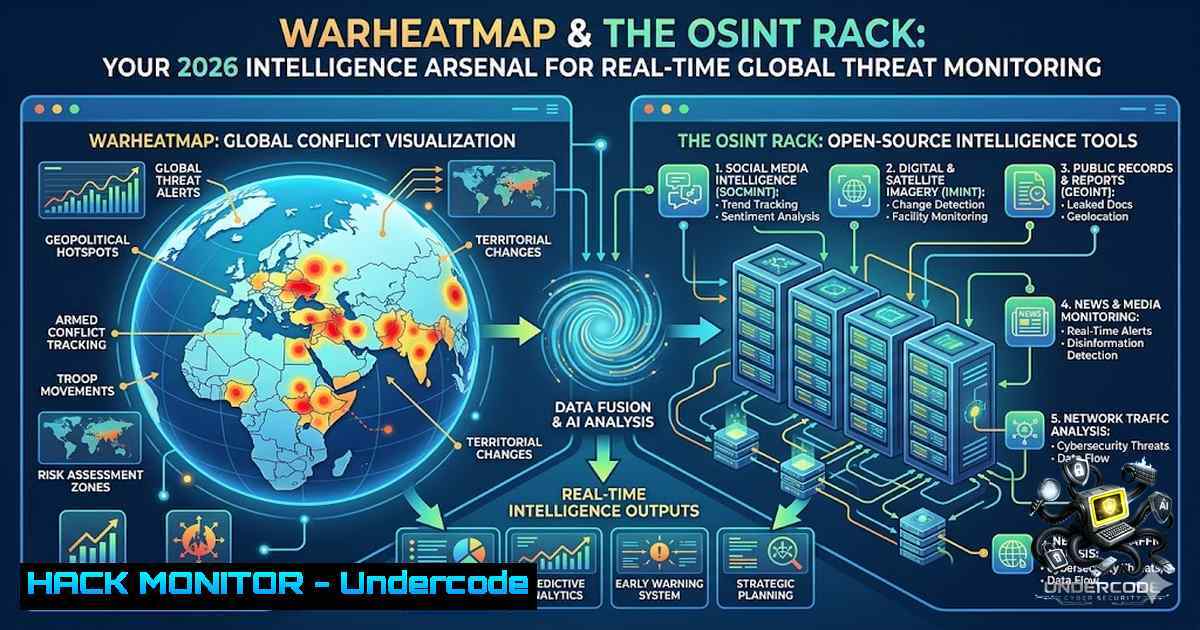
In the rapidly evolving landscape of cybersecurity and geopolitical intelligence, the ability to gather and analyze open-source intelligence (OSINT) is no longer a luxury—it is a necessity for security professionals, analysts, and threat researchers. The recent spotlight on platforms like WarHeatmap and the comprehensive OSINT Rack repository highlights a critical shift: intelligence gathering is becoming more visual, more automated, and more accessible than ever before. This article explores how these tools can be integrated into a robust security framework, providing practitioners with the capabilities to monitor global conflicts, track threat actors, and protect digital assets in real-time.
Learning Objectives:
- Understand the core functionalities and applications of WarHeatmap for real-time geopolitical and conflict intelligence.
- Navigate and utilize the extensive collection of OSINT tools available on The OSINT Rack for various investigative needs.
- Learn to implement practical OSINT techniques, including Linux commands, Windows-based tools, and API security measures, to enhance threat intelligence operations.
1. WarHeatmap: Visualizing Global Conflict in Real-Time
WarHeatmap is a sophisticated platform designed to provide real-time open-source intelligence on global conflicts. It serves as a live, interactive map that aggregates and visualizes conflict data, naval movements, and critical security events from over 38 sources. For cybersecurity analysts and threat intelligence professionals, this tool offers an invaluable macro-level view of geopolitical flashpoints that could impact global supply chains, cyber operations, and national security.
Step-by-Step Guide: How to Use WarHeatmap for OSINT
- Access the Platform: Navigate to `https://warheatmap.app/`. Be prepared to complete a compliance verification step due to the sensitive nature of the data.
2. Understand the Interface: Upon access, you will see a global heat map with filters for critical and high-severity events. The dashboard displays live intelligence data, including naval activity and a count of active events.
3. Apply Filters: Use the filter options to narrow down your view. For instance, you can filter by region, event type (e.g., naval, conflict), or severity to focus on specific areas of interest.
4. Analyze AI-Processed Data: The platform employs an AI engine to process incoming data, providing structured intelligence that can be used for situational awareness and reporting.2. The OSINT Rack: Your Curated Intelligence Toolkit
The OSINT Rack is a comprehensive, curated collection of over 496 OSINT resources, ranging from free tools to freemium platforms and data sources. It acts as a central hub for investigators, offering tools for email lookup, social media intelligence, breach monitoring, and more.
Step-by-Step Guide: Navigating The OSINT Rack
1. Explore the Repository: Visit `https://osintrack.com/` to access the full list of tools, which are updated regularly with new entries.
- Identify Tool Categories: The tools are categorized by function. For example, you can find platforms like “Behind the Email” for email OSINT, “IGDetective” for Instagram analysis, and “Revealer” for breach monitoring.
- Select a Tool Based on Your Objective: If you are conducting a social media investigation, you might use “TikTok Stalker” for real-time activity monitoring or “Scavio TikTok API” for data extraction. For dark web research, “VoidAccess” can extract and map relationships.
- Integrate Tools into Your Workflow: Many platforms offer APIs or CLI tools. For instance, “SerpApi” provides structured JSON data from search engines, which can be integrated into automated threat intelligence pipelines.
-
Linux OSINT Commands: The Power of the CLI
For many security professionals, the command line is the most efficient way to conduct OSINT. Linux offers a plethora of powerful tools that can be combined to automate reconnaissance and data analysis.
Step-by-Step Guide: Essential Linux OSINT Commands
- Username Reconnaissance with Sherlock: Use `sherlock` to search for a username across over 300 social networks. The command is
sherlock <username>. This tool is invaluable for footprinting a target. - Email and Domain Gathering with theHarvester: To find email addresses and subdomains, use
theHarvester -d <domain> -b all. This tool pulls data from public sources like search engines and PGP key servers. - Automated Intelligence with SpiderFoot: For comprehensive reconnaissance, `spiderfoot -s
-m all` can automate the process of gathering intelligence about an IP address, domain, or email from over 100 OSINT sources. - Data Parsing with Text Tools: Use classic Unix tools like
grep,awk,sed,sort, and `uniq` to parse and analyze large datasets. For example, `cat file.txt | grep “@domain.com” | sort | uniq -c | sort -1r` can quickly identify the most frequent email patterns.
4. Windows OSINT and PowerShell Modules
While Linux is often the preferred environment for OSINT, Windows-based tools and PowerShell modules are equally powerful for specific tasks, particularly in enterprise environments.
Step-by-Step Guide: Windows OSINT Techniques
- Artifact Gathering with Meerkat: Meerkat is a collection of PowerShell modules designed for artifact gathering and reconnaissance of Windows-based endpoints. It can be used without a pre-deployed agent, making it ideal for incident response and security operations.
- Cross-Platform Recon with UHT-Framework: The UHT-Framework is a Python-based penetration testing and OSINT toolkit that supports Windows, Linux, and macOS. It provides automated installation and a modern CLI for reconnaissance.
- Interactive OSINT with OsintInteractive: This versatile CLI tool supports multiple languages and provides an interactive shell for OSINT investigations, making it accessible for both beginners and experts.
5. Securing APIs in the OSINT Ecosystem
APIs are the backbone of modern OSINT platforms, enabling automated data extraction and integration. However, they also represent a significant attack surface. In 2026, securing APIs is paramount, as more than 90% of web applications have attack surfaces exposed via APIs.
Step-by-Step Guide: API Security Hardening
- Implement Strong Authentication and Authorization: Ensure all APIs use robust authentication (e.g., OAuth 2.0) and granular authorization to limit access based on user roles.
- Encrypt All Traffic with TLS: Protect data in transit by enforcing TLS encryption for all API communications.
- Validate Input and Sanitize Output: Implement strict input validation to block malicious payloads, such as SQL injection or cross-site scripting (XSS) attacks.
- Conduct Continuous API Security Testing: Regularly test APIs for vulnerabilities using automated scanning tools and manual penetration testing.
- Monitor and Block Anomalies: Deploy real-time monitoring to detect and block anomalous API calls, which could indicate an attack or data exfiltration attempt.
6. Cloud Security Hardening for OSINT Platforms
Many OSINT tools are hosted in the cloud, making cloud security a critical component of any intelligence operation. Following established frameworks like NIST SP 800-53 and CIS Controls can help harden these environments.
Step-by-Step Guide: Cloud Security Hardening
- Understand the Shared Responsibility Model: Clearly define the security responsibilities between your organization and the cloud provider.
- Enhance Identity and Access Management (IAM): Implement the principle of least privilege, ensuring users and services have only the permissions they need.
- Encrypt Data at Rest and in Transit: Use strong encryption for all data stored in the cloud and for data transmitted between services.
- Implement Zero Trust Architecture: Adopt a Zero Trust model where no user or device is trusted by default, and every access request is verified.
- Enforce Strict Patch Management: Remediate critical and high-severity vulnerabilities within 14 days across all operating systems, applications, and firmware.
What Undercode Say:
- Key Takeaway 1: WarHeatmap and The OSINT Rack represent the democratization of intelligence. By making powerful tools accessible, they empower smaller security teams and independent researchers to conduct sophisticated investigations that were once the domain of nation-states and large corporations.
- Key Takeaway 2: The convergence of AI with OSINT is accelerating. Platforms like Tesari AI and Claude-OSINT are pushing the boundaries, enabling automated, evidence-based investigations that can process vast amounts of data in seconds.
- Analysis: The modern cybersecurity professional must be a multi-tool specialist. The ability to switch between a real-time geopolitical map like WarHeatmap, a curated tool repository like The OSINT Rack, and a terminal running Python or PowerShell scripts is becoming the baseline for effective threat intelligence. The integration of these tools into a cohesive workflow, supported by strong API and cloud security practices, is what separates proactive security teams from reactive ones. As we move further into 2026, the lines between cyber threats and physical conflicts will continue to blur, making OSINT proficiency not just a skill, but a strategic imperative.
Prediction:
- -1 The increasing availability of powerful OSINT tools like WarHeatmap will also lower the barrier for malicious actors, leading to a rise in sophisticated social engineering and targeted attacks based on publicly available intelligence.
- -1 The reliance on APIs for OSINT data extraction will create a larger attack surface, making API security a critical battleground in the cybersecurity landscape of 2026 and beyond.
- +1 Conversely, the democratization of OSINT will lead to greater transparency and accountability, as journalists, human rights organizations, and independent watchdogs will have the tools to verify information and expose wrongdoing.
- +1 AI-powered OSINT platforms will dramatically reduce the time required for investigations, allowing security teams to respond to threats in near real-time and proactively hunt for vulnerabilities before they are exploited.
▶️ Related Video (80% Match):
🎯Let’s Practice For Free:
🎓 Live Courses & Certifications:
Join Undercode Academy for Verified Certifications
🚀 Request a Custom Project:
Secure, high-velocity infrastructure and disruptive technological engineering. Contact our engineering team for high-tier development and proprietary systems:
[email protected]
💎 Smart Architecture | 🛡️ Secure by Design | ⭐ Trusted by Thousands
IT/Security Reporter URL:
Reported By: Mariosantella Osint – Hackers Feeds
Extra Hub: Undercode MoN
Basic Verification: Pass ✅


