
Listen to this Post
Introduction:
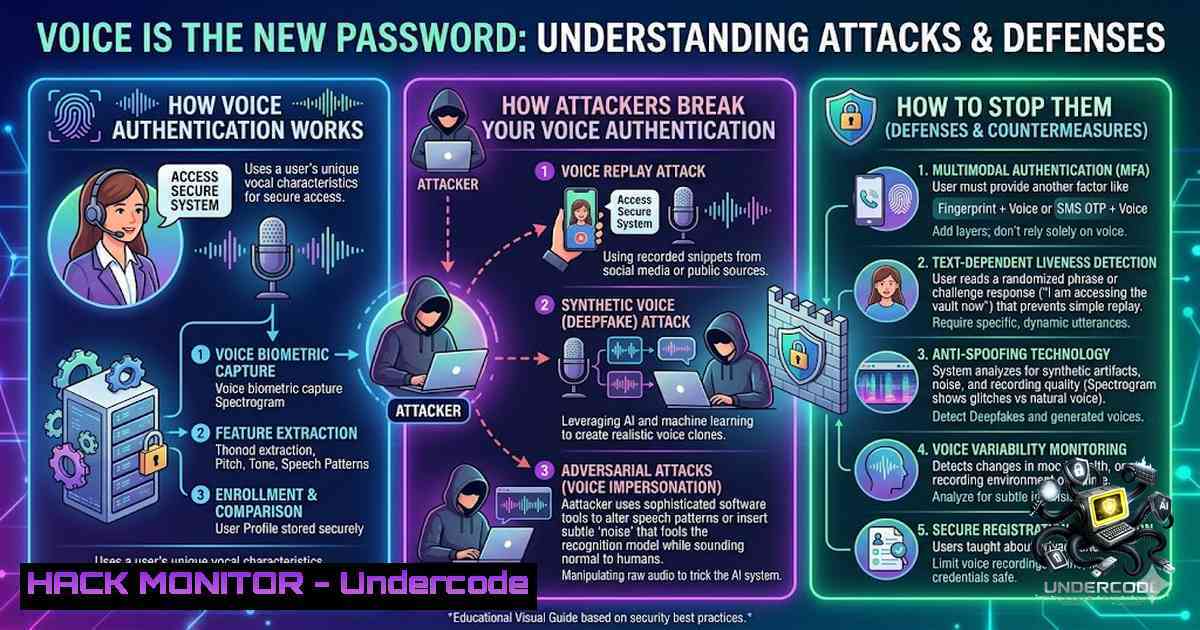
Voice authentication leverages unique vocal biometrics—spectral envelope, pitch, cadence, and articulation—to verify identity without passwords. While it promises frictionless security, it also introduces new attack surfaces, from replay attacks to deepfake synthesis. This article explores how to implement voice authentication securely, harden APIs and cloud infrastructure, and defend against adversarial voice spoofing.
Learning Objectives:
- Implement a voice authentication pipeline using Python libraries and REST APIs with anti-spoofing measures.
- Harden cloud-deployed voice services against replay, synthesis, and AI-driven voice cloning attacks.
- Apply Linux/Windows commands to monitor, log, and mitigate vulnerabilities in voice-enabled systems.
You Should Know
- Setting Up a Basic Voice Biometric Pipeline (Python + SpeechBrain)
Voice authentication typically involves enrollment (storing a voiceprint) and verification (comparing a live sample). Below is a step-by-step guide using the open‑source SpeechBrain toolkit on Linux.
Step 1: Install dependencies
sudo apt update && sudo apt install python3-pip ffmpeg -y
pip3 install speechbrain torchaudio soundfile
Step 2: Enrollment script (extract speaker embedding)
import speechbrain as sb
from speechbrain.pretrained import SpeakerRecognition

model = SpeakerRecognition.from_hparams(source="speechbrain/spkrec-ecapa-voxceleb", savedir="tmp_model")
 Extract embedding from enrollment file
embedding = model.encode_batch("enroll.wav")
 Save embedding (binary)
import pickle
with open("voiceprint.pkl", "wb") as f:
pickle.dump(embedding, f)
Step 3: Verification script
import speechbrain.pretrained
model = speechbrain.pretrained.SpeakerRecognition.from_hparams("speechbrain/spkrec-ecapa-voxceleb")
score, prediction = model.verify_files("enroll.wav", "verify.wav")  score = similarity
if prediction:
print("Access granted")
else:
print("Voice mismatch")
What this does: It converts voice samples into fixed‑length embeddings (ECAPA‑TDNN) and computes cosine similarity. Use a threshold (e.g., 0.65) to balance false acceptance vs. rejection.
- Hardening the Voice Authentication API Against Replay & Deepfakes
Voice APIs are vulnerable to recorded replays and AI-generated speech. Implement liveness detection and challenge‑response.
Step‑by‑step guide (Linux + Flask + WebRTC VAD):
1. Install liveness dependencies
pip3 install webrtcvad flask pyopenssl
2. Add random phrase challenges – server sends a dynamic phrase (e.g., “Today’s code is 8472”), user speaks it. This defeats simple replay.
from flask import Flask, request, jsonify
import webrtcvad, wave
app = Flask(<strong>name</strong>)
@app.route('/verify', methods=['POST'])
def verify():
audio = request.files['audio'].read()
vad = webrtcvad.Vad(2)  aggressiveness 2
is_speech = vad.is_speech(audio, sample_rate=16000)
if not is_speech:
return jsonify({"error": "Liveness failed - no active speech"})
 Compare against stored voiceprint (see Section 1)
return jsonify({"auth": "success"})
3. Run with Gunicorn + rate limiting
pip3 install gunicorn limiter
gunicorn -w 4 -b 0.0.0.0:8443 --certfile cert.pem --keyfile key.pem app:app
4. Windows equivalent (PowerShell) for API endpoint testing
Invoke-RestMethod -Uri "https://localhost:8443/verify" -Method POST -InFile "test.wav" -ContentType "audio/wav"
Why it matters: Without challenge‑response, an attacker can simply record your user’s voice from a voicemail or social media and replay it.
3. Cloud Hardening for Voice Biometric Services
Voiceprint databases are high‑value targets. Encrypt embeddings at rest and in transit, and isolate the inference service.
Step‑by‑step (AWS/GCP example with Linux commands):
1. Encrypt stored voiceprints using AES‑256 (Linux)
 Generate key
openssl rand -base64 32 > vault.key
 Encrypt each voiceprint
openssl enc -aes-256-cbc -salt -in voiceprint.pkl -out voiceprint.enc -pass file:vault.key
2. Set up a private VPC with no public IP for the voice service. Use a bastion host.
 On the voice server, restrict firewall
sudo ufw default deny incoming
sudo ufw allow from 10.0.0.0/8 to any port 8443 proto tcp
sudo ufw enable
3. Deploy with Docker and enable audit logging
FROM python:3.10
RUN pip install speechbrain webrtcvad
COPY app.py /app.py
CMD ["gunicorn", "--access-logfile", "-", "--error-logfile", "-", "app:app"]
docker run -p 8443:8443 -v /var/log/voice:/var/log voice-auth
4. Monitor for anomalies (Windows – use Sysmon + PowerShell)
 Monitor failed auth attempts
Get-EventLog -LogName Security -InstanceId 4625 | Where-Object {$_.Message -like "voice"}
Takeaway: Cloud misconfigurations (open S3 buckets, public inference endpoints) expose voiceprints to attackers – treat them like passwords.
- Attacking Voice Authentication: Spoofing & Mitigation (Red Team Perspective)
Understanding the attack chain helps defenders. Common methods:
- Replay attack – play recorded “yes” or “I approve”.
- Voice cloning – using 5–10 seconds of target speech (from YouTube, TikTok) with tools like Coqui TTS or Real‑Time Voice Cloning.
- Synthetic bypass – modify the raw waveform to fool embedding models (adversarial perturbations).
Step‑by‑step mitigation using anti‑spoofing (ASVspoof) models:
1. Install LFCC‑based spoof detector
pip3 install git+https://github.com/asvspoof/ASVspoof2019.git
2. Add a binary classifier that flags synthetic or replayed audio
from asvspoof import SpoofDetector
detector = SpoofDetector()
live_score = detector.predict("user_sample.wav")  0 = bonafide, 1 = spoof
if live_score > 0.7:
return "Rejected – possible spoofing"
3. Combine with acoustic liveness (microphone noise floor, breath detection)
 Using SoX to check for unnatural silence patterns
sox sample.wav -1 stats 2>&1 | grep "Silence"
4. Linux command to test robustness of your own voice model
 Generate a synthetic voice clone using open-source TTS (coqui)
tts --text "My voice is my password" --model_name tts_models/en/ljspeech/tacotron2-DDC --speaker_idx "target"
 Then attempt verification with the cloned audio
python verify.py --enroll target.wav --test clone.wav
Result: A properly hardened system will reject >95% of low‑effort clones and replays.
- Integrating Voice Authentication with MFA & Zero Trust
Voice alone is not enough for high‑risk transactions. Combine it with a device attestation or a one‑time code.
Step‑by‑step (Linux + Windows + TOTP):
1. Generate TOTP secret on server
 Install oathtool
sudo apt install oathtool
secret=$(head -c 16 /dev/urandom | base32)
echo $secret > /etc/voice/totp_secret
2. Voice + TOTP verification workflow
import pyotp
totp = pyotp.TOTP(secret)
if voice_match and totp.verify(user_provided_otp):
grant_access()
3. Windows – integrate voice auth into AD FS for VPN access
 Add voice assertion as a claim
Add-ADFSClaimDescription -1ame "VoiceVerified" -ClaimType "https://visglobal/voice" -IsAccepted $true
4. Enforce device compliance (Linux with ModSecurity)
 Reject requests from non‑corporate user agents
modsec_rule='SecRule REQUEST_HEADERS:User-Agent "!@contains MyCorpAgent" "deny,status:403"'
echo $modsec_rule >> /etc/modsecurity/conf.d/voice.conf
systemctl restart nginx
Why zero trust: Voice can be captured remotely. A compromised endpoint can replay the audio even if the user is not present. TOTP + device ID closes that window.
- Training & Certification Pathways for Voice Security Professionals
Organizations adopting voice authentication need skilled teams. Recommended courses and hands‑on labs:
- For AI security – “Adversarial Machine Learning for Biometrics” (MIT OpenCourseWare) + try the `foolbox` library:
import foolbox as fb
fmodel = fb.TensorFlowModel(model, bounds=(0,1))
attack = fb.attacks.LinfPGD()
adversarial = attack(fmodel, voice_sample, label)
- For system administrators – Linux hardening (CIS benchmarks) and API security (OWASP API Security Top 10). Practice with:
Scan voice API for misconfigurations
nmap -p 8443 --script http-methods,http-headers voice-server.com
- For blue teams – Splunk queries to detect voice replay bursts:
index=voice_auth sourcetype=nginx | stats count by client_ip | where count > 10/minute
- Official certifications – Certified Identity and Access Manager (CIAM) from Kantara Initiative; Certified Biometrics Professional (CBP) from Biometrics Institute.
Action step: Set up a lab using the free tier of Google Cloud Speech‑to‑Text (misused for voiceprint extraction) and defend it using the commands above.
What Undercode Say:
- Key Takeaway 1: Voice authentication reduces friction but introduces unique threats (replay, deepfake, adversarial audio). Never deploy it as a single factor without liveness and challenge-response.
- Key Takeaway 2: Hardening requires a defense‑in‑depth stack – encrypted voiceprint storage, API rate limiting, asynchronous liveness checks, and integration with TOTP or device attestation.
Analysis: The post from VIS Global Pty Ltd rightly highlights the customer experience benefits of voice authentication, but it glosses over the technical realities of spoofing. Over the next 18 months, we will see a surge in voice‑based attacks driven by generative AI. Organizations must move from “voice as a convenience” to “voice as one factor among many.” The commands and architectures above provide a practical starting point for security teams to test their own voice pipelines. Without active defence, voice becomes the new SMS 2FA – convenient but easily broken. The market will differentiate vendors that implement anti‑spoofing (e.g., using ASVspoof or resonant liveness) from those that rely solely on basic speaker verification. Training and red‑teaming are essential; certification courses should update their curricula to include deepfake detection.
Expected Output:
Introduction: (same as above – voice authentication benefits and risks)
What Undercode Say: (key takeaways + analysis as shown)
Prediction:
+1 Voice authentication will become a standard step in passwordless MFA suites by 2028, with integrated liveness detection as a baseline feature in major IAM platforms (Okta, Auth0).
-1 Cybercriminals will weaponize generative voice models (e.g., OpenAI’s Voice Engine) to perform real‑time voice deepfakes during customer support calls, leading to financial fraud – companies that deploy static voiceprints without adaptive challenge will suffer breaches.
+1 Cloud providers (AWS, Azure) will offer managed anti‑spoofing models as a service, reducing implementation complexity for small businesses.
-1 Regulatory bodies (GDPR, CCPA) may classify voiceprints as biometric data, imposing strict consent and breach notification rules – non‑compliant voice auth implementations will incur heavy fines.
+1 Open‑source tooling (SpeechBrain, Coqui, ASVspoof) will accelerate community‑driven security testing, making red‑teaming voice systems accessible to every penetration tester.
▶️ Related Video (74% Match):
🎯Let’s Practice For Free:
🎓 Live Courses & Certifications:
Join Undercode Academy for Verified Certifications
🚀 Request a Custom Project:
Secure, high-velocity infrastructure and disruptive technological engineering. Contact our engineering team for high-tier development and proprietary systems:
[email protected]
💎 Smart Architecture | 🛡️ Secure by Design | ⭐ Trusted by Thousands
IT/Security Reporter URL:
Reported By: Voiceauthentication Cybersecurity – Hackers Feeds
Extra Hub: Undercode MoN
Basic Verification: Pass ✅


