Listen to this Post
Introduction:
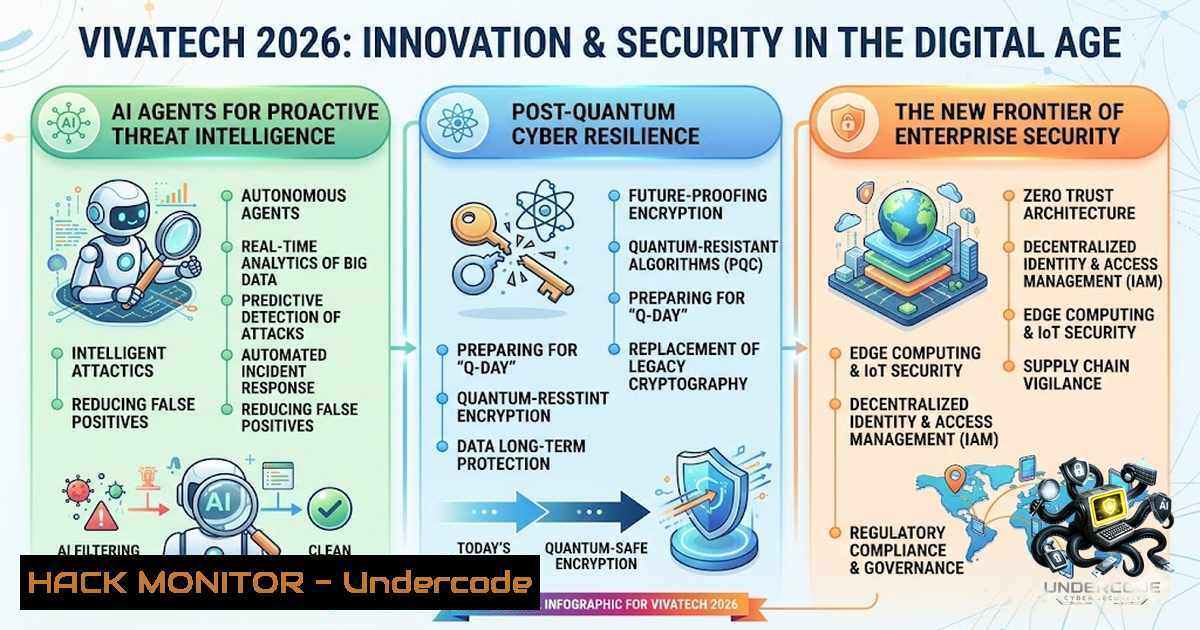
VivaTech 2026 has officially kicked off in Paris, and this year’s edition marks a definitive shift from abstract AI discourse to tangible, production-ready implementations across every sector—from healthcare and logistics to defense and aerospace. As industry giants like AWS, NVIDIA, Orange, and OVHcloud unveil their latest innovations alongside a formidable lineup of European cybersecurity startups, the underlying narrative is clear: the future of business is autonomous, AI-driven, and must be inherently secure. This article distills the most critical technical takeaways from the event, providing cybersecurity professionals and IT architects with actionable insights, hardening commands, and strategic frameworks to navigate the converging realms of agentic AI, sovereign cloud infrastructure, and post-quantum cryptography.
Learning Objectives:
- Objective 1: Understand the architecture and security implications of deploying autonomous AI agents and digital twins in enterprise environments.
- Objective 2: Master practical hardening techniques for AI workloads, including IAM least-privilege policies, network segmentation, and prompt injection defense.
- Objective 3: Develop a strategic roadmap for migrating to post-quantum cryptography (PQC) and implementing crypto-agility to defend against “harvest now, decrypt later” threats.
You Should Know:
- Hardening Multi-Agent AI Systems Against Prompt Injection & Data Leakage
The proliferation of agentic AI—exemplified by startups like Dust and Aily Labs, and infrastructure plays like OVHai Workspace—introduces a dramatically expanded attack surface. Exposing agent endpoints to the internet makes them prime targets for prompt injection, denial-of-service, and the exfiltration of sensitive Personally Identifiable Information (PII). To counter these threats, organizations must adopt a defense-in-depth strategy that secures the AI model’s inputs and outputs before they reach the core logic.
Step‑by‑step guide to securing a multi-agent system (Google Cloud CLI):
Step 1: Enable Core Security APIs.
Before implementing guardrails, ensure the necessary Google Cloud services are activated to inspect and sanitize traffic.
gcloud services enable --project $(gcloud config get-value project) \
aiplatform.googleapis.com \
modelarmor.googleapis.com \
dlp.googleapis.com \
run.googleapis.com
Reference: Google Cloud Codelabs
Step 2: Create a Sensitive Data Protection (SDP) Template.
Define policies to detect and redact PII (e.g., email addresses, phone numbers) from user prompts before they are processed by the agent.
 Example: Creating an inspection template via gcloud (simplified)
gcloud dlp inspect-templates create \
--display-1ame="ai-pii-redact" \
--info-types="EMAIL_ADDRESS","PHONE_NUMBER" \
--min-likelihood="POSSIBLE"
Step 3: Deploy Model Armor for Input/Output Filtering.
Model Armor acts as a firewall for your generative AI applications, blocking malicious inputs and preventing unsafe outputs. Integrate this as a middleware layer in your agent’s backend to intercept prompts.
 Pseudo-code integration for backend interception
from google.cloud import modelarmor
client = modelarmor.ModelArmorClient()
response = client.sanitize_prompt(
parent=f"projects/{project_id}/locations/{region}",
prompt={"text": user_input}
)
if response.sanitized_text:
 Forward sanitized prompt to the agent
agent.process(response.sanitized_text)
else:
 Block the request
raise SecurityException("Prompt blocked due to policy violation.")
Reference: Google Cloud Codelabs
Step 4: Implement Least-Privilege IAM and Authenticated Networking.
Ensure that your agents run with the minimum permissions necessary and that all inter-service communication is authenticated and encrypted.
 Restrict Cloud Run service to internal traffic only
gcloud run deploy my-ai-agent \
--ingress=internal \
--vpc-connector=projects/PROJECT/locations/REGION/connectors/CONNECTOR
- Post-Quantum Cryptography (PQC): Preparing for the “Harvest Now, Decrypt Later” Era
Quantum computing was a major theme at VivaTech, with OVHcloud showcasing its quantum R&D and Quandela’s quantum computer. However, the immediate cybersecurity imperative is post-quantum cryptography (PQC). As highlighted by experts, adversaries are already exfiltrating encrypted data today with the expectation that future quantum computers will decrypt it. For any data with confidentiality requirements extending beyond 2032, the migration to PQC must begin now. NIST finalized the first three PQC standards in August 2024, and compliance deadlines (e.g., CNSA 2.0 by 2027 for new US National Security Systems) are fast approaching.
Step‑by‑step guide to initiating your PQC migration:
Step 1: Inventory Cryptographic Assets.
You cannot secure what you do not know. Conduct a comprehensive inventory of all systems, applications, and certificates that rely on vulnerable asymmetric cryptography (RSA, ECC, Diffie-Hellman).
 Linux: Scan for TLS certificates using RSA/ECC
find /etc/ssl /usr/local/etc/ssl -1ame ".crt" -o -1ame ".pem" | while read cert; do
openssl x509 -in "$cert" -text -1oout | grep "Public-Key" | grep -E "RSA|EC"
done
Step 2: Establish Crypto-Agile Governance.
Set up a governance framework that allows you to replace cryptographic algorithms without overhauling entire systems. This involves decoupling cryptography from applications via abstraction layers.
Step 3: Prioritize High-Value Assets.
Focus initial PQC implementation on long-lived data and authentication mechanisms. This includes Certificate Authorities, JWTs, SAML assertions, and TLS handshakes, all of which are vulnerable to Shor’s algorithm.
 Python: Example of using a hybrid PQC approach (Kyber + ECDH) for key exchange
 Note: Requires 'oqs' library (Open Quantum Safe)
import oqs
import secrets

Generate a key pair for Kyber (Post-Quantum KEM)
with oqs.KeyEncapsulation("Kyber512") as kem:
public_key = kem.generate_keypair()
 Encapsulate a shared secret
ciphertext, shared_secret_server = kem.encap_secret(public_key)
 Client side: decapsulate
with oqs.KeyEncapsulation("Kyber512") as kem_client:
shared_secret_client = kem_client.decap_secret(ciphertext, kem_client.secret_key)
assert shared_secret_server == shared_secret_client
Reference: PQC Migration Handbook
- Cloud & AI Infrastructure Hardening: Securing the Sovereign Cloud
With European sovereign cloud initiatives taking center stage—driven by players like OVHcloud, Orange, and the DEEP consortium—securing the underlying infrastructure is paramount. As AI workloads and data volumes explode, the “cyber gap” narrative is fundamentally changing; security teams must now protect not just data, but the AI models and pipelines themselves.
Step‑by‑step guide to hardening an AI development environment (Linux/Cloud CLI):
Step 1: Provision a Secure VPC with Private Networking.
Mitigate unsolicited traffic by ensuring your AI workloads run in a private, isolated network environment.
 GCP: Create a VPC with no public subnets
gcloud compute networks create ai-vpc --subnet-mode=custom
gcloud compute networks subnets create ai-subnet --1etwork=ai-vpc \
--range=10.0.0.0/24 --region=us-central1 --enable-private-ip-google-access
Step 2: Harden Compute Instances Against Bootkits and Privilege Escalation.
Apply security-optimized OS images and enforce Secure Boot.
 Linux: Harden SSH and disable root login
sudo sed -i 's/PermitRootLogin yes/PermitRootLogin no/' /etc/ssh/sshd_config
sudo systemctl restart sshd
 Enable automatic security updates
sudo apt-get install unattended-upgrades -y
sudo dpkg-reconfigure --priority=low unattended-upgrades -y
Step 3: Implement Confidential Computing.
For highly sensitive AI models, leverage Trusted Execution Environments (TEEs) to ensure data remains encrypted even during processing.
 Example: Deploying a container with TDX (Intel Trust Domain Extensions) support
 Ensure your cloud provider supports TDX instances
docker run --security-opt=confidential=on my-ai-model:latest
- Deepfake Detection & Network Digital Twins: Proactive Defense
Orange’s showcase at VivaTech highlighted two critical defensive technologies: deepfake detection and Network Digital Twins. Deepfakes pose a direct threat to identity and authentication systems, while Digital Twins allow security teams to simulate and stress-test network infrastructures using generative AI before attacks occur.
Step‑by‑step guide to deploying a deepfake detection pipeline (Conceptual):
Step 1: Integrate Real-Time Audio/Video Analysis.
Deploy AI models trained to identify inconsistencies in facial micro-expressions, lighting, and audio artifacts. Orange’s solution analyzes streams in real-time to block identity usurpation attempts instantly.
 Pseudo-code for integrating a deepfake detection API
import requests
def analyze_media(file_path):
url = "https://api.deepfake-detector.com/v1/analyze"
files = {'file': open(file_path, 'rb')}
response = requests.post(url, files=files)
if response.json()['confidence'] > 0.85:
raise SecurityException("Deepfake detected. Blocking transmission.")
return True
Step 2: Simulate Network Attacks using Digital Twins.
Use a Digital Twin to model your network and run “what-if” scenarios for DDoS attacks or configuration errors without impacting production.
 Example: Simulating a network partition in a Kubernetes environment
kubectl create -f - <<EOF
apiVersion: litmuschaos.io/v1alpha1
kind: ChaosEngine
metadata:
name: network-partition
spec:
experiments:
- name: pod-1etwork-partition
spec:
components:
env:
- name: TARGET_PODS
value: "ai-agent-pod"
- name: NETWORK_PARTITION
value: "10.0.0.0/24"
EOF
- Security Orchestration, Automation, and Response (SOAR) for AI Workloads
As AI agents become autonomous, the need for automated incident response is critical. Startups like Filigran, Riot Security, and Aikido Security—all featured in VivaTech’s Top 100 Rising European Startups—are pioneering AI-driven security platforms that cut noise by up to 95% and provide one-click fixes. Integrating these tools into your CI/CD pipeline ensures security is “shifted left.”
Step‑by‑step guide to integrating AI-driven security scanning (Linux):
Step 1: Automate Vulnerability Scanning in CI/CD.
Integrate tools like Aikido or open-source scanners to audit code for security flaws. Carnegie Mellon research shows that while 61% of AI-generated code is functionally correct, only 10.5% is secure.
 Example: Running a security scan using a generic SAST tool
sast-scanner scan --path ./src --output report.json
if grep -q "CRITICAL" report.json; then
echo "Critical vulnerabilities found. Failing build."
exit 1
fi
Step 2: Deploy Hardening Agents for Continuous Compliance.
Use tools like the GCP Hardening Agent—an interactive CLI assistant that audits your live environment and deploys compliance guardrails using Infrastructure as Code (IaC).
 Hypothetical command for a hardening agent
hardening-agent audit --environment=production --fix-mode=auto
What Undercode Say:
- Key Takeaway 1: The transition from AI experimentation to production deployment requires a parallel evolution in security posture. “Shift-left” security must now encompass AI model inputs, outputs, and the agentic workflows that connect them.
- Key Takeaway 2: Post-quantum cryptography is no longer a theoretical concern; it is a compliance and risk management imperative for 2026. Organizations must inventory cryptographic assets and begin hybrid PQC deployments now to avoid a “Y2K-style” scramble before the 2030s.
Prediction:
- +1 The integration of AI agents with Security Orchestration, Automation, and Response (SOAR) platforms will lead to a 40% reduction in Mean Time to Remediation (MTTR) for common vulnerabilities by 2028, as autonomous agents will be capable of self-patching.
- -1 However, the rapid adoption of agentic AI without corresponding security hardening will trigger a wave of sophisticated supply chain attacks targeting AI model repositories and agent communication protocols within the next 18 months.
- +1 European sovereign cloud initiatives, bolstered by events like VivaTech, will successfully create a viable alternative to US hyperscalers, driving innovation in data residency and post-quantum security compliance.
- -1 The “harvest now, decrypt later” threat will materialize into a major data breach crisis by 2030 if enterprises delay PQC migration, forcing emergency cryptographic rollouts that could destabilize critical infrastructure.
- +1 The focus on “useful and responsible AI” will catalyze the development of standardized AI security frameworks, similar to OWASP for web applications, providing much-1eeded guardrails for developers and security teams alike.
▶️ Related Video (80% Match):
🎯Let’s Practice For Free:
🎓 Live Courses & Certifications:
Join Undercode Academy for Verified Certifications
🚀 Request a Custom Project:
Secure, high-velocity infrastructure and disruptive technological engineering. Contact our engineering team for high-tier development and proprietary systems:
[email protected]
💎 Smart Architecture | 🛡️ Secure by Design | ⭐ Trusted by Thousands
IT/Security Reporter URL:
Reported By: Jmetayer Vivatech – Hackers Feeds
Extra Hub: Undercode MoN
Basic Verification: Pass ✅


