Listen to this Post
Introduction:
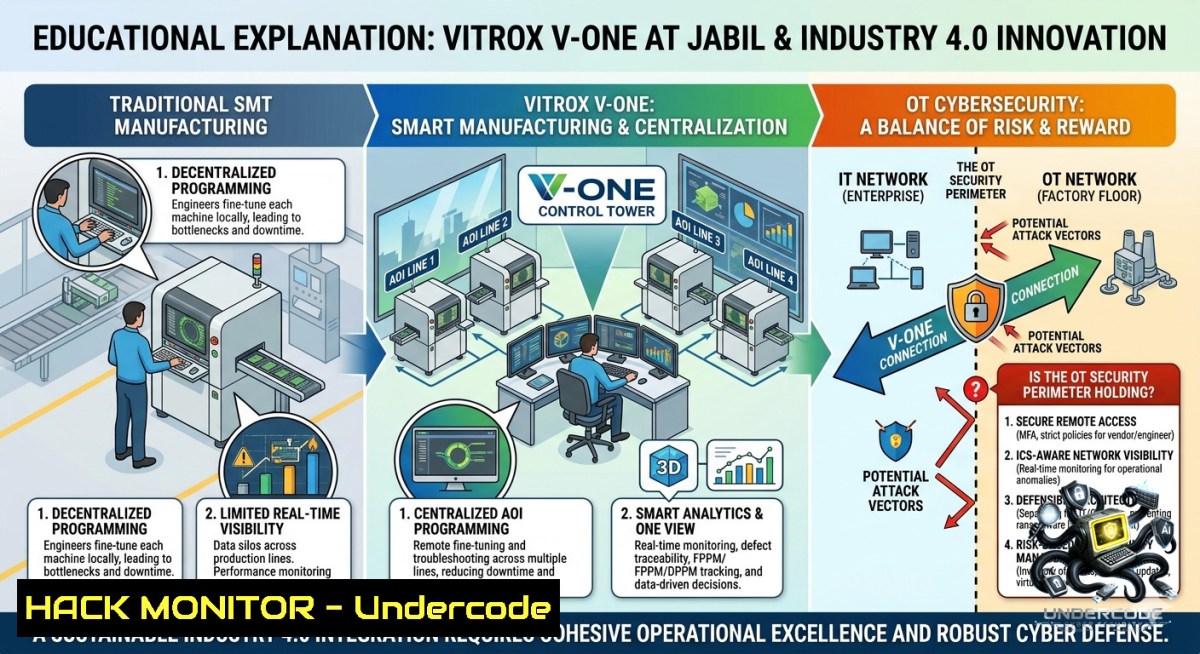
The convergence of operational technology (OT) with data-driven analytics is reshaping electronics manufacturing. ViTrox’s V-ONE Digital Factory Solution, now integrated into Jabil’s production lines, enables centralized Automated Optical Inspection (AOI) programming, real-time equipment monitoring, and defect analysis—all managed remotely. While this slashes troubleshooting time and boosts efficiency, it thrusts industrial networks into the spotlight, demanding that cybersecurity controls be just as agile and automated as the production lines they protect.
Learning Objectives:
- Understand how centralized AOI programming and real-time monitoring platforms like V-ONE introduce new cybersecurity risks to manufacturing environments.
- Learn to apply industrial hardening techniques, access restrictions, and Zero Trust principles to secure OT networks.
- Identify practical commands and configurations for segmenting industrial networks, monitoring remote access sessions, and hardening Linux-based IIoT gateways.
You Should Know:
1. Hardening Centralized AOI Programming Access (Step‑by‑Step Guide)
Before V-ONE, engineers manually configured AOI machines on the shop floor, a practice that physically isolated the programming process. Today, remote access from a central control tower is the norm, but that shift requires strict access controls to prevent lateral movement from an engineer’s workstation to the OT zone.
Linux (IIoT Gateway / Control Server Hardening)
- Restrict SSH access to authorized jump hosts only:
sudo ufw allow from 192.168.10.0/24 to any port 22 proto tcp
sudo ufw default deny incoming
sudo ufw enable
- Mandate SSH key authentication and disable password logins (
/etc/ssh/sshd_config):PasswordAuthentication no PermitRootLogin no AllowUsers [email protected]/24
- Use `auditd` to track configuration changes to AOI recipes:
sudo auditctl -w /opt/vitrox/config/ -p wa -k AOI_CONFIG_CHANGE
Windows (Remote Management Host)
- Restrict AOI programming workstations using IPsec policies or Windows Defender Firewall, blocking all inbound SMB/RDP from non‑management subnets.
- Enforce AppLocker to allow only approved executables (e.g., V-ONE client, VVTS viewer) and block all others.
Step‑by‑step hardening workflow:
- Identify each AOI machine’s management interface and document its IP.
- Create a dedicated management VLAN (e.g., VLAN 100) and move all AOI programming interfaces into it.
- Deploy a jump host (Linux or Windows) inside the OT management zone; require multi‑factor authentication (MFA) for all logins.
- Enforce a “deny‑by‑default” firewall rule set between the IT office network and the OT management VLAN.
- Enable session recording (e.g., using `script` or commercial OT logging tools) for every remote AOI programming session.
-
Securing the V‑ONE Control Tower & Real‑time Data Streams
The V‑ONE Control Tower aggregates real‑time equipment metrics, defect analysis, and quality tracking from hundreds of AOI machines. Without proper segmentation, a compromised control tower node could view, modify, or halt inspection rules across the entire plant.
Network segmentation example (Linux iptables on the control tower):
 Allow only AOI machines (subnet 10.10.50.0/24) to send telemetry to port 8080
iptables -A INPUT -p tcp --dport 8080 -s 10.10.50.0/24 -j ACCEPT
 Drop any other inbound traffic to the control tower
iptables -A INPUT -j DROP
Application‑level controls:
- Enable HTTPS with mutual TLS (mTLS) between AOI agents and the V‑ONE aggregator. Reject any plaintext or self‑signed certificate traffic.
- Use a read‑only API key for dashboard visualizations and a separate, highly restricted key for any write operation (e.g., updating inspection parameters).
Step‑by‑step monitoring setup:
- Deploy a SIEM forwarder (e.g., Syslog‑ng or Winlogbeat) on the V‑ONE control node.
- Forward all logs to a centralized SOC with rules for:
– Multiple failed authentication attempts from an AOI machine.
– Configuration changes to inspection thresholds outside of maintenance windows.
– Unusual data export volumes (potential data exfiltration of quality metrics).
3. Create a dashboard that correlates “remote programming sessions” with “defect‑rate anomalies” to spot potential tampering.
- Zero Trust for Industry 4.0: Applying F‑wall, Micro‑segmentation, and Least Privilege
The FBI and CISA recently released guidance on applying Zero Trust principles to OT. For an environment like Jabil’s, that means assuming the V‑ONE network is already compromised and verifying every request.
Practical steps:
- Segment horizontally: Place each AOI machine, the V‑ONE control tower, and the historian database into separate micro‑segments. Use a firewall (or a software‑defined perimeter) that allows only specific protocols (e.g., MQTT, OPC UA) on dedicated ports.
- Remove unnecessary lateral paths: On every AOI gateway, disable all unused physical ports (USB, Ethernet) and stop unnecessary services (e.g., FTP, Telnet, SMB).
Stop and mask an unused service on Linux
sudo systemctl stop smbd
sudo systemctl disable smbd
sudo systemctl mask smbd
- Enforce just‑in‑time (JIT) administration: Engineers should receive temporary, time‑bound privileges to modify AOI programs, with all actions logged and reviewed.
- Monitoring Remote AOI Sessions – Commands & Tutorials
Engineers now manage multiple inspection systems from a central location without interrupting live production. While efficient, this creates a new attack surface: a compromised engineer’s laptop could push malicious inspection parameters that hide defects.
Live session monitoring (Linux jump host):
- Record every terminal session using `tlog` or
script:script --logging --log-io /var/log/aoi-sessions/$(date +%Y%m%d-%H%M%S)-$USER.log
- Forward recorded sessions to a secure log server that cannot be purged by the user.
Windows‑based monitoring:
- Deploy Sysmon to log process creation (especially for `V-ONE.exe` and
VVTS_viewer.exe) and network connections. - Use PowerShell transcription enabled by Group Policy:
Set-ItemProperty -Path "HKLM:\SOFTWARE\Policies\Microsoft\Windows\PowerShell\Transcription" -1ame "EnableTranscripting" -Value 1
Tutorial – Monitoring file integrity on AOI recipe directories:
 Install AIDE (Advanced Intrusion Detection Environment)
sudo apt install aide -y
 Initialize the database for /opt/vitrox/config
sudo aideinit -c /etc/aide/aide.conf
 Add a cron job to run daily and email changes
0 2    /usr/bin/aide --check | mail -s "AOI Config Integrity" [email protected]
5. Hardening the Historian & Defect‑Analysis Pipeline
V‑ONE provides data‑driven decision‑making by feeding defect metrics and FPPM/DPPM benchmarks into quality dashboards. If an attacker manipulates this data, they could force the plant to accept defective boards or ignore genuine process drift.
PostgreSQL / Time‑series database hardening:
-- Revoke public schema permissions
REVOKE CREATE ON SCHEMA public FROM PUBLIC;
-- Create a read‑only role for dashboard users
CREATE ROLE dashboard_ro;
GRANT SELECT ON ALL TABLES IN SCHEMA quality_metrics TO dashboard_ro;
-- Force SSL for all connections
ALTER SYSTEM SET ssl = 'on';
ALTER SYSTEM SET ssl_ca_file = '/etc/postgresql/ssl/ca.crt';
Tutorial – Audit logging for defect data changes:
CREATE TABLE audit_defect_change (
id SERIAL PRIMARY KEY,
changed_at TIMESTAMPTZ DEFAULT NOW(),
changed_by TEXT,
old_fppm NUMERIC,
new_fppm NUMERIC,
aoi_machine_ip INET
);
CREATE TRIGGER track_fppm_changes
AFTER UPDATE ON quality_metrics
FOR EACH ROW EXECUTE FUNCTION log_fppm_change();
6. Industrial Cybersecurity Training & Resources
To secure Industry 4.0 environments, plant OT staff and IT security teams need specialized training. The following free and paid resources help bridge the IT‑OT gap:
- CISA ICS Virtual Learning Portal (Free, self‑paced) – Topics include “Mapping IT Defense‑in‑Depth Solutions to ICS” and “Attack Methodologies in IT & ICS”.
- CISA ICS301 (Advanced, In‑person) – Hands‑on Red/Blue team exercise in an actual control systems environment using Kali Linux and Metasploit.
- Certified Operational Technology Security Specialist (COTSS) – Focuses on SCADA, DCS, and industrial network security.
- EC‑Council ICS/SCADA Cybersecurity – Defensive architecture and incident response for OT networks.
What Undercode Say:
- Key Takeaway 1: The integration of V‑ONE at Jabil showcases how centralized remote programming and real‑time analytics boost agility, but every new connection from the IT side to the OT floor is a potential vector for ransomware or supply‑chain attacks.
- Key Takeaway 2: Effective defense lies in micro‑segmentation, just‑in‑time access, and continuous session recording—not just perimeter firewalls. Hardening the control tower, historian database, and AOI gateways with OS‑level controls and strict authentication can prevent a single breach from compromising the entire production line.
Analysis:
The electronics manufacturing sector has historically relied on air‑gapped or barely networked machines. As solutions like V‑ONE prove their value, the temptation to connect everything for predictive maintenance and real‑time dashboards will become irresistible. However, OT environments have unique constraints: legacy controllers, infrequent patching, and real‑time availability requirements. The Jabil–ViTrox partnership serves as a perfect case study: centralizing AOI programming reduces downtime and improves quality, but it also transforms every AOI machine into a network‑connected endpoint. Without mandatory encryption, least‑privilege access, and immutable audit logs, the same system that empowers engineers could become a backdoor for attackers to manipulate inspection pass/fail decisions, leading to undetected quality escapes or even safety incidents. The future of smart manufacturing depends on baking security into the digital factory blueprint from day one, not bolting it on after a breach.
Prediction:
- +1 The adoption of digital factory platforms like V‑ONE will accelerate Industry 4.0 adoption, pushing manufacturers to develop dedicated OT security teams and incident response playbooks—creating a new specialty in “manufacturing cybersecurity engineering.”
- -1 Without enforceable standards for secure remote programming and real‑time analytics pipelines, early adopters will face a wave of ransomware attacks that not only encrypt files but also manipulate inspection thresholds, causing silent quality escapes before the breach is even detected.
▶️ Related Video (66% Match):
🎯Let’s Practice For Free:
🎓 Live Courses & Certifications:
Join Undercode Academy for Verified Certifications
🚀 Request a Custom Project:
Secure, high-velocity infrastructure and disruptive technological engineering. Contact our engineering team for high-tier development and proprietary systems:
[email protected]
💎 Smart Architecture | 🛡️ Secure by Design | ⭐ Trusted by Thousands
IT/Security Reporter URL:
Reported By: Printedcircuit Industry – Hackers Feeds
Extra Hub: Undercode MoN
Basic Verification: Pass ✅


