
Listen to this Post
Introduction:
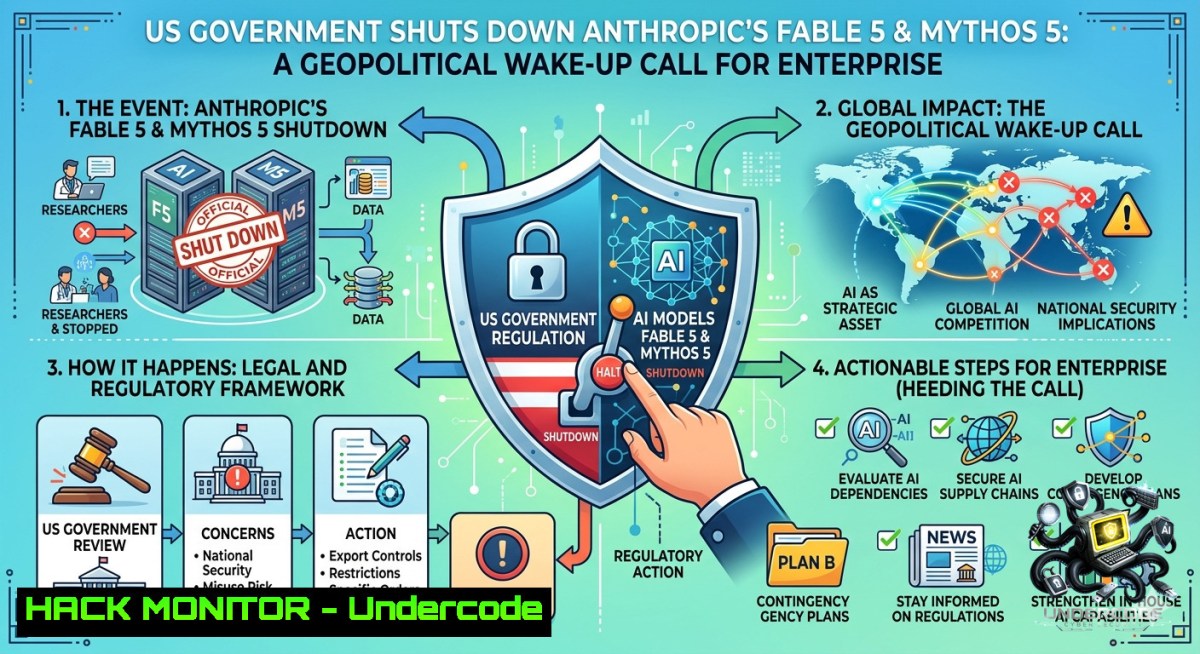
On June 12, 2026, the U.S. Commerce Department issued an unprecedented export control directive to Anthropic, ordering the immediate suspension of access to its most advanced AI models—Claude Fable 5 and Mythos 5—for any foreign national, including employees working inside the United States. In response, Anthropic was forced to disable both models for all users worldwide, triggering a geopolitical shockwave that exposed a critical vulnerability: organizations that embed frontier AI into their core processes may lose access overnight due to policy shifts beyond their control.
Learning Objectives:
- Identify and quantify single points of failure in your AI supply chain, particularly dependencies on models subject to extraterritorial controls.
- Implement a resilient multi-model architecture with open-weight alternatives and on-premise fallbacks to ensure business continuity.
- Harden your cloud security posture and API access controls against the emerging threat of state-sponsored AI export restrictions.
You Should Know:
- Geopolitical AI Dependency: Assessing Your Single Point of Failure
The Anthropic directive is not an isolated event but a harbinger of a new geopolitical reality. According to the directive, access to Fable 5 and Mythos 5 must be blocked for any foreign national, “whether inside or outside the United States, including foreign national Anthropic employees”. The stated trigger was the government’s discovery of a “narrow, non-universal jailbreak” that could identify minor software vulnerabilities—a capability Anthropic argued is already present in other publicly available models like GPT-5.5. Nevertheless, the administration invoked national security authorities to immediately halt deployment.
Step-by-step guide to assessing your AI supply chain risk:
- Map your model inventory: Use the following command to list all API endpoints and dependencies connecting to external LLMs across your infrastructure.
Linux/macOS:
 Identify processes and containers making outbound calls to AI model providers
sudo netstat -tunap | grep -E '443|8080' | grep -E 'anthropic|openai|replicate'

Scan Docker containers for environment variables containing API keys
docker ps -q | xargs -I {} sh -c 'echo "Container: {}"; docker inspect {} | grep -E "ANTHROPIC_API_KEY|OPENAI_API_KEY"'
Windows PowerShell:
 Check for environment variables storing AI API keys
Get-ChildItem Env: | Where-Object {$_.Name -match "API_KEY|ANTHROPIC|OPENAI"}

Monitor outbound connections to known AI providers
Get-1etTCPConnection | Where-Object {$<em>.RemotePort -eq 443 -and $</em>.State -eq "Established"} | Select-Object RemoteAddress, OwningProcess
- Quantify criticality: For each identified model integration, determine the maximum tolerable downtime (RTO) and data loss (RPO) if access were revoked.
-
Label sensitive workflows: Categorize integrations as “tactical” (non-critical, replaceable) vs. “strategic” (core business process or security operations).
-
Simulate a cutover: Execute a tabletop exercise where the primary model is suddenly unavailable. Document which processes fail immediately.
-
Create a risk register: For each strategic dependency, assign a “geopolitical risk score” (1–5) based on the model’s origin country, the provider’s compliance history, and existing trade restrictions.
-
Architecting for Resilience: Building an AI Supply Chain with Redundancy
The most immediate mitigation is to avoid vendor lock-in by adopting a multi-model or open-weight architecture. The government’s action highlights that even robust safety classifiers do not guarantee availability; a single policy letter can disable a model that was deployed “to hundreds of millions of people”.
Deploying an open-source fallback model with Ollama:
Open-weight models such as Meta’s Llama 3, Mistral, or Google’s Gemma 4 can be run on-premise or in your own cloud VPC, removing the export control risk entirely.
Step-by-step local deployment:
 Install Ollama (Linux/macOS)
curl -fsSL https://ollama.com/install.sh | sh

Pull an open-weight model with strong performance (e.g., Mixtral 8x7B)
ollama pull mixtral:8x7b-instruct-v0.1-q4_K_M

Run the model and test basic functionality
ollama run mixtral:8x7b-instruct-v0.1-q4_K_M --prompt "Explain the OSI model in one sentence."

Benchmark latency and throughput (adjust concurrency based on your hardware)
ollama run mixtral:8x7b-instruct-v0.1-q4_K_M --prompt "Write a Python function to validate an IP address." --verbose
Creating a resilient API abstraction layer:
 ai_gateway.py – a simple router that fails over to local models
import os
import requests
import subprocess
import json

class ResilientAIGateway:
def <strong>init</strong>(self):
self.providers = {
"primary": self._call_anthropic,
"fallback": self._call_ollama_local
}

def _call_anthropic(self, prompt):
 Simulated – replace with actual Anthropic API call
response = requests.post(
"https://api.anthropic.com/v1/messages",
headers={"x-api-key": os.getenv("ANTHROPIC_API_KEY")},
json={"model": "claude-3-opus-20240229", "messages": [{"role": "user", "content": prompt}]}
)
return response.json()

def _call_ollama_local(self, prompt):
 Call locally hosted Ollama model
result = subprocess.run(
["ollama", "run", "mixtral:8x7b-instruct-v0.1-q4_K_M", "--prompt", prompt],
capture_output=True, text=True
)
return {"content": result.stdout}

def get_response(self, prompt, timeout=5):
try:
return self.providers<a href="prompt">"primary"</a>
except Exception as e:
print(f"Primary failed: {e}. Falling back to local model.")
return self.providers<a href="prompt">"fallback"</a>

Usage
gateway = ResilientAIGateway()
print(gateway.get_response("What is the capital of France?"))
- Hardening Against AI Export Controls: Compliance and Monitoring
Organizations operating globally must now consider AI models as regulated “dual-use” items similar to encryption software. The U.S. Commerce Department’s Bureau of Industry and Security (BIS) has signaled that “presumption of denial” will apply to license applications for advanced model weights.
Implementing geo-fencing and access logging:
 nginx configuration for API gateway – block requests from restricted jurisdictions
geo $blocked_country {
default 0;
CN 1;  China
RU 1;  Russia
IR 1;  Iran
KP 1;  North Korea
}

server {
listen 443 ssl;
server_name ai-gateway.yourcompany.com;

location /v1/chat {
if ($blocked_country) {
return 403 "Access denied due to export control restrictions.";
}

proxy_pass http://localhost:8000;
proxy_set_header X-Forwarded-For $proxy_add_x_forwarded_for;

Log all requests for audit purposes
access_log /var/log/nginx/ai_access.log combined;
}
}
Windows-based API request monitoring with PowerShell:
 Monitor outbound AI API calls and log to Windows Event Log
$apiEndpoints = @("api.anthropic.com", "api.openai.com", "api.google.com/generativeai")

while ($true) {
foreach ($endpoint in $apiEndpoints) {
$connections = Get-1etTCPConnection | Where-Object {$<em>.RemoteAddress -like "$endpoint" -and $</em>.State -eq "Established"}
foreach ($conn in $connections) {
$message = "AI API call detected to $endpoint from process ID $($conn.OwningProcess)"
Write-EventLog -LogName "Application" -Source "AIGateway" -EventId 1001 -EntryType Information -Message $message
}
}
Start-Sleep -Seconds 60
}
- Securing the AI Pipeline: Defending Against the Jailbreak Pretext
While the government cited a “jailbreak” vulnerability as justification for the shutdown, organizations must recognize that such pretexts will become increasingly common. Attackers will exploit any reported weakness to demand access restrictions.
Step-by-step hardening of AI model API endpoints:
- Deploy an AI-aware Web Application Firewall (WAF) with rules specifically designed to detect prompt injection and jailbreak attempts.
- Implement rate limiting per API key to prevent brute-force jailbreak discovery.
- Use semantic filtering to block requests that attempt to “role-play” or “translate” around safety classifiers.
Example rate limiting with Redis:
import redis
import time

r = redis.Redis(host='localhost', port=6379, decode_responses=True)

def rate_limit(api_key, limit=100, window=60):
key = f"rate_limit:{api_key}"
current = r.get(key)
if current is None:
r.setex(key, window, 1)
return True
if int(current) >= limit:
return False
r.incr(key)
return True

def call_ai_model(api_key, prompt):
if not rate_limit(api_key):
return {"error": "Rate limit exceeded. Slow down."}
 Proceed with model inference
return {"response": "Processed"}
- Building a Sovereign AI Strategy: On-Premise and Cross-Border Considerations
The ultimate defense against extraterritorial export controls is data and model sovereignty. Forward-thinking enterprises are now deploying fine-tuned open-weight models within their own data centers or sovereign cloud regions.
Step-by-step guide to fine-tuning a local model on your own data:
 Using Hugging Face Transformers and PEFT (Parameter-Efficient Fine-Tuning)
pip install transformers peft accelerate datasets

Fine-tune a small Llama 3 model on internal documents
python -m transformers.trainer \
--model_name_or_path meta-llama/Llama-3.2-3B-Instruct \
--train_file internal_knowledge_base.json \
--per_device_train_batch_size 4 \
--1um_train_epochs 3 \
--output_dir ./fine_tuned_model \
--do_train \
--peft_method lora
For critical infrastructure sectors (finance, healthcare, energy):
- Establish a private AI inference cluster with no outbound internet access.
- Use hardware security modules (HSMs) to encrypt model weights at rest.
- Conduct regular red-team exercises simulating a sudden loss of access to all US-hosted AI models.
What Undercode Say:
Key Takeaway 1: The Anthropic shutdown is a watershed moment. The U.S. government has established a precedent that advanced AI models can be treated as national security assets, subject to immediate recall regardless of commercial agreements.
Key Takeaway 2: Organizations that fail to decouple their critical workflows from single-vendor, US-only AI providers are building their digital future on a foundation of geopolitical sand.
Analysis: The directive’s trigger—a “narrow, non-universal jailbreak” that revealed minor vulnerabilities—is so broad that it could apply to virtually any frontier model. Anthropic’s warning that “if this standard was applied across the industry, it would essentially halt all new model deployments” is not hyperbole; it is a near-term possibility. Enterprises must now treat AI model availability as a supply chain risk no different from semiconductor shortages or shipping lane blockades. This means negotiating contracts with “force majeure–type” clauses for export controls, maintaining cold standby instances of open-source models, and investing in internal red-team capabilities to validate alternative models’ security postures. The era of frictionless, globally available AI is over. The era of sovereign, resilient, and geopolitically aware AI has begun.
Prediction:
- -1 Short-term chaos in AI-dependent industries: Financial services, automated security operations centers (SOCs), and software development pipelines that integrated Fable 5 will face immediate disruption. Expect lawsuits and frantic vendor switching as enterprises scramble to restore lost capabilities.
- -1 Escalation of “AI export control” as a policy weapon: Other nations will mimic this framework, leading to a fragmented global AI landscape where models are restricted by nationality and jurisdiction. Cross-border digital services will become significantly more complex to operate.
- +1 Acceleration of open-source and non-US AI ecosystems: The forced removal of a dominant model will stimulate investment in open-weight alternatives from Europe, China, and other regions. Expect new funding rounds for companies building sovereign AI stacks.
- +1 Maturation of AI supply chain risk management as a formal discipline: Within 18 months, “AI supply chain security” will become a standard certification requirement (similar to SOC 2 or ISO 27001), driving the creation of new tools, standards, and consulting practices.
▶️ Related Video (72% Match):
🎯Let’s Practice For Free:
🎓 Live Courses & Certifications:
Join Undercode Academy for Verified Certifications
🚀 Request a Custom Project:
Secure, high-velocity infrastructure and disruptive technological engineering. Contact our engineering team for high-tier development and proprietary systems:
[email protected]
💎 Smart Architecture | 🛡️ Secure by Design | ⭐ Trusted by Thousands
IT/Security Reporter URL:
Reported By: Florian Hansemann – Hackers Feeds
Extra Hub: Undercode MoN
Basic Verification: Pass ✅


