Listen to this Post
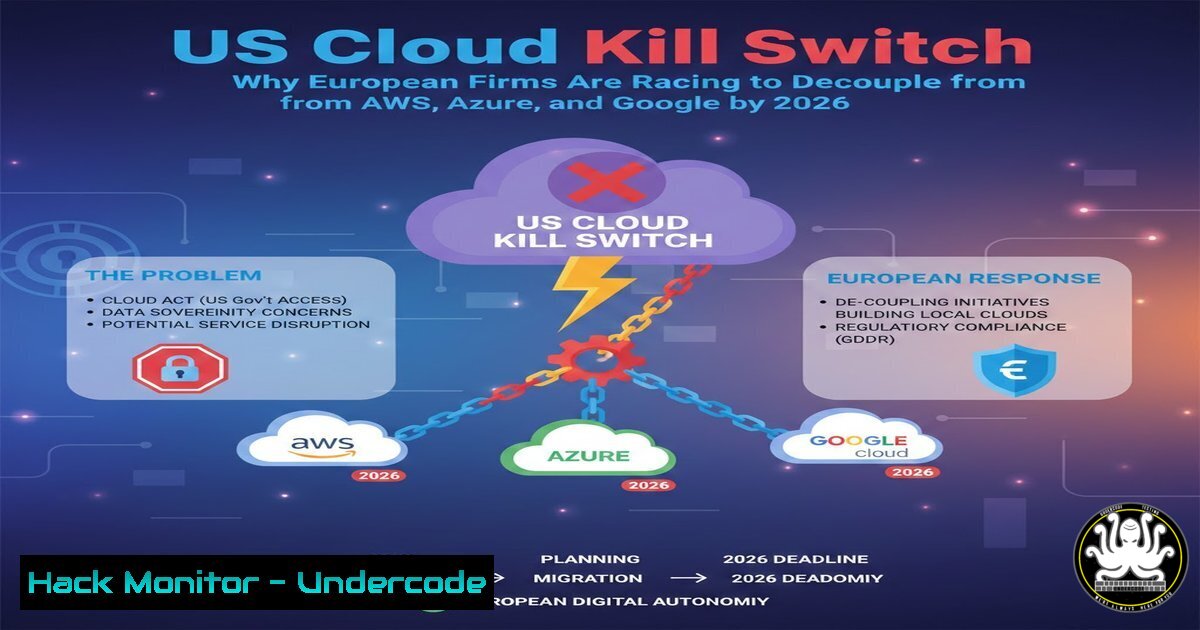
Introduction:
The long-standing assumption that data stored in European data centers by US hyperscalers is safe from American jurisdiction is crumbling. Recent political shifts and the firing of key oversight board members have exposed the fragility of the EU-US Data Privacy Framework, reigniting fears over the CLOUD Act and FISA 702 . For cybersecurity and IT professionals, this isn’t just a legal battle; it is a technical crisis of “legal access” versus “technical controls,” where the kill switch for critical infrastructure lies not in Europe, but in Washington D.C. .
Learning Objectives:
- Objective 1: Understand the technical implications of the CLOUD Act, FISA, and the “kill switch” on cloud architecture and IAM.
- Objective 2: Learn how to execute a technical Transfer Impact Assessment (TIA) to identify data leakage points.
- Objective 3: Implement open-source and self-hosted alternatives to US hyperscalers to achieve true digital sovereignty.
You Should Know:
- The Legal Backdoor: Why Encryption Isn’t Enough Against US Surveillance
It is a common misconception that encrypting data renders it safe from government overreach. However, laws like the CLOUD Act and FISA 702 target the keys and the identities. The United States can compel US-based companies (like Microsoft, AWS, and Google) to hand over data they control, regardless of where it is stored .
Specifically, FISA 702 allows warrantless collection of communications data of non-US persons. If your organization uses a US-based Identity and Access Management (IAM) solution, the US government can compel the vendor to hand over:
– Authentication logs and access patterns.
– Biometric data and password hashes.
– Role-based privileges across enterprise apps .
Technical Guide: Verifying Data Residency and Legal Exposure
To check if your data is technically accessible to US authorities, you must audit the control plane, not just the data plane.
Linux Command to trace the physical route of your data path (Checking for ICMP and backbone ownership):
 Trace the route to your cloud provider's European endpoint
 Look for hops that revert to US-based backbone providers (Level3, Cogent, etc.)
mtr --report-wide your-eu-cloud-instance.cloudprovider.com

Use whois to check the ownership of the IP blocks in the route
whois <IP_ADDRESS_OF_HOP> | grep -i "OrgName|CIDR"
Windows PowerShell (Testing for Legal Hold API exposure):
Often, the risk isn’t the data at rest, but the management APIs. Use `curl` to test if your logs are being shipped to non-EU regions.
 Check Azure Activity Logs diagnostic settings to ensure they are not exported to US regions
Get-AzDiagnosticSetting -ResourceId <your_resource_id> | Select-Object -Property WorkspaceId, StorageAccountId

Ensure the WorkspaceId points to a EU region (e.g., westeurope)
- The “Kill Switch” Scenario: Preparing for Sudden Service Termination
The comment by Dario Maisto in the source discussion mentions the “kill switch.” This refers to the ability of the US government to force companies to stop providing services to specific entities (like the Amsterdam Trade Bank precedent) . This is an existential risk—losing access to systems, not just data.
Step‑by‑step guide: Building a Geographically Redundant, Sovereign Failover
To mitigate the “kill switch,” you cannot rely solely on US hyperscalers. You need a hybrid or multi-cloud approach with independent European providers.
- Identify Critical Workloads: List systems that would cause business death if switched off.
- Deploy Open-Source PaaS: Utilize open-source platforms like Hop3 (developed by Abilian) which allows you to deploy F/OSS applications on your own infrastructure, breaking reliance on proprietary control planes .
- Implement Active-Active DNS with Geo-Fencing: Use a European DNS provider that allows you to block traffic from US-controlled IP ranges if sanctions hit.
Configuration Snippet (using BIND views for sovereignty):
 In /etc/named.conf, create views to serve different DNS records
view "internal-sovereign" {
match-clients { 192.168.1.0/24; };  Your internal EU office
recursion yes;
zone "critical-app.local" {
type master;
file "critical-app.internal.db";  Points to on-prem sovereign cloud
};
};

view "external" {
match-clients { any; };
recursion no;
zone "critical-app.local" {
type master;
file "critical-app.external.db";  Points to public cloud (expendable)
};
};
3. Identity and Access Management (IAM) Sovereignty
If the US government can compel Microsoft to hand over your Azure AD (now Entra ID) logs, they have a map of your entire digital estate. The comment by XWiki highlights that self-hosting open-source software is the only way to ensure no hidden dependencies .
Step‑by‑step guide: Migrating from Azure AD/Okta to Open-Source IAM (Keycloak)
1. Extract User Data:
 PowerShell for Azure AD (Export users with attributes)
Connect-AzureAD
Get-AzureADUser -All $true | Export-Csv -Path "users_export.csv" -NoTypeInformation
2. Hash Migration: Ensure passwords are migrated using compatible hashing algorithms (Keycloak supports BCrypt, PBKDF2, etc.). Use Python to convert AD hashes.
3. Deploy Keycloak on Sovereign Hardware:
 On a European VPS (e.g., Hetzner, OVH)
docker run -p 8080:8080 -e KEYCLOAK_ADMIN=admin -e KEYCLOAK_ADMIN_PASSWORD=change_me quay.io/keycloak/keycloak:latest start-dev
4. Configure Federation: Instead of relying on US-based social logins (Google/GitHub), federate with EU-based identity providers or SAML.
- Hardening Against the Cloud (CLOUD) Act with Encryption
Simon Besteman notes that “PKE doesn’t support email,” meaning standard email encryption doesn’t protect metadata . To truly protect against data seizures, you need technologies that prevent the server from even seeing the search terms.
Technical Deep Dive: Implementing dIBAEKS (Designated-server Identity-Based Authenticated Encryption with Keyword Search)
Recent research suggests moving towards dIBAEKS to prevent “inside offline keyword guessing attacks.” This ensures that even if the US government compels the cloud server to search, the server cannot guess what keyword (e.g., “Project X”) the user is searching for because only the designated server can test the trapdoor .
Conceptual CLI for managing encrypted email search (using hypothetical tools):
 Sender side: Encrypt email and keywords for receiver ([email protected]) at server mail.sovereign.eu
dIBAEKS-encrypt --receiver [email protected] --keyword "ProjectAlpha" --file confidential.pdf --output confidential.pdf.enc

Receiver side: Generate a trapdoor for the server to search, without revealing the keyword to the server
dIBAEKS-trapdoor --receiver [email protected] --keyword "ProjectAlpha" --output trapdoor.token

Server side: Use its own secret key to test the trapdoor against the index
dIBAEKS-test --server-key /etc/mailserver.key --trapdoor trapdoor.token --index ./mail_index/
5. Supply Chain Attacks and Silicon Sovereignty
The discussion touches on the broader issue of control. Lars Marowsky-Brée points out that even if data is local, the software supply chain is still American . If a vulnerability is found, the patch comes from the US. If Trump makes a policy change, the software could change behavior overnight.
Step‑by‑step guide: Creating a Local Mirror for Vulnerability Patching
To ensure you can patch even if transatlantic links are severed, maintain a local repository mirror.
Linux (Debian/Ubuntu) – Local Apt Mirror for Security Updates:
 Install apt-mirror
sudo apt-get install apt-mirror

Edit /etc/apt/mirror.list to point to a European archive (e.g., ftp.debian.org) and security.debian.org
sudo nano /etc/apt/mirror.list

Run the mirror (ensure you have several TB of storage)
sudo apt-mirror /etc/apt/mirror.list

Serve the mirror via Apache or Nginx internally
 Clients point their sources.list to http://internal-mirror.local/debian
6. Transfer Impact Assessment (TIA) for Security Engineers
Under GDPR, you must conduct a TIA before transferring data to the US, even with Standard Contractual Clauses (SCCs) . As a security engineer, you must provide evidence of technical controls.
Checklist for TIA Technical Documentation:
- Data Lineage: Map all API calls that leave the EU. Use `tcpdump` to capture egress traffic to AWS S3 buckets in
us-east-1.sudo tcpdump -i eth0 -n host <cloud-provider-ip> and port 443 -w egress_to_us.pcap
- Key Management: Verify that encryption keys are stored in an HSM located in the EU and are not escrowed by the US parent company.
For Azure: Check Key Vault region
az keyvault show --name <your-kv> --query "properties.location"
- Subprocessor Audit: Scrape the vendor’s subprocessor list to ensure no US-based subcontractors (e.g., AWS support staff in the US) are accessing logs.
What Undercode Say:
- Trust is a Protocol, Not a Press Release: European legal entities of US clouds are “sovereign-washing.” The kill switch is real, and the control plane remains in the US. Technical audits must verify jurisdiction, not just data residency.
- Open Source is the only Verifiable Sovereignty: As highlighted by XWiki and the Hop3 project, only when the code is auditable, the infrastructure is self-owned, and the supply chain is localized can an organization claim true digital sovereignty .
The analysis of the current geopolitical landscape reveals that the era of blind trust in hyperscalers is over. Security professionals must shift their focus from merely “securing the cloud” to “securing from the cloud.” This involves implementing complex cryptographic controls like dIBAEKS to prevent keyword guessing, deploying open-source IAM alternatives, and architecting for immediate failover to European providers. The dependency on US jurisprudence is now a technical debt that must be paid down with code and infrastructure, not just legal agreements.
Prediction:
Within the next 18 months, we will see the emergence of a “Digital Schengen” zone for data. The EU will likely fast-track certification for cloud services that are legally and technically immune to non-EU jurisdiction. This will bifurcate the cloud market: US hyperscalers will be relegated to handling non-sensitive, general-purpose workloads, while a new wave of European Open-Source PaaS providers will capture government, healthcare, and defense contracts. The CISO role will increasingly merge with that of a geopolitical risk officer.
▶️ Related Video (72% Match):
🎯Let’s Practice For Free:
IT/Security Reporter URL:
Reported By: Simonbesteman Its – Hackers Feeds
Extra Hub: Undercode MoN
Basic Verification: Pass ✅


