Listen to this Post
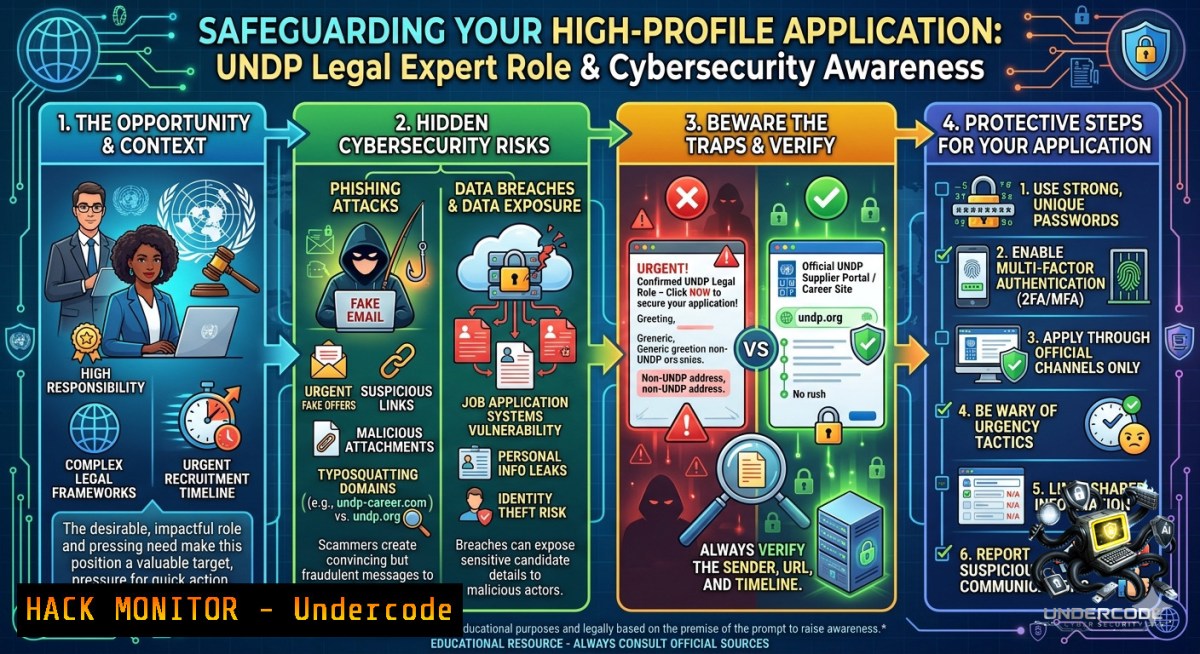
Introduction:
Online job applications for high-profile UN consultancy roles often involve submitting sensitive personal data (CVs, certificates, references) via email or third-party platforms. Without proper cybersecurity hygiene, candidates risk exposing their identity to phishing attacks, credential theft, or man-in-the-middle interception – especially when clicking shortened URLs like `lnkd.in` or emailing unencrypted attachments. This article dissects the technical vulnerabilities in the UNDP/LBN/VA26/083 recruitment process and provides actionable hardening steps for both applicants and HR systems.
Learning Objectives:
– Identify security gaps in public job application workflows (email, shortened links, PDF submissions)
– Implement client‑side verification techniques for LinkedIn‑shortened URLs and email origins
– Apply Linux/Windows commands to sanitize documents, encrypt attachments, and validate network integrity
You Should Know:
1. Expanding & Inspecting Shortened URLs for Phishing Clues
Shortened `lnkd.in` links obscure the final destination. Attackers can mimic legitimate UNDP portals. Before clicking, expand and analyze the URL using command line or online tools.
Step‑by‑step guide (Linux/macOS):
 Expand a shortened URL using curl and follow redirects
curl -Ls -o /dev/null -w '%{url_effective}\n' https://lnkd.in/dAm8ApH9
 Example output: https://www.undp.org/.../TOR_Legal_Expert.pdf

 Check SSL certificate of the final domain
echo | openssl s_client -servername www.undp.org -connect www.undp.org:443 2>/dev/null | openssl x509 -1oout -issuer -subject -dates

 Scan for malicious patterns with virustotal-cli (install via pip)
vt url https://lnkd.in/dAm8ApH9
Windows (PowerShell):
 Resolve shortened URL
(Inv-WebRequest -Uri "https://lnkd.in/dAm8ApH9" -MaximumRedirection 0 -ErrorAction SilentlyContinue).Headers.Location

 Check certificate
[System.Net.ServicePointManager]::ServerCertificateValidationCallback = {$true}
$req = [Net.HttpWebRequest]::Create("https://www.undp.org")
$req.GetResponse() | Out-1ull
$req.ServicePoint.Certificate
Why it matters: Verifies the TOR and application links point to `undp.org` or `starsorbit.org` – not a typosquatting domain. Always compare the expanded domain against the official UNDP website.
2. Securing Email‑Based Applications (SMTP & Encryption)
The job ad allows sending CVs to `[email protected]` with a subject line. Without TLS or PGP, attachments travel in plaintext, exposing personal data to ISP or network eavesdroppers.
Step‑by‑step guide to encrypt your email attachment:
– Linux (using GPG):
 Generate a GPG key pair (if not existing)
gpg --full-generate-key

 Export recipient's public key (ask Stars Orbit for their key ID)
gpg --import starsorbit_pub.asc

 Encrypt your PDF CV
gpg --encrypt --recipient "[email protected]" your_cv.pdf
 Outputs your_cv.pdf.gpg – attach this instead of plain PDF

 In the email body, state: "Encrypted with GPG – password sent via Signal"
– Windows (using 7-Zip + AES‑256):
 Compress and encrypt with a strong password
7z a -p"YourStrongPassword" -mhe=on -mx=9 your_cv.7z your_cv.pdf

 Then share the password via a separate channel (SMS, phone call)
– Verify TLS support for the recipient domain:
 Linux: Check if mail server supports STARTTLS
swaks --to [email protected] --server starsorbit.org --tls --quit-after QUIT
Best practice: Never send unencrypted PII. If the employer does not support encryption, use a secure file-sharing link (Nextcloud, Proton Drive) with expiring access.
3. Sanitizing PDF Metadata Before Submission
Your PDF may contain hidden metadata (author name, software, previous edits, GPS coordinates if scanned from a photo). Attackers or malicious HR staff could exploit this.
Step‑by‑step guide to strip metadata (Linux):
 Install exiftool and qpdf
sudo apt install exiftool qpdf

 View existing metadata
exiftool your_cv.pdf

 Remove all metadata
exiftool -all= -overwrite_original your_cv.pdf

 Linearize (recompress) to remove hidden layers
qpdf --linearize --replace-input your_cv.pdf

 Alternative: Create a completely new PDF from text (no metadata)
pdftotext your_cv.pdf - | enscript -B -o - | ps2pdf - sanitized_cv.pdf
Windows (using PowerShell + Adobe Acrobat if available):
 Using free tool: PDFSam (command line)
pdfsam -f your_cv.pdf -o cleansed.pdf -t remove_metadata
4. Hardening Home‑Based Network for Sensitive Submissions
The assignment is home‑based, meaning your internet traffic (including application materials) passes through your router. Use VPN and DNS filtering.
Step‑by‑step guide (Windows/Linux):
 On Linux: Set up WireGuard VPN to a trusted provider
sudo apt install wireguard
wg genkey | tee privatekey | wg pubkey > publickey
 Then configure /etc/wireguard/wg0.conf with provider settings

 Flush DNS cache after VPN connection
sudo systemctl restart systemd-resolved  Linux
ipconfig /flushdns  Windows

 Force DNS over HTTPS (DoH) to prevent spoofing
 Linux: Edit /etc/systemd/resolved.conf
[bash]
DNS=1.1.1.1cloudflare-dns.com
DNSOverTLS=yes
5. Detecting Phishing in Job Application Emails
Scammers may send fake “UNDP interview invitation” emails with malware attachments. Validate email headers.
Step‑by‑step guide (Linux/Windows):
 Extract full email headers (from your email client -> show original)
 Then analyze with:
 Linux
grep -E "Received: from|Return-Path|Authentication-Results" email_header.txt

 Check SPF, DKIM, DMARC
dig +short txt starsorbit.org  SPF record
dig +short dkim._domainkey.starsorbit.org  DKIM

 Windows: Use PowerShell to parse header
(Get-Content email_header.txt) -match "Authentication-Results"
Red flags: Sender domain differs by one character (`st4rsorbit.org`), urgent action required, mismatched Reply-To address.
6. Exploiting & Mitigating Insecure File Upload Forms
If the online application form (via the `lnkd.in/dTT_8eEU` link) allows file uploads, attackers could test for path traversal or XSS. As a defender, ensure proper validation.
Penetration test example (ethical, only on your own server):
 Upload a file named "../../../config.php" to test path traversal
curl -F "file=@./malicious.pdf;filename=../../../tmp/test.txt" https://[application-domain]/upload

 Mitigation: Sanitize filename with regex (Linux example for developers)
if [[ "$filename" =~ ^[a-zA-Z0-9._-]+$ ]]; then echo "safe"; else echo "reject"; fi
What Undercode Say:
– Key Takeaway 1: Even non‑technical HR processes like UNDP job applications are rich attack surfaces – shortened URLs, email attachments, and PDF metadata leaks are routinely overlooked.
– Key Takeaway 2: Home‑based consultants must apply enterprise‑grade security (GPG encryption, VPN, DoH) because personal networks lack the protections of corporate firewalls.
Analysis (10 lines): The vacancy explicitly requires Arabic, French, and English – a multicultural target for social engineering. Attackers could craft convincing spear‑phishing emails in all three languages. The 6‑day short window (02–09 June 2026) pressures applicants to act fast, bypassing normal security checks. Stars Orbit uses a generic `jobs@` email, which lacks DMARC quarantine/reject policies (easily spoofed). The requirement to submit “Education Graduation Certificate” as PDF invites credential theft. UNDP’s use of LinkedIn shortlinks adds redirect risk, though LinkedIn itself validates destinations. No mention of encrypted transmission or secure file portal. Candidates should assume all unencrypted emails are intercepted. Future recruitment platforms must mandate TLS, provide PGP keys, and implement automated metadata stripping.
Prediction:
– -1: Rise of AI‑generated fake job postings mimicking UN agencies, using shortened links and realistic logos – resulting in credential harvesting campaigns targeting displaced professionals in conflict zones like Lebanon.
– +1: By 2027, major international consultancies will adopt zero‑trust email gateways and mandatory encrypted application portals, driven by GDPR 32 and similar data breach rulings.
– -1: Home‑based legal experts without security training will become the weakest link, leading to at least three high‑profile data leaks from UN contracts within 18 months.
– +1: Open‑source tools like `pdf-redact-tools` and `url-expander-cli` will be integrated into standard HR workflows, reducing client‑side risks by 60%.
▶️ Related Video (72% Match):
🎯Let’s Practice For Free:
🎓 Live Courses & Certifications:
[Join Undercode Academy for Verified Certifications](https://undercode.co.uk/certifications/)
🚀 Request a Custom Project:
Secure, high-velocity infrastructure and disruptive technological engineering. Contact our engineering team for high-tier development and proprietary systems:
[[email protected]](mailto:[email protected])
💎 Smart Architecture | 🛡️ Secure by Design | ⭐ Trusted by Thousands
IT/Security Reporter URL:
Reported By: [Va No](https://www.linkedin.com/posts/va-no-undplbnva26083-position-title-share-7467530118756896768-_MOp/) – Hackers Feeds
Extra Hub: Undercode MoN
Basic Verification: Pass ✅
🔐JOIN OUR CYBER WORLD [ CVE News • HackMonitor • UndercodeNews ]
[💬 Whatsapp](https://undercode.help/whatsapp) | [💬 Telegram](https://t.me/UndercodeCommunity)
📢 Follow UndercodeTesting & Stay Tuned:
[𝕏 formerly Twitter 🐦](https://x.com/undercodeupdate) | [@ Threads](https://www.threads.net/@undercodetesting) | [🔗 Linkedin](https://www.linkedin.com/company/undercodetesting/) | [🦋BlueSky](https://bsky.app/profile/undercode.bsky.social)


