
Listen to this Post
Introduction:
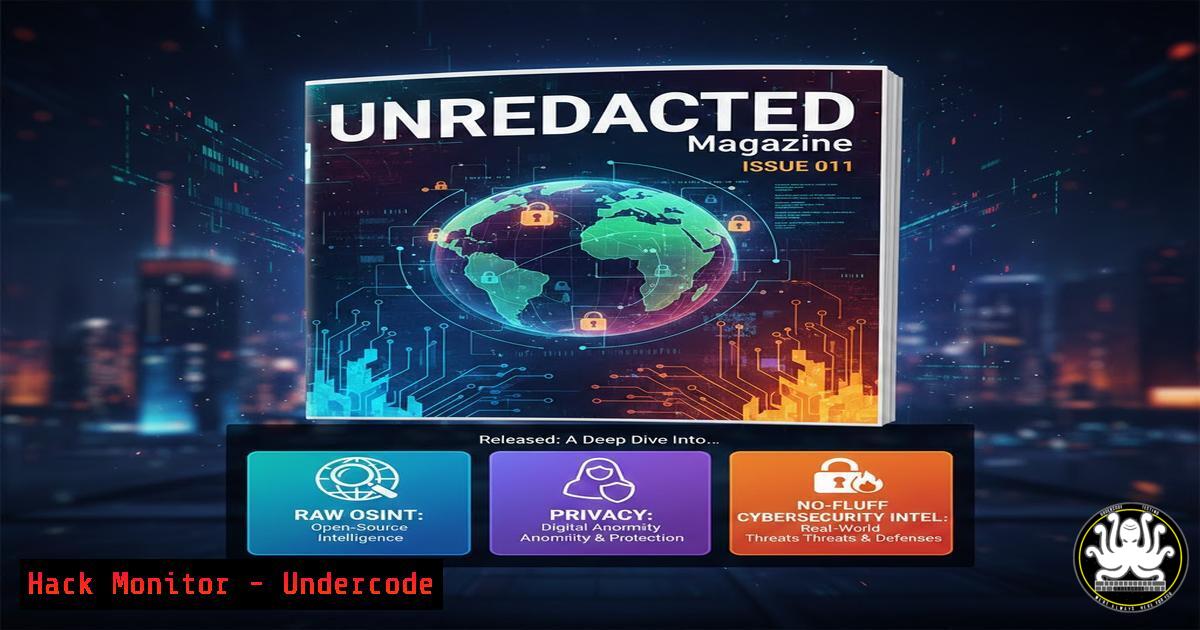
In an online ecosystem saturated with sponsored content, biased reporting, and superficial tech blogs, the release of Michael Bazzell’s UNREDACTED Magazine Issue 011 serves as a critical countermeasure for cybersecurity professionals. This 77-page publication strips away the noise to deliver raw intelligence and hands-on methodologies for Open-Source Intelligence (OSINT), operational security (OpSec), and advanced digital privacy. For IT and AI engineers, this resource provides unfiltered technical data essential for hardening systems, conducting threat research, and understanding the current landscape of data exposure.
Learning Objectives:
- Understand the value of ad-free, unfiltered intelligence feeds for cybersecurity research.
- Analyze advanced OSINT techniques for asset discovery and vulnerability assessment.
- Implement practical OpSec measures derived from raw investigative journalism.
You Should Know:
1. The Philosophy of “No Fluff” Intelligence Gathering
Michael Bazzell’s work, specifically within UNREDACTED, rejects the typical tech media model of filler content. For a cybersecurity expert, this translates to a focus on direct, applicable data. The magazine often includes technical walkthroughs, data broker opt-out guides, and investigative case studies that reveal how personal and corporate data is actually exposed online. This approach is vital for IT teams tasked with reducing the corporate attack surface; by understanding how adversaries scrape data, defenders can better simulate those attacks to find their own leaks.
2. Practical OSINT: Reconnaissance and Data Validation
One of the core pillars of UNREDACTED is advanced OSINT. To simulate the techniques discussed, a security professional must be proficient in using command-line tools to gather and parse data. Below are practical steps to validate digital assets, a common theme in such investigative reports.
Step‑by‑step guide: Analyzing URL Reputation and Infrastructure
This process helps you determine if a URL (like those shared in the magazine post) is safe and what infrastructure it uses.
- Linux/macOS (using cURL and WHOIS):
First, inspect the HTTP headers of the target to see the server technology and security policies without downloading the full content.curl -I https://payhip.com
What this does: Fetches only the headers. Look for
Server,X-Frame-Options, and `Content-Security-Policy` to gauge basic security posture.
Next, perform a WHOIS lookup to identify the hosting provider and registration details, which is crucial for threat intelligence.
whois payhip.com | grep -E 'Registrar|Creation Date|Name Server'
What this does: Filters the WHOIS record to show only the registrar, when the domain was created, and its nameservers. This helps in identifying if a domain is new (potentially malicious) or using suspicious infrastructure.
- Windows (PowerShell):
For Windows environments, you can use `Resolve-DnsName` to verify domain resolution and `Test-NetConnection` for port checks.Resolve-DnsName payhip.com | Format-List Test-NetConnection payhip.com -Port 443
What this does: The first command resolves the domain to its IP addresses. The second checks if HTTPS (port 443) is open and accessible, verifying the web service is operational.
3. Configuring a Sandboxed Environment for Intel Analysis
When dealing with raw data or links from independent publications, isolating your analysis environment is crucial. Virtualization is key.
Step‑by‑step guide: Setting up a Disposable VM with Linux for URL Analysis
This guide uses `virt-manager` (KVM/QEMU) on a Linux host, a recommended setup for forensic analysis discussed in privacy circles.
- Step 1: Install KVM and Virt-Manager.
sudo apt update && sudo apt install qemu-kvm libvirt-daemon-system virt-manager -y
sudo systemctl enable --now libvirtd
sudo adduser $USER libvirt
What this does: Installs the virtualization stack, starts the service, and adds your user to the `libvirt` group to manage VMs without root.
-
Step 2: Create a “Disposable” VM.
Openvirt-manager. Create a new VM, install a lightweight Linux distribution (like Xubuntu or Debian netinstall). After installation, configure the network to use “NAT” to keep it isolated from your host LAN but allow internet access. -
Step 3: Snapshot Clean State.
Before using the VM to visit any links (like the UNREDACTED Payhip page), shut down the VM. Invirt-manager, right-click the VM and select “Snapshot”. Create a snapshot named “Clean-Install”.
What this does: Allows you to revert the VM to this exact clean state after you have finished your analysis, ensuring no malware or tracking cookies persist.
4. API Security: Automating Threat Feeds
Modern AI and cybersecurity engineering involves consuming threat intelligence feeds via APIs. If you were to integrate a publication’s data feed (if available) or create a scraper for indicators of compromise (IOCs), you must secure the API keys.
Step‑by‑step guide: Hardening API Credentials in Linux
Never hardcode credentials in scripts.
- Using Environment Variables:
Instead of writing `api_key = “xyz123″` in your Python script, export it in your shell.export UNREDACTED_API_KEY="your_super_secret_key_here"
Then, in your Python script:
import os
api_key = os.getenv('UNREDACTED_API_KEY')
print(f"Using API Key: {api_key[:4]}...")  Only print first 4 chars for verification
What this does: Keeps the key out of your source code and script history. It resides only in the shell’s memory for that session.
- Using Encrypted Vaults (Ansible Vault):
For more complex configurations, use `ansible-vault`.
ansible-vault create secrets.yml
Enter your vault password, then add content like api_key: your_key. To use it, you would reference it in playbooks, decrypting only at runtime.
5. Cloud Hardening: Data Leak Prevention
Publications like UNREDACTED often expose how data brokers operate. From a cloud security perspective, this highlights the need for strict access controls to prevent your own data from ending up in these brokers.
Step‑by‑step guide: Auditing Public S3 Buckets (AWS CLI)
A common source of data leaks is misconfigured cloud storage.
- Step 1: Install and Configure AWS CLI.
pip install awscli --upgrade
aws configure
Enter your Access Key ID, Secret Access Key, and default region.
-
Step 2: Check for Public Buckets.
List all your buckets and check their ACLs (Access Control Lists).aws s3api list-buckets --query "Buckets[].Name" --output text | xargs -I {} aws s3api get-bucket-acl --bucket {} --query "Grants[?Grantee.URI=='http://acs.amazonaws.com/groups/global/AllUsers']"What this does: This one-liner lists all buckets, then for each bucket, queries the ACL to see if there is a grant for “AllUsers” (public access). If any results return, you have a bucket that is publicly readable—a critical finding.
What Undercode Say:
- Key Takeaway 1: In an era of AI-generated content and sponsored tech reviews, raw, ad-free resources like UNREDACTED Magazine are indispensable for the serious security practitioner. They provide the unfiltered truth about vulnerabilities and investigative techniques that commercial entities often avoid.
- Key Takeaway 2: The skillset required to utilize such intelligence goes beyond reading. It demands hands-on proficiency with command-line tools for OSINT (cURL, WHOIS), virtualization for safe analysis (KVM), and cloud hardening (AWS CLI) to translate knowledge into actionable defense.
- Analysis: The release of issue 011 is a reminder that the cybersecurity field is ultimately a battle of information. Those who rely on curated, sanitized data are always one step behind. By consuming and applying the raw methodologies championed by experts like Bazzell, engineers and analysts can proactively identify their own exposure, understand adversarial tradecraft, and build resilient systems based on reality rather than marketing fluff. The 77 pages likely contain actionable commands and techniques that can be immediately applied to any security stack.
Prediction:
As AI becomes capable of generating convincing but often misleading “analysis,” the value of human-curated, raw investigative journalism in cybersecurity will skyrocket. We will see a shift where elite security teams prioritize subscriptions to independent, ad-free intelligence sources over generalized threat feeds. The future of defense lies not in more data, but in the quality and rawness of the intelligence used to train models and inform human decisions. Expect tools and techniques featured in publications like UNREDACTED to become the baseline curriculum for advanced cybersecurity training programs within the next 12–18 months.
▶️ Related Video (76% Match):
🎯Let’s Practice For Free:
IT/Security Reporter URL:
Reported By: Michael Bazzell – Hackers Feeds
Extra Hub: Undercode MoN
Basic Verification: Pass ✅


