
Listen to this Post
Introduction:
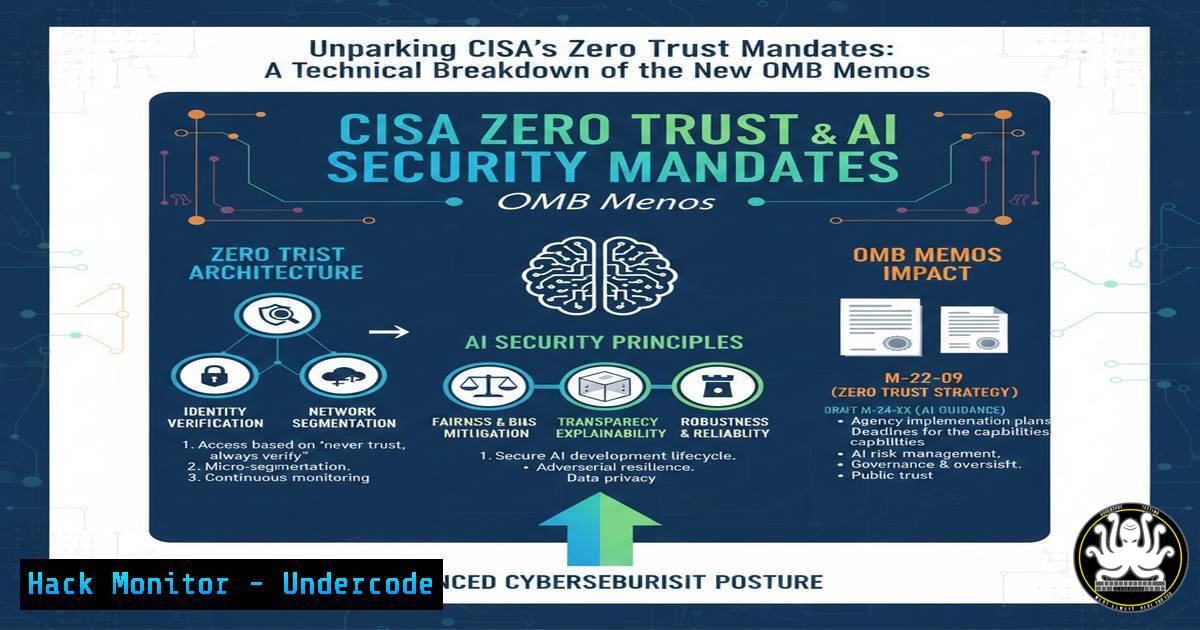
In a significant push to modernize federal cybersecurity, the Office of Management and Budget (OMB), in coordination with CISA, has released a series of memos mandating strict zero trust architecture (ZTA) implementation and governing the safe use of Artificial Intelligence (AI) within federal agencies. These directives move beyond theoretical frameworks, demanding specific technical controls, inventory management, and vulnerability remediation timelines. For security professionals, this signals a shift from planning to enforced execution, impacting everything from identity management to software supply chains.
Learning Objectives:
- Understand the specific technical requirements outlined in the OMB memos regarding Zero Trust and AI.
- Identify the critical deadlines and compliance metrics for federal agencies and their contractors.
- Learn the command-line and configuration steps necessary to audit systems against these new standards.
- Analyze the implications of AI-specific security mandates on development and operations.
You Should Know:
- The End of Implicit Trust: Enforcing Identity as the Perimeter
The memo explicitly dismantles the concept of network location as a primary security control. Agencies must implement continuous, multi-faceted identity verification for every access request, regardless of origin. This requires a shift to technologies like phishing-resistant Multi-Factor Authentication (MFA) and least-privilege access policies.
Step‑by‑step guide: Auditing Active Directory for Privileged Accounts
To comply, administrators must first identify where implicit trust currently exists. A critical first step is auditing privileged accounts that might bypass MFA.
1. On a Domain Controller or management machine, open PowerShell as an administrator.
2. Run the following command to find all members of the high-privilege domain groups:
Get-ADGroupMember -Identity "Domain Admins" | Select-Object Name, SamAccountName
Get-ADGroupMember -Identity "Enterprise Admins" | Select-Object Name, SamAccountName
3. To identify accounts configured for service principal names (SPNs) which often have passwords that rarely change and can be targeted for Kerberoasting, use:
Get-ADUser -Filter {ServicePrincipalName -ne "$null"} -Properties ServicePrincipalName | Select-Object Name, ServicePrincipalName
4. Cross-reference this list with your MFA provider’s enrollment reports. Any account without MFA configured represents a direct violation of the new mandates and must be remediated immediately.
- Asset Inventory and Vulnerability Management: You Cannot Protect What You Cannot See
The memos stress the need for comprehensive, automated asset discovery. Agencies are no longer permitted to operate with partial visibility. This necessitates deploying endpoint detection and response (EDR) agents across all assets, including legacy systems and cloud workloads.
Step‑by‑step guide: Linux Endpoint Discovery and Agent Deployment Verification
Ensuring visibility on Linux servers is paramount. Here is how to verify the installation status of a common EDR agent (using Falco as an open-source example) and ensure it’s running.
1. SSH into the Linux server.
- Check if the Falco driver is loaded (similar checks apply to CrowdStrike, SentinelOne, etc.):
Check for the Falco kernel module
lsmod | grep falco
Or check for the eBPF probe
sudo bpftool prog list | grep falco
- Verify the service is active and enabled to start on boot (a key compliance requirement):
sudo systemctl status falco --no-pager -l
Look for "Active: active (running)" and ensure it is enabled
sudo systemctl is-enabled falco
- If the service is not running, attempt to start it and investigate logs:
sudo systemctl start falco
sudo journalctl -u falco --since "5 minutes ago"
- To scan for unmanaged assets on the network (simulating a CISA requirement), use `nmap` to compare live hosts against your CMDB:
Scan a specific subnet for live hosts
sudo nmap -sn 192.168.1.0/24 | grep "Nmap scan" | awk '{print $5}' > live_hosts.txt
Compare this list to your authorized asset list (assuming you have one in authorized_hosts.txt)
grep -v -f authorized_hosts.txt live_hosts.txt
Any IP address output by the last command represents an unmanaged or “shadow IT” asset requiring immediate investigation.
3. AI Security: Protecting Models and Pipelines
The memo addresses the unique risks of AI, focusing on the security of development pipelines (MLSecOps) and the protection of training data from poisoning and exfiltration. This requires hardening the CI/CD pipelines used to build and deploy models.
Step‑by‑step guide: Hardening a JupyterHub Environment
Many data science teams use JupyterHub, which can be a significant risk if misconfigured. Here’s how to apply basic security hardening in line with the memo’s intent.
1. Restrict Access by IP (in `jupyterhub_config.py`):
 Add this to restrict access to a specific internal network
c.JupyterHub.ip = '10.0.0.0'
c.JupyterHub.port = 8000
2. Enforce HTTPS with a valid certificate (using a reverse proxy like nginx, but ensure Jupyter itself is secure):
 Ensure cookies are only sent over HTTPS
c.JupyterHub.tornado_settings = {
'headers': {
'X-Frame-Options': 'DENY',
'Strict-Transport-Security': 'max-age=31536000; includeSubDomains; preload',
}
}
3. Implement Resource Limits to prevent a compromised model training job from launching a denial-of-service attack on the host:
 Using the systemd spawner as an example
from jupyterhub_systemdspawner import SystemdSpawner
c.JupyterHub.spawner_class = SystemdSpawner
c.SystemdSpawner.mem_limit = '8G'  Limit memory to 8 Gigabytes
c.SystemdSpawner.cpu_limit = 4  Limit to 4 CPU cores
4. Logging and Monitoring: The Non-Negotiable Baseline
The mandate reinforces that logging is not optional. Specifically, it requires centralized, searchable logs for all critical events: authentication, authorization changes, and resource access. The focus is on immutability and retention.
Step‑by‑step guide: Configuring Linux Auditd for File Integrity Monitoring
To meet the requirement of tracking access to sensitive files (e.g., training datasets, configuration files), `auditd` must be configured.
1. Add rules to monitor key AI-related directories (e.g., /data/models, /etc/mlflow). Edit /etc/audit/rules.d/audit.rules:
 Monitor all write and attribute changes to model files
-w /data/models -p wa -k model_integrity
 Monitor changes to MLflow configuration
-w /etc/mlflow/mlflow.conf -p wa -k mlflow_config
2. Load the new rules and verify them:
sudo augenrules --load
sudo auditctl -l
3. To search for events related to the `model_integrity` key:
sudo ausearch -k model_integrity --start today
What Undecode Says:
- Key Takeaway 1: The OMB memos transform “Zero Trust” from a buzzword into a strict compliance framework with teeth. Security teams must move beyond conceptual diagrams and implement concrete, auditable controls like device compliance checks before granting access, or risk losing funding and authorization to operate.
- Key Takeaway 2: AI security is no longer just about algorithmic bias; it is now firmly in the domain of infrastructure security. The mandates force a convergence of data science and IT security (DevSecOps for ML), requiring controls against prompt injection, model theft, and data poisoning to be as robust as traditional perimeter defenses.
The reality is that these federal mandates will soon become the de facto standard for any enterprise doing business with the government, and likely a benchmark for the private sector. The era of fragmented security is ending; centralized visibility, automated response, and cryptographic proof of identity are now the baseline for survival in the modern threat landscape.
Prediction:
This will accelerate the consolidation of the security vendor market. Agencies will struggle to integrate disparate “best-of-breed” tools to meet these integrated mandates, leading to a surge in adoption of unified platforms (like CNAPPs and XDRs) that can provide the required visibility and control out-of-the-box. We will also see a sharp rise in the targeting of AI/ML pipelines by state-sponsored actors, attempting to exploit the very vulnerabilities these new memos are trying to patch.
▶️ Related Video (76% Match):
🎯Let’s Practice For Free:
IT/Security Reporter URL:
Reported By: Greg Coquillo – Hackers Feeds
Extra Hub: Undercode MoN
Basic Verification: Pass ✅


