
Listen to this Post
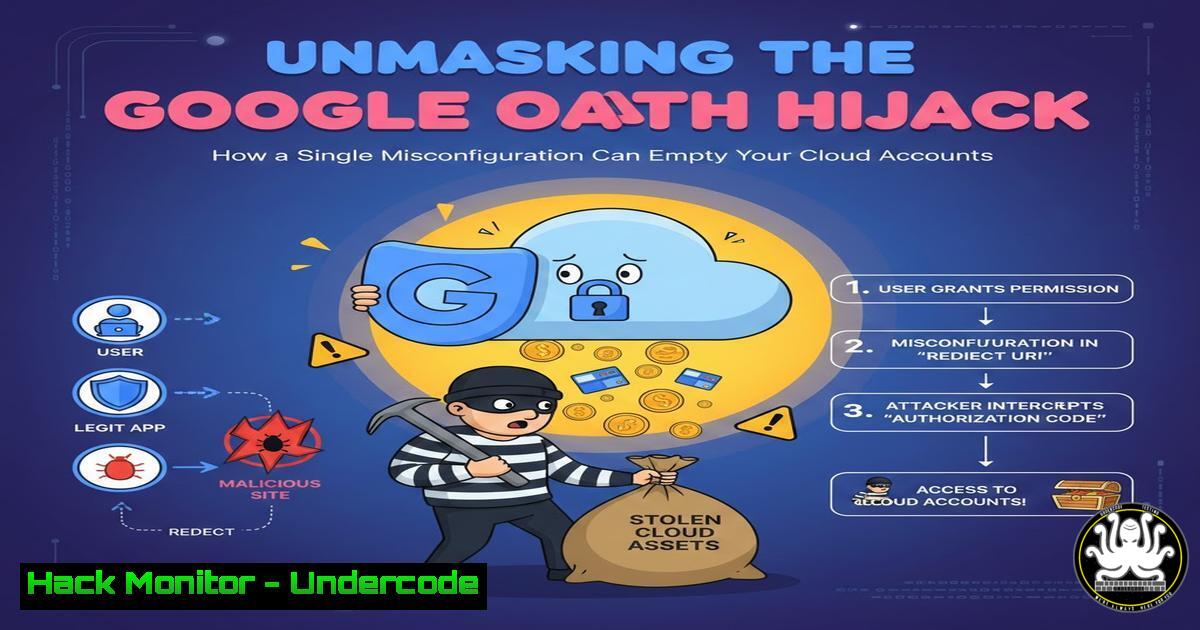
Introduction:
A sophisticated credential harvesting campaign is exploiting trusted Google OAuth prompts to trick users into granting access to their cloud environments. This attack chain leverages legitimate cloud runtimes and open redirects to create an almost undetectable phishing flow, bypassing traditional security filters. Understanding this technique is critical for cloud security professionals and DevOps engineers managing cloud infrastructure.
Learning Objectives:
- Decode the anatomy of a sophisticated OAuth-based credential harvesting attack
- Implement hardening measures for cloud runtimes and OAuth consent configurations
- Develop detection strategies for malicious OAuth token generation and usage
You Should Know:
- The Attack Chain: From Open Redirect to Full Compromise
The attack begins with a seemingly legitimate Google OAuth consent screen pointing to a trusted domain like cloud[-]run.app. The malicious flow exploits an open redirect vulnerability combined with carefully crafted CSS to present a convincing authentication prompt.
Step-by-step guide:
- Attackers identify services with open redirect vulnerabilities where the `redirect_uri` parameter isn’t properly validated
- They craft OAuth authorization requests using Google’s official endpoint:
https://accounts.google.com/o/oauth2/v2/auth/oauthchooseaccount?
client_id=[bash]&
redirect_uri=https://target-service.com/redirect?next=[bash]&
response_type=code&scope=email%20profile%20openid&
state=random_state_value
- The CSS manipulation makes the malicious page appear identical to legitimate Google authentication
- Once users enter credentials, attackers capture OAuth authorization codes which are then exchanged for access tokens
2. Cloud Runtime Exploitation: The Perfect Attack Vector
Attackers increasingly abuse cloud platforms’ free tiers and trial periods to host malicious components. Services like Google Cloud Run, AWS Lambda, and Azure Functions provide legitimate-looking domains that bypass domain reputation filters.
Step-by-step guide to investigate suspicious cloud runtimes:
 Check for anomalous cloud resources in GCP
gcloud asset search-all-resources --query="displayName:-run"
gcloud run services list --region=us-central1 --format="table(service,status,url)"

Analyze cloud run service details
gcloud run services describe suspicious-service --region=us-central1
3. OAuth Consent Screen Manipulation Detection
Malicious OAuth apps often display subtle inconsistencies in their consent screens. Security teams should monitor for anomalies in the OAuth flow.
Step-by-step detection methodology:
- Verify the application name matches expected vendor applications
- Check that the domain in the consent screen matches the expected domain
- Monitor for unusual permission scopes being requested
- Implement OAuth token inspection:
Verify OAuth token details
curl -H "Authorization: Bearer ya29.a0AfH6SMC..." \
"https://www.googleapis.com/oauth2/v3/tokeninfo"

Check authorized OAuth applications in Google Workspace
gcloud iam service-accounts get-iam-policy [service-account-email] \
--format=json
4. Open Redirect Vulnerability Identification and Patching
Open redirect vulnerabilities provide the initial entry point for these attacks. Regular security assessments should include redirect parameter testing.
Step-by-step vulnerability assessment:
 Test for open redirect vulnerabilities
curl -I "https://target-site.com/redirect?url=https://evil.com"
curl -I "https://target-site.com/logout?next=https://phishing.com"

Automated testing with nuclei
nuclei -t http/technologies/open-redirect.yaml -u https://target-site.com
Remediation code for developers:
// Secure redirect implementation
$whitelist = [
'https://trusted-domain1.com',
'https://trusted-domain2.com',
'/relative/path'
];

$redirect = $_GET['redirect'] ?? '/default';
if (in_array($redirect, $whitelist)) {
header("Location: " . $redirect);
} else {
header("Location: /error");
}
5. OAuth Application Allowlisting Implementation
Enterprise environments should implement OAuth application allowlisting to prevent unauthorized applications from accessing corporate data.
Step-by-step implementation for Google Workspace:
- Navigate to Google Admin Console > Security > Access and data control > API controls
- Enable “OAuth app access control” for all organizational units
- Configure allowlist to permit only verified applications
- Regularly audit third-party application access:
Review domain-wide delegation
gcloud iam list-grantable-roles //cloudresourcemanager.googleapis.com/projects/[bash]
6. Cloud Audit Logging for OAuth Activity Monitoring
Comprehensive logging provides visibility into OAuth token usage and potential abuse patterns.
Step-by-step cloud monitoring configuration:
 Enable essential audit logs in GCP
gcloud services enable audit.googleapis.com
gcloud services enable logging.googleapis.com

Create log-based metrics for OAuth anomalies
gcloud logging metrics create "suspicious-oauth-tokens" \
--description="Detect anomalous OAuth token generation" \
--log-filter='resource.type="global" AND
protoPayload.methodName="google.oauth2.v2.Token" AND
protoPayload.response.access_token!=""'
7. Incident Response Playbook for OAuth Compromise
When OAuth compromise is suspected, immediate response actions can limit damage and preserve evidence.
Step-by-step incident response:
- Immediately revoke suspicious OAuth tokens:
Revoke specific OAuth token
curl -d "token=ya29.a0AfH6SMC..." https://oauth2.googleapis.com/revoke

Bulk revoke domain-wide delegation
gcloud iam service-accounts keys list [email protected]
gcloud iam service-accounts keys delete [bash] [email protected]
- Review recent OAuth activity in Google Admin Console
- Check for anomalous API calls in cloud audit logs
- Rotate affected service account keys and OAuth client secrets
What Undercode Say:
- Human Factors Remain the Weakest Link: Despite technical safeguards, social engineering continues to bypass even sophisticated security controls. The visual authenticity of these phishing pages makes user education increasingly challenging.
- Cloud Convenience Creates Attack Surface: The very features that make cloud platforms developer-friendly also create abundant attack vectors that adversaries systematically exploit.
Analysis:
This attack methodology represents a significant evolution in credential harvesting techniques. By leveraging legitimate cloud infrastructure and OAuth flows, attackers completely bypass traditional email security filters and domain blacklists. The psychological aspect is particularly sophisticated—users see a familiar Google-branded interface on a seemingly legitimate cloud domain, eliminating typical red flags. What makes this especially dangerous is the post-compromise persistence: unlike stolen passwords, OAuth tokens can provide prolonged access even after password rotation. The cloud industry faces a fundamental challenge in balancing usability against security when their own platforms become attack vehicles.
Prediction:
OAuth-based attacks will increasingly target not just individual accounts but entire cloud environments through service account compromise. We anticipate seeing AI-generated OAuth consent screens that dynamically adapt to target organizations’ branding and language patterns. The next evolution will likely involve OAuth token hijacking combined with container escape techniques in cloud runtimes, enabling lateral movement across cloud tenants. As zero-trust architectures become standard, attackers will shift focus to compromising the trust mechanisms themselves, making OAuth security not just an application concern but a fundamental infrastructure protection requirement.
🎯Let’s Practice For Free:
IT/Security Reporter URL:
Reported By: S%C3%BCmeyye Bet%C3%BCl – Hackers Feeds
Extra Hub: Undercode MoN
Basic Verification: Pass ✅


