Listen to this Post
Introduction:
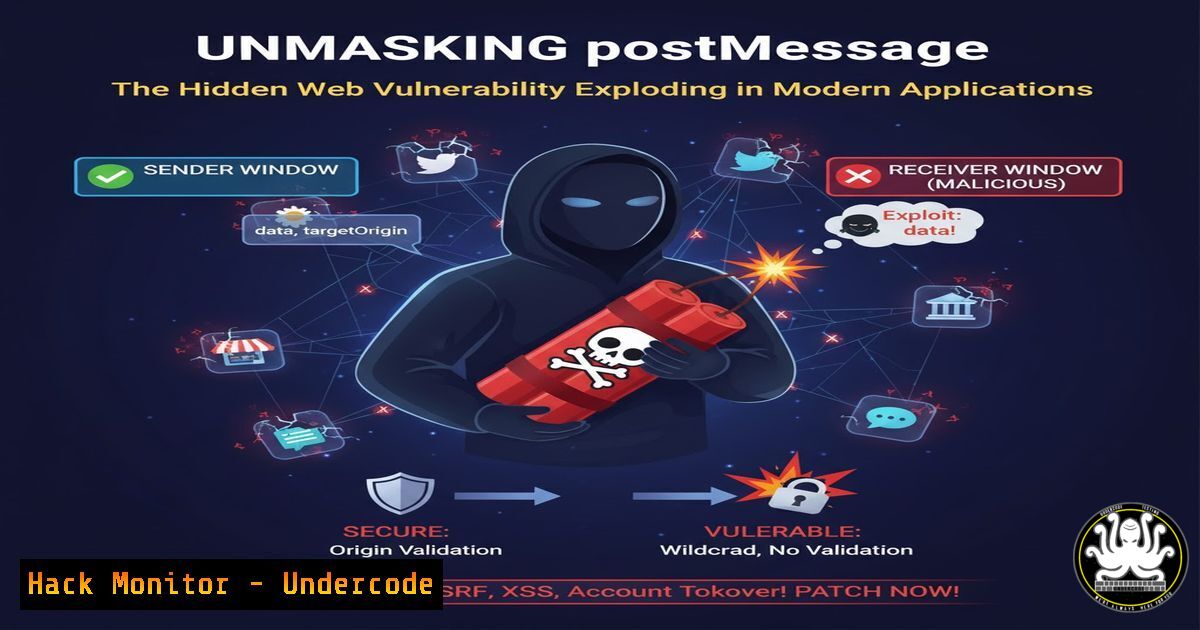
The `postMessage` API is a fundamental web technology enabling cross-origin communication between browser windows, iframes, and web workers. However, when implemented without rigorous security controls, it becomes a prime vector for client-side attacks, leading to data theft and account compromise. Understanding its mechanics is no longer optional for developers and security professionals.
Learning Objectives:
- Understand the core mechanics and security pitfalls of the HTML5 `postMessage` API.
- Learn to identify and exploit common misconfigurations like missing origin checks and overly permissive targets.
- Master defensive coding practices and runtime monitoring techniques to secure applications.
You Should Know:
1. The Fundamentals of postMessage
The `postMessage` API allows scripts from one origin to asynchronously send messages to scripts in another origin, bypassing the same-origin policy. The security relies entirely on the sender and receiver correctly validating each other.
// SENDING A MESSAGE
// In window A (https://example.com)
var targetWindow = window.frames[bash]; // Or window.open(...)
targetWindow.postMessage('{"user":"admin"}', 'https://target-site.com');

// RECEIVING A MESSAGE
// In window B (https://target-site.com)
window.addEventListener('message', function(event) {
// SECURITY CHECK: Verify the message's origin
if (event.origin !== 'https://example.com') {
return; // Ignore messages from unexpected origins
}
var data = JSON.parse(event.data);
console.log(data.user);
});
Step-by-step guide:
This code demonstrates basic cross-origin communication. The sender (window A) uses `postMessage` to send a stringified JSON object to a target window. The critical security step is in the receiver (window B), which uses the `event.origin` property to verify the sender’s origin before processing the data. Without this check, any website could send malicious messages to this endpoint.
2. Exploiting Missing Origin Validation
The most common `postMessage` vulnerability occurs when the receiving event listener fails to validate the `event.origin` property. This allows an attacker on any domain to send malicious messages that the application will trust and execute.
<!-- ATTACKER'S MALICIOUS PAGE hosted on http://evil.com -->

<script>
// This iframe points to the vulnerable application
var win = window.open('https://vulnerable-app.com/user-profile');
setTimeout(function() {
// Send a forged message without any origin check on the target side
win.postMessage('{"type":"changeEmail","newEmail":"[email protected]"}', '');
}, 2000);
</script>
Step-by-step guide:
An attacker lures a victim to their malicious page. This page opens the vulnerable application in a new window or iframe. After a brief delay (allowing the target page to load), it uses `postMessage` to send a forged command. Because the vulnerable application does not check the event.origin, it processes the message as if it came from a trusted source, potentially changing the user’s email address to one controlled by the attacker.
3. Exploiting Weak Origin Validation with Regex Bypasses
Sometimes, applications implement origin checks but use flawed logic or weak regular expressions that can be bypassed.
// VULNERABLE RECEIVER CODE on https://vulnerable-app.com
window.addEventListener('message', function(event) {
// Flawed check: only verifies that the origin contains 'vulnerable-app.com'
if (event.origin.indexOf('vulnerable-app.com') > -1) {
// Process sensitive command
executeCommand(JSON.parse(event.data));
}
});
Exploitation:
An attacker can register a domain like `vulnerable-app.com.evil.com` or create a subdomain vulnerable-app.com.attacker.com. When the malicious script from this domain sends a message, the weak `indexOf` check will pass because the string `vulnerable-app.com` is present.
4. Exploiting Wildcard Targets in postMessage Calls
A vulnerability can also exist on the sender’s side if the `targetOrigin` argument in `postMessage` is set to a wildcard ''. This allows the message to be sent to any origin, including malicious ones, if the sender window can be manipulated.
// VULNERABLE SENDER CODE on https://trusted-app.com
// This script sends data to a parent window without specifying a target origin
window.parent.postMessage(sensitiveUserData, ''); // UNSAFE

// SECURE SENDER CODE
// Always specify the exact target origin
window.parent.postMessage(sensitiveUserData, 'https://trusted-dashboard.com');
Step-by-step guide:
If a page on `trusted-app.com` sends sensitive data using the wildcard '', an attacker can embed this page in an iframe on evil.com. The `trusted-app.com` page will willingly send the sensitive data to the parent frame (evil.com) because the wildcard targetOrigin allows it. The secure practice is to always specify the exact, intended origin.
5. Identifying Vulnerabilities with Browser DevTools
Security researchers and developers can use the browser’s developer tools to proactively find and audit `postMessage` listeners.
Chrome DevTools Guide:
1. Open the target web application in Chrome.
2. Press `F12` to open Developer Tools.
3. Navigate to the Sources tab.
- Press `Ctrl+Shift+F` (or `Cmd+Opt+F` on Mac) to open the global search pane.
- Search for the string `”addEventListener(‘message'”` or
".onmessage =". - Review all found event listeners. Look for the absence of an `event.origin` check or any logic flaws in the check.
- Set breakpoints within these listeners to inspect the `event` object at runtime and see which origins are sending messages.
6. Secure postMessage Implementation: A Defense-in-Depth Model
Mitigating `postMessage` risks requires a defense-in-depth approach, combining strict origin checks and message content validation.
// SECURE MESSAGE HANDLER
window.addEventListener('message', function(event) {
// 1. STRICT ORIGIN VALIDATION: Use an allowlist
const allowedOrigins = ['https://trusted-partner.com', 'https://my-app.net'];
if (!allowedOrigins.includes(event.origin)) {
console.warn(<code>Blocked message from untrusted origin: ${event.origin}</code>);
return;
}

// 2. VALIDATE MESSAGE STRUCTURE & CONTENT
let command;
try {
command = JSON.parse(event.data);
} catch (e) {
return; // Ignore non-JSON messages
}

// 3. Check for expected properties and sanitize values
if (command.type === 'update' && typeof command.newEmail === 'string') {
// 4. Sanitize input: Use a library to validate email format
if (isValidEmail(command.newEmail)) {
updateUserEmail(command.newEmail);
}
}
});

function isValidEmail(email) {
const emailRegex = /^[^\s@]+@[^\s@]+.[^\s@]+$/;
return emailRegex.test(email);
}
Step-by-step guide:
This secure implementation employs multiple layers of defense. First, it checks the sender’s origin against a strict allowlist. Second, it safely parses the message data. Third, it validates the structure and type of the received command. Finally, it sanitizes or validates the actual data (like the email address) before performing any sensitive operations.
7. Advanced Monitoring with Content Security Policy (CSP)
While CSP cannot directly block `postMessage` calls, it can be a powerful tool to mitigate the impact of a successful exploit by preventing data exfiltration and unauthorized script execution.
Content-Security-Policy: default-src 'self'; script-src 'self' 'unsafe-eval'; connect-src 'self'; object-src 'none';
Step-by-step guide:
This CSP directive is configured in the HTTP headers of your web application. It instructs the browser to only execute scripts from the application’s own origin ('self'), blocking any inline scripts or scripts from malicious domains that an attacker might try to load via a `postMessage` exploit. Similarly, `connect-src ‘self’` prevents the attacker from using `XMLHttpRequest` or `fetch` to send stolen data to an external server.
What Undercode Say:
- The `postMessage` API shifts the security burden from the browser to the developer, creating a wide attack surface through simple coding errors.
- Exploitation is often low-complexity but high-impact, leading directly to sensitive actions like password changes, data retrieval, and DOM-based XSS.
The inherent risk of `postMessage` lies in its design philosophy: it provides powerful capabilities by trusting developers to implement security correctly. This has proven to be a flawed assumption, leading to widespread vulnerabilities even in major applications. The combination of missing origin checks and the ability to influence sensitive application state creates a perfect storm for client-side attacks. As web applications become more modular and reliant on iframes and cross-origin components, the improper implementation of this API will continue to be a goldmine for bug bounty hunters and a critical vulnerability for enterprises. Proactive auditing, strict allowlisting, and robust input validation are not just best practices but essential requirements for modern web development.
Prediction:
The prevalence of `postMessage` vulnerabilities will intensify with the growing adoption of micro-frontend architectures and third-party embedded widgets, which heavily rely on cross-origin communication. We predict a rise in automated scanning tools specifically targeting this API, and subsequently, a wave of sophisticated, automated attacks exploiting these misconfigurations at scale. This will force a shift in the Web Security Model, potentially leading to the development of more strict, declarative APIs for cross-origin communication that reduce the potential for developer error.
🎯Let’s Practice For Free:
IT/Security Reporter URL:
Reported By: Omar Aljabr – Hackers Feeds
Extra Hub: Undercode MoN
Basic Verification: Pass ✅


