Listen to this Post
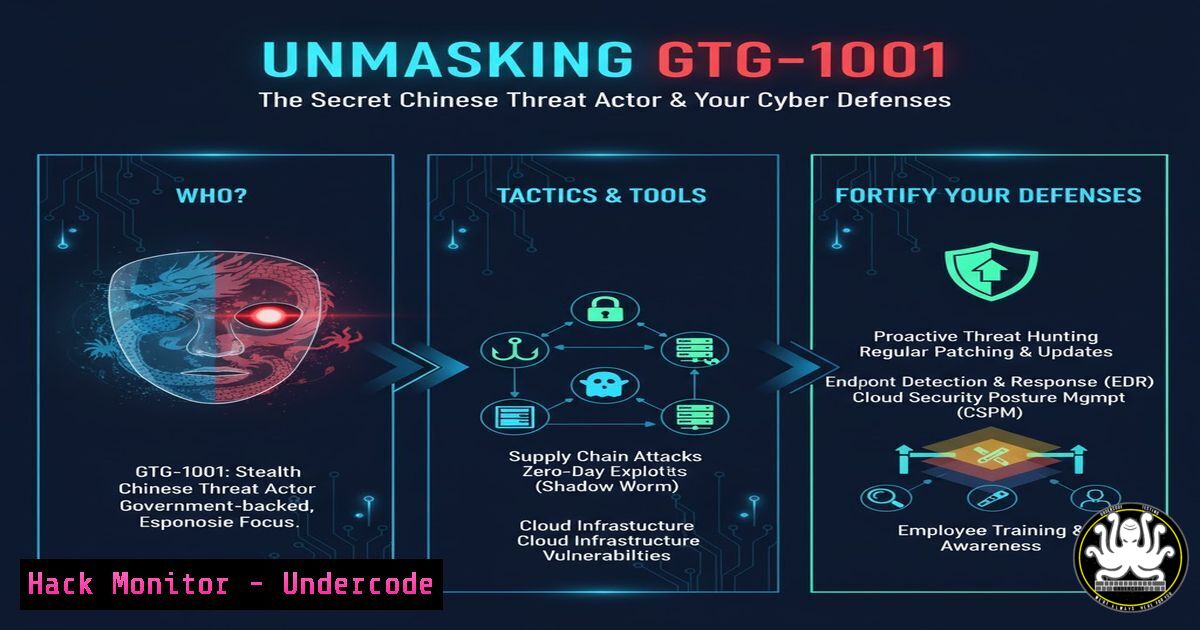
Introduction:
The cybersecurity landscape is increasingly defined by the sophisticated operations of nation-state actors, with attribution and tracking becoming as critical as defense. A recent deep dive into an Anthropic Cyber Espionage report has unearthed a tantalizing mystery: the designation of a Chinese threat actor as “GTG-1002” implicitly confirms the existence of a “GTG-1001.” This revelation, coupled with industry-wide efforts by giants like Google, Mandiant, CrowdStrike, and Microsoft to harmonize threat actor naming, signals a pivotal shift towards greater clarity and collaboration in threat intelligence. Understanding this ecosystem is no longer optional for modern security teams.
Learning Objectives:
- Decipher the significance of threat actor designations like GTG-1002 and the implications of an undisclosed GTG-1001.
- Learn how to leverage public threat intelligence matrices and reports to bolster your own security posture.
- Implement practical hunting and detection techniques for advanced persistent threats (APTs) using common security tools.
You Should Know:
1. The Threat Actor Nomenclature Revolution
The chaotic world of threat actor naming, where a single group can be known by a dozen different names, is undergoing a consolidation. Major cybersecurity firms are working to create a unified language. Google’s Mandiant uses designations like APT41, while Microsoft uses names like Nickel. The emerging harmonization effort, exemplified by the cross-reference matrix available from CrowdStrike and Microsoft, aims to map these aliases to a common framework. The “GTG” prefix in the Anthropic report is a new piece in this puzzle, suggesting an internal or emerging taxonomy that the public is only just glimpsing.
Step-by-step guide explaining what this does and how to use it:
Step 1: Acquire the Matrix. Download the harmonization matrix from the provided link (https://lnkd.in/g_YximAA). This is typically an Excel file listing various threat actors and their corresponding names across different vendors.
Step 2: Correlate Intelligence. When a new threat report is published, use the matrix to identify all known aliases for the mentioned group. For instance, if a report discusses “APT1,” you can quickly find that CrowdStrike calls it “Jackie Panda.”
Step 3: Enrich Your SIEM. Use these unified names as keywords and tags within your Security Information and Event Management (SIEM) system. This ensures that alerts from different intelligence feeds referencing the same group are correlated, reducing alert fatigue and improving detection accuracy.
- Operationalizing the Anthropic Report on Chinese Cyber Espionage
The Anthropic report, discussed in the linked session (https://luma.com/n5ntvjs6), and the supporting Mandiant analysis (https://lnkd.in/gVS55NYp) provide critical insights into the Tactics, Techniques, and Procedures (TTPs) of Chinese state-sponsored groups. These documents are not just for reading; they are a blueprint for building defensive controls.
Step-by-step guide explaining what this does and how to use it:
Step 1: Map TTPs to MITRE ATT&CK. Extract specific techniques from the report (e.g., “Spearphishing Link,” “Living off the Land”) and map them to their corresponding MITRE ATT&CK IDs (e.g., T1566.002, T1059.003).
Step 2: Develop Detection Rules. Create custom detection rules in your tools. For example, to detect suspicious PowerShell activity often used in Living off the Land attacks, you could implement a Sigma rule or a Splunk query looking for PowerShell commands with hidden windows or base64-encoded arguments.
Example Splunk SPL:
index=windows (EventCode=4688 OR EventCode=4104) (CommandLine=" -enc" OR CommandLine=" -w hidden") | table _time, host, User, CommandLine
Example Windows Command for Audit Policy (via Command Prompt as Administrator):
auditpol /set /subcategory:"Process Creation" /success:enable /failure:enable
Step 3: Hunt for IOCs. Input the Indicators of Compromise (IPs, domains, hashes) from the report into your threat intelligence platform and EDR solutions to proactively search for past compromises.
3. Proactive Hunting for the Unknown: GTG-1001
The confirmed existence of GTG-1002 begs the question: who is GTG-1001? This represents the “unknown unknowns” in your environment. Proactive hunting assumes a breach and searches for anomalous activity that signature-based detection might miss.
Step-by-step guide explaining what this does and how to use it:
Step 1: Establish a Baseline. Use tools to understand normal network and endpoint behavior. This includes typical user login times, common processes, and standard network connections.
Linux Command to list all listening ports and associated processes:
sudo netstat -tulnp
Windows Command for the same:
netstat -ano | findstr LISTENING
Step 2: Hunt for Anomalies. Look for deviations from the baseline. This could be a service running under a user’s context, unexpected outbound connections to rare destinations, or scheduled tasks created by non-admin users.
Step 3: Utilize EDR APIs. Modern Endpoint Detection and Response (EDR) tools have powerful APIs. Script automated hunts that query for specific sequences of behavior that match the TTPs of similar threat actors, even if you don’t have a specific IOC for GTG-1001.
4. Hardening Cloud Assets Against Nation-State Reconnaissance
Nation-state actors frequently target cloud infrastructure due to misconfigurations and excessive permissions. The principle of least privilege is your first and most powerful defense.
Step-by-step guide explaining what this does and how to use it:
Step 1: Audit IAM Policies. In your cloud environment (e.g., AWS, Azure, GCP), run access analyzer tools to identify resources shared with external entities or roles with overly permissive policies.
Step 2: Implement Multi-Factor Authentication (MFA). Enforce MFA for all user accounts, especially privileged ones. This is a simple but highly effective barrier against credential theft.
Step 3: Enable Comprehensive Logging. Ensure cloud trail (AWS), activity log (Azure), or audit log (GCP) is enabled and delivered to a secure, centralized logging store that is immutable and accessible only to a limited number of security personnel.
5. Building a Threat-Informed Defense Program
Ultimately, the goal is to move from a reactive to a proactive posture. This means your defenses are directly informed by the real-world TTPs of your most likely adversaries.
Step-by-step guide explaining what this does and how to use it:
Step 1: Adopt the MITRE ATT&CK Framework. Use it as a common language to describe adversary behavior and to gap-assess your current security controls.
Step 2: Conduct Purple Team Exercises. Don’t just run penetration tests (Red Team). Run collaborative exercises where the Red Team emulates a specific threat group like GTG-1002, and the Blue Team (defenders) works in tandem to detect and stop them, validating your detection capabilities.
Step 3: Automate Intelligence Ingestion. Create a pipeline that automatically ingests reports from vendors like Mandiant and CrowdStrike, parses the IOCs and TTPs, and updates blocklists and detection rules in your security stack.
What Undercode Say:
- The harmonization of threat actor naming is a force multiplier for the entire security community, breaking down silos and accelerating collective defense.
- The mystery of GTG-1001 is a powerful reminder that for every known advanced threat, there are likely others operating in the shadows, whose discovery depends on our vigilance and hunting maturity.
The focus on a specific, unnamed actor like GTG-1001 is not merely academic. It underscores a critical evolution in cybersecurity: the shift from chasing individual malware hashes to understanding adversary behavior and infrastructure. The value in the Anthropic report and the ensuing discussion is not just in the technical details of GTG-1002, but in the methodology it represents. By dissecting these reports and leveraging cross-industry collaboration, organizations can build defenses that are resilient not just to known threats, but to the entire class of techniques employed by sophisticated nation-states. The real takeaway is that your security program must be as dynamic and intelligent as the adversaries it aims to thwart.
Prediction:
The public harmonization of threat actor names will rapidly become the industry standard, leading to more automated and effective threat intelligence sharing across platforms. Within the next 18-24 months, we will see Security Orchestration, Automation, and Response (SOAR) platforms and EDR solutions natively integrating these unified taxonomies, allowing for automatic detection rule updates and proactive hunting campaigns based on newly published adversary profiles. This will raise the cost and complexity for threat actors like GTG-1001 and GTG-1002, forcing them to innovate more rapidly, but ultimately giving a significant defensive advantage to organizations that have invested in a threat-informed defense strategy.
🎯Let’s Practice For Free:
IT/Security Reporter URL:
Reported By: Fromanshu Dont – Hackers Feeds
Extra Hub: Undercode MoN
Basic Verification: Pass ✅


