Listen to this Post
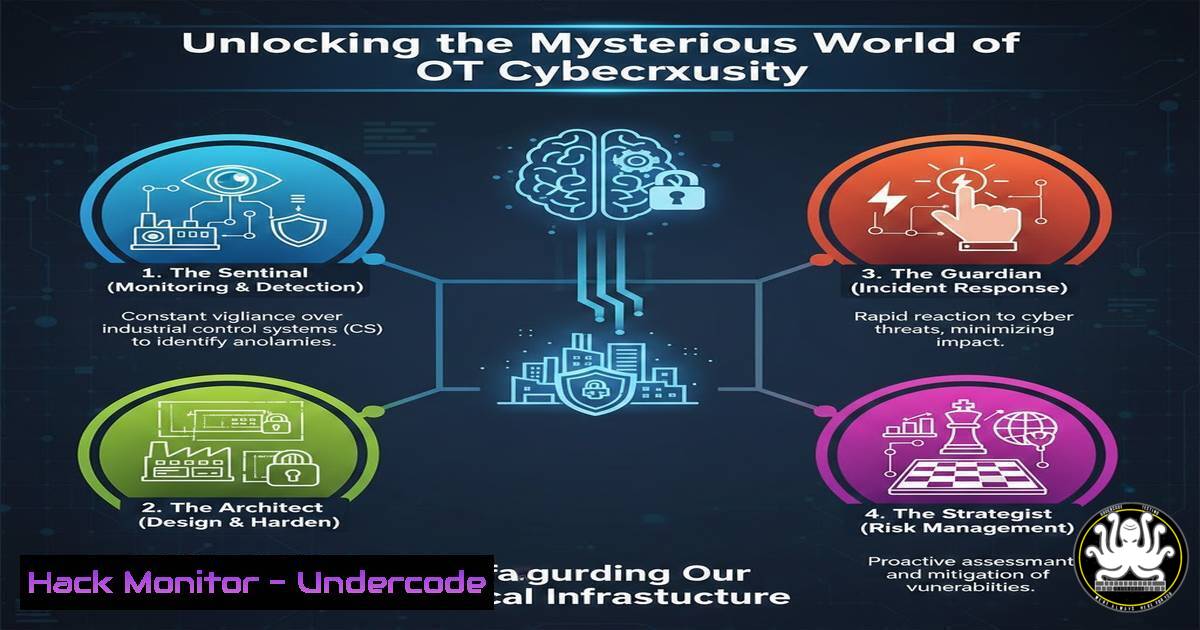
Introduction:
The cybersecurity landscape of Operational Technology (OT) and Industrial Control Systems (ICS) presents a unique and critical frontier, where digital security directly impacts physical safety and industrial availability. Unlike traditional IT, OT environments—power grids, water treatment plants, manufacturing lines—require a specialized blend of technical knowledge, process understanding, and safety-first mindset. Navigating a career here means understanding the distinct, and often hybrid, roles that form the backbone of industrial cyber defense.
Learning Objectives:
- Differentiate between the four core OT cybersecurity roles: Analyst, Engineer, Architect, and Manager.
- Identify the key technical tasks, tools, and frameworks associated with each role.
- Develop a practical roadmap for skills and commands necessary to operate in an OT/ICS security capacity.
You Should Know:
- The OT Cybersecurity Analyst: The Sentinel on the Wall
This role is the first line of defense, focused on continuous vigilance within a historically “invisible” network. The Analyst’s domain is the Security Information and Event Management (SIEM) system, network anomaly detection, and painstaking log analysis. Their goal isn’t just to find malware, but to detect subtle signs of process manipulation, unauthorized engineering changes, or abnormal device communication that could precede a catastrophic failure.
Step‑by‑step guide explaining what this does and how to use it:
Task: Investigate an alert for unusual MODBUS/TCP traffic from an engineering workstation.
Step 1: Access & Query. Log into your OT-aware SIEM (e.g., Dragos, Nozomi Networks, or a tuned Splunk instance). Query for MODBUS function codes (like `05` Write Single Coil or `06` Write Single Register) originating from a non-engineer’s IP address.
Sample Splunk SPL:
index=ot_siem sourcetype="firewall" dest_port=502 src_ip="10.10.5.25" | table _time, src_ip, dest_ip, modbus_func_code
Step 2: Contextualize. Cross-reference the destination IP with your asset inventory to identify if the target is a critical PLC controlling a valve or turbine. Validate if this was a scheduled maintenance window.
Step 3: Enrich & Escalate. Use a threat intelligence platform to check the source IP against known malicious actors. If unauthorized, immediately escalate with a detailed incident report to the OT Engineer and Manager, following safety-of-operations procedures.
- The OT Cybersecurity Engineer: The Builder of Defenses
The Engineer translates architectural designs and policy into reality. They are hands-on with firewalls, host hardening, and the secure deployment of monitoring agents. Their work often involves delicate, scheduled outages and deep coordination with control system engineers to avoid disrupting production.
Step‑by‑step guide explaining what this does and how to use it:
Task: Harden a Windows-based Engineering Workstation per ISA/IEC 62443 standards.
Step 1: Baseline Configuration. Use Microsoft Security Compliance Toolkit to apply an industrial baseline. Disable unnecessary services (e.g., WinRM, Spooler) on interfaces connected to the control network.
PowerShell Command to Disable a Service:
Set-Service -Name "Spooler" -StartupType Disabled -Status Stopped
Step 2: Application Control. Implement application whitelisting via Windows Defender Application Control or a dedicated tool. Create a signed policy allowing only approved engineering software (e.g., specific versions of Siemens TIA Portal, Rockwell Studio 5000).
Step 3: Network Hardening. Configure the host firewall to allow only required ICS protocols (e.g., allow TCP/44818 for EtherNet/IP) from specific source subnets. Deny all other inbound traffic.
3. The OT Cybersecurity Architect: The Master Planner
The Architect designs the secure foundation of the entire industrial site. Their primary tool is the ISA/IEC 62443 framework, which they use to design zones (groupings of assets with similar security requirements) and conduits (controlled communication pathways). This is high-level design work with massive operational consequences.
Step‑by‑step guide explaining what this does and how to use it:
Task: Design a DMZ (Conduit) between the Enterprise IT zone and the Cell/Area Zone containing HMIs and PLCs.
Step 1: Asset Classification. Inventory all assets communicating across this boundary (e.g., historians, patch servers). Document their required data flows (source, destination, port, protocol).
Step 2: DMZ Design. Specify a dual-firewall or firewall-with-DMZ-interface architecture. Define the security policies: Enterprise -> DMZ (allow historian queries on TCP/443), DMZ -> Cell Zone (allow read-only OPC DA traffic from a specific DMZ server to PLCs on TCP/135).
Step 3: Specify Technology & Validation. Select firewalls capable of deep packet inspection for industrial protocols. Mandate that all rules are documented with a business justification and are reviewed every six months. Design a network tap in the conduit for passive monitoring by the Analyst’s tools.
- The OT Cybersecurity Manager: The Strategist and Advocate
The Manager operates at the intersection of technology, safety, business, and human dynamics. They secure budget, manage vendor relationships, and, most critically, foster the fragile collaboration between OT and IT departments. Their success is measured in risk reduction, safety record, and uptime—not just blocked attacks.
Step‑by‑step guide explaining what this does and how to use it:
Task: Develop and justify the annual OT cybersecurity budget to the Plant Leadership.
Step 1: Risk-Based Proposal. Base requests on a quantified risk assessment. For example: “Unpatched PLCs in the refining unit represent a 30% risk of disruption. A $50k investment in an offline patch management solution reduces this to 10%.”
Step 2: Build the Business Case. Translate technical needs into business/SAFETY outcomes. Don’t ask for a “firewall”; ask for “funding to segment the reactor control network to prevent a safety instrumented system (SIS) compromise, aligning us with OSHA guidelines.”
Step 3: Vendor & Program Management. Select and manage a consulting firm for a penetration test, ensuring the Statement of Work (SOW) explicitly forbids disruptive testing on live control systems. Establish a monthly OT-IT Governance Board with defined agendas to resolve jurisdictional disputes.
What Undercode Say:
- Convergence Demands Hybrid Skillsets: The most effective OT security professionals are “purple teams” of one, blending IT security skills with a relentless respect for operational safety and physical processes. The future belongs to those who can write a Python script to parse PCAPs and understand the consequences of a relay failing closed.
- The Framework is Your Blueprint, Not Your Shackles: While standards like NIST SP 800-82 and ISA/IEC 62443 are essential, they must be applied with context. Rigid, IT-centric enforcement in an OT environment can introduce more risk than it mitigates. Pragmatism, guided by safety, is the supreme principle.
Prediction:
The evolution of IT/OT convergence and the aggressive adoption of Industrial IoT (IIoT) will exponentially increase the attack surface of critical infrastructure. This will force a massive shift. The “one-person team” will become untenable, driving rapid growth in dedicated OT security departments within industrial firms. Consequently, we will see a surge in specialized, accredited training and certification programs, and regulatory bodies will move from issuing guidelines to enforcing mandatory, auditable cybersecurity standards for critical infrastructure, similar to environmental or safety regulations. The roles defined today will become formalized, specialized, and in critically high demand.
▶️ Related Video (70% Match):
🎯Let’s Practice For Free:
IT/Security Reporter URL:
Reported By: Mikeholcomb Ot – Hackers Feeds
Extra Hub: Undercode MoN
Basic Verification: Pass ✅


