Listen to this Post
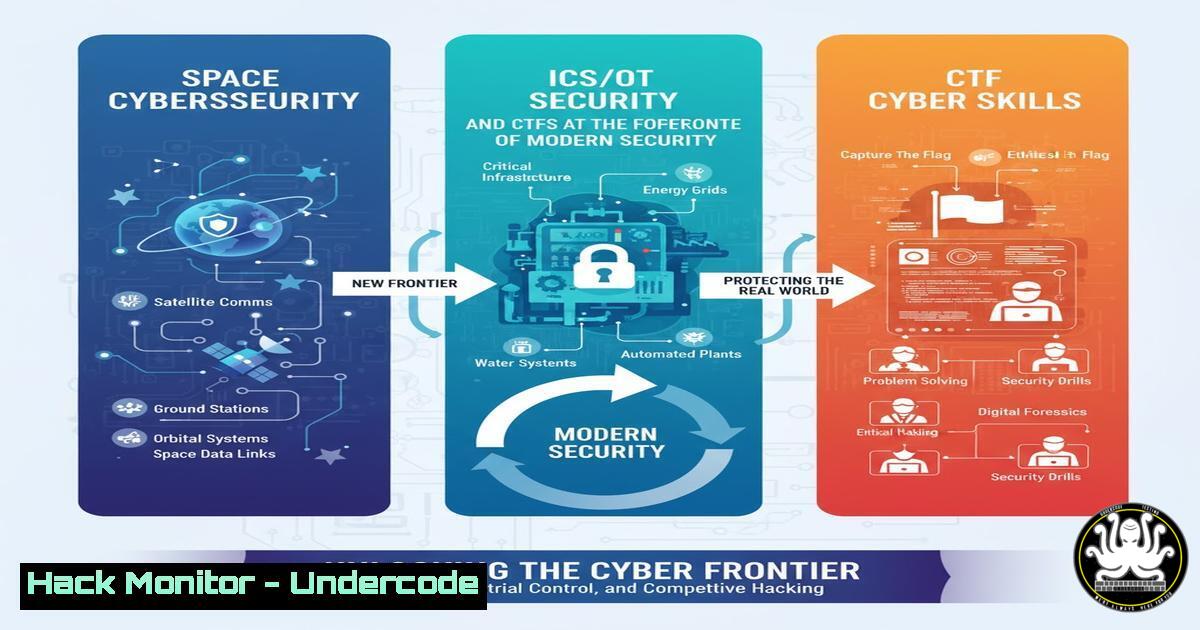
Introduction:
The convergence of space systems, industrial control systems (ICS), and competitive cyber training represents the expanding battlefield of modern cybersecurity. Events like the CyLynk Hck4G Conference highlight how security professionals are tackling threats across these critical domains, emphasizing the need for robust defense strategies and hands-on skills development to protect our most vital infrastructure.
Learning Objectives:
- Understand the unique security challenges and attack surfaces in space and ICS/OT environments.
- Learn the fundamental strategies for effective participation in Capture The Flag (CTF) competitions.
- Develop actionable skills for system hardening, vulnerability assessment, and mitigating social engineering threats.
You Should Know:
1. The New Space Cybersecurity Frontier
The “New Space” era, characterized by private companies and smaller satellites, introduces a vastly expanded attack surface. Ground stations, communication links, and satellite bus systems are all potential targets. Adversaries may seek to disrupt services, hijack assets, or use compromised systems as a foothold for broader attacks.
Step‑by‑step guide explaining what this does and how to use it.
Step 1: Harden Ground Station Systems. Ground stations are the most accessible component. Secure them by minimizing their attack surface.
On a Linux-based ground station server, enforce strict firewall rules and disable non-essential services.
 Block all incoming traffic by default
sudo ufw default deny incoming
sudo ufw default allow outgoing
 Allow specific, necessary ports (e.g., SSH on a non-standard port)
sudo ufw allow 8022/tcp
sudo ufw enable
 Disable unused services to reduce footprint
sudo systemctl disable avahi-daemon
sudo systemctl stop avahi-daemon
Step 2: Secure Communication Channels. Space-to-ground links often use standard radio protocols that can be intercepted. Encryption and authentication are non-negotiable.
Ensure all command and control (C2) traffic is encrypted using strong, validated protocols like TLS 1.3 or application-specific encryption. Never rely on “security through obscurity.”
Step 3: Implement Continuous Monitoring. Use Intrusion Detection Systems (IDS) tailored for network and system-level anomalies specific to your mission operations.
2. Hardening Industrial Control Systems (ICS)
ICS environments, which manage critical infrastructure like power grids and water systems, were historically air-gapped but are now increasingly connected. This exposes them to threats that can have physical-world consequences. Security focuses on availability and integrity over confidentiality.
Step‑by‑step guide explaining what this does and how to use it.
Step 1: Network Segmentation. Isolate critical control networks from corporate IT networks using an industrial demilitarized zone (IDMZ). This prevents a simple breach on the business network from spreading to the operational technology (OT) environment.
Step 2: Harden Windows-Based HMI/SCADA Systems. Many Human-Machine Interfaces (HMIs) run on Windows.
In a Windows Command Prompt or PowerShell, disable unnecessary services and audit system configurations.
 PowerShell: Get a list of running services to identify non-essential ones
Get-Service | Where-Object {$_.Status -eq 'Running'}
 Disable a specific service (e.g., Telnet, which is insecure)
Stop-Service Telnet -Force
Set-Service Telnet -StartupType Disabled
Step 3: Application Whitelisting. Use tools like Windows AppLocker to prevent unauthorized executables, scripts, and software from running on ICS controllers and HMIs, mitigating many malware threats.
- Mastering Capture The Flag (CTF) for Skill Development
CTF competitions are a practical training ground for offensive and defensive security techniques. They simulate real-world scenarios across categories like web exploitation, forensics, cryptography, and reverse engineering.
Step‑by‑step guide explaining what this does and how to use it.
Step 1: Reconnaissance and Enumeration. Before attacking, you must map the target.
Use `nmap` to discover open ports and services.
 Basic TCP SYN scan with service version detection
nmap -sS -sV <target_ip>
 A more comprehensive scan
nmap -sC -sV -O <target_ip>
Step 2: Web Application Testing. A common CTF category. Look for common vulnerabilities.
Use `curl` or a browser’s developer tools to inspect requests and responses.
Test for SQL Injection manually or with tools like sqlmap.
 Basic sqlmap command to test a parameter
sqlmap -u "http://<target>/page.php?id=1" --batch
Step 3: Binary Exploitation. This involves finding and exploiting a vulnerability in a compiled program.
Use a disassembler like `Ghidra` or a debugger like `GDB` with GEF/PEDA extensions to analyze the binary for buffer overflows or format string bugs.
4. Countering Social Engineering and Youth Exploitation
As highlighted in the conference panel, social engineering remains a highly effective attack vector. Adversaries may exploit teenagers’ technical skills and desire for belonging, manipulating them into carrying out attacks for cybercriminal gangs.
Step‑by‑step guide explaining what this does and how to use it.
Step 1: Security Awareness Training. This is the primary defense. Training must be ongoing and cover how to identify phishing attempts, suspicious requests, and the tactics of manipulation.
Step 2: Implement Technical Controls.
Enforce Multi-Factor Authentication (MFA) on all critical accounts to neutralize stolen credentials.
Use email filtering solutions to block phishing emails before they reach the inbox.
Step 3: Foster a Positive Community. Create safe, legal, and constructive outlets for technical curiosity, such as mentoring programs and CTF teams, to provide an alternative to malicious pathways.
5. API Security in a Connected World
APIs are the backbone of modern cloud, mobile, and ICS applications but are often poorly secured, leading to data breaches.
Step‑by‑step guide explaining what this does and how to use it.
Step 1: Inventory and Document All APIs. You cannot secure what you don’t know about. Use automated tools to discover shadow APIs.
Step 2: Enforce Strong Authentication and Authorization. Never assume an API is for internal use only. Use OAuth 2.0 and ensure endpoints properly check user permissions for each request (avoiding Broken Object Level Authorization).
Step 3: Rate Limiting and Input Validation.
Implement rate limiting to prevent Denial-of-Service (DoS) and brute-force attacks.
Validate and sanitize all input to prevent injection attacks. For a web API, this means treating all input as untrusted.
What Undercode Say:
- The cybersecurity perimeter has fundamentally expanded beyond traditional IT, now encompassing orbital assets and physical industrial processes. Defending this new frontier requires domain-specific knowledge.
- Hands-on, experiential learning through CTFs and conferences is not a bonus but a critical component of developing a competent cybersecurity workforce capable of responding to these evolving threats.
The conference’s focus on space, ICS, and the human element of exploitation reveals a mature understanding of the current threat landscape. The technical skills demonstrated in CTFs are directly transferable to defending real-world systems. However, the most insightful takeaway is the emphasis on the human factor—both as a vulnerability, through social engineering, and as a solution, through community and “experiences.” The future of security depends not only on robust code and configurations but also on fostering resilient and ethically-grounded professionals. The integration of these hard technical skills with soft community-focused initiatives is the key to building a comprehensive defense.
Prediction:
The lines between cyber and physical security will continue to blur, with successful attacks on space-based assets or critical ICS causing significant, real-world disruption. We will see a rise in state-sponsored and criminal groups specifically targeting these systems for geopolitical leverage or extortion. Concurrently, the weaponization of social engineering will become more sophisticated, leveraging AI to create hyper-personalized manipulation campaigns. The organizations that will thrive are those that invest now in cross-domain security expertise, zero-trust architectures, and building a strong, ethical security culture from the ground up.
🎯Let’s Practice For Free:
IT/Security Reporter URL:
Reported By: Peter Lake – Hackers Feeds
Extra Hub: Undercode MoN
Basic Verification: Pass ✅


