Listen to this Post
Introduction
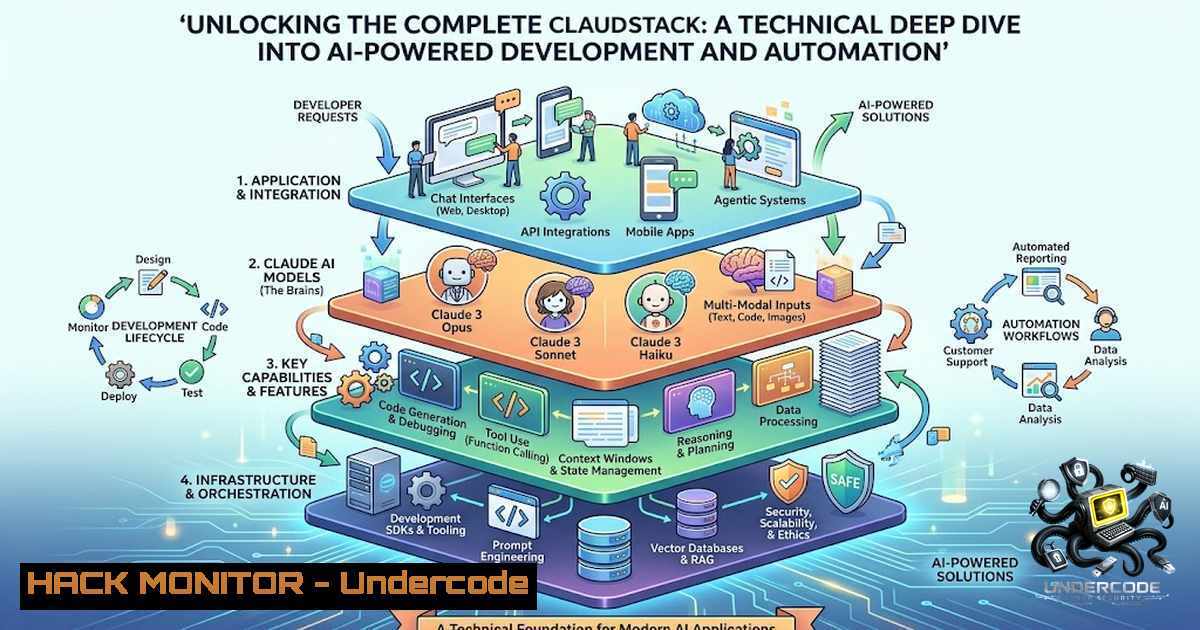
The landscape of artificial intelligence has evolved far beyond simple chatbots and text generators. Anthropic’s Claude ecosystem now represents a comprehensive development platform—complete with a tiered model architecture, integrated development environments, and a sophisticated Model Context Protocol (MCP) that enables AI agents to interact with external tools, databases, and desktop applications. Understanding how to leverage this stack effectively can transform workflows, automate repetitive tasks, and significantly enhance productivity across development, security, and operations teams.
Learning Objectives
- Master the Claude model hierarchy and select the optimal model for specific use cases based on capability, speed, and cost trade-offs
- Implement advanced prompt engineering and context engineering techniques to maximize output quality and minimize token consumption
- Build interactive artifacts and live dashboards without traditional coding or BI tools
- Integrate Claude Code into existing development workflows across VS Code, JetBrains, and CLI environments
- Deploy MCP connectors to create autonomous AI agents that interact with GitHub, Notion, Slack, and enterprise systems
- Automate security scanning and vulnerability detection using Claude’s built-in security review capabilities
You Should Know
- Understanding the Claude Model Hierarchy: Choosing the Right Tool for the Job
Claude’s model lineup has expanded from three to four distinct tiers, each optimized for different use cases. Understanding this hierarchy is fundamental to cost-effective AI implementation.
Model Breakdown:
| Model | Primary Use Case | Key Characteristics |
|-|||
| Claude Fable 5 | Long-running AI agents, complex enterprise workflows | Top-tier intelligence for days-long autonomous projects |
| Claude Opus 4.8 | Deep reasoning, strategy, architecture | Complex agentic coding and enterprise work |
| Claude Sonnet 5 | Daily work, coding, writing | Best combination of speed and intelligence at 40-60% of Opus cost |
| Claude Haiku 4.5 | Fast, low-cost automation | Fastest model with near-frontier intelligence |
Technical Implementation:
When working with the Claude API, selecting the right model is achieved through the `model` parameter in your API requests:
import anthropic

client = anthropic.Anthropic(api_key="YOUR_API_KEY")

For complex agentic tasks - use Fable 5
response = client.messages.create(
model="claude-3-5-fable-20260609",
max_tokens=4096,
messages=[{"role": "user", "content": "Your complex prompt here"}]
)

For daily coding tasks - use Sonnet 5
response = client.messages.create(
model="claude-3-5-sonnet-20260702",
max_tokens=4096,
messages=[{"role": "user", "content": "Your coding prompt here"}]
)

For fast automation - use Haiku 4.5
response = client.messages.create(
model="claude-3-5-haiku-20260415",
max_tokens=2048,
messages=[{"role": "user", "content": "Your automation prompt here"}]
)
Best Practice: Match the model to the complexity of the task—not every prompt needs the most powerful model. Use Fable 5 for ambitious, multi-step autonomous projects; Sonnet 5 for work you run at scale where speed and cost per call matter; and Haiku 4.5 for high-volume, low-latency automation.
2. Context Engineering: The New Rules of Prompting
The quality of your prompt directly impacts the quality of the answer. With Claude 5 generation models, the discipline has evolved from simple prompt engineering to comprehensive context engineering.
The Five Components of Effective Prompting:
- Role – Define who Claude is acting as (e.g., “You are a senior security engineer”)
2. Context – Provide relevant background information
- Goal – Specify what you want to achieve
- Output Format – Define how the response should be structured
5. Constraints – Set boundaries and limitations
Advanced Technique: Prompt Caching
Prompt caching works by prefix matching—the API caches everything from the start of the request up to each `cache_control` breakpoint. This means the order you put things in matters enormously; you want as many of your requests to share a prefix as possible.
Implementation Example:
import anthropic

client = anthropic.Anthropic(api_key="YOUR_API_KEY")

Structure your prompt with cache_control for optimal caching
response = client.messages.create(
model="claude-3-5-sonnet-20260702",
max_tokens=4096,
messages=[
{
"role": "user",
"content": [
{
"type": "text",
"text": "You are a security expert reviewing code for vulnerabilities.",
"cache_control": {"type": "ephemeral"}  Cache this prefix
},
{
"type": "text",
"text": "Review the following code for SQL injection, XSS, and authentication flaws: [CODE HERE]"
}
]
}
]
)
Pro Tip: Use the `claude doctor` command in Claude Code to rightsize your skills and `CLAUDE.md` files. Keep `CLAUDE.md` concise, avoid changing it mid-session, and don’t write temporary or volatile content in it.
3. Building with Artifacts and Live Dashboards
Artifacts transform Claude from a text generator into a visual development platform. These interactive outputs appear in a side panel next to your conversation and can include dashboards, interactive documents, presentations, wireframes, and visual prototypes.
Live Artifacts are persistent dashboards that live in Claude Cowork and pull fresh data every time you open them—no need to re-upload files or re-run prompts.
Creating Your First Live Artifact:
- Open Cowork on Claude Desktop and select “Live artifacts” from the sidebar
2. Click “New artifact” in the top right
- Describe what you want Claude to build (e.g., “Create a project dashboard with Gantt charts, progress bars, and milestone tracking”)
4. Claude generates an interactive, editable artifact
Example: Financial Dashboard Without BI Tools
Claude can create comprehensive financial dashboards without spending time learning traditional BI tools—calculating key metrics, preparing data, and visualizing them as interactive artifacts.
From Claude Code to Artifacts:
Artifacts can also be published from Claude Code sessions to private URLs on claude.ai, updating in place as the session continues working:
 In Claude Code terminal
 Generate an artifact from your session
/artifact create "Security Dashboard" --type dashboard

Share with your organization
/artifact share --org

Or publish to a public link
/artifact publish --public
4. Supercharging Development with Claude Code
Claude Code now works inside multiple development environments: CLI, VS Code, and JetBrains IDEs. The integration uses a bidirectional communication layer connecting Claude Code’s CLI with IDE extensions.
Getting Started:
 Install Claude Code globally
npm install -g @anthropic/claude-code

Navigate to your project
cd /path/to/your/project

Start Claude Code
claude

Or open directly in VS Code
code --install-extension anthropic.claude-code
Best Practices for Development:
- Legacy Code Understanding: Let Claude explain legacy code, generate unit tests, review pull requests, and refactor modules—not just write code from scratch
- Security Reviews: Run `/security-review` in the terminal to analyze your codebase for potential security concerns
- Automated Testing: Use Claude to generate comprehensive test suites
Permission Model:
Claude Code operates with a permission model that requests, manages, and configures permissions in VS Code, JetBrains, and CLI environments. Understanding permission prompts, safety scopes, and best practices is crucial for secure operation.
Security Consideration: Be aware that AI-assisted development tools have been found to have vulnerabilities allowing data exfiltration and remote code execution. Always operate Claude Code in controlled environments and review its actions.
- The Model Context Protocol (MCP): Building Connected AI Agents
MCP is an open standard that enables developers to build secure, two-way connections between their data sources and AI-powered tools. It represents the most powerful aspect of the Claude stack—transforming Claude from a chatbot into an autonomous agent capable of interacting with external systems.
MCP Connectors Available:
- GitHub (35 tools, ~26K tokens)
- Notion, Slack, Gmail, Google Drive
- Jira, Confluence, GitLab, Miro
- Google Workspace, Microsoft 365, HubSpot
- Grafana, Sentry, Figma
Setting Up MCP Connectors:
The easiest way to add integrations is using Claude Desktop Connectors:
1. Open Claude Desktop Settings
2. Go to Developer → Edit Config
3. Add the connector URL in your `claude_desktop_config.json`
{
"mcpServers": {
"github": {
"command": "npx",
"args": ["-y", "@modelcontextprotocol/server-github"],
"env": {
"GITHUB_PERSONAL_ACCESS_TOKEN": "your_token_here"
}
},
"notion": {
"command": "npx",
"args": ["-y", "@modelcontextprotocol/server-1otion"],
"env": {
"NOTION_API_KEY": "your_api_key_here"
}
}
}
}
Building Autonomous Agents:
With MCP, Claude can:
- Create, update, and close incidents directly from Slack
- Automatically generate structured incident pages, timelines, postmortem drafts, and runbook references
- Search, retrieve, and summarize content from workplace tools including Google Drive, Notion, Slack, and Confluence
Advanced: Self-Hosted MCP Gateway
For enterprise deployments, self-hosted MCP gateways provide PII sanitization, write-safety, and audit logging:
 Deploy MCP gateway
docker run -d \
--1ame mcpgate \
-p 8080:8080 \
-v /path/to/config:/config \
mcpgate/mcpgate:latest
6. Computer Use: Desktop Automation with Claude
The Computer Use tool gives Claude screenshot, mouse, and keyboard control of a desktop environment. This enables autonomous GUI automation workflows.
Implementation Example:
from anthropic import Anthropic
import pyautogui
import mss

client = Anthropic(api_key="YOUR_API_KEY")

Capture screen
with mss.mss() as sct:
screenshot = sct.shot(output="screenshot.png")

Send to Claude with computer use tool
response = client.messages.create(
model="claude-3-5-sonnet-20260702",
max_tokens=4096,
tools=[{
"type": "computer_20251124",
"name": "computer",
"display_width_px": 1920,
"display_height_px": 1080,
"display_number": 1
}],
messages=[{
"role": "user",
"content": [
{"type": "image", "source": {"type": "base64", "media_type": "image/png", "data": base64_image}},
{"type": "text", "text": "Open the browser, navigate to the dashboard, and take a screenshot"}
]
}]
)
Security Precautions:
⚠️ Computer Use is an experimental feature with significant security implications. Only use in isolated, controlled environments. The package gates the built-in tools Claude calls when given desktop access: computer (mouse/keyboard/screenshot) and bash (shell commands).
Local MCP Server for Computer Control:
For Windows environments, a local MCP server exposes mouse, keyboard, screen, clipboard, and window-management tools via the Model Context Protocol and a REST API.
7. Automated Security Scanning and Vulnerability Detection
One of Claude’s most powerful features is its ability to scan codebases for vulnerabilities before deployment. This transforms security from a manual review process into an automated, continuous practice.
Built-in Security Review:
 Inside your project directory with Claude Code
claude

Run security review
/security-review
Claude analyzes your codebase and identifies potential security concerns including:
– SQL injection risks
– Cross-site scripting (XSS) vulnerabilities
– Authentication flaws
– Insecure data handling
– Dependency vulnerabilities
Security Sweep Plugin:
The Security Sweep plugin provides comprehensive scanning capabilities:
 Install the plugin
/plugin install security-sweep

Run a full security scan
/security-sweep scan

Scan for specific vulnerability types
/security-sweep scan --type secrets,injection,auth
This finds hardcoded secrets, injection flaws, auth issues, misconfigurations, and AI-specific vulnerabilities, covering OWASP Mobile Top 10 (2024) and OWASP LLM Top 10 (2025).
ASPM Scanning:
For Application Security Posture Management:
 Run ASPM scan
/aspm-scan

Generates ASPM_SCAN.md report
 Combines Semgrep SAST with optional autonomous pentest
VigilSec Integration:
For real-time protection:
 Initialize VigilSec globally
vigil init --global

Every file Claude Code writes is scanned before it saves
 Scan a single file
vigil scan docker-compose.yml

Scan a directory
vigil scan ./src
Vulnerability Hunter Skill:
Run an autonomous vulnerability scan that produces a structured security report covering the finding, its location, a replication PoC, a corrected patch, and a severity rating.
8. Boosting Productivity with Desktop and Browser Automation
Claude can now help inside Excel, Chrome, and desktop workflows using Cowork. Use it to summarize spreadsheets, automate repetitive browser tasks, organize research, and accelerate reporting.
Practical Automation Examples:
- Spreadsheet Summarization: Upload Excel files and ask Claude to summarize key metrics, identify trends, or create visualizations
- Browser Task Automation: Use Claude to navigate websites, extract data, fill forms, and organize research
- Reporting Acceleration: Generate reports from multiple data sources with a single prompt
Implementation Strategy:
Start with one repetitive workflow, automate it, test it thoroughly, then expand. Small, reliable automations outperform large, fragile ones.
What Undercode Say
- Context is King: The quality of your output is directly proportional to the quality of your input. Invest time in crafting precise prompts with role, context, goal, format, and constraints.
-
Model Selection is Cost Optimization: Using Opus or Fable for simple tasks is like using a supercomputer to check email. Match the model to the task complexity to optimize both cost and performance.
-
MCP is the Game Changer: Claude’s true power emerges not from better prompts but from building a connected AI workspace where Claude remembers context, uses tools, automates tasks, and collaborates across workflows. The biggest shift isn’t better prompts anymore—it’s building that connected ecosystem.
-
Security Must Be Proactive: With great power comes great responsibility. Claude’s ability to review code for vulnerabilities is invaluable, but security scanning should be integrated into every stage of development, not just as a final check.
-
Start Small, Scale Smart: Begin with one automation, perfect it, then expand. Reliable, focused automations provide more value than complex, brittle systems.
Analysis: The Claude ecosystem represents a paradigm shift from AI as a conversational tool to AI as a collaborative development partner. The integration of MCP connectors, security scanning, and desktop automation creates a platform where AI agents can genuinely augment human productivity. However, this power comes with significant security considerations—the IDEsaster research revealed over thirty vulnerabilities in AI-assisted development tools. Organizations must implement proper governance, permission models, and security reviews when deploying Claude at scale. The future belongs to those who can balance AI empowerment with security discipline.
Prediction
- +1 Enterprise adoption of MCP-based AI agents will accelerate dramatically, with organizations deploying autonomous agents for incident management, code review, and security scanning within 12-18 months.
-
+1 The distinction between AI coding assistants and autonomous AI developers will blur, with Claude Code evolving to handle increasingly complex, multi-step development tasks with minimal human supervision.
-
-1 The security risks associated with AI-assisted development tools will grow as attackers develop techniques to exploit AI agents for data exfiltration and code injection, necessitating new security frameworks.
-
+1 The Model Context Protocol will emerge as the industry standard for AI-tool integration, with Anthropic’s donation of MCP to the Agentic AI Foundation accelerating adoption across the AI ecosystem.
-
-1 Organizations that fail to implement proper governance and permission models for AI agents will face significant security incidents, as autonomous AI tools become prime targets for exploitation.
-
+1 Live Artifacts and interactive dashboards will democratize data visualization, enabling non-technical users to create sophisticated analytics without traditional BI tools or coding skills.
-
+1 The cost-performance ratio of Claude models will continue to improve, with Sonnet-level intelligence becoming increasingly accessible for high-volume automation tasks.
▶️ Related Video (80% Match):
https://www.youtube.com/watch?v=bcM9dP_uXJU
🎯Let’s Practice For Free:
🎓 Live Courses & Certifications:
Join Undercode Academy for Verified Certifications
🚀 Request a Custom Project:
Secure, high-velocity infrastructure and disruptive technological engineering. Contact our engineering team for high-tier development and proprietary systems:
[email protected]
💎 Smart Architecture | 🛡️ Secure by Design | ⭐ Trusted by Thousands
IT/Security Reporter URL:
Reported By: Abhinav Gupta – Hackers Feeds
Extra Hub: Undercode MoN
Basic Verification: Pass ✅


