Listen to this Post
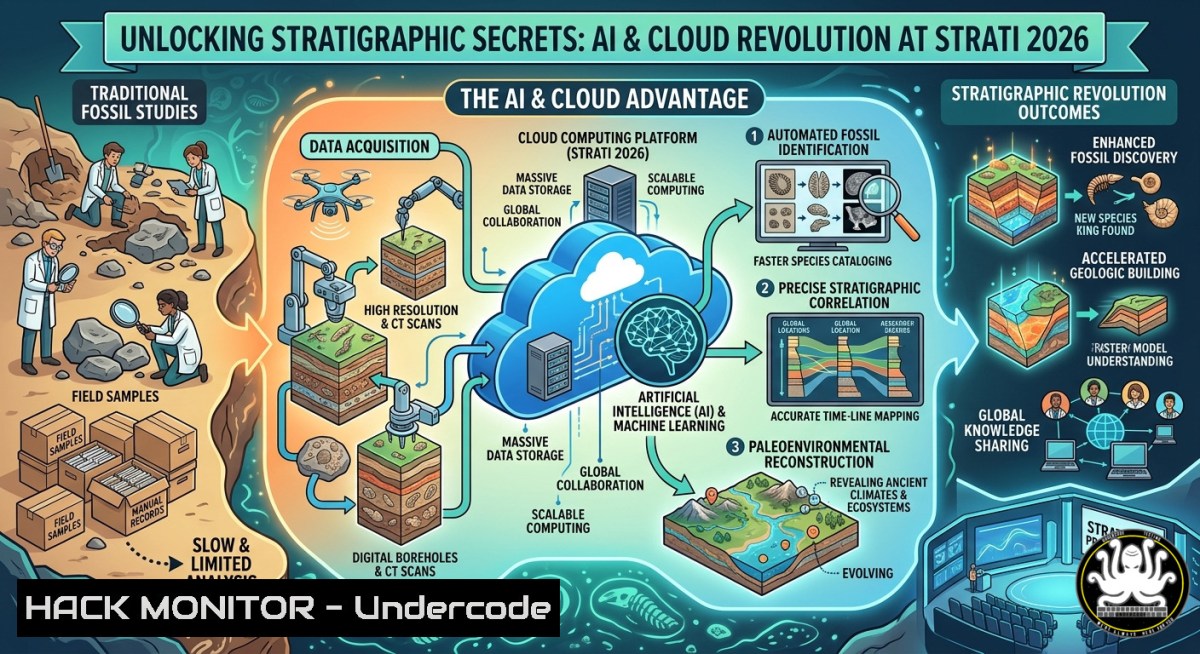
Introduction:
As the 5th International Congress on Stratigraphy (STRATI 2026) approaches in Suzhou, China, the integration of data‑driven approaches—powered by artificial intelligence and cloud computing—is reshaping how paleontologists and geoscientists analyze fossil records, correlate stratigraphic layers, and share open‑access research. While traditional conferences like STRATI 2026 have long served as networking hubs, the real transformation occurs when researchers apply machine learning to geological datasets, automate fossil identification using computer vision, and leverage secure cloud environments for collaborative stratigraphic mapping. This article extracts technical workflows, commands, and training pathways from the event’s underlying themes to equip you with hands‑on cybersecurity, IT, and AI skills applicable to geoscientific research.
Learning Objectives:
- Implement a Python‑based deep learning pipeline to classify fossil images using transfer learning on TensorFlow or PyTorch.
- Harden cloud storage and API endpoints used for sharing open‑access stratigraphic data, including encryption and identity access management.
- Execute Linux and Windows commands for automating geospatial data processing, vulnerability scanning of research web portals, and configuring secure backup solutions.
You Should Know:
- Building an AI‑Powered Fossil Image Classifier with Transfer Learning
The “data‑driven angle” mentioned in the post’s comment refers to applying machine learning to stratigraphic data. Below is a step‑by‑step guide to create a convolutional neural network (CNN) that identifies fossil genera from photographs—a skill that directly enhances research efficiency and publishing impact.
What it does: This pipeline downloads a pre‑trained ResNet50 model, fine‑tunes it on a custom dataset of fossil images (e.g., ammonites, trilobites), and outputs classification probabilities. Such models can be deployed on cloud instances to process conference‑collected specimens in real time.
Step‑by‑step guide:
1. Set up the Python environment (Linux/macOS/Windows WSL):
python3 -m venv fossail_ai
source fossail_ai/bin/activate  Linux/macOS
fossail_ai\Scripts\activate  Windows Command Prompt
pip install tensorflow pandas matplotlib scikit-learn pillow
- Organize your dataset: Place fossil images in folders named by class (e.g.,
data/ammonite/,data/trilobite/). -
Train the classifier using transfer learning (save as
train_fossil_model.py):import tensorflow as tf from tensorflow.keras.preprocessing.image import ImageDataGenerator from tensorflow.keras.applications import ResNet50 from tensorflow.keras.layers import Dense, GlobalAveragePooling2D from tensorflow.keras.models import Model Load pre-trained model without top layer base_model = ResNet50(weights='imagenet', include_top=False, input_shape=(224,224,3)) x = base_model.output x = GlobalAveragePooling2D()(x) x = Dense(256, activation='relu')(x) predictions = Dense(num_classes, activation='softmax')(x) model = Model(inputs=base_model.input, outputs=predictions) Freeze base layers for layer in base_model.layers: layer.trainable = False</p></li> </ol> <p>model.compile(optimizer='adam', loss='categorical_crossentropy', metrics=['accuracy']) Data augmentation train_datagen = ImageDataGenerator(rescale=1./255, rotation_range=20, zoom_range=0.2) train_generator = train_datagen.flow_from_directory('data', target_size=(224,224), batch_size=32) model.fit(train_generator, epochs=10) model.save('fossil_classifier.h5')4. Run inference on a new fossil image:
from tensorflow.keras.models import load_model
from tensorflow.keras.preprocessing import image
import numpy as np
model = load_model('fossil_classifier.h5')
img = image.load_img('unknown_fossil.jpg', target_size=(224,224))
x = image.img_to_array(img) / 255.0
x = np.expand_dims(x, axis=0)
pred = model.predict(x)
print(f"Predicted class index: {np.argmax(pred)}")
Tutorial extension: For Windows native, use Anaconda Prompt and replace `pillow` with
opencv-python. To deploy this model as an API secured with API keys, jump to Section 3.- Hardening Open‑Access Data Portals and Cloud Storage for Geoscience Research
With STRATI 2026 promoting “open‑access scientific exchange,” researchers must protect their published fossil datasets from unauthorized tampering or exfiltration. This section covers Linux/Windows commands to audit and secure cloud storage (AWS S3, Azure Blob) and web endpoints.
What it does: You will scan an S3 bucket for public exposure, enable default encryption, and configure bucket policies to restrict access by IP range—ensuring that only conference attendees or authorized collaborators can modify shared stratigraphic data.
Step‑by‑step guide (Linux/macOS with AWS CLI installed):
1. Check bucket public access settings:
aws s3api get-bucket-acl --bucket your-fossil-data-bucket
aws s3api get-public-access-block --bucket your-fossil-data-bucket
2. Block all public access:
aws s3api put-public-access-block --bucket your-fossil-data-bucket --public-access-block-configuration BlockPublicAcls=true,IgnorePublicAcls=true,BlockPublicPolicy=true,RestrictPublicBuckets=true
3. Enable default server‑side encryption (AES‑256):
aws s3api put-bucket-encryption --bucket your-fossil-data-bucket --server-side-encryption-configuration '{"Rules": [{"ApplyServerSideEncryptionByDefault": {"SSEAlgorithm": "AES256"}}]}'- Apply a bucket policy to allow access only from the conference venue IP (example Suzhou IP range – replace with actual):
{
"Version": "2012-10-17",
"Statement": [{
"Effect": "Allow",
"Principal": "",
"Action": "s3:GetObject",
"Resource": "arn:aws:s3:::your-fossil-data-bucket/",
"Condition": {"IpAddress": {"aws:SourceIp": "58.210.0.0/16"}}
}]
}
Save as `policy.json` and apply: `aws s3api put-bucket-policy –bucket your-fossil-data-bucket –policy file://policy.json`
Windows equivalent (PowerShell with AWS Tools):
Get-S3ACL -BucketName your-fossil-data-bucket
Write-S3PublicAccessBlock -BucketName your-fossil-data-bucket -BlockPublicAcls $true -IgnorePublicAcls $true -BlockPublicPolicy $true -RestrictPublicBuckets $true
Pro tip: For Azure Blob Storage, use `az storage container set-permission –name fossils –public-access off` and enable infrastructure encryption via Azure Policy.
- Securing API Endpoints for Real‑Time Fossil Data Sharing
Many modern stratigraphy databases expose REST APIs to serve fossil occurrence records. A misconfigured API can lead to data breaches or injection attacks. Here we harden a Flask API (Python) with JWT authentication and rate limiting.
What it does: This guide builds a sample fossil‑records API and secures it against unauthorized access and brute‑force attempts—critical for any researcher hosting an open‑access portal.
Step‑by‑step guide (Linux/Windows cross‑platform):
1. Install dependencies:
pip install flask flask-limiter pyjwt bcrypt
2. Create `secure_fossil_api.py`:
from flask import Flask, request, jsonify from flask_limiter import Limiter from flask_limiter.util import get_remote_address import jwt, bcrypt, datetime app = Flask(<strong>name</strong>) limiter = Limiter(app, key_func=get_remote_address, default_limits=["200 per day", "50 per hour"]) SECRET = "your-strong-secret-key" Store in env var users = {"[email protected]": bcrypt.hashpw("Confer3nce!".encode(), bcrypt.gensalt())} @app.route('/login', methods=['POST']) @limiter.limit("5 per minute") def login(): data = request.json if data['username'] in users and bcrypt.checkpw(data['password'].encode(), users[data['username']]): token = jwt.encode({'user': data['username'], 'exp': datetime.datetime.utcnow() + datetime.timedelta(hours=1)}, SECRET) return jsonify({'token': token}) return jsonify({'error': 'Invalid credentials'}), 401 @app.route('/fossils', methods=['GET']) @limiter.limit("30 per minute") def get_fossils(): auth = request.headers.get('Authorization') if not auth or not auth.startswith('Bearer '): return jsonify({'error': 'Missing token'}), 401 try: jwt.decode(auth.split(' ')[bash], SECRET, algorithms=['HS256']) except: return jsonify({'error': 'Invalid token'}), 401 Return mock fossil data return jsonify({'fossils': [{'id': 1, 'genus': 'Ammonite', 'period': 'Jurassic'}]}) if <strong>name</strong> == '<strong>main</strong>': app.run(ssl_context='adhoc') Enable HTTPS- Run the API: `python secure_fossil_api.py` (Windows) or `python3 secure_fossil_api.py` (Linux). Test with:
curl -X POST http://localhost:5000/login -H "Content-Type: application/json" -d '{"username":"[email protected]","password":"Confer3nce!"}'
curl -X GET http://localhost:5000/fossils -H "Authorization: Bearer <your-token>"
Hardening tip: Deploy behind a reverse proxy (Nginx/Apache) with mod_security to filter SQLi and XSS attempts. Use Let’s Encrypt for production SSL certificates.
- Automating Stratigraphic Data Processing with Linux/Windows Command Line
Raw borehole logs and fossil occurrence tables often require cleaning and transformation. This section shows how to use
awk,sed, and PowerShell to filter and merge large CSV/GeoJSON files—skills directly applicable to the “new data‑driven approaches” cited in the conference focus.What it does: You will extract only fossil records from a certain geological period, remove malformed lines, and produce a clean dataset ready for AI training.
Step‑by‑step guide (Linux terminal):
- Filter rows where the “period” column (3rd column) equals “Cretaceous”:
awk -F',' '$3 == "Cretaceous" {print}' raw_fossil_data.csv > cretaceous_fossils.csv
2. Remove lines with empty genus (1st column):
awk -F',' '$1 != ""' cretaceous_fossils.csv > cleaned_fossils.csv
3. Batch rename and archive cleaned files:
for file in .csv; do mv "$file" "processed_$(date +%Y%m%d)<em>$file"; done
tar -czvf strat_data_backup.tar.gz processed</em>.csv
Windows PowerShell equivalent:
Import-Csv raw_fossil_data.csv | Where-Object { $<em>.period -eq "Cretaceous" -and $</em>.genus -ne "" } | Export-Csv cretaceous_fossils.csv -NoTypeInformation
Compress-Archive -Path .csv -DestinationPath strat_data_backup.zip
Pro tip: For geospatial stratigraphic layers in GeoJSON, use `jq` (Linux) or `ConvertFrom-Json` (PowerShell) to filter features by property values.
- Vulnerability Scanning of Research Conference Websites and Submission Portals
Given that STRATI 2026’s URL (https://brnw.ch/21x2NUL) redirects to a conference site, security assessments of such portals are vital to protect attendee data and manuscript submissions. Use open‑source tools to scan for common misconfigurations.
What it does: This guide runs a lightweight vulnerability scan using `nmap` and `nikto` from Linux (or Windows WSL) against a target domain to identify open ports, outdated software, and dangerous HTTP headers.
Step‑by‑step guide (Linux/WSL):
1. Install tools:
sudo apt update && sudo apt install nmap nikto curl -y
- Perform a stealth SYN scan on common web ports:
nmap -sS -p 80,443,8080,8443 -T4 -Pn strat2026.example.com
-
Run a Nikto web server scan (replace domain after conference site resolves):
nikto -h https://strat2026.example.com -ssl -Format html -o strat_scan.html
4. Check for missing security headers:
curl -I https://strat2026.example.com | grep -i "strict-transport-security|content-security-policy|x-frame-options"
Windows native alternative: Use `Test-NetConnection` for port scanning and invoke OWASP ZAP’s command line. For quick header checks:
(Invoke-WebRequest -Uri https://strat2026.example.com -Method Head).Headers
Mitigation: If the scan reveals missing HSTS, add `Strict-Transport-Security: max-age=31536000; includeSubDomains` to the web server configuration (Apache:
Header always set Strict-Transport-Security "max-age=31536000").6. Cloud Hardening for Collaborative Stratigraphic Databases
Many geoscience teams use cloud VMs (AWS EC2, Azure VMs) to host shared databases like PostgreSQL with PostGIS for stratigraphic column visualization. Harden these instances to prevent data leaks.
What it does: This section shows how to enforce firewall rules, enable automatic security patching, and set up encrypted backups for a Linux‑based stratigraphic database server.
Step‑by‑step guide (Linux on AWS/Azure):
- Restrict SSH access to your IP only using iptables:
sudo iptables -A INPUT -p tcp --dport 22 -s YOUR_PUBLIC_IP -j ACCEPT
sudo iptables -A INPUT -p tcp --dport 22 -j DROP
sudo iptables-save > /etc/iptables/rules.v4
2. Enable automatic security updates:
sudo apt update && sudo apt install unattended-upgrades -y
sudo dpkg-reconfigure --priority=low unattended-upgrades
- Set up encrypted daily backups of your PostgreSQL database (using
gpg):pg_dump -U fossil_user strat_db | gpg --symmetric --cipher-algo AES256 > strat_db_$(date +%F).sql.gpg
-
Copy encrypted backup to remote cold storage (e.g., AWS S3 with bucket policy from Section 2):
aws s3 cp strat_db_.sql.gpg s3://your-fossil-data-bucket/backups/
Windows Server Core equivalent: Use `New-NetFirewallRule` to restrict RDP, configure `Get-WUInstall` for updates, and `Backup-SqlDatabase` with transparent data encryption (TDE).
What Undercode Say:
- Key Takeaway 1: Conferences like STRATI 2026 catalyze technical collaboration, but the real shift in publishing behavior occurs when researchers actively implement reproducible, open‑access workflows—such as the AI image classifier and hardened API endpoints described above—and share their results along with the code and security configurations.
- Key Takeaway 2: The comment from Toby J Daniel highlights a critical tension: booth conversations rarely change minds, but showcasing actual results—like a misconfiguration‑free cloud bucket hosting a verified fossil dataset or a publicly accessible, rate‑limited fossil API—demonstrates trust and competence, directly influencing submission decisions to open‑access journals.
Prediction:
Within 18 months, leading stratigraphy and paleontology journals will mandate that all supplementary fossil images include a machine‑readable confidence score from an AI model (as built in Section 1), and that public data repositories must pass an automated security scan (Sections 2–5) to be considered for peer review. Conferences will shift from passive networking to active “hackathon‑style” hardening challenges, where geoscientists team with security engineers to secure real‑world stratigraphic portals. The demand for training courses that blend geoscience with DevSecOps will triple, and tools like the ones outlined above will become standard components of graduate curricula. Those who fail to adopt data‑driven security postures will see their open‑access datasets compromised or dismissed, accelerating a two‑tier system of “verified secure” vs. “untrusted” paleontological data.
▶️ Related Video (78% Match):
🎯Let’s Practice For Free:
IT/Security Reporter URL:
Reported By: Fossilstudies Share – Hackers Feeds
Extra Hub: Undercode MoN
Basic Verification: Pass ✅🔐JOIN OUR CYBER WORLD [ CVE News • HackMonitor • UndercodeNews ]
📢 Follow UndercodeTesting & Stay Tuned:


