
Listen to this Post
Introduction:
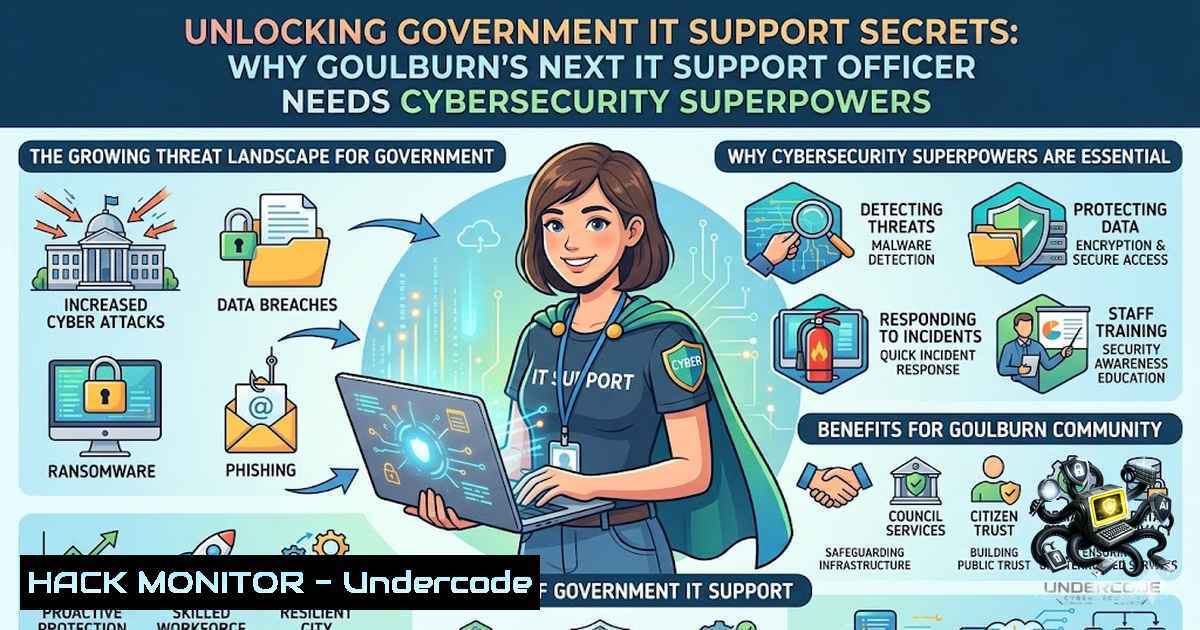
In an era where state government digital infrastructures are prime targets for sophisticated cyber adversaries, the humble Support Officer role has evolved far beyond resetting passwords and troubleshooting printers. When IT Alliance Australia announces a Support Officer position for a NSW State Government client in Goulburn【0†L1-L3】, they aren’t just seeking a helpdesk technician—they’re hunting for a frontline cyber defender capable of securing sensitive citizen data while maintaining operational continuity across distributed government networks.
Learning Objectives:
- Master the core competencies required for modern government IT support roles, including identity access management and endpoint security
- Understand the intersection of IT support and cybersecurity in state government environments
- Acquire practical command-line skills for Windows and Linux systems relevant to troubleshooting and security hardening
- Learn to identify, document, and escalate security incidents following government-grade protocols
You Should Know:
- Decoding the Support Officer Role in State Government IT
The Support Officer position advertised for Goulburn represents a critical juncture in NSW Government’s digital transformation journey【0†L1-L3】. Unlike private sector counterparts, government IT support professionals must navigate the Protective Security Policy Framework (PSPF) and Information Security Registered Assessors Program (IRAP) requirements while delivering frontline support. This role demands proficiency in ticketing systems like ServiceNow or Jira Service Management, Active Directory administration, and Microsoft 365 Government tenant management—all while maintaining strict confidentiality protocols.
The position typically involves managing endpoint security through Microsoft Defender for Endpoint or CrowdStrike, implementing conditional access policies, and ensuring compliance with the Australian Government’s Information Security Manual (ISM). Support Officers are often the first responders to phishing attempts, ransomware indicators, and unusual authentication patterns, making their role pivotal in the government’s cyber defense posture.
Step‑by‑step guide for Active Directory security auditing on Windows Server:
- Open PowerShell as Administrator and run: `Get-ADUser -Filter -Properties LastLogonDate,PasswordLastSet | Export-Csv C:\ADAudit.csv`
2. Identify stale accounts using: `Search-ADAccount -AccountInactive -TimeSpan 90.00:00:00 | Disable-ADAccount -Confirm:$false`
3. Audit privileged groups: `Get-ADGroupMember “Domain Admins” | Select-Object Name,SamAccountName`
4. Enable advanced audit logging: `auditpol /set /subcategory:”User Account Management” /success:enable /failure:enable`
5. Review security logs for anomalies: `Get-WinEvent -LogName Security -MaxEvents 100 | Where-Object {$_.Id -in (4624,4625,4720,4732)}`
2. Essential Linux Commands for Government-Grade Troubleshooting
Government IT environments increasingly incorporate Linux-based systems, particularly for critical infrastructure, database servers, and containerized applications. A Support Officer must be comfortable navigating both Red Hat Enterprise Linux and Ubuntu LTS distributions, often in air-gapped or highly restricted network segments.
The following commands form the backbone of Linux troubleshooting in secure government environments:
Step‑by‑step guide for system health assessment and security validation:
- Check system integrity: `sudo aide –check` (Advanced Intrusion Detection Environment)
- Review authentication logs: `sudo journalctl -u sshd -f –since “1 hour ago”`
3. Monitor real-time process activity: `sudo htop` or `sudo atop -r /var/log/atop/atop_$(date +%Y%m%d)`
4. Validate SELinux/AppArmor status: `sestatus` or `sudo aa-status`
- Inspect network connections: `sudo ss -tulpn | grep LISTEN` and `sudo netstat -antp | grep ESTABLISHED`
6. Check for unauthorized cron jobs: `for user in $(cut -f1 -d: /etc/passwd); do crontab -u $user -l 2>/dev/null; done`
7. Verify file integrity of critical binaries: `sudo rpm -Va` (RHEL) or `sudo debsums -c` (Debian)
3. Cloud Security Hardening for Government Tenants
As NSW Government agencies migrate to cloud platforms like Microsoft Azure Government and AWS GovCloud, Support Officers must understand cloud-specific security controls. The position likely involves managing hybrid identities, implementing Zero Trust architectures, and responding to cloud-1ative security alerts.
Step‑by‑step guide for Azure AD conditional access policy implementation:
- Navigate to Azure AD → Security → Conditional Access
- Create a new policy requiring multifactor authentication for all users accessing government applications
- Configure location-based conditional access to block sign-ins from outside Australia unless explicitly approved
- Implement session controls to limit access duration to 8 hours for non-privileged accounts
- Set up sign-in risk policies to automatically block high-risk authentications
6. Enable continuous access evaluation for real-time enforcement
- Test policies using What If tool before activation
For AWS environments, Support Officers should be familiar with:
- Configuring Security Groups with least-privilege principles
- Implementing AWS Config rules for compliance monitoring
- Using AWS Systems Manager for patch management across EC2 instances
- Setting up VPC Flow Logs for network traffic analysis
- Enabling AWS Shield Advanced for DDoS protection
4. API Security and Integration Monitoring
Modern government IT ecosystems rely heavily on APIs for service integration between departments, external vendors, and citizen-facing portals. Support Officers must understand API security fundamentals to troubleshoot authentication failures and identify potential abuse patterns.
Step‑by‑step guide for API security assessment:
- Validate OAuth 2.0 token expiration and refresh mechanisms: `curl -X POST https://api.gov.au/oauth/token -d “grant_type=client_credentials&client_id=XXX&client_secret=YYY”`
2. Test API rate limiting: `for i in {1..100}; do curl -s -o /dev/null -w “%{http_code}\n” https://api.gov.au/endpoint; done | sort | uniq -c`
3. Inspect API response headers for security misconfigurations: `curl -I https://api.gov.au/endpoint`
4. Check for exposed sensitive data in responses using jq: `curl -s https://api.gov.au/data | jq ‘. | select(.ssn != null)’` - Validate input sanitization by testing common injection payloads
- Monitor API gateway logs for anomalous traffic patterns using ELK stack or Splunk
5. Vulnerability Exploitation and Mitigation Strategies
Understanding the attacker’s mindset is crucial for effective defense. Support Officers should be familiar with common exploitation techniques and their mitigation strategies, particularly those affecting government systems.
Common vulnerabilities in government IT environments:
- CVE-2021-44228 (Log4Shell): Affects Java-based applications; mitigation involves updating Log4j to version 2.17.1+ or setting `log4j2.formatMsgNoLookups=true`
– CVE-2022-30190 (Follina): Windows MSDT vulnerability; mitigation includes disabling MSDT URL protocol or applying Microsoft’s official patches - ProxyShell/ProxyLogon: Exchange Server vulnerabilities; requires cumulative updates and disabling unnecessary services
- PrintNightmare: Windows Print Spooler remote code execution; mitigation involves disabling Print Spooler service where not required
Step‑by‑step guide for vulnerability scanning with OpenVAS:
- Install OpenVAS: `sudo apt-get install openvas` (Ubuntu) or `sudo yum install openvas` (RHEL)
- Initialize the database: `sudo greenbone-1vt-sync && sudo greenbone-scapdata-sync`
3. Start services: `sudo systemctl start openvas-scanner && sudo systemctl start openvas-manager`
4. Create a new task targeting the government subnet (e.g., 10.0.0.0/24) - Configure scan configuration to include “Full and Fast” with port range 1-65535
- Execute the scan and generate HTML/PDF reports for remediation tracking
- Schedule weekly scans and integrate results with vulnerability management platforms
6. Incident Response and Documentation Protocols
Government Support Officers are often the first line of defense during security incidents. Proper documentation and escalation procedures are critical for maintaining chain of custody and ensuring legal admissibility of evidence.
Step‑by‑step guide for initial incident response:
- Isolate affected systems from the network: `ipconfig /release` (Windows) or `sudo ifdown eth0` (Linux)
- Capture volatile data: `sudo dd if=/dev/mem of=/tmp/mem.dump bs=1M count=100` (Linux) or use FTK Imager (Windows)
- Record system time and running processes: `date && ps aux` (Linux) or `wmic process list` (Windows)
- Collect network connection logs: `netstat -an` (Windows) or `ss -anp` (Linux)
- Preserve event logs: `wevtutil epl Security C:\Security.evtx` (Windows) or `sudo cp /var/log/syslog /mnt/forensics/` (Linux)
- Calculate cryptographic hashes: `certutil -hashfile C:\file.exe SHA256` (Windows) or `sha256sum /path/to/file` (Linux)
- Document all actions in a secure incident log with timestamps and personnel identifiers
7. Training and Continuous Professional Development
The cybersecurity landscape evolves rapidly, and government Support Officers must pursue ongoing education to maintain their effectiveness. IT Alliance Australia’s recruitment drive emphasizes the importance of professional development【0†L8-L10】.
Recommended certifications and training paths:
- CompTIA Security+: Foundational cybersecurity knowledge required for all government IT roles
- Microsoft Certified: Security Operations Analyst Associate: Focuses on Microsoft Defender and Azure Sentinel
- ISC2 CISSP: Advanced certification for experienced professionals
- SANS SEC401: Security Essentials Bootcamp Style
- AWS Certified Security – Specialty: Cloud security specialization
- Certified Information Security Manager (CISM) : Management-focused certification
Practical training exercises should include:
- Setting up a home lab using VirtualBox or VMware with vulnerable machines (Metasploitable, DVWA)
- Participating in Capture The Flag (CTF) competitions on platforms like TryHackMe or HackTheBox
- Completing AWS Skill Builder and Microsoft Learn security modules
- Attending security webinars and conferences (e.g., Australian Cyber Conference, RSA Conference)
- Subscribing to threat intelligence feeds (CISA, ACSC, FBI)
What Undercode Say:
- Key Takeaway 1: The Support Officer role in NSW Government is not a traditional helpdesk position—it’s a cybersecurity-adjacent role requiring proficiency in endpoint protection, identity management, and incident response, with formal security clearances and IRAP familiarity becoming baseline requirements.
- Key Takeaway 2: Technical proficiency across Windows, Linux, and cloud platforms (Azure/AWS) is non-1egotiable, but the differentiator lies in understanding government-specific compliance frameworks (ISM, PSPF) and the ability to translate security policies into actionable operational procedures.
The analysis reveals that government IT support has undergone a paradigm shift from reactive troubleshooting to proactive security operations. Candidates who demonstrate hands-on experience with security tools, scripting abilities (PowerShell, Bash, Python), and a deep understanding of the Australian Government’s cyber security posture will have a significant advantage. The emphasis on equal employment opportunity and accessibility accommodations【0†L12】 reflects the government’s commitment to building diverse, resilient teams capable of defending against evolving cyber threats. Furthermore, the recruitment process itself—relying on direct email applications rather than automated systems【0†L5】—suggests a preference for candidates who can communicate effectively and navigate bureaucratic protocols.
Prediction:
+1 The convergence of IT support and cybersecurity will accelerate, with government Support Officers increasingly expected to hold dual certifications (e.g., Security+ and Azure Administrator) within the next 24 months
+1 Goulburn’s strategic position as a regional government hub will attract investment in cybersecurity training centers, creating a localized talent pipeline for NSW Government agencies
-1 The shortage of qualified candidates meeting both technical and security clearance requirements will force agencies to compromise on either technical skills or onboarding timelines, potentially increasing operational risk
+1 Automation and AI-driven monitoring tools will augment Support Officer capabilities, reducing mean time to detection (MTTD) for security incidents by up to 40% in government environments
-1 Legacy systems integration challenges will persist, requiring Support Officers to maintain proficiency in outdated technologies alongside modern cloud platforms, increasing cognitive load and error potential
▶️ Related Video (82% Match):
🎯Let’s Practice For Free:
🎓 Live Courses & Certifications:
Join Undercode Academy for Verified Certifications
🚀 Request a Custom Project:
Secure, high-velocity infrastructure and disruptive technological engineering. Contact our engineering team for high-tier development and proprietary systems:
[email protected]
💎 Smart Architecture | 🛡️ Secure by Design | ⭐ Trusted by Thousands
IT/Security Reporter URL:
Reported By: Supportofficer Share – Hackers Feeds
Extra Hub: Undercode MoN
Basic Verification: Pass ✅


