
Listen to this Post
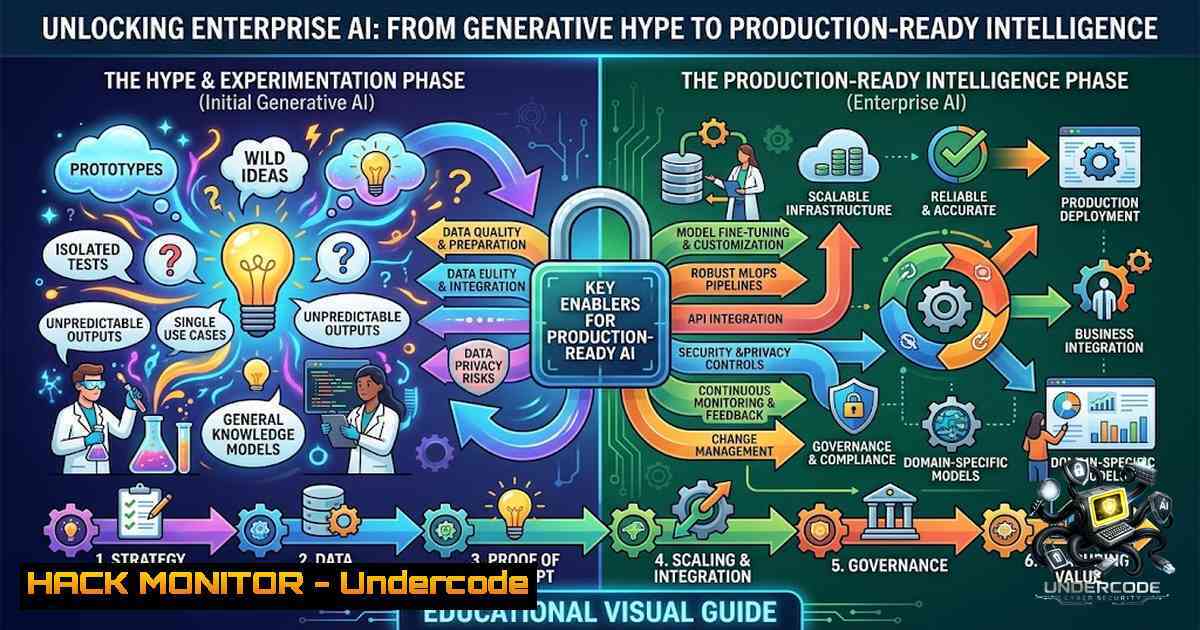
Introduction:
Generative AI has moved beyond experimental playgrounds into the boardroom, with enterprise leaders racing to embed large language models (LLMs) into core business workflows. However, the gap between proof-of-concept and production-grade AI remains wide, plagued by data privacy concerns, infrastructure complexity, and a shortage of skilled talent. This article distills the essential technical and strategic frameworks needed to operationalize generative AI securely and at scale, bridging the divide between business ambition and engineering reality.
Learning Objectives:
- Understand the architectural components required for enterprise-grade generative AI deployment
- Master data preparation and pipeline security for LLM fine-tuning and retrieval-augmented generation (RAG)
- Implement robust API security, access controls, and monitoring for AI services
- Evaluate and mitigate common vulnerabilities in AI supply chains and model outputs
- Develop a roadmap for transitioning from AI experimentation to sustainable production
You Should Know:
1. The Enterprise AI Stack: Choosing Your Foundation
Operationalizing generative AI begins with selecting the right infrastructure layer. Most enterprises adopt a hybrid approach combining commercial LLMs (OpenAI, Anthropic, Google) with open-weight models (Llama, Mistral, Falcon) deployed in private clouds or on-premises. The decision hinges on data sensitivity, latency requirements, and total cost of ownership.
For on-premises deployment, consider using vLLM or Text Generation Inference (TGI) for high-throughput inference. Below is a basic setup for running a Llama 3 model using vLLM on a Linux server with GPU support:
 Install Python virtual environment and dependencies
python3 -m venv llm-env
source llm-env/bin/activate
pip install vllm transformers accelerate

Download a model from Hugging Face (replace with your model ID)
huggingface-cli download meta-llama/Meta-Llama-3-8B-Instruct --local-dir ./llama3-8b

Launch the vLLM server
python -m vllm.entrypoints.openai.api_server \
--model ./llama3-8b \
--tensor-parallel-size 2 \
--max-model-len 8192 \
--port 8000
On Windows, you can use WSL2 with CUDA support or deploy via Docker Desktop:
 Windows PowerShell: Enable WSL2 and install Ubuntu
wsl --install -d Ubuntu
 Inside WSL, follow the Linux commands above
 Alternatively, use Docker
docker run --gpus all -p 8000:8000 vllm/vllm-openai:latest \
--model meta-llama/Meta-Llama-3-8B-Instruct
Step‑by‑step guide:
- Assess your data residency and compliance requirements to choose between cloud, hybrid, or on-prem.
- Benchmark model performance (throughput, latency, accuracy) using your own evaluation datasets.
- Implement a model gateway that routes requests to the optimal model based on cost, performance, and privacy constraints.
- Set up auto-scaling policies to handle variable workloads without over-provisioning resources.
2. Data Readiness: The Unseen Bottleneck
“Garbage in, garbage out” has never been more relevant. Enterprise AI initiatives fail most often due to poor data quality, not model inadequacy. For retrieval-augmented generation (RAG), your knowledge base must be clean, chunked appropriately, and embedded with high-fidelity vectors.
Start by auditing your existing data sources—databases, document repositories, wikis, and APIs. Use ETL pipelines to extract, transform, and load data into a vector database like Pinecone, Weaviate, or pgvector.
Example: Chunking and embedding documents using Python with LangChain:
from langchain.document_loaders import DirectoryLoader
from langchain.text_splitter import RecursiveCharacterTextSplitter
from langchain.embeddings import OpenAIEmbeddings
from langchain.vectorstores import Pinecone

Load documents from a directory
loader = DirectoryLoader('./docs/', glob='/.txt')
documents = loader.load()

Split into chunks
text_splitter = RecursiveCharacterTextSplitter(
chunk_size=1000,
chunk_overlap=200,
length_function=len,
)
chunks = text_splitter.split_documents(documents)

Generate embeddings and store in vector DB
embeddings = OpenAIEmbeddings()
vectorstore = Pinecone.from_documents(chunks, embeddings, index_name='enterprise-rag')
Step‑by‑step guide:
- Inventory all structured and unstructured data sources across your organization.
- Implement data lineage and versioning to track changes and ensure reproducibility.
- Apply PII redaction and anonymization before feeding data into any AI pipeline.
- Continuously monitor embedding drift and update your vector index as source data changes.
3. Securing the AI Supply Chain
The AI supply chain—from training data to pre-trained models to third-party APIs—introduces new attack vectors. Model poisoning, prompt injection, and data leakage are real threats that demand proactive defenses.
Implement a rigorous model validation pipeline that scans for vulnerabilities using tools like Giskard or Adversarial Robustness Toolbox (ART). Establish strict access controls for model registries and API keys.
Example: Using Giskard to scan a model for security and performance issues:
 Install Giskard
pip install giskard

Run a scan on your model (Python script)
import giskard
from giskard.llm import scan

Define your model prediction function
def predict(prompt: str) -> str:
 Your LLM call here
return model.generate(prompt)

Create a Giskard model wrapper
giskard_model = giskard.Model(
model=predict,
model_type="text_generation",
name="Enterprise LLM",
)

Run the scan
report = scan(giskard_model)
report.to_html("security_report.html")
Step‑by‑step guide:
- Enforce mutual TLS (mTLS) between all AI service components to prevent man-in-the-middle attacks.
- Use secret management tools (HashiCorp Vault, AWS Secrets Manager) to rotate API keys and credentials automatically.
- Implement rate limiting and request validation at the API gateway to mitigate denial-of-service and injection attempts.
- Regularly audit model cards and provenance to ensure you are not using compromised or backdoored models.
4. Prompt Engineering and Guardrails
Prompt engineering is both an art and a science. Well-crafted prompts reduce hallucination, enforce formatting, and guide model behavior. However, prompts alone are insufficient; you need programmatic guardrails to filter inputs and outputs.
Use frameworks like Guardrails AI or NeMo Guardrails to define policies that reject unsafe inputs or sanitize model outputs before they reach end-users.
Example: Defining a simple guardrail with NeMo Guardrails:
 config.yml
rails:
input:
- flow: check_input
actions:
- action: check_profanity
- action: check_pii
output:
- flow: check_output
actions:
- action: check_hallucination
- action: sanitize_output
Then, run the guardrail server:
 Install NeMo Guardrails
pip install nemoguardrails

Start the guardrail server
python -m nemoguardrails.server --config ./config.yml
Step‑by‑step guide:
- Develop a prompt template library with version control for different use cases (chat, summarization, code generation).
- Implement a feedback loop where user corrections are used to refine prompts and guardrails continuously.
- Test prompts against adversarial inputs using red-team exercises.
- Monitor output toxicity and factual accuracy using automated evaluation metrics (e.g., BERTScore, ROUGE, fact-checking APIs).
5. Monitoring and Observability for AI Systems
Production AI systems require deep observability beyond traditional application performance monitoring (APM). You need to track model drift, token usage, latency percentiles, and user satisfaction scores.
Instrument your AI pipeline to emit metrics to Prometheus and logs to ELK stack. Use tools like Arize AI or WhyLabs for dedicated ML monitoring.
Example: Exposing metrics from a FastAPI application using Prometheus:
from fastapi import FastAPI
from prometheus_fastapi_instrumentator import Instrumentator
import time

app = FastAPI()
Instrumentator().instrument(app).expose(app)

@app.post("/generate")
async def generate(prompt: str):
start = time.time()
response = call_llm(prompt)
duration = time.time() - start
 Record custom metric
return {"response": response, "latency": duration}
Step‑by‑step guide:
- Define SLOs (Service Level Objectives) for latency, accuracy, and availability for each AI service.
- Set up automated alerts when drift exceeds thresholds or when error rates spike.
- Implement canary deployments to test new model versions on a small subset of traffic before full rollout.
- Create dashboards that correlate business outcomes (e.g., conversion rates) with model performance metrics.
6. Cost Optimization and Governance
Running LLMs at scale is expensive. Inference costs can spiral out of control without careful planning. Implement token budgeting, caching, and model routing to minimize expenses.
Use semantic caching to avoid redundant LLM calls. For example, Redis with vector similarity can cache responses for semantically similar queries.
Example: Implementing a semantic cache with Redis and sentence-transformers:
import redis
import numpy as np
from sentence_transformers import SentenceTransformer

r = redis.Redis(host='localhost', port=6379, decode_responses=True)
model = SentenceTransformer('all-MiniLM-L6-v2')

def cached_generate(prompt: str, threshold: float = 0.9):
emb = model.encode(prompt)
 Find similar cached prompts (simplified)
for key in r.scan_iter("cache:"):
cached_emb = np.frombuffer(r.get(key), dtype=np.float32)
similarity = np.dot(emb, cached_emb) / (np.linalg.norm(emb)  np.linalg.norm(cached_emb))
if similarity > threshold:
return r.get(f"response:{key}")
 No cache hit, call LLM
response = call_llm(prompt)
 Store in cache
r.set(f"cache:{prompt}", emb.tobytes())
r.set(f"response:{prompt}", response)
return response
Step‑by‑step guide:
- Track token usage per user, per department, and per use case to allocate costs accurately.
- Implement model routing where simpler (cheaper) models handle routine queries and only complex ones trigger the flagship model.
- Use spot instances or preemptible VMs for non-critical batch inference jobs.
- Regularly review and prune fine-tuned models to remove redundant parameters (quantization, pruning).
What Undercode Say:
- Key Takeaway 1: Enterprise AI success is 80% data engineering and 20% model selection—invest in data pipelines before chasing the latest LLM.
- Key Takeaway 2: Security cannot be an afterthought; embed guardrails, encryption, and access controls from day one to avoid costly remediation later.
- Key Takeaway 3: Observability is the cornerstone of sustainable AI—without it, you are flying blind into performance degradation and cost overruns.
- Key Takeaway 4: The transition from pilot to production requires a cultural shift, not just a technological one—cross-functional teams (data, security, operations) must collaborate closely.
- Key Takeaway 5: Cost governance is as critical as performance governance—implement semantic caching and model routing to keep budgets under control without sacrificing user experience.
Analysis: The enterprise AI landscape is rapidly maturing, but the hype often outpaces practical know-how. Organizations that treat AI as a core engineering discipline—with rigorous CI/CD, security reviews, and performance monitoring—will outcompete those that treat it as a mere API call. The tools and commands outlined above provide a foundational toolkit, but the real differentiator lies in organizational discipline and continuous learning. As models evolve and new attack surfaces emerge, the enterprise must adopt a mindset of perpetual adaptation, where AI systems are not static artifacts but living, governed services that improve with every interaction.
Prediction:
- +1 The convergence of generative AI with traditional DevOps (MLOps) will spawn a new category of “AI Reliability Engineers” by 2027, making AI operations as standardized as cloud infrastructure.
- +1 Open-weight models will gain significant enterprise traction as they close the performance gap with proprietary APIs, driven by privacy and cost concerns.
- -1 A major data breach involving an AI training pipeline will occur within the next 18 months, prompting regulatory frameworks similar to GDPR specifically for AI models.
- -1 The skills gap in AI security and infrastructure will widen, creating a premium for professionals who can bridge business strategy with hands-on engineering.
- +1 Semantic caching and model routing will become standard practice, reducing enterprise AI operational costs by an average of 40% by 2028.
- +1 Retrieval-augmented generation (RAG) will evolve from a nice-to-have to a mandatory component for any regulated industry, as it provides traceability and auditability that pure generative models cannot.
- -1 Without standardized guardrails, the proliferation of AI-generated content will lead to a “trust collapse” in certain sectors, forcing enterprises to over-invest in verification mechanisms.
- +1 The integration of AI with zero-trust security architectures will create new defense-in-depth layers, making AI systems more resilient to adversarial attacks than traditional software.
▶️ Related Video (90% Match):
🎯Let’s Practice For Free:
🎓 Live Courses & Certifications:
Join Undercode Academy for Verified Certifications
🚀 Request a Custom Project:
Secure, high-velocity infrastructure and disruptive technological engineering. Contact our engineering team for high-tier development and proprietary systems:
[email protected]
💎 Smart Architecture | 🛡️ Secure by Design | ⭐ Trusted by Thousands
IT/Security Reporter URL:
Reported By: Sudhirsinha Artificialintelligence – Hackers Feeds
Extra Hub: Undercode MoN
Basic Verification: Pass ✅


