Listen to this Post
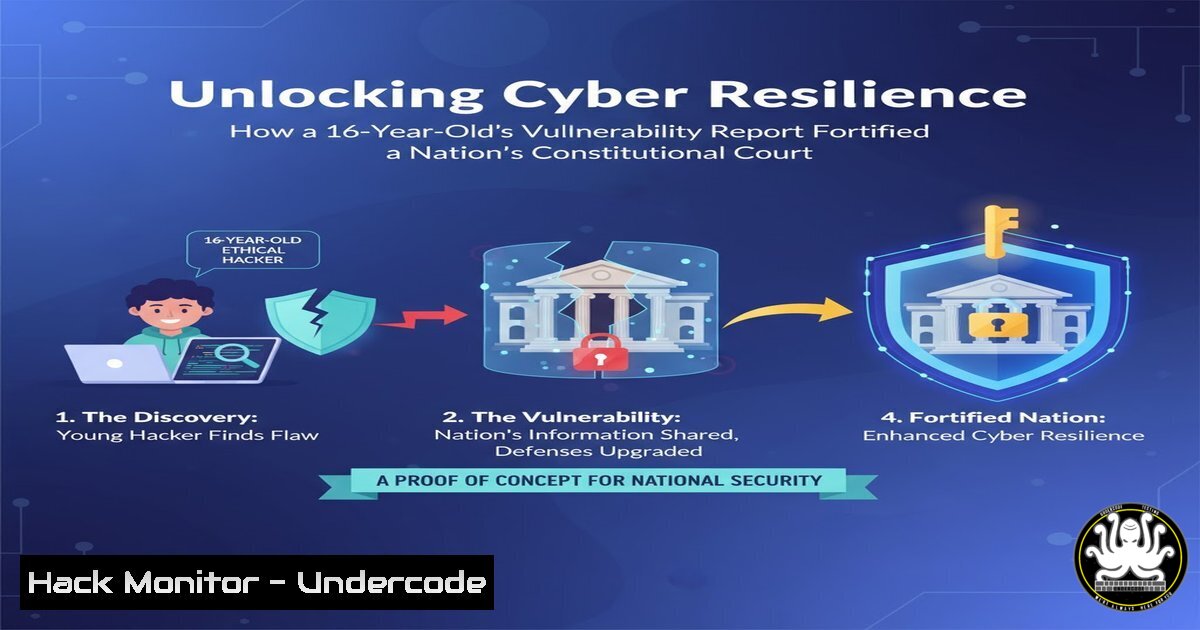
Introduction:
In an era where digital threats target critical national infrastructure, the collaboration between independent security researchers and governmental Computer Security Incident Response Teams (CSIRTs) has become a cornerstone of cyber defense. The recent successful vulnerability disclosure by a young ethical hacker to Indonesia’s Constitutional Court (MKRI) exemplifies this modern security paradigm, demonstrating how proactive threat hunting and institutional responsiveness can jointly strengthen sovereign digital assets. This incident underscores a global shift towards embracing crowdsourced security and transparent disclosure channels to preemptively mitigate risks.
Learning Objectives:
- Understand the end-to-end process of responsible vulnerability disclosure to a governmental CSIRT.
- Identify common web application vulnerabilities typically found in institutional systems and learn their remediation.
- Learn essential command-line and tool-based techniques for initial vulnerability assessment and validation.
You Should Know:
- The Responsible Disclosure Protocol with a Governmental CSIRT
Responsible disclosure is a formalized process where a security researcher privately reports a discovered vulnerability to the organization’s security team, allowing for remediation before any public announcement. When dealing with a governmental CSIRT, the process demands heightened professionalism and precision.
Step-by-step guide explaining what this does and how to use it.
Step 1: Identification and Validation. The first step is to conclusively confirm the vulnerability. For a common flaw like Cross-Site Scripting (XSS), this involves crafting a non-destructive payload to prove exploitability.
Example (Using `curl` to test for Reflected XSS):
curl -G "https://target-domain.com/search" --data-urlencode "query=<script>alert('XSS')</script>"
Example (Simple Python script to check for SQLi time delays):
import requests
target_url = "http://example.com/login"
payloads = ["' OR SLEEP(5)--", "' OR 1=1--"]
for payload in payloads:
data = {'username': payload, 'password':'test'}
try:
r = requests.post(target_url, data=data, timeout=10)
print(f"Payload: {payload} - Response Time: {r.elapsed.total_seconds()}s")
except requests.exceptions.Timeout:
print(f"Payload: {payload} - Timed out (possible SQLi)")
Step 2: Secure Communication. Never use the vulnerable system itself to report the issue. Locate the official security contact or PGP key, often found in the organization’s security.txt file (/.well-known/security.txt) or CSIRT page.
Step 3: Draft the Disclosure Report. The report must be clear, concise, and contain all necessary details for replication.
Subject: `Vulnerability Disclosure: [Vulnerability Type] in [Component/URL]`
Body: Include a detailed description, steps to reproduce, proof-of-concept (PoC) code or screenshots, the impacted URL, and the potential security impact.
2. Common Vulnerabilities in Institutional Web Portals
Government web portals often handle sensitive citizen data, making them prime targets. The most frequently discovered vulnerabilities include SQL Injection (SQLi), Cross-Site Scripting (XSS), and security misconfigurations.
Step-by-step guide explaining what this does and how to use it.
Step 1: Reconnaissance. Use subdomain enumeration and directory brute-forcing to map the application’s attack surface.
Tool: `amass` for passive enumeration
amass enum -passive -d mkri.go.id
Tool: `ffuf` for directory brute-forcing
ffuf -w /usr/share/wordlists/dirb/common.txt -u https://mkri.go.id/FUZZ -mc 200,301,302,403
Step 2: Automated Scanning (Ethically). Use tools like `nikto` to get a baseline of potential issues. Always configure the tool to be non-intrusive and respect the `robots.txt` file.
Command:
nikto -h https://mkri.go.id -C all -Tuning 9
Step 3: Manual Testing. Automation misses context. Manually test all input fields, URL parameters, and headers for SQLi and XSS.
SQLi Test in a Search Field: Input a single quote (') and observe for database errors.
XSS Test in a Contact Form: Input a payload like <img src=x onerror=alert('found')>.
3. Leveraging Browser Developer Tools for Bug Hunting
The Developer Tools (F12) in modern browsers are a powerhouse for finding client-side vulnerabilities and analyzing network traffic.
Step-by-step guide explaining what this does and how to use it.
Step 1: Analyze the Console. Look for JavaScript errors that might reveal sensitive information or flawed logic.
Step 2: Inspect the Network Tab. Monitor all HTTP requests and responses. Look for endpoints that return sensitive data (e.g., user details, internal IDs) or exhibit strange status codes.
Action: Filter by `js` or `json` to find API endpoints. Check if these endpoints lack proper authentication.
Step 3: Review Source Code and Storage. The “Sources” and “Application” (or “Storage”) tabs can reveal hardcoded API keys, secrets, or overly permissive CORS configurations.
4. Essential Linux Commands for Security Analysis
A researcher’s workflow is often powered by the Linux command line for quick data parsing and network checks.
Step-by-step guide explaining what this does and how to use it.
`grep` for Pattern Searching: Quickly find exposed emails or keys in source code.
Command to find email patterns in a file:
grep -E -o "\b[A-Za-z0-9._%+-]+@[A-Za-z0-9.-]+.[A-Z|a-z]{2,}\b" downloaded_page.html
`curl` for HTTP Interaction: A versatile tool for crafting custom requests.
Command to send a custom User-Agent header:
curl -H "User-Agent: Mozilla/5.0 (Security-Scanner)" -I https://target.com
nslookup/dig for DNS Reconnaissance: Gather information about the target’s infrastructure.
Command:
dig A mkri.go.id
nslookup -type=MX mkri.go.id
5. Hardening Web Application Configurations
Mitigating the vulnerabilities found is the responsibility of the CSIRT and development team. Key actions include:
For XSS: Implement a strict Content Security Policy (CSP) and sanitize all user input on the server side.
For SQLi: Use parameterized queries or prepared statements exclusively, never concatenating user input into SQL commands.
General Hardening: Ensure security headers like X-Content-Type-Options: nosniff, X-Frame-Options: DENY, and `Strict-Transport-Security` are set.
Step-by-step guide explaining what this does and how to use it.
Step 1: Input Validation. On the server, whitelist allowed characters for each input field.
Step 2: Output Encoding. Encode data before rendering it in the browser to neutralize script tags.
Step 3: Security Headers. Configure the web server (e.g., Nginx, Apache) to include security headers.
Example Nginx configuration snippet:
add_header X-Frame-Options "SAMEORIGIN" always;
add_header X-XSS-Protection "1; mode=block" always;
add_header Strict-Transport-Security "max-age=63072000; includeSubDomains; preload" always;
What Undercode Say:
- The Age of the Defender is Collaborative. The most robust cybersecurity posture is no longer built solely on internal expertise but on fostering trusted channels for external researchers to contribute. This case proves that even a single, well-handled report can significantly uplift an institution’s security.
- Youth and Talent are the New Frontier in Security. The fact that the researcher is 16 years old shatters the traditional credential-based model of trust in cybersecurity. It highlights that skill, ethics, and a methodical approach are the true currencies, opening doors for a new generation of diverse talent.
This successful collaboration is a microcosm of a larger, necessary trend. It demonstrates that national cyber resilience is a shared responsibility. By institutionalizing transparent and respectful disclosure processes, government bodies can effectively crowdsource their defense, turning potential adversaries into valuable allies. The positive outcome here serves as a compelling model for other public and private institutions in Indonesia and beyond, proving that a proactive, open-door policy towards security researchers is not a weakness, but a critical strategic strength.
Prediction:
This event will catalyze a wave of similar collaborations across Indonesia’s public sector, leading to the formalization of more bug bounty programs and vulnerability disclosure policies (VDPs) for government entities. We predict that within two years, Indonesia will emerge as a regional leader in public-sector cybersecurity transparency, inspiring neighboring countries to adopt similar frameworks. This will simultaneously lead to a surge in skilled, young Indonesian ethical hackers entering the global cybersecurity arena, further strengthening the country’s overall digital sovereignty and threat resistance capabilities.
🎯Let’s Practice For Free:
IT/Security Reporter URL:
Reported By: Fathi Akhdan – Hackers Feeds
Extra Hub: Undercode MoN
Basic Verification: Pass ✅


