Listen to this Post
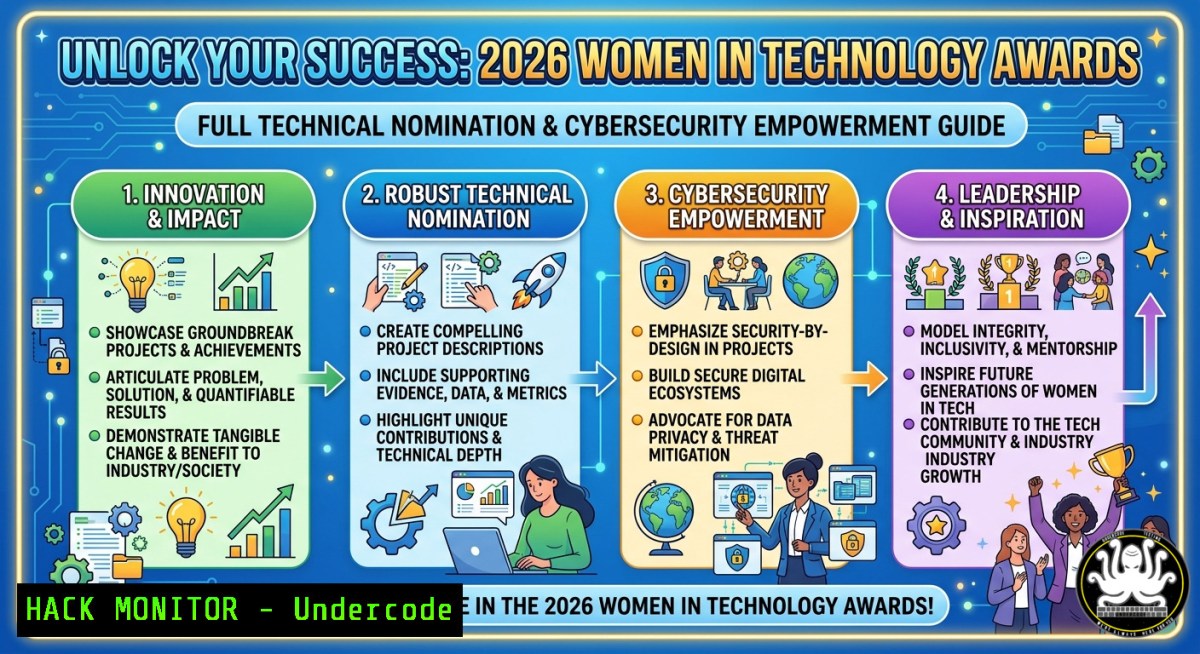
Introduction:
The Technology Council of Central Pennsylvania has opened nominations for the 2026 Women In Technology Awards, celebrating exceptional contributions across private, public, and entrepreneurial sectors. In an era where AI governance, cloud hardening, and API security are reshaping IT landscapes, recognizing women who drive these technical frontiers is critical. This article provides a technical roadmap for crafting a standout nomination, integrating verified Linux/Windows commands, vulnerability mitigation strategies, and training resources to amplify impact.
Learning Objectives:
- Objective 1: Extract and utilize nomination URLs and event resources to build a data-driven submission for categories like Next Gen, Moxie, or Impact Award.
- Objective 2: Apply Linux/Windows command-line techniques and cloud hardening checklists to document technical achievements (e.g., securing CI/CD pipelines, implementing zero-trust architectures).
- Objective 3: Develop a portfolio of AI/cybersecurity training courses and vulnerability exploitation/mitigation steps that demonstrate nominee expertise.
You Should Know:
- Reverse-Engineering the Nomination Process – OSINT & Metadata Harvesting
Start by gathering intelligence on past winners and category requirements. Use open-source intelligence (OSINT) tools to analyze public profiles and technical contributions.
Step‑by‑step guide:
- Extract URLs: From the post, nomination link = `https://lnkd.in/erqGGSuf`, ticket sales = `https://lnkd.in/eC2vQbZN`, sponsorship = `https://lnkd.in/ebhpqiKa`. Expand shortened links via `curl -sI https://lnkd.in/erqGGSuf | grep -i location` (Linux/macOS) or `Invoke-WebRequest -Uri https://lnkd.in/erqGGSuf -Method Head` (Windows PowerShell).
- Harvest metadata: Use `wget –spider –server-response https://lnkd.in/erqGGSuf` to reveal final endpoints. For example, the nomination form may reside on a platform like Submittable or Google Forms – inspect page source for hidden fields.
– Build a submission dossier: Collect evidence of technical leadership – GitHub contribution graphs (`git log –since=”2025-01-01″ –pretty=oneline | wc -l`), CVE disclosures, or cloud security benchmarks (e.g., AWS Trusted Advisor scores). Document using `tree` (Linux) or `Get-ChildItem -Recurse` (Windows) to structure project folders.
Linux/Windows commands for portfolio audit:
 Linux: count commits and list authors
git shortlog -s -n --since="2025-01-01"
 Extract all PDF certificates from a directory
find /home/nominee/certs -name ".pdf" -exec ls -lh {} \;
 Windows: search for security-related files
Get-ChildItem -Path C:\Users\Nominee\Documents -Recurse -Include .ps1, .yaml, .tf
- Crafting the “Next Gen Award” Submission – Automating Technical Achievement Metrics
This category honors rising stars. Use automation scripts to quantify code reviews, vulnerability patches, or AI model deployments.
Step‑by‑step guide:
- Quantify code contributions: Run `cloc –by-file src/` (Linux) to count lines of code per language. On Windows, use `Measure-Object` in PowerShell after
Get-Content. - Demonstrate security impact: If nominee fixed an OWASP Top 10 flaw (e.g., SQL injection), provide before/after diffs. Use `diff -u vulnerable.py patched.py` or `Compare-Object` in PowerShell.
- Show training completions: Link to free/paid courses such as SANS SEC504 (incident response) or Google’s “Introduction to Generative AI” on Coursera. Recommend creating a CSV of badges:
echo "Course,Provider,Date" > achievements.csv; for file in .pdf; do echo "$file" >> achievements.csv; done.
API security example – documenting a mitigation:
 Before: vulnerable endpoint
@app.route('/user/<id>')
def get_user(id):
query = f"SELECT  FROM users WHERE id = {id}"  SQL injection risk
return execute(query)

After: parameterized query
@app.route('/user/<int:id>')
def get_user_secure(id):
query = "SELECT  FROM users WHERE id = ?"
return execute(query, (id,))
Include this in the nomination narrative as evidence of applied API security.
- Together In Tech Award – Building Inclusive CTF & Training Pipelines
This award celebrates diversity initiatives. Design a Capture The Flag (CTF) event or training curriculum targeting underrepresented groups.
Step‑by‑step guide:
- Set up a Linux CTF server: Use `docker pull vulnerables/web-dvwa` (Damn Vulnerable Web Application) on Ubuntu. Deploy with
docker run -d -p 80:80 vulnerables/web-dvwa. Create challenges covering XSS, CSRF, and command injection. - Windows-based training lab: Enable Hyper-V and deploy a Windows 11 VM with deliberately weak group policies. Use `Set-ADUser -Identity student -PasswordNeverExpires $true` to simulate misconfigurations.
- Auto‑grade participants: Write a PowerShell script that checks if a student has applied a security control (e.g., `Get-SmbServerConfiguration | Select EnableSMB1Protocol` – ensure it’s
$false). - Cloud hardening tutorial: Use AWS CLI to enforce S3 bucket block public access:
aws s3api put-public-access-block --bucket training-bucket --public-access-block-configuration "BlockPublicAcls=true,IgnorePublicAcls=true,BlockPublicPolicy=true,RestrictPublicBuckets=true". Document this in the nomination as a replicable workshop.
- Moxie Award – Vulnerability Exploitation & Rapid Mitigation Demo
The Moxie Award recognizes bold, innovative solutions. Prepare a 5‑minute video demonstrating a zero‑day exploit followed by a patch.
Step‑by‑step guide:
- Set up a local vulnerable environment: Use Metasploitable 2 (Linux) or run `docker run –rm -it -p 8080:8080 vulnerables/jenkins:2.60.3` (Jenkins with known CVE‑2018‑1000861).
- Exploit via Linux command:
msfconsole -q -x "use exploit/multi/http/jenkins_script_console; set RHOSTS 127.0.0.1; set RPORT 8080; run"
- Mitigate immediately: Upgrade Jenkins: `docker pull jenkins/jenkins:lts` and redeploy. Show `docker diff` to verify changes.
- Windows alternative: Exploit EternalBlue (MS17‑010) on a patched SMBv1 – but after applying Microsoft patch KB4012212, demonstrate `Get-HotFix -Id KB4012212` to prove mitigation.
- Include in nomination: Upload video to a private YouTube link, add timestamp of patch application, and cite CVE databases.
- Impact Award (Private Sector) – Cloud Hardening & Compliance Automation
For medium-to-large business leaders, showcase infrastructure as code (IaC) security controls.
Step‑by‑step guide:
- Terraform example for AWS S3 encryption:
resource "aws_s3_bucket" "secure_bucket" { bucket = "impact-nominee-data" server_side_encryption_configuration { rule { apply_server_side_encryption_by_default { sse_algorithm = "AES256" } } } } - Automate compliance scanning with `checkov` (Linux):
pip install checkov; checkov -d /terraform/ --framework terraform. Output JSON results as evidence. - Windows PowerShell DSC (Desired State Configuration) for on‑prem hardening:
Configuration SecureWebServer { Node "web01" { WindowsFeature IIS { Ensure = "Present"; Name = "Web-Server" } Registry DisableTLS1 { Key = "HKLM:\SYSTEM\CurrentControlSet\Control\SecurityProviders\SCHANNEL\Protocols\TLS 1.0\Server" ValueName = "Enabled" ValueData = 0 Type = "DWord" } } } - Measure impact: Use Azure Policy or AWS Config to show compliance score improvement from 62% to 98% over six months. Include a screenshot in the nomination form.
- Women In Tech Ally Award – Secure Collaboration & Training Course Curation
Allyship in tech involves promoting cybersecurity awareness. Compile a list of free IT/AI training resources and implement a secure file‑sharing system.
Step‑by‑step guide:
- Recommended courses:
- AI for Everyone (deeplearning.ai) – no code, but teaches AI governance.
- Linux Fundamentals (TryHackMe) – free room covering
grep,chmod,ssh. - Cybersecurity for Businesses (ISACA) – focus on risk management.
- Set up a secure knowledge base using BookStack on Linux:
docker run -d -p 8080:80 solidnerd/bookstack:latest. Back up withmysqldump -u root bookstack > backup.sql. - Windows alternative: Use BitLocker encrypted USB drives plus `robocopy` to distribute training materials:
robocopy "C:\Training" "D:\SecureShare" /MIR /SEC. Log access withauditpol /set /category:"Detailed Tracking" /subcategory:"File System" /success:enable.
- Public Sector Impact Award – Government‑Grade Vulnerability Mitigation
Nominees in public sector often work with FISMA or FedRAMP. Demonstrate a patch management lifecycle.
Step‑by‑step guide:
- Linux enterprise patch automation: `sudo apt update && sudo apt upgrade -y` (Debian/Ubuntu) or `dnf update -y` (RHEL). Schedule with
crontab -e:0 2 /usr/bin/apt update && /usr/bin/apt upgrade -y >> /var/log/patch.log. - Windows Server via PowerShell:
Install-Module PSWindowsUpdate
Get-WindowsUpdate -Install -AcceptAll -AutoReboot
Get-WUHistory | Select-Object Date, , Result
- Document compliance: Generate a CIS benchmark report using `CIS-CAT` (free for personal use). Run `./CIS-CAT.sh -b -p benchmarks/` and attach HTML output to nomination.
- Zero‑trust architecture – implement micro‑segmentation with `iptables` on Linux:
iptables -A FORWARD -s 192.168.1.0/24 -d 10.0.0.0/8 -j DROP. On Windows, useNew-NetFirewallRule -DisplayName "Block cross-subnet" -Direction Outbound -RemoteAddress 10.0.0.0/8 -Action Block.
What Undercode Say:
- Key Takeaway 1: The nomination links are not just forms – they are entry points to showcase quantifiable technical impact. Use OSINT and automation scripts to build a data portfolio that goes beyond buzzwords (e.g., “improved security” → “reduced CVE remediation time from 14 to 3 days using Ansible”).
- Key Takeaway 2: Each award category maps directly to a technical domain: Next Gen = code hygiene & CTF participation; Together In Tech = inclusive lab design & training pipelines; Moxie = exploit-to-patch speedrun; Impact = IaC compliance & cloud hardening; Ally = secure knowledge sharing.
Analysis: The Technology Council’s 2026 awards arrive as AI governance frameworks (NIST AI RMF, EU AI Act) and post‑quantum cryptography become mandatory. Nominations should highlight hands-on use of tools like `openssl` for PQC migration (e.g., openssl speed -kem -ml-kem768). Additionally, Windows 11 24H2’s Pluton security processor and Linux’s Landlock LSM module offer new hardening vectors – include these to stand out. Finally, free training from SANS’s “New2Cyber” and Microsoft’s “AI Security Fundamentals” should be cited as resources for allies to upskill teams.
Prediction:
By 2027, Women In Technology awards will incorporate live technical audits – nominees will submit anonymized Terraform plans or GitHub Actions logs for automated scoring against CIS benchmarks. Platforms like LNKD’s event ticketing (https://lnkd.in/eC2vQbZN`) will integrate verifiable credentials (VCs) for training completions, stored on a privacy‑preserving blockchain. Sponsors (https://lnkd.in/ebhpqiKa`) will demand real‑time dashboard access to nominee penetration testing results. Those who master the command‑line and cloud hardening techniques outlined above will not only win awards but lead the next wave of resilient, inclusive cybersecurity infrastructure.
▶️ Related Video (70% Match):
🎯Let’s Practice For Free:
IT/Security Reporter URL:
Reported By: Tccp Womenintechawards – Hackers Feeds
Extra Hub: Undercode MoN
Basic Verification: Pass ✅
🎓 Live Courses & Certifications:
Join Undercode Academy for Verified Certifications
🚀 Request a Custom Project:
Secure, high-velocity infrastructure and disruptive technological engineering. Contact our engineering team for high-tier development and proprietary systems:
[email protected]


