
Listen to this Post
Introduction:
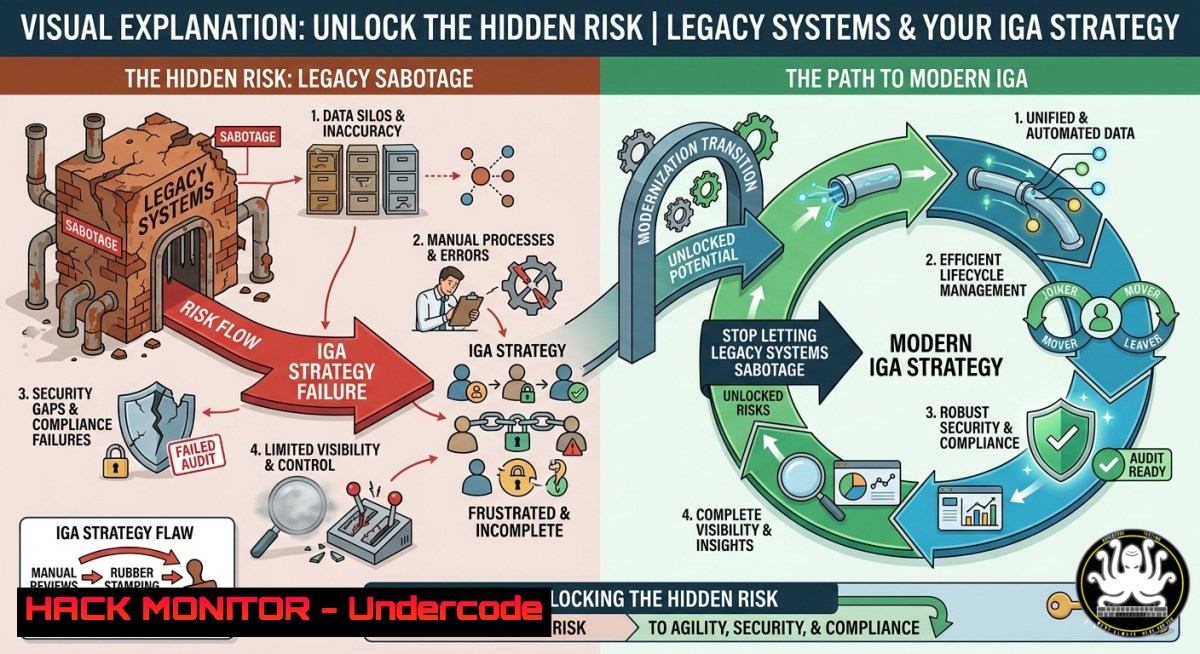
Identity Governance and Administration (IGA) platforms are the cornerstone of enterprise security, yet a staggering number of organizations remain blind to the “disconnected” systems that operate outside their governance reach. Traditional IGA solutions and manual scripts fail to bridge these critical gaps, creating severe compliance blind spots and exposing organizations to identity fatigue and regulatory penalties.
Learning Objectives:
- Understand the scope of the “disconnected application” problem and its security implications.
- Identify the operational and compliance risks of manual and bespoke identity processes.
- Explore a modern approach using low-code automation platforms, like READI, to extend governance to every system.
You Should Know:
- The Disconnected Reality: Why 80% of Your Systems Are Ungoverned
Most enterprises have successfully integrated only a small fraction of their critical applications into their IGA platform. The rest, typically legacy line-of-business apps, homegrown tools, and file shares, remain completely disconnected. These systems don’t support modern APIs like SCIM or REST, making native integration with platforms like SailPoint or Saviynt prohibitively complex or expensive.
This isn’t just a technical inconvenience; it’s a massive security liability. Organizations cannot automate provisioning or deprovisioning for these systems, leading to orphaned accounts and excessive permissions that persist for years. As highlighted in the 2025 State of IGA report, 73.9% of organizations have users with access they don’t need, a direct result of these governance gaps. Manual processes, including the use of bespoke PowerShell scripts, are error-prone, fail to scale with mergers and acquisitions, and are a leading cause of costly compliance audit failures under frameworks like SOX, HIPAA, and GDPR.
Step-by-Step Guide to Discovery: Before you can fix the problem, you need to find it. Use these commands to start mapping your environment’s blind spots.
- Linux: Scan for open ports or identify key application services that may host unsanctioned identity stores.
Identify listening services on a server
sudo netstat -tulpn | grep LISTEN

Find potential config files containing hardcoded credentials or service accounts
grep -r "PASSWORD" /etc/ --include=".conf" --include=".cfg" 2>/dev/null
-
Windows (PowerShell): Uncover local accounts and AD orphaned accounts that would be invisible to an IGA.
List all local users on a server (common for legacy apps)
Get-LocalUser | Where-Object {$_.Enabled -eq $true}

Find AD users without a manager set or those disabled for >90 days
Search-ADAccount -AccountDisabled -UsersOnly | Where-Object {$_.LastLogonDate -lt (Get-Date).AddDays(-90)}
- The IGA Project Roadblock: Why Traditional Connectors Fail
The frustrating reality is that no matter how sophisticated your IGA platform is, it cannot govern a system it cannot talk to. This architectural gap is the primary reason IGA projects fail or suffer from “identity fatigue,” leading to stalled deployments. Organizations often resort to expensive, fragile custom-coded connectors or, worse, manage these systems outside of governance entirely.
To solve this, a new paradigm is required—one that abstracts the complexity of connectivity. Platforms like READI serve as a “governance foundation,” using a low-code, automation-first approach to bridge the divide. Instead of building a unique API for every legacy system, these platforms use a library of connectors supporting various methods (REST, SOAP, JDBC, AI-driven RPA) to ingest, normalize, and forward identity data to your central IGA.
Step-by-Step Guide: Automate a Legacy File Share Provisioning (Using a Low-Code Approach)
This example demonstrates the logic you would configure in a tool like READI Connector Studio to automate a task typically done manually.
- Trigger: A request for a new employee appears in your IGA platform for access to a network share (e.g.,
\\LegacyApp\Finance). - Action (Simulated Logic): The automation engine uses a pre-built connector to execute a secure script on the target server.
- Command (PowerShell Core): The script runs a verified command to create the directory and set explicit permissions.
Script to provision access to a disconnected file server param ( [bash]$UserName, [bash]$Department ) $Path = "\LegacyApp\${Department}" Create directory if it doesn't exist if (!(Test-Path $Path)) { New-Item -ItemType Directory -Path $Path } Grant Modify access to the specific user icacls $Path /grant "${UserName}:(OI)(CI)M" /T Log the action for audit compliance Write-Output "$(Get-Date) - Granted access to $UserName on $Path" >> "C:\IGA_Audit.log" -
API Security & Cloud Hardening for Hybrid Identities
Integrating legacy systems often forces organizations to expose internal services, inadvertently increasing their attack surface. Hardening these hybrid connections is critical. Traditional perimeter defenses are insufficient when you are pulling data from a mainframe into a cloud-based IGA. Every new integration point introduces potential API security flaws if not properly managed.
API Security & Hardening Commands
- Linux (API Gateway Security Check): Validate that your endpoints are not exposing dangerous HTTP methods.
Scan for open or misconfigured API endpoints using nmap nmap -p 443 --script http-methods --script-args http-methods.url-path=/api/v1/users {API_GATEWAY_IP} Check TLS configuration to prevent weak cipher usage nmap --script ssl-enum-ciphers -p 443 {API_GATEWAY_IP} -
Windows (Service Account Hardening): Harden the privileged accounts used for automation.
Enforce restrictions on a service account used by the automation tool
Prevent interactive logon
Set-ADUser -Identity "svc_iga_bot" -LogonWorkstations "NULL"
Ensure password never expires (requires additional vaulting)
Set-ADAccountControl -Identity "svc_iga_bot" -PasswordNeverExpires $true -CannotChangePassword $true
- Mitigating the Risk: From Manual Remediation to Automated Compliance
The final step is moving from reactive auditing to continuous compliance. Disconnected apps are notorious for “privilege creep,” where users accumulate access they no longer need. Traditional quarterly access reviews fail to catch these anomalies in real-time. Modern IGA solutions must inject AI and automation to monitor for violations and trigger instant remediation.
Mitigation & Fix-It Guide: The Orphaned Account Remediation Workflow
When a user leaves the company, a disconnected application might retain their access. Use this script to identify and kill those sessions.
- Detect: Query your automation tool’s audit log for “last logon” timestamps.
- Verify: Check against HR termination feeds (e.g., from Workday or SAP).
- Remediate: Execute the following script to disable the account and revoke tokens.
Linux (Revoking Sessions):
 Forcefully kill all user processes on a legacy Linux box
pkill -u {orphaned_username}
 Lock the account
passwd -l {orphaned_username}
Windows (Disabling via API):
 Use Invoke-RestMethod to trigger a remediation bot in your platform
$body = @{ "userID" = "jsmith123"; "action" = "DISABLE" } | ConvertTo-Json
Invoke-RestMethod -Uri "https://{YourREADIInstance}/api/remediate" -Method POST -Body $body -ContentType "application/json"
What Undercode Say:
- Key Takeaway 1: Your IGA platform is not the problem; the legacy ecosystems it cannot reach are the real vulnerability. Manual scripts and spreadsheets are not security controls, they are compliance theater.
- Key Takeaway 2: The solution lies in abstraction. Adding a low-code automation layer between your legacy systems and the IGA platform allows you to unify governance without rewriting critical business logic.
Analysis: The core issue is that security teams are fighting a distributed “entitlement explosion” with tools designed for a static, on-premise world. The move to the cloud has amplified, not solved, this problem. Solutions like READI succeed because they start with the premise that the environment will never be perfectly standardized. By embracing a “connect anything” architecture, organizations can finally achieve the single source of truth required for Zero Trust. The data is clear: failing to bridge the disconnected gap means accepting regulatory fines and a significant percentage of unknown risk.
Prediction:
As attack surfaces continue to expand into generative AI agents and non-human identities, the number of disconnected entities will increase exponentially. We will see a rapid shift from monolithic IGA “suites” to agile, API-first integration layers that act as universal identity hubs. The next 24 months will force every major enterprise to audit their “governance shadow,” and those that fail to automate will be the primary vectors for the next wave of identity-based breaches.
▶️ Related Video (84% Match):
🎯Let’s Practice For Free:
IT/Security Reporter URL:
Reported By: Jimdes How – Hackers Feeds
Extra Hub: Undercode MoN
Basic Verification: Pass ✅


