Listen to this Post
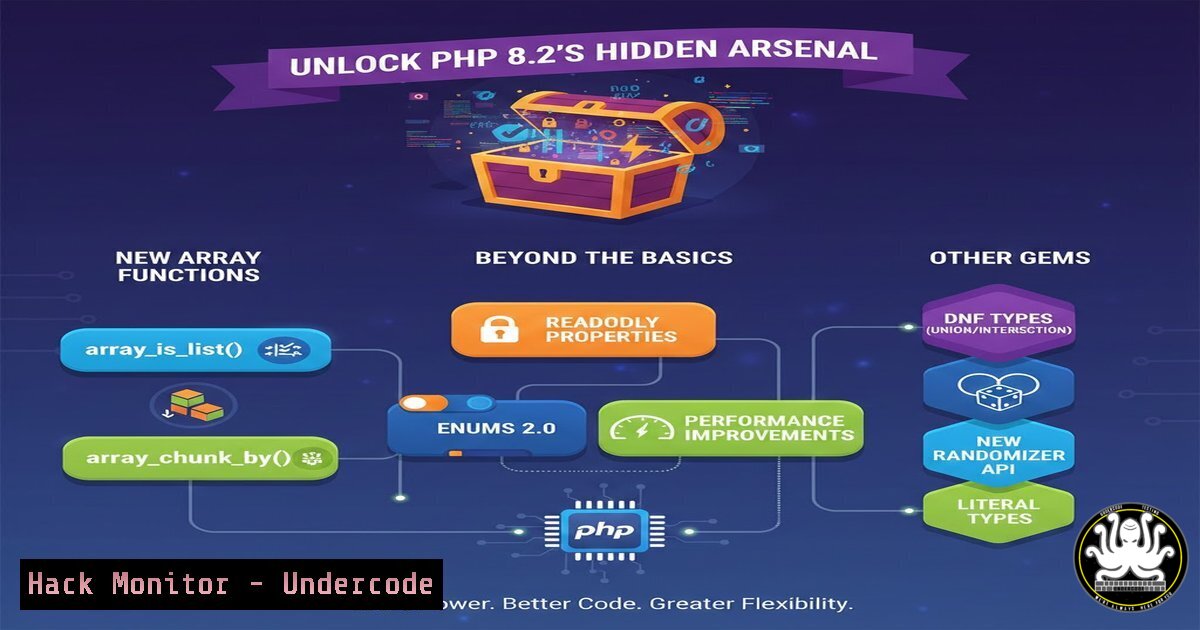
Introduction:
The recent discourse surrounding PHP 8.5, sparked by developer conversations on professional networks, highlights a critical juncture in the language’s evolution. While some perceive a slowdown in innovation, the update delivers substantial under-the-hood enhancements that directly impact application security, performance, and maintainability. For cybersecurity professionals and backend developers, understanding these changes is paramount to building resilient systems and preventing emerging vulnerability classes.
Learning Objectives:
- Deconstruct the performance and security implications of PHP 8.5’s JIT compiler improvements and new type system features.
- Implement secure coding practices using new attributes and functions to mitigate common web application threats.
- Integrate PHP 8.5 into a hardened development and production environment, utilizing new operational commands.
You Should Know:
1. JIT Compiler Enhancements: The Silent Performance Multiplier
The Just-In-Time compiler, introduced in PHP 8.0, has received significant optimizations in 8.5. Contrary to superficial views, this isn’t about “two new array functions” but about a fundamental boost in execution speed for CPU-intensive tasks like cryptography, data serialization, and complex mathematical operations. This makes PHP a more viable platform for real-time data processing and AI-driven microservices.
Step‑by‑step guide explaining what this does and how to use it.
The JIT compiler translates parts of the PHP bytecode into native machine code at runtime, leading to faster execution. To leverage it, you must configure it in your `php.ini` file.
1. Locate your `php.ini` file: `php –ini`
- Edit the file and configure the JIT settings:
[bash]
opcache.enable=1
opcache.jit_buffer_size=100M
opcache.jit=1255  Tracing JIT mode for optimal performance
3. Restart your PHP-FPM service or web server:
Linux (Systemd):
sudo systemctl restart php8.5-fpm nginx
Windows:
net stop "PHP-FPM" && net start "PHP-FPM"
4. Verify JIT is active by creating a `phpinfo.php` file and checking the OPcache section, or run: `php -r “var_dump(opcache_get_status()[‘jit’][‘on’]);”`
2. The `[\SensitiveParameter]` Attribute: Bolstering Security Logs
A critical security-focused addition, this attribute prevents sensitive data, such as passwords or API keys, from appearing in stack traces. This is a direct mitigation against information leakage vulnerabilities, which are a primary source of data for attackers performing reconnaissance.
Step‑by‑step guide explaining what this does and how to use it.
When a function parameter is marked with [\SensitiveParameter], its value is replaced with `Object(SensitiveParameterValue)` in any stack trace.
1. Apply the attribute to function parameters that handle sensitive data:
<?php
function connectToDatabase(
string $hostname,
[\SensitiveParameter] string $password,
string $username
) {
throw new Exception("Connection failed!");
}
2. Intentionally cause an error to see the mitigation in action:
try {
connectToDatabase('localhost', 'my_secret_password', 'admin');
} catch (Exception $e) {
echo $e->getTraceAsString();
}
3. The output stack trace will show the password parameter’s value as Object(SensitiveParameterValue), effectively scrubbing it from your logs.
- Readonly Class Amendments: Enforcing Immutability for Secure Data Objects
PHP 8.5 refines the readonly classes introduced in 8.2. This enforces deep immutability on objects, a cornerstone of secure programming. It prevents accidental or malicious modification of critical data objects, such as configuration containers, DTOs (Data Transfer Objects), or entities after their initial creation, reducing state-related bugs.
Step‑by‑step guide explaining what this does and how to use it.
A readonly class ensures that all properties of the class are implicitly readonly.
1. Define a readonly class to hold sensitive configuration:
<?php
readonly class DatabaseConfig {
public function __construct(
public string $host,
[\SensitiveParameter] public string $password,
public string $user
) {}
}
2. Instantiate the object with the initial configuration:
$config = new DatabaseConfig('db.example.com', 'secret', 'app_user');
3. Any attempt to modify a property will now result in a fatal error, securing the configuration from tampering:
$config->host = 'malicious.host.com'; // Fatal Error: Cannot modify readonly property
4. System Call Hardening with `proc_open` Control
The `proc_open` function, often used for executing system commands, has been hardened. This is critical for applications that need to interact with the OS, as it reduces the risk of command injection vulnerabilities propagating into shell escapes.
Step‑by‑step guide explaining what this does and how to use it.
PHP 8.5 introduces more granular control over the environment and execution of child processes.
1. Use the new `’blocking_pipes’` option to manage I/O more predictably and avoid deadlocks in complex scripts.
<?php
$descriptorspec = [
0 => ["pipe", "r"], // stdin
1 => ["pipe", "w"], // stdout
2 => ["pipe", "w"] // stderr
];
$process = proc_open('ls -la', $descriptorspec, $pipes, null, null, ['blocking_pipes' => false]);
2. Always validate and sanitize user input before passing it to any command executed via proc_open, shell_exec, or exec.
$user_input = $_GET['dir'] ?? '';
// NEVER DO THIS: $process = proc_open("ls -la " . $user_input, ...);
// INSTEAD, sanitize:
if (preg_match('/^[a-zA-Z0-9_-\/.]+$/', $user_input)) {
$process = proc_open("ls -la " . escapeshellarg($user_input), ...);
} else {
throw new InvalidArgumentException("Invalid directory name.");
}
5. Granular Random Number Generation with `random_(int|float)`
While the `random_bytes()` and `random_int()` functions are cryptographically secure, PHP 8.5 adds more flexibility with `random_float()` and enhanced range controls for random_int(). This is essential for generating secure tokens, salts, and other cryptographic material.
Step‑by‑step guide explaining what this does and how to use it.
These functions provide a more intuitive and secure interface for generating random numbers within specific ranges.
1. Generate a cryptographically secure random float:
<?php
$probability = random_float(); // Returns a float between 0 and 1.0
2. Generate a secure integer within a specific, inclusive range:
$diceRoll = random_int(1, 6); // Returns an int between 1 and 6
$apiKey = bin2hex(random_bytes(32)); // Generate a 64-character hex API key
3. Use these functions to replace insecure alternatives like `rand()` and `mt_rand()` in all security-sensitive contexts.
What Undercode Say:
- The perceived lack of innovation in PHP is a misnomer; the focus has shifted to critical, non-functional requirements like security, performance, and type safety, which are the bedrock of enterprise-grade applications.
- Adopting features like the `[\SensitiveParameter]` attribute and readonly classes is a low-effort, high-impact strategy for proactively closing common security vulnerabilities related to information disclosure and data integrity.
Analysis:
The community’s mixed reaction to PHP 8.5 underscores a broader industry challenge: valuing flashy, user-facing features over foundational stability and security. The updates in 8.5 are a deliberate and mature response to the demands of modern, secure software development. By fortifying its core with stronger type systems, immutable data structures, and explicit security controls, PHP is not stagnating but rather evolving to meet the rigors of cloud-native and security-conscious environments. Dismissing this release based on a superficial feature count is a strategic mistake for any development team. The real story is PHP’s continued pivot towards becoming a hardened, performant, and reliable backend language.
Prediction:
The security-centric features in PHP 8.5, particularly [\SensitiveParameter], will set a new standard for secure coding practices in the web ecosystem. We predict that within two years, similar functionality will be adopted or emulated by other major web languages and frameworks. Furthermore, the performance optimizations will solidify PHP’s position in the backend stack for data-intensive applications, potentially expanding its use in edge computing and serverless architectures where cold start performance and execution speed are critical. The language’s evolution will continue to be characterized by incremental, stability-focused enhancements that prioritize long-term security and maintainability over syntactic novelty.
🎯Let’s Practice For Free:
IT/Security Reporter URL:
Reported By: Abdelrahman Muhammed – Hackers Feeds
Extra Hub: Undercode MoN
Basic Verification: Pass ✅


