Listen to this Post
Introduction:
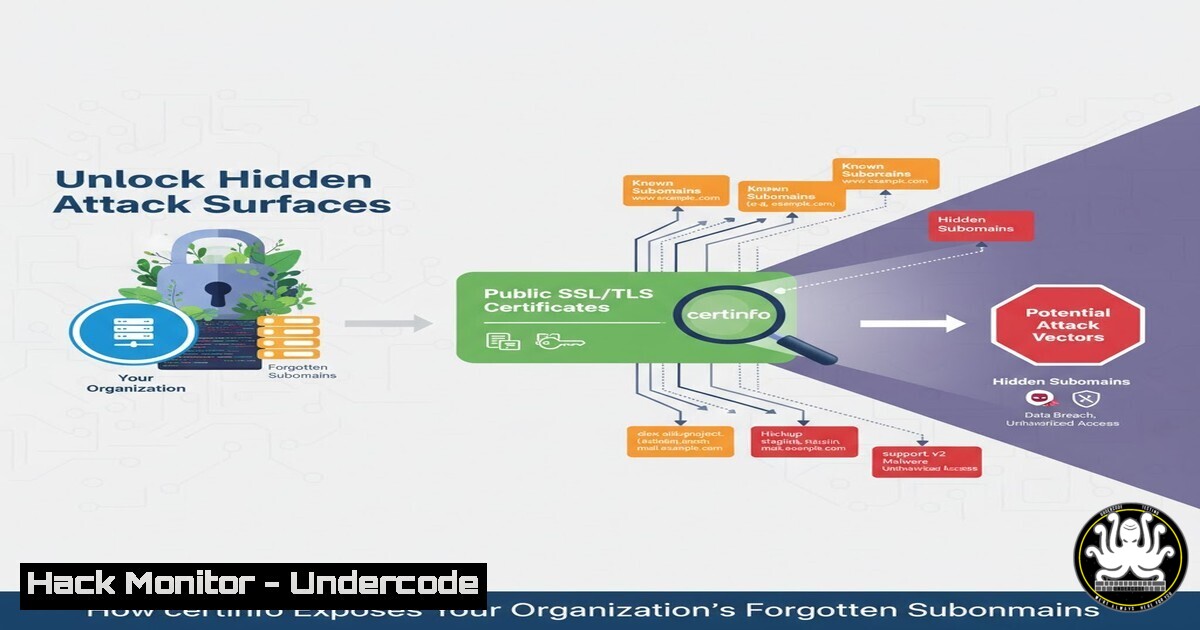
In the relentless pursuit of comprehensive attack surface management, security professionals often overlook a treasure trove of publicly available information: SSL certificates. The tool `certinfo` automates the extraction of this data, transforming passive reconnaissance into an active discovery process that can reveal forgotten, shadow, and development subdomains ripe for exploitation.
Learning Objectives:
- Understand the critical intelligence embedded within SSL/TLS certificates for attack surface enumeration.
- Master the command-line usage of the `certinfo` tool for both basic and recursive domain discovery.
- Integrate certificate scraping into a standardized reconnaissance workflow to identify potential security blind spots.
You Should Know:
1. The Power of Certificate Transparency in Reconnaissance
SSL certificates are a foundational element of web security, but the Certificate Transparency (CT) logs they are recorded in serve as a public directory of an organization’s digital assets. Every certificate contains a Subject Alternative Name (SAN) field, which can list dozens, sometimes hundreds, of domain names associated with a single IP address or host. Attackers and bug bounty hunters use tools like `certinfo` to scrape these logs and SAN fields, building a comprehensive map of a target’s infrastructure that often includes non-public subdomains. This process, known as certificate scraping, is a passive and stealthy reconnaissance technique that is difficult to detect.
2. Installing and Running a Basic certinfo Scan
The first step is to acquire the tool from its official repository. Using a package manager like `go install` is the most straightforward method for security researchers working in a Linux or macOS environment.
Command:
go install github.com/example/certinfo@latest
Step-by-step guide:
This command uses the Go programming language’s built-in package manager to download, compile, and install the `certinfo` tool directly from its source code repository. Ensure you have Go (version 1.16 or higher) installed and configured on your system. After execution, the `certinfo` binary will be placed in your `$GOPATH/bin` directory, which should be included in your system’s PATH. You can verify the installation by running `certinfo -h` to view the help menu.
3. Performing Initial Certificate Data Extraction
Once installed, you can begin extracting fundamental certificate information from a target host. This provides a snapshot of the certificate currently in use.
Command:
certinfo -host example.com
Step-by-step guide:
This command connects to `example.com` on the default TLS port (443) and retrieves the presented SSL certificate. The output will typically include the certificate’s issuer, validity period, and the primary subject name. While useful for a quick check, this basic scan does not leverage the full power of the tool, as it only shows the certificate for the specific host you connected to, not the treasure trove of domains in its SAN field.
4. Unleashing Recursive Subdomain Enumeration
The true power of `certinfo` for attack surface mapping is unlocked with the `-recursive` flag. This feature performs a deeper search by extracting all domains from the SAN field of the initial target’s certificate and then, critically, repeats the process for any new unique domains it discovers.
Command:
certinfo -host example.com -recursive
Step-by-step guide:
When you execute this command, `certinfo` first fetches the certificate for example.com. It parses the SAN field and collects all listed domains (e.g., www.example.com, api.example.com, staging.example.com). It then iterates through this newly discovered list, fetching the certificate for `api.example.com` and extracting its SANs, and so on. This recursive process continues until no new unique subdomains are found, often revealing a sprawling network of interconnected services.
- Expanding Scope with Input Files for Large-Scale Recon
For penetration testers assessing entire organizations, targeting a single domain is insufficient. `certinfo` can accept a list of target domains from a file, automating the reconnaissance across multiple core assets simultaneously.
Command:
certinfo -list domains.txt -recursive
Step-by-step guide:
First, create a text file (domains.txt) containing one domain per line (e.g., company.com, company.org, company-net.com). The `-list` flag instructs `certinfo` to read this file. Combined with -recursive, the tool will perform a recursive certificate scrape on every domain in the list, merging the results into a single, comprehensive output of discovered subdomains. This is invaluable for the initial scoping phase of a security assessment.
6. Filtering and Outputting Results for Analysis
The raw output of discovered domains can be voluminous. Integrating `certinfo` with other command-line tools allows for immediate filtering and analysis. A common practice is to sort the results, remove duplicates, and then feed them into a tool for live host checking.
Command:
certinfo -host example.com -recursive | sort -u > discovered_subdomains.txt
Step-by-step guide:
This pipeline does three things. First, `certinfo` performs the recursive scan. The `|` (pipe) symbol sends this output to the `sort -u` command, which sorts the list alphabetically and removes any duplicate entries. Finally, the `>` operator writes this cleaned-up list to a file named discovered_subdomains.txt. This file can then be used as input for other tools like `httpx` or `nmap` to determine which subdomains are actively hosting live web services.
7. Integrating with Active Probes for Validation
Discovering a subdomain in a certificate does not guarantee it is live. The final step in the workflow is to validate which discovered hosts are active. This is where a tool like `httpx` comes in, taking the list from `certinfo` and probing for HTTP/HTTPS services.
Command:
cat discovered_subdomains.txt | httpx -silent | tee live_subdomains.txt
Step-by-step guide:
This command reads the list of subdomains from the file generated in the previous step. The `cat` command outputs the file’s contents, which are piped into httpx. The `-silent` flag suppresses extra output, showing only the URLs of live hosts. The `tee` command both displays the results in the terminal and simultaneously writes them to a new file, live_subdomains.txt. This final list represents the validated, active portion of your expanded attack surface.
What Undercode Say:
- Key Takeaway 1: Certificate scraping is no longer a niche technique but a fundamental pillar of modern reconnaissance. The automation provided by tools like `certinfo` drastically lowers the barrier to entry, allowing both defenders and attackers to map an organization’s digital footprint with unprecedented speed and completeness.
- Key Takeaway 2: The recursive enumeration feature is a game-changer, automating the discovery of second and third-order dependencies. A single certificate on a development server can lead to the discovery of internal API endpoints, backup systems, or legacy applications that were never meant to be public.
The analysis from Undercode suggests that the ease of use and effectiveness of `certinfo` signifies a broader trend in offensive security: the weaponization of public data. Defenders can no longer rely on obscurity. Any domain listed in a public SSL certificate, even for an internal service, must be considered part of the monitored attack surface. Failure to inventory and secure these assets based on CT log data is a critical oversight. Proactive defense now mandates that blue teams run the same recursive certificate scans as their red team counterparts, using the results to continuously harden and monitor their entire domain ecosystem.
Prediction:
The proliferation of automated, recursive reconnaissance tools like `certinfo` will force a fundamental shift in defensive cybersecurity strategies. Organizations will be compelled to adopt more rigorous certificate management policies, potentially moving away from wildcard certificates for critical systems to limit SAN field exposure. We predict a rise in “Certificate Surface Management” platforms that automatically correlate CT log data with internal asset inventories, providing real-time alerts on unauthorized or suspicious certificate issuance. Furthermore, as defenses adapt, attackers will evolve their techniques, likely integrating these scraping tools directly into AI-driven bots that continuously map target infrastructures, discover new assets within minutes of going live, and launch automated attacks with zero human intervention. The race between attack surface discovery and protection is about to accelerate exponentially.
🎯Let’s Practice For Free:
IT/Security Reporter URL:
Reported By: Rix4uni Bugbounty – Hackers Feeds
Extra Hub: Undercode MoN
Basic Verification: Pass ✅


