Listen to this Post
Introduction
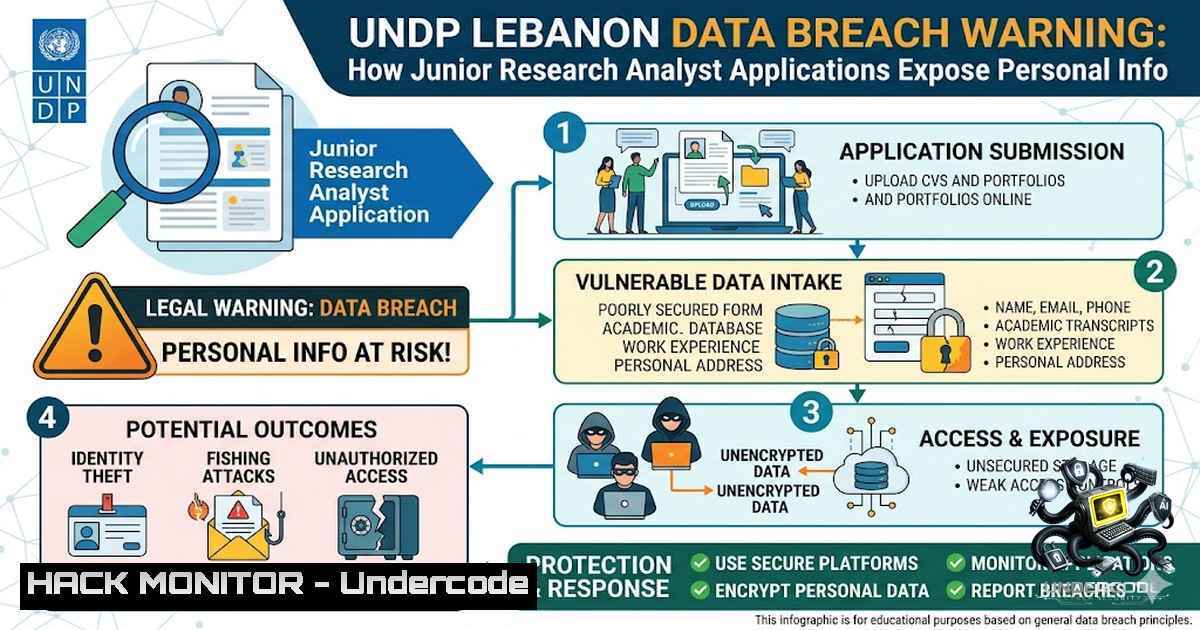
The United Nations Development Programme (UNDP) Lebanon office recently posted a vacancy for a Junior Research Analyst position in Beirut, requiring applicants to submit sensitive personal documents including CVs, educational certificates, and references via online platforms【10†L1-L6】. While this appears to be a routine recruitment process, the underlying data collection mechanisms—email submissions, third-party application links, and unencrypted PDF transfers—present significant cybersecurity risks that both applicants and organizations must address. This article examines the security implications of online job application systems and provides actionable technical guidance for protecting sensitive personal information during recruitment processes.
Learning Objectives
- Understand the cybersecurity vulnerabilities inherent in online job application submission methods (email, third-party platforms)
- Implement encryption techniques for securing sensitive documents (CVs, certificates, references) during transmission
- Master practical Linux and Windows commands for file encryption, secure deletion, and metadata sanitization
- Learn to verify the authenticity of recruitment communications and avoid phishing attempts
- Configure secure email protocols and document handling procedures for organizational recruitment teams
You Should Know
1. Email-Based Document Submission: The Hidden Threat Surface
The UNDP vacancy announcement provides two application options: an online link and email submission to [email protected]【10†L18-L20】. Email remains one of the most exploited vectors for data interception, with unencrypted attachments traversing multiple mail servers where they can be logged, cached, or intercepted. When you attach your CV, P11 form, and graduation certificate to an email, you’re essentially transmitting your identity documents—including birth dates, contact information, employment history, and educational credentials—in plain text across the internet.
Step‑by‑step guide to encrypting email attachments on Linux:
 Generate a GPG key pair (if you don't have one)
gpg --full-generate-key

List your keys to find the key ID
gpg --list-keys

Encrypt a file for a specific recipient (replace [email protected])
gpg --encrypt --recipient "[email protected]" CV.pdf

This creates CV.pdf.gpg - send this encrypted file instead
 For self-encryption (password-protected):
gpg --symmetric --cipher-algo AES256 CV.pdf
 You'll be prompted for a passphrase - share this separately via phone/SMS

To decrypt on recipient's side:
gpg --decrypt CV.pdf.gpg > CV.pdf
Windows equivalent using built-in tools:
 Using Windows built-in EFS (Encrypting File System) - right-click file > Properties > Advanced > Encrypt contents
 For stronger encryption, use 7-Zip with AES-256:
 Download 7-Zip, then:
7z a -pYourPassword -mhe=on -tzip Encrypted_CV.zip CV.pdf

Using PowerShell to create a secure archive with password:
Compress-Archive -Path CV.pdf -DestinationPath CV.zip
 Then use 7-Zip GUI to add password protection
Organizational best practice: Recruitment teams should provide a secure file upload portal with TLS 1.3 encryption and end-to-end encryption capabilities, rather than relying on standard email infrastructure.
2. Third-Party Application Links: Verifying Authenticity Before Clicking
The vacancy announcement includes two LinkedIn shortened links (lnkd.in)【10†L8】【10†L17】. Shortened URLs obscure the final destination, making them prime candidates for phishing redirects, credential harvesting, or malware distribution. A sophisticated attacker could register a lookalike domain, clone the UNDP application page, and capture every submitted document and password.
Step‑by‑step guide to URL inspection and verification:
Linux command-line URL expansion:
 Expand shortened URLs without visiting them
curl -sI https://lnkd.in/dxA-M2cV | grep -i location
 Or use:
wget --spider --server-response https://lnkd.in/dxA-M2cV 2>&1 | grep Location

Check domain reputation using VirusTotal API (replace API_KEY)
curl -X GET "https://www.virustotal.com/api/v3/domains/lnkd.in" -H "x-apikey: YOUR_API_KEY"

Verify SSL certificate validity
openssl s_client -connect lnkd.in:443 -servername lnkd.in < /dev/null 2>/dev/null | openssl x509 -1oout -dates
Windows PowerShell URL inspection:
 Resolve shortened URL
$request = [System.Net.WebRequest]::Create("https://lnkd.in/dxA-M2cV")
$request.Method = "HEAD"
$response = $request.GetResponse()
$response.ResponseUri.AbsoluteUri

Check SSL certificate
$url = "https://lnkd.in/dxA-M2cV"
$webRequest = [Net.WebRequest]::Create($url)
$webRequest.Timeout = 10000
$webRequest.GetResponse() | Out-1ull
$webRequest.ServicePoint.Certificate | Format-List
Application security checklist:
- Always expand shortened URLs before clicking using tools like CheckShortURL or unshorten.me
- Verify the destination domain matches the official organization (should end with `.undp.org` or trusted domain)
- Check for HTTPS and valid SSL certificate (padlock icon in browser)
- Examine the URL for typosquatting (e.g., `undp-org.com` vs
undp.org) - Never enter credentials on a page reached via an untrusted redirect
3. PDF Metadata Sanitization: What Your Documents Reveal
When you submit your CV or P11 form as a PDF, you’re not just sending visible content. PDF files contain extensive metadata including author name, software version, creation date, modification history, hidden text, and sometimes even tracked changes and comments. This metadata can reveal your operating system, PDF editor used, document revision history, and potentially geolocation data if GPS-enabled software was used.
Step‑by‑step guide to PDF metadata sanitization:
Linux using exiftool:
 Install exiftool
sudo apt install exiftool  Debian/Ubuntu
sudo yum install perl-Image-ExifTool  RHEL/CentOS

View all metadata in a PDF
exiftool CV.pdf

Remove all metadata (create a clean copy)
exiftool -all= -overwrite_original CV.pdf

Remove specific metadata fields
exiftool -Author= -Creator= -Producer= -CreateDate= -ModifyDate= CV.pdf

For batch processing multiple PDFs
for f in .pdf; do exiftool -all= -overwrite_original "$f"; done
Windows using PowerShell and third-party tools:
 Using iTextSharp or PDFtk (download PDFtk free version)
 Remove metadata using PDFtk:
pdftk CV.pdf dump_data_utf8 output metadata.txt
 Edit metadata.txt to remove unwanted fields
pdftk CV.pdf update_info_utf8 metadata.txt output CV_clean.pdf

Using PowerShell with COM object (Adobe Acrobat required)
$pdf = New-Object -ComObject AcroExch.PDDoc
$pdf.Open("C:\CV.pdf")
$pdf.SetInfo("Author", "")
$pdf.SetInfo("", "")
$pdf.Save(1, "C:\CV_clean.pdf")
$pdf.Close()
Python script for cross-platform metadata removal:
from PyPDF2 import PdfReader, PdfWriter

reader = PdfReader("CV.pdf")
writer = PdfWriter()

Copy all pages without metadata
for page in reader.pages:
writer.add_page(page)

Remove metadata
writer.add_metadata({})

with open("CV_clean.pdf", "wb") as f:
writer.write(f)
- Secure File Deletion: Ensuring Old Copies Don’t Come Back to Haunt You
When you edit and resave your CV multiple times, older versions may remain recoverable from your hard drive, cloud sync folders, or email sent folder. Recruiters who store applications indefinitely create a treasure trove for attackers. Both applicants and organizations need secure deletion protocols.
Step‑by‑step guide to secure file deletion:
Linux secure deletion:
 Using shred (overwrites file multiple times)
shred -v -z -1 7 CV_old.pdf
 -v: verbose, -z: add final overwrite with zeros, -1 7: 7 passes

Using dd to overwrite free space (for entire partition)
sudo dd if=/dev/urandom of=/home/user/fillfile bs=1M status=progress; rm fillfile

Using srm (secure removal tool)
sudo apt install srm
srm -v -z CV_old.pdf

For SSDs, use blkdiscard (TRIM) instead of overwriting
sudo blkdiscard /dev/sda1  CAUTION: Wipes entire partition
Windows secure deletion:
 Using cipher.exe to overwrite free space
cipher /w:C:\

Using PowerShell with System.IO.File
$file = [System.IO.File]::OpenWrite("CV_old.pdf")
$random = New-Object System.Random
$buffer = New-Object byte<a href="4096"></a>
for ($i=0; $i -lt 100; $i++) {
$random.NextBytes($buffer)
$file.Write($buffer, 0, $buffer.Length)
}
$file.Close()
Remove-Item "CV_old.pdf"

Using Sysinternals SDelete (Microsoft tool)
sdelete -p 7 CV_old.pdf
Organizational policy recommendation: Implement a data retention policy that automatically purges applicant data after 6-12 months using automated secure deletion scripts.
5. Phishing Detection: Spotting Fake Recruitment Communications
The UNDP announcement warns that “only candidates who are short-listed will be contacted”【10†L13】. Attackers exploit this by sending fake interview invitations or offer letters with malicious attachments or links to credential-harvesting portals. The urgency of job hunting makes candidates particularly vulnerable to such social engineering attacks.
Step‑by‑step guide to email header analysis:
Linux email header analysis:
 Save email headers to a file and analyze
cat email_headers.txt | grep -E "Received:|From:|Return-Path:|Authentication-Results:"

Check SPF, DKIM, DMARC records for the sending domain
dig TXT _spf.google.com  SPF record
dig TXT _domainkey.google.com  DKIM
dig TXT _dmarc.google.com  DMARC

Using Python to parse headers
python3 -c "
import email
from email import policy
from email.parser import BytesParser
with open('email_headers.txt', 'rb') as f:
msg = BytesParser(policy=policy.default).parse(f)
print('From:', msg['From'])
print('Return-Path:', msg['Return-Path'])
print('Authentication-Results:', msg['Authentication-Results'])
"
Windows PowerShell header analysis:
 Using Outlook COM object (if available)
$outlook = New-Object -ComObject Outlook.Application
$mail = $outlook.Session.GetItemFromID("your-mail-id")
$mail.PropertyAccessor.GetProperty("http://schemas.microsoft.com/mapi/proptag/0x007D001E")

Using Telnet to manually verify SMTP server
telnet mail.undp.org 25
EHLO yourdomain.com
MAIL FROM: <a href="mailto:test@example.com">test@example.com</a>
RCPT TO: <a href="mailto:recruiter@undp.org">recruiter@undp.org</a>
DATA
Subject: Test
.
QUIT
Red flags to check in recruitment emails:
- Sender domain differs from official organization (e.g., `@undp-jobs.com` vs
@undp.org) - Poor grammar, urgent language demanding immediate action
- Requests for payment, bank details, or passport copies upfront
- Links that don’t match the official application portal
- Attachments with unusual extensions (.exe, .scr, .js, .vbs)
- API Security for Recruitment Platforms: Protecting Application Data in Transit
Modern recruitment systems use APIs to connect frontend application forms to backend databases. Insecure API endpoints can expose candidate data through injection attacks, broken authentication, or excessive data exposure. The UNDP’s application link likely interfaces with an API that handles document uploads and form submissions.
Step‑by‑step guide to API security testing (for organizations):
 Testing for insecure API endpoints using curl
 Check for exposed Swagger/OpenAPI documentation
curl -s https://recruitment.undp.org/api/swagger.json | jq .

Test for SQL injection in query parameters
curl -X GET "https://recruitment.undp.org/api/applications?userid=1' OR '1'='1"

Test for excessive data exposure
curl -X GET "https://recruitment.undp.org/api/user/123" -H "Authorization: Bearer $TOKEN"

Test rate limiting (send 1000 requests in quick succession)
for i in {1..1000}; do curl -s -o /dev/null -w "%{http_code}\n" https://recruitment.undp.org/api/apply; done | sort | uniq -c
Python script for API fuzzing:
import requests
import json

Test for IDOR (Insecure Direct Object Reference)
for i in range(1000, 1100):
response = requests.get(f"https://recruitment.undp.org/api/applicant/{i}")
if response.status_code == 200:
print(f"Found accessible applicant: {i}")

Test for mass assignment vulnerabilities
payload = {
"name": "Test User",
"email": "[email protected]",
"is_admin": True  Attempt to escalate privileges
}
response = requests.post("https://recruitment.undp.org/api/update-profile", json=payload)
Organizational API security checklist:
- Implement OAuth 2.0 with PKCE for authentication
- Use rate limiting and request throttling
- Validate all input parameters against strict schemas
- Encrypt all PII at rest using AES-256
- Implement proper CORS policies
- Regular penetration testing of recruitment APIs
7. Two-Factor Authentication (2FA) for Application Portals
The UNDP application process doesn’t explicitly mention 2FA, but any organization handling sensitive applicant data should implement it. Candidates should also enable 2FA on their email accounts to prevent attackers from intercepting recruitment communications.
Step‑by‑step guide to implementing TOTP 2FA (for developers):
Python implementation using pyotp:
import pyotp
import qrcode
import io

Generate a secret key for each user
secret = pyotp.random_base32()
print(f"Secret: {secret}")

Generate TOTP URI for QR code
totp = pyotp.TOTP(secret)
uri = totp.provisioning_uri("[email protected]", issuer_name="UNDP Recruitment")

Generate QR code
img = qrcode.make(uri)
img.save("2fa_qr.png")

Verify OTP during login
user_otp = input("Enter 6-digit code: ")
if totp.verify(user_otp):
print("Authentication successful")
else:
print("Invalid OTP")
Linux command for generating TOTP (using oathtool):
 Install oathtool
sudo apt install oathtool

Generate secret
secret=$(head -c 20 /dev/urandom | base32)
echo "Secret: $secret"

Generate current OTP
oathtool --totp -b "$secret"

Generate QR code using qrencode
qrencode -o qr.png "otpauth://totp/UNDP:[email protected]?secret=$secret&issuer=UNDP"
What Undercode Say
- Key Takeaway 1: The UNDP Lebanon job posting, while legitimate, exposes a critical gap in recruitment cybersecurity—email remains the weakest link in the application chain, with unencrypted CVs and certificates traversing insecure channels daily. Organizations must transition to encrypted file upload portals with end-to-end encryption and mandatory TLS 1.3.
-
Key Takeaway 2: Applicants bear equal responsibility for their data security. Simple practices like PDF metadata sanitization, URL verification, and secure deletion of old CV versions can prevent identity theft and credential harvesting. The recruitment process is a two-way security street.
Analysis: The UNDP vacancy announcement serves as a microcosm of broader cybersecurity challenges in the humanitarian and development sectors. With 2+ years of experience required for sensitive governance research roles, these candidates possess valuable professional data that attackers actively seek【10†L14-L16】. The 4-month duration (10 working days per month) suggests project-based funding, which often correlates with rushed IT implementations and overlooked security protocols【10†L3】. The mandatory bilingual requirement (Arabic and English) indicates the role involves sensitive regional communications, making data protection even more critical【10†L15】. Organizations like UNDP should lead by example, implementing zero-trust architectures for recruitment and publishing transparency reports on data protection measures. The use of LinkedIn shortened URLs, while convenient, contradicts best practices for secure communications—official UN entities should use full, verifiable URLs with clear domain authentication. As AI-powered resume parsing becomes ubiquitous, the metadata embedded in PDFs could be exploited to train adversarial models or infer candidate characteristics beyond what’s intended. The upcoming wave of AI-driven recruitment will only amplify these risks, necessitating proactive security measures today.
Prediction
- +1 Organizations will increasingly adopt blockchain-based credential verification systems within 2-3 years, allowing candidates to share verified credentials without exposing full documents, reducing the attack surface for identity theft.
-
-1 The rise of AI-powered resume parsing will create new vulnerabilities—adversarial attacks on CV text can manipulate AI screening systems, while metadata extraction will enable sophisticated profiling without candidate consent.
-
+1 GDPR and similar privacy regulations will force recruitment platforms to implement mandatory encryption, data minimization, and automated deletion policies, turning compliance into a competitive advantage for security-conscious organizations.
-
-1 Shortened URLs in job postings will remain a persistent phishing vector, with attackers becoming more sophisticated in cloning recruitment portals and using AI-generated content to craft convincing fake application sites.
-
+1 The adoption of passwordless authentication (WebAuthn, passkeys) for recruitment portals will eliminate credential theft risks, making application processes more secure and user-friendly within the next 18 months.
-
-1 As remote work expands, the geographic dispersion of recruitment teams will increase the complexity of securing application data, with inconsistent security practices across regional offices creating exploitable gaps.
-
+1 Machine learning-based anomaly detection will become standard for recruitment platforms, automatically flagging suspicious application patterns, unusual data access, and potential data exfiltration attempts in real-time.
▶️ Related Video (78% Match):
https://www.youtube.com/watch?v=994DUwRFhEM
🎯Let’s Practice For Free:
🎓 Live Courses & Certifications:
Join Undercode Academy for Verified Certifications
🚀 Request a Custom Project:
Secure, high-velocity infrastructure and disruptive technological engineering. Contact our engineering team for high-tier development and proprietary systems:
[email protected]
💎 Smart Architecture | 🛡️ Secure by Design | ⭐ Trusted by Thousands
IT/Security Reporter URL:
Reported By: Vacancy Announcement – Hackers Feeds
Extra Hub: Undercode MoN
Basic Verification: Pass ✅


