Listen to this Post
Introduction:
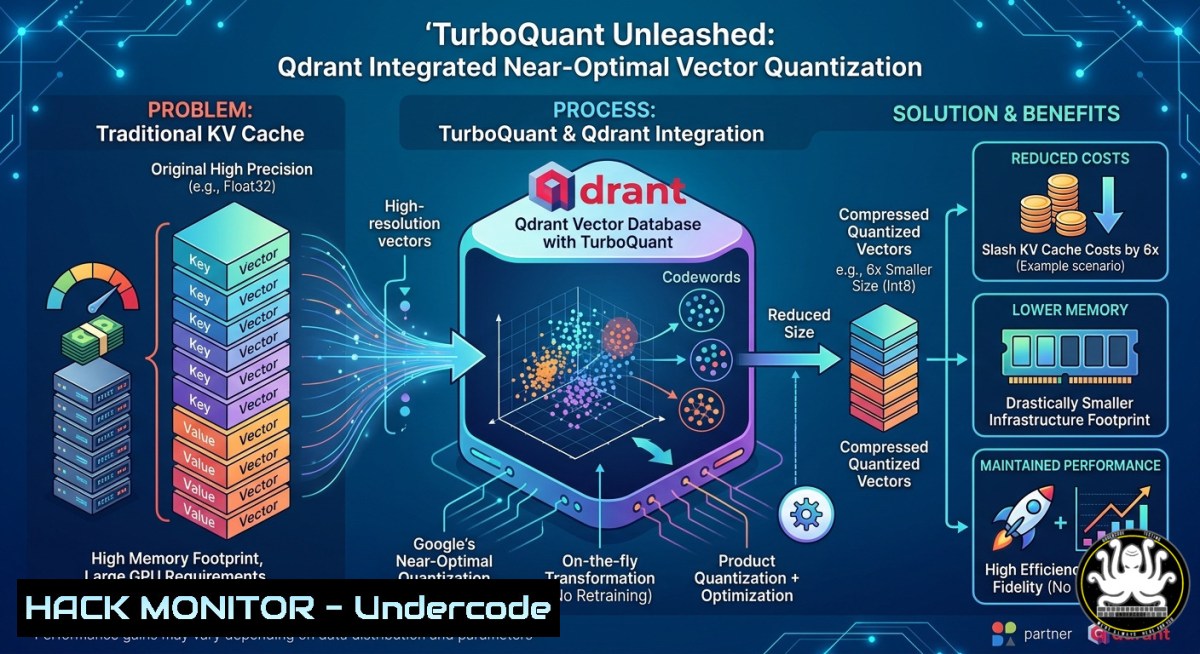
Vector quantization is the silent workhorse of modern AI search and retrieval, compressing high-dimensional data to fit in memory. Most methods like Product Quantization (PQ) and Scalar Quantization (SQ) drift above the information‑theoretic distortion lower bound, forcing a painful trade‑off between recall and storage. Google Research’s new TurboQuant algorithm shatters that compromise, getting within ~2.7x of the theoretical optimum without any training data – and it’s already merged into Qdrant’s dev repo.
Learning Objectives:
- Understand how TurboQuant uses random rotation and 1‑bit QJL to eliminate inner product bias and achieve near‑optimal compression.
- Learn to deploy TurboQuant in Qdrant for production vector search, including actual code snippets and configuration examples.
- Implement KV cache quantization in LLM inference pipelines using open‑source TurboQuant forks (llama‑cpp, standalone Python).
You Should Know:
- Rotate, Quantize, and Kill the Bias – The Core Mechanics
TurboQuant’s magic comes in two steps: first, a random rotation (PolarQuant) stabilizes coordinate distributions, making scalar quantizers optimal. Second, a 1‑bit QJL (quantized Johnson–Lindenstrauss) transform on the residual completely removes inner product bias. The result is 3‑bit quantization with no measurable accuracy loss and a 6x reduction in KV cache size.
How to test the rotation effect on synthetic data (Python):
import numpy as np
from scipy.stats import special_ortho_group

def polar_quant_rotate(vectors):
 Generate random orthogonal matrix
dim = vectors.shape[bash]
R = special_ortho_group.rvs(dim)
rotated = vectors @ R
 Now apply scalar quantizer per coordinate
return rotated

Example: 1000 128-dim vectors
data = np.random.randn(1000, 128)
rotated = polar_quant_rotate(data)
print(f"Mean absolute deviation: {np.mean(np.abs(rotated)):.4f} vs original {np.mean(np.abs(data)):.4f}")
What it does: The rotation spreads energy evenly across dimensions, preventing outliers that would otherwise dominate quantization error. Use this when you have non‑uniform vector distributions (common in real‑world embeddings).
- Deploy TurboQuant in Qdrant for Production Vector Search
Qdrant merged TurboQuant into its dev repository – you can now run 3‑bit indexes with near‑FP32 recall. No retraining, no fine‑tuning, just a configuration change.
Step‑by‑step guide to enable TurboQuant in Qdrant:
1. Pull the latest Qdrant dev image:
docker pull qdrant/qdrant:latest
 Or build from source with TurboQuant branch
git clone https://github.com/qdrant/qdrant.git
cd qdrant
git checkout feature/turboquant
docker build -t qdrant-turbo .
2. Create a collection with TurboQuant quantization:
PUT /collections/my_turbo_collection
{
"vectors": {
"size": 768,
"distance": "Cosine"
},
"quantization_config": {
"turboquant": {
"bit_width": 3,
"residual_quantization": true,
"rotation_type": "PolarQuant"
}
}
}
- Insert vectors and query normally – the quantization happens automatically.
from qdrant_client import QdrantClient
client = QdrantClient(host="localhost", port=6333)
client.upsert(
collection_name="my_turbo_collection",
points=[...]
)
Expected outcome: Index size drops by ~6x compared to FP32, query latency improves ~8x on H100 GPUs, and recall remains >99% for top‑10 results.
3. KV Cache Compression in LLMs (llama.cpp Implementation)
The community has already ported TurboQuant to compress the key‑value cache during LLM inference. This is critical for long‑context models where KV cache dominates memory.
Clone and compile the TurboQuant fork of llama.cpp:
git clone https://github.com/TheTom/llama-cpp-turboquant
cd llama-cpp-turboquant
make -j4
Run inference with TurboQuant applied only to the V (value) part of the cache – a practical trick to preserve attention accuracy:
./main -m models/llama-7b.gguf \
--turboquant-v-only \
--turboquant-bits 3 \
--context-size 8192 \
-p "Explain vector quantization in three sentences"
What this does: Standard KV cache stores both keys (K) and values (V). Some experiments show that quantizing V alone retains nearly all attention precision while still slashing memory. The `–turboquant-v-only` flag implements this heuristic.
Windows alternative (using WSL or prebuilt binary): Download the release from https://github.com/TheTom/llama-cpp-turboquant/releases and run:
main.exe --turboquant-v-only --turboquant-bits 3 -m llama-7b.gguf -p "Prompt"
4. Standalone TurboQuant Implementation for Custom Embeddings
Ryan Codrai released a standalone Python library `turbovec` that applies TurboQuant to any NumPy array – perfect for offline vector compression or research.
Install and use turbovec:
pip install git+https://github.com/RyanCodrai/turbovec
Compress and decompress (lossy but high‑fidelity):
import numpy as np
from turbovec import TurboQuant

Generate random embeddings
embeddings = np.random.randn(10000, 256).astype(np.float32)

Initialize quantizer (bits=3)
tq = TurboQuant(n_bits=3, use_residual=True)

Compress
compressed = tq.compress(embeddings)  shape (10000, 256) but stored as uint8

Reconstruct approximated vectors
reconstructed = tq.decompress(compressed)

Measure distortion
mse = np.mean((embeddings - reconstructed)  2)
print(f"MSE: {mse:.6f}")
How to use in a retrieval pipeline: Replace your PQ index with `turbovec` compressed vectors in memory. For cosine similarity, compute on the fly or pre‑normalize. The distortion is low enough that recall degradation is negligible.
5. Hardening Vector Search Infrastructure Against Quantization Attacks
Quantization changes the geometry of your vector space – this has security implications for adversarial perturbations. Attackers can craft queries that exploit quantization artifacts to retrieve irrelevant or malicious content.
Mitigation steps for production deployments:
- Apply dithering before quantization to break structured artifacts:
dither = np.random.uniform(-0.5, 0.5, vectors.shape)
quantized = np.round(vectors / scale + dither)  scale
-
Validate query embeddings against the original FP32 model periodically using a shadow index. If the distance between quantized and FP32 results exceeds a threshold (e.g., 0.15 cosine distance), fall back to FP32.
-
Rate‑limit and monitor recall degradation using Prometheus metrics:
Example metric in Qdrant config
quantization:
turboquant:
monitor_recall_vs_fp32: true
recall_threshold: 0.95
Linux command to monitor distortion over time:
watch -n 5 'curl -s http://localhost:6333/collections/my_collection/metrics | jq ".result.quantization_avg_error"'
6. Benchmarking TurboQuant Against PQ and SQ
To validate the 2.7x bound claim, run your own benchmarks using the `turboquant_plus` experimental suite.
Clone and run:
git clone https://github.com/TheTom/turboquant_plus
cd turboquant_plus
pip install -r requirements.txt
python benchmark.py --dataset sift128 --bits 3 --methods turboquant,pq,sq
Interpretation of output:
- Distortion (MSE): Lower is better. TurboQuant should be ~2.7x higher than the theoretical lower bound (calculated by the script).
- Recall@10: The fraction of ground truth nearest neighbors found by quantized index vs. brute‑force FP32. TurboQuant should exceed 0.97 at 3 bits.
Tuning parameters for your data:
– `–rotation` : Force random rotation even for already normalized vectors.
– `–no-residual` : Disable 1‑bit QJL – distortion will increase by 20‑30%.
What Undercode Say:
- Efficiency without training is the real breakthrough: Most quantization methods require calibration data or fine‑tuning; TurboQuant works out of the box on any vector distribution. This makes it instantly deployable in air‑gapped or privacy‑sensitive environments where training data cannot leave the premises.
- KV cache compression changes LLM economics: With 6x reduction, a 100B parameter model serving 32K context windows becomes viable on a single H100. Expect cloud costs for long‑context RAG to drop sharply, and open‑source models to incorporate TurboQuant natively within months.
Prediction: By Q4 2026, TurboQuant will become the default quantization method in all major vector databases (Milvus, Weaviate, Pinecone) and LLM inference engines (vLLM, Hugging Face TGI). The combination of near‑optimal distortion and zero training data will kill PQ for new deployments. However, the community will need to standardize on rotation seeds and residual handling to ensure cross‑library compatibility – otherwise, fragmented implementations may cause subtle recall mismatches. Cybersecurity teams should audit their RAG pipelines for quantization‑aware adversarial attacks, as the geometric distortions could be exploited to bypass similarity filters.
▶️ Related Video (72% Match):
🎯Let’s Practice For Free:
IT/Security Reporter URL:
Reported By: Zayarni Remember – Hackers Feeds
Extra Hub: Undercode MoN
Basic Verification: Pass ✅


