Listen to this Post
Introduction:
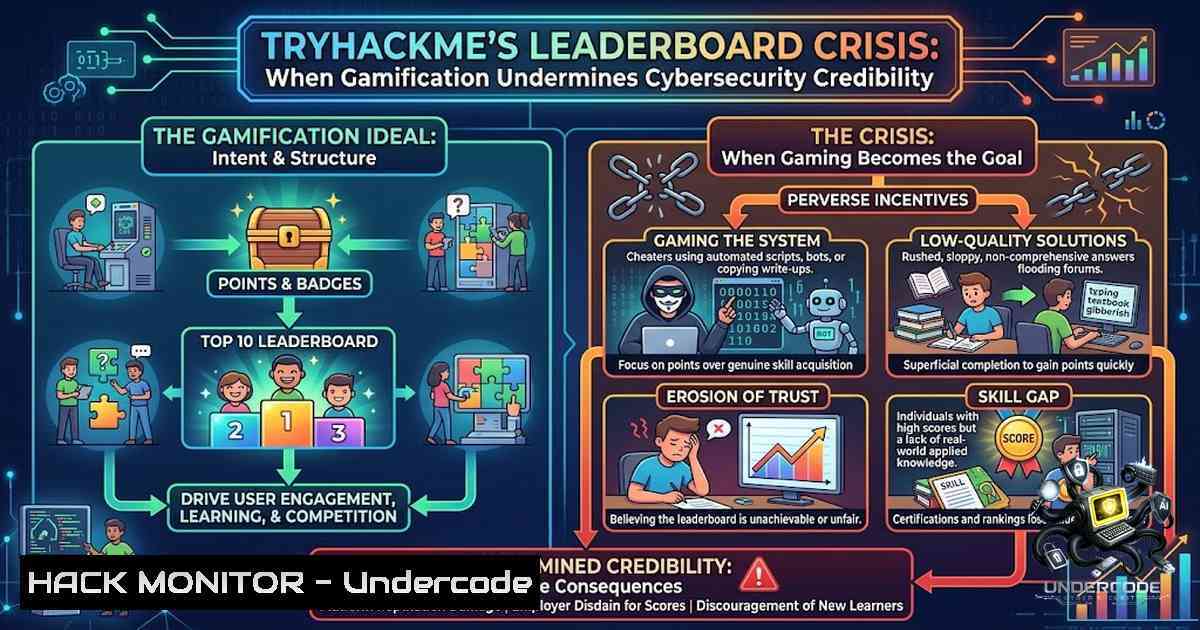
TryHackMe has long been celebrated as the gold standard for gamified cybersecurity training, transforming complex penetration testing and defensive security concepts into accessible, rewarding learning experiences. However, a growing controversy surrounding the platform’s leaderboard system has exposed a fundamental flaw: when point-maxing strategies—such as repeatedly answering the same mobile app questions or manipulating weekly league groupings—outperform genuine skill development, the leaderboard ceases to reflect technical competency. This article examines the mechanics behind these exploits, provides actionable technical insights for cybersecurity professionals, and explores what this crisis means for the future of gamified security education.
Learning Objectives:
- Understand the logic flaws in TryHackMe’s points and league systems that enable “point maxing” without technical skill.
- Learn to identify and mitigate similar gamification vulnerabilities in enterprise training and CTF platforms.
- Gain practical Linux and Windows commands for monitoring, auditing, and securing gamified learning environments.
You Should Know:
- The Mechanics of Point Maxing: How the System Was Gamed
The TryHackMe leaderboard was designed to reward consistent learning and room completion. Points are awarded for answering questions correctly, with challenge rooms offering more points than walkthroughs. However, as documented in the anonymous op-ed “The Downfall of the TryHackMe Leaderboard,” several logic flaws enabled users to accumulate massive points without solving new or difficult content.
Weekly League Exploitation: Users who complete two rooms in a week are grouped into leagues of approximately 30 people. By solving rooms in advance but delaying submissions until late in the weekly cycle, users could enter leagues with freshly grouped, less active competitors and immediately dominate the leaderboard. This strategy—dubbed “point maxing”—is not cheating in the traditional sense; it simply optimizes around the platform’s own rules.
Mobile App Repetition: The TryHackMe Pulse mobile app allows users to earn points from daily interactions. High-ranking players discovered they could repeatedly answer the same 20+ questions on the app, earning thousands of points with minimal effort. As one top-50 player noted, this yielded “5k+ points, a headache, and a sore thumb” . Statistics reveal that some users accumulated 63,000 points in a single month—a feat impossible through legitimate room completion alone.
Step‑by‑step guide: Auditing Gamification Logic Flaws
For security professionals and platform administrators, here is a methodology to identify and remediate similar vulnerabilities in your own systems:
Step 1: Map the Points Economy
- Document every action that awards points, including frequency caps and diminishing returns.
- Use `curl` or `Burp Suite` to intercept API calls and analyze point-increment logic.
- Linux command example:
curl -X GET "https://api.tryhackme.com/user/points" -H "Authorization: Bearer $TOKEN" | jq '.points'
Step 2: Identify Repetition Loopholes
- Check if the same endpoint can be called multiple times without validation.
- Windows PowerShell example for API fuzzing:
for ($i=0; $i -lt 100; $i++) { Invoke-RestMethod -Uri "https://api.tryhackme.com/action/complete" -Method POST -Body @{questionId="123"} }
Step 3: Analyze Grouping Algorithms
- Reverse-engineer how users are grouped (e.g., by completion time, activity level).
- Implement rate-limiting and cooldown periods between point-earning actions.
Step 4: Deploy Anomaly Detection
- Use `Splunk` or `ELK` to monitor unusual point accumulation patterns.
- Set alerts for users exceeding 95th percentile point velocity.
- The Credibility Crisis: What the Leaderboard Really Measures
The leaderboard was intended to reflect “skills, ingenuity, and perseverance pertaining to the actual subject matter”. Instead, it now rewards system-gaming behavior. This is not merely a cosmetic issue; it has tangible consequences for the cybersecurity community. Top-ranked players—many of whom spent thousands of hours mastering offensive and defensive techniques—are being overtaken by users exploiting point-maxing strategies.
The South Park Parallel: As one veteran observed, the situation mirrors the “Make Love, Not Warcraft” episode, where players grind repetitive tasks for hours to gain meaningless levels. When the path of least resistance yields the highest reward, the leaderboard becomes a measure of persistence, not proficiency.
Step‑by‑step guide: Restoring Leaderboard Integrity
Step 1: Implement Weighted Scoring
- Assign higher weights to first-time completions and progressively lower weights to repeated actions.
- Introduce decay factors for points earned from repetitive tasks.
Step 2: Cap Mobile App Points
- Limit daily points from mobile interactions to a reasonable threshold (e.g., 50 points/day).
- Require CAPTCHA or biometric verification for high-frequency actions.
Step 3: Introduce Skill Verification Challenges
- Periodic unannounced skill checks that must be passed to retain leaderboard standing.
- Use `OSSEC` or `Wazuh` to monitor for automated submission patterns.
Step 4: Transparent Leaderboard Algorithms
- Publish the points calculation methodology and update it quarterly based on community feedback.
- Allow users to view their point breakdown by category (rooms, mobile, streaks).
- Linux and Windows Commands for Platform Security Auditing
For cybersecurity professionals tasked with auditing gamified platforms or building similar systems, here are essential commands and tools:
Linux Commands:
- Monitor API traffic for anomalies:
sudo tcpdump -i eth0 -A -s 0 'tcp port 443 and host api.tryhackme.com'
- Analyze log files for unusual activity patterns:
grep -E "points|score|leaderboard" /var/log/nginx/access.log | awk '{print $1, $7}' | sort | uniq -c | sort -1r - Use `jq` to parse JSON responses from point-earning endpoints:
curl -s https://api.tryhackme.com/leaderboard | jq '.users[] | select(.points > 50000)'
Windows Commands:
- Use `PowerShell` to monitor repeated API calls:
Get-1etTCPConnection -State Established | Where-Object {$_.RemotePort -eq 443} | Group-Object RemoteAddress | Sort-Object Count -Descending - Analyze IIS logs for point-injection patterns:
Import-Csv C:\inetpub\logs\LogFiles\W3SVC1\u_ex.log | Group-Object cs-uri-stem | Sort-Object Count -Descending | Select-Object -First 20
Tool Configurations:
- Configure `Fail2ban` to temporarily block IPs exceeding a threshold of point-earning requests per minute.
- Deploy `ModSecurity` with custom rules to detect and log suspicious payloads in point-submission forms.
4. API Security Lessons from the TryHackMe Incident
The TryHackMe leaderboard controversy offers critical lessons for API security and rate-limiting design. The platform’s failure to enforce idempotency and rate limits on point-earning endpoints enabled the mobile app repetition exploit.
Step‑by‑step guide: Securing Point-Earning APIs
Step 1: Enforce Idempotency
- Use unique request IDs to prevent duplicate point awards.
- Implement Redis-based caching to track recent submissions per user.
Step 2: Implement Rate Limiting
- Use `nginx` rate-limiting modules:
limit_req_zone $binary_remote_addr zone=points:10m rate=5r/m;
limit_req zone=points burst=10 nodelay;
Step 3: Validate Client-Side State
- Do not trust client-side timestamps or point calculations; always validate on the server.
- Use digital signatures or HMACs to verify request integrity.
Step 4: Monitor for Anomalies
- Deploy `Prometheus` and `Grafana` to visualize point velocity per user.
- Set alerts for users with point velocity exceeding 3 standard deviations from the mean.
5. Cloud Hardening for Gamified Platforms
Gamified platforms like TryHackMe often rely on cloud infrastructure. Here are hardening techniques to prevent similar exploits:
AWS Example:
- Use `AWS WAF` to block repeated requests from the same IP.
- Implement `AWS Lambda` functions to validate point-earning logic with serverless compute.
- Enable `CloudTrail` to log all API calls for forensic analysis.
Azure Example:
- Use `Azure Front Door` with rate-limiting policies.
- Deploy `Azure Sentinel` for SIEM monitoring of unusual point patterns.
- Implement `Azure API Management` with policies to enforce quotas and throttling.
GCP Example:
- Use `Cloud Armor` with custom rules to mitigate abuse.
- Deploy `Cloud Functions` to handle point calculations with built-in validation.
- Enable `Cloud Logging` and `Cloud Monitoring` for real-time alerts.
6. Vulnerability Exploitation and Mitigation in CTF Platforms
The TryHackMe incident also highlights broader vulnerabilities in CTF and gamified training platforms. These systems are prime targets for exploitation because they teach users to think like attackers.
Common Vulnerabilities:
- Insecure Direct Object References (IDOR): Users may manipulate room IDs to claim points for uncompleted rooms.
- Business Logic Flaws: As seen with the league grouping exploit, logic errors can be abused without code-level vulnerabilities.
- Rate-Limit Bypasses: Attackers may use distributed requests (botnets) to evade simple IP-based rate limits.
Mitigation Strategies:
- Conduct regular penetration testing of the points and leaderboard systems.
- Use `OWASP ZAP` or `Burp Suite` to automate logic-flaw detection.
- Implement `Web Application Firewalls` with custom rules for point-related endpoints.
- Educate developers on secure coding practices for gamification logic.
What Undercode Say:
- Key Takeaway 1: Gamification without robust anti-abuse mechanisms inevitably incentivizes system-gaming behavior, undermining the credibility of skill-based leaderboards.
- Key Takeaway 2: The TryHackMe controversy is a case study in how security platforms must continuously audit their own reward systems, as their users are trained to find and exploit logic flaws.
Analysis: The TryHackMe leaderboard crisis is not an isolated incident; it reflects a systemic challenge in gamified education. When platforms prioritize engagement metrics over skill validation, they create perverse incentives that reward exploitation over expertise. The fact that top players spent “several thousands of hours” mastering the craft only to be overtaken by repetitive mobile app grinding underscores the urgency of reform. Moreover, the platform’s initial resistance to addressing these flaws—through “canned responses, silence, or closed cases”—eroded trust within the community. Moving forward, TryHackMe and similar platforms must adopt transparent, auditable scoring systems that dynamically adjust to close loopholes. This incident also serves as a wake-up call for enterprises using gamified training: leaderboards are motivational tools, not competency certifications, and should be treated as such.
Prediction:
- +1 The controversy will accelerate the development of more sophisticated, AI-driven anomaly detection systems for gamified platforms, improving overall platform security.
- -1 If TryHackMe fails to implement meaningful reforms, the platform risks losing its credibility among experienced professionals, potentially driving them to alternatives like Hack The Box or Offensive Security.
- -1 The incident may prompt regulatory scrutiny of gamified certification platforms, especially if they are used as proxies for job qualifications in cybersecurity hiring.
- +1 This crisis could lead to industry-wide best practices for gamification scoring, benefiting the broader cybersecurity training ecosystem.
- -1 Short-term, the leaderboard will remain a poor indicator of skill, potentially misleading employers who rely on it as a talent signal.
▶️ Related Video (92% Match):
🎯Let’s Practice For Free:
🎓 Live Courses & Certifications:
Join Undercode Academy for Verified Certifications
🚀 Request a Custom Project:
Secure, high-velocity infrastructure and disruptive technological engineering. Contact our engineering team for high-tier development and proprietary systems:
[email protected]
💎 Smart Architecture | 🛡️ Secure by Design | ⭐ Trusted by Thousands
IT/Security Reporter URL:
Reported By: Dirkpraet Cybersecurity – Hackers Feeds
Extra Hub: Undercode MoN
Basic Verification: Pass ✅


